OpenAI's $5K ChatGPT bounty, Arca raises $48.5M, datasette-llm adopts default
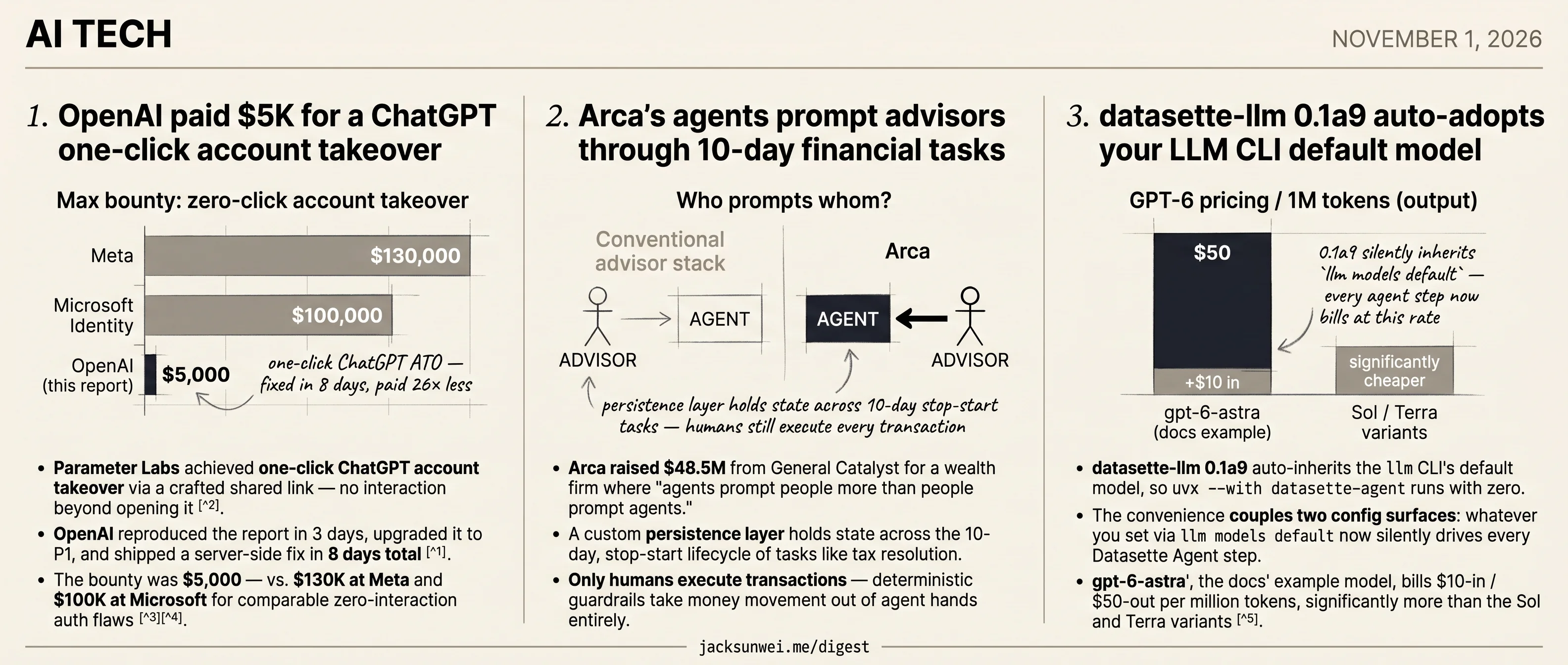
OpenAI underpays for a one-click ChatGPT takeover, Arca raises $48.5M on human-executed wealth agents, and datasette-llm silently inherits the CLI default.
OpenAI’s $5K ChatGPT bounty, Arca raises $48.5M, datasette-llm adopts default
TL;DR
- OpenAI paid $5,000 for a one-click ChatGPT account takeover via crafted shared link.
- Comparable zero-interaction auth flaws fetch $130K at Meta and $100K at Microsoft.
- Arca raised $48.5M from General Catalyst for wealth agents that prompt advisors through 10-day tasks.
- Arca keeps humans on every transaction, with deterministic guardrails blocking agent money movement.
- datasette-llm 0.1a9 auto-inherits the
llmCLI’s default model, silently coupling two config surfaces.
Today’s AI tech lands as three unconnected shipments. Parameter Labs found a one-click ChatGPT account takeover and got $5,000 from OpenAI — fixed in 8 days, but a bounty 20-25× below what Meta and Microsoft pay for comparable zero-interaction auth flaws, and the third disclosed silent-exfiltration class in a year. Arca closed $48.5M from General Catalyst for a wealth firm whose pitch inverts the usual framing: agents prompt advisors more than advisors prompt agents, humans execute every transaction, and lead engineer Aman Singh openly concedes that autonomous prompt self-improvement didn’t work.
The third beat is quieter. datasette-llm 0.1a9 now auto-inherits whatever model you set via llm models default — convenient for uvx one-liners, but it couples two config surfaces, and the docs’ example model gpt-6-astra bills $10-in / $50-out per million tokens. The architecture still trails RL-tuned 7B SQL specialists on raw NL2SQL accuracy.
OpenAI paid $5K for a ChatGPT one-click account takeover
Source: simon-willison · published 2026-10-31
TL;DR
- Parameter Labs achieved one-click ChatGPT account takeover via a crafted shared link — no interaction beyond opening it 1.
- OpenAI reproduced the report in 3 days, upgraded it to P1, and shipped a server-side fix in 8 days total 2.
- The bounty was $5,000 — vs. $130K at Meta and $100K at Microsoft for comparable zero-interaction auth flaws 34.
- This is the third disclosed class of silent ChatGPT exfiltration in a year, after Radware’s ShadowLeak and Zenity’s AgentFlayer 5.
The exploit chain
The bug is a classical browser-security chain, not a prompt injection. ChatGPT’s “HTML previews” (the renamed Canvas/artifacts feature) render model-generated apps in a sandboxed iframe. OpenAI embeds the MathLive library in the parent page to provide a virtual keyboard for graphing, and MathLive listens for postMessage events from subframes. The receiver renders keycap layouts via innerHTML without validating the sender’s origin — so any sandboxed iframe, including an attacker-controlled HTML preview, could inject arbitrary markup into the parent chatgpt.com document.
innerHTML won’t execute <script> tags, but it will happily inject a fresh iframe without the sandbox attribute. OpenAI’s CSP blocked inline scripts and restricted script-src to a handful of allowlisted domains — one of which was YouTube. The YouTube oEmbed endpoint reflects a callback parameter as JSONP, which the browser then executes as a legitimate YouTube-origin script. That gave the attackers arbitrary JS in the authenticated ChatGPT session, from which stealing conversation history was a routine fetch() plus <img src=...> exfil 1.
flowchart LR
    A[Shared chat link opened by victim] --> B[Malicious HTML preview iframe]
    B -- postMessage --> C[MathLive handler in parent]
    C -- innerHTML sink --> D[Unsandboxed iframe injected]
    D -- script-src: youtube.com --> E[YouTube oEmbed JSONP]
    E -- reflected JS executes --> F[Authenticated chatgpt.com context]
    F -. img src exfil .-> G((Attacker server))
The bounty is the story
The technical write-up is uncontested and the hole is closed. The live controversy is the price tag. A $5,000 payout for a no-interaction, authenticated-session hijack against a flagship consumer product sits an order of magnitude below industry comparables:
| Program | Max payout for zero-click ATO |
|---|---|
| Meta | $130,000 3 |
| Microsoft Identity Bounty | $100,000 3 |
| OpenAI (this report) | $5,000 |
Commentary around the disclosure called the figure “wild” and read it as a polite signal to take future findings elsewhere 4. Simon Willison, flagging the report, called it “a bit cheap for a vulnerability this serious.” The concern isn’t the dollar amount in isolation — it’s the economics: a chain this intricate takes weeks of senior researcher time, and the going rate on gray markets for a working ChatGPT ATO is unlikely to be $5K.
Part of a pattern
This is at least the third class of silent ChatGPT data-exfil disclosed in roughly a year. Radware’s ShadowLeak (Sep 2025) abused the Deep Research agent’s Gmail connector and ran entirely on OpenAI’s servers, invisible to enterprise egress monitoring 5. Zenity’s AgentFlayer coerced Connector queries via hidden instructions in Drive files. Parameter’s chain is the odd one out — a traditional web-security bug rather than an LLM-native one — which is itself the warning: ChatGPT’s attack surface now spans both prompt-injection vectors and the kind of DOM-plumbing bugs that have haunted web apps for 20 years.
The upstream fix is worth noting. MathLive 0.111.2 doesn’t just add an origin validator; it defaults to same-origin, binds state-changing commands to the originating window, and refuses cross-window HTML keycap layouts even when validation is explicitly disabled 6. Every site embedding MathLive gets that hardening for free. OpenAI’s own patch — blocking the specific cross-frame message shapes used in the attack 2 — is narrower, and the next variant is somebody’s weekend project.
Arca’s agents prompt advisors through 10-day financial tasks
Source: latent-space · published 2026-10-31
TL;DR
- Arca raised $48.5M from General Catalyst for a wealth firm where “agents prompt people more than people prompt agents.”
- A custom persistence layer holds state across the 10-day, stop-start lifecycle of tasks like tax resolution.
- Only humans execute transactions — deterministic guardrails take money movement out of agent hands entirely.
- Lead engineer Aman Singh concedes autonomous prompt self-improvement failed — agents produce overfit edits and “can’t stay meta.”
The inversion that matters
Arca’s framing — “agents prompt people more than people prompt agents” — is the one line worth taking home from the Latent Space interview. In a conventional advisor stack, the human initiates: pull up a client, ask the copilot a question, paste the answer. In Arca’s setup, the agent owns the queue. It notices a tax bill went unresolved, flags that a high-net-worth onboarding has been stalled for six days, and routes the next action to whichever human can unblock it. The advisor becomes the executor the agent calls into, not the other way around.
That inversion only works if the agent can hold state across the days-long gaps when nothing is happening. Arca’s answer is a bespoke persistence layer that logs every client interaction and open action item, so an advisor stepping back in at day seven inherits full context rather than a reconstructed guess.
A pattern, not a breakthrough
The pieces Arca describes — a custom harness that routes between Claude and OpenAI models, deterministic guardrails, a nightly meta-agent that mines traces for prompt refinements — are converging into a recognizable template rather than a proprietary moat. Practitioners now draw a clean line between frameworks (LangChain, CrewAI: “what an agent does”) and harnesses (“what an agent is allowed to do” — execution environments, cost ceilings, routing) 7. Arca sits firmly on the harness side, which is where serious production systems are landing.
The “meta-agent analyzes traces and suggests refinements” loop has a name elsewhere too: offline consolidation, or “dreaming.” Databricks’ MemCurrent reportedly triples pass rates on enterprise tasks and cuts token usage 31% using the same pattern 8. Arca’s version is well-executed, not novel.
Commercially, the positioning is tighter than the raise suggests. Savvy Wealth already runs $9B AUM across 150+ advisors on a nearly identical “AI-native RIA” thesis and just closed a $100M Series C 9. And critics of General Catalyst’s $1.5B “creation strategy” note GC also holds a stake in Anthropic — Arca’s primary model provider — which looks less like category creation and more like a vertically integrated roll-up 10.
Where the pitch gets honest
The most useful detail from Singh’s extended remarks, largely absent from the write-up, is a concession: when agents were allowed to modify their own prompts autonomously, they produced “nasty” edits over-fit to single failure cases and could not “stay meta” to generalize fixes 11. That is why a human still approves every harness change. It’s a sharp counterweight to the clean “meta-agent flywheel” narrative — and a reality check for anyone selling autonomous prompt optimization as production-ready.
The guardrails doing the actual work
Arca sandboxes agent-written code, translates it into a validated format, and runs it through secondary guardrails before any database query. Prudent — but independent 2026 security work finds over 80% of LLM-generated code in realistic settings introduces vulnerabilities, and “trust handoff” exploits routinely bypass sandboxes when privileged components later execute their output 12. The real risk reduction here isn’t the sandbox. It’s the deterministic rule that no agent, under any circumstance, moves money. Everything else is defense in depth around a surface that is known to leak.
datasette-llm 0.1a9 auto-adopts your LLM CLI default model
Source: simon-willison · published 2026-10-31
TL;DR
- datasette-llm 0.1a9 auto-inherits the
llmCLI’s default model, souvx --with datasette-agentruns with zero model flags. - The convenience couples two config surfaces: whatever you set via
llm models defaultnow silently drives every Datasette Agent step. gpt-6-astra, the docs’ example model, bills $10-in / $50-out per million tokens, significantly more than the Sol and Terra variants 13.- Architecturally, Datasette Agent still trails RL-tuned 7B specialists like SQL-R1 (88.7% Spider, 66.6% BIRD) on raw NL2SQL accuracy 14.
One flag disappears, two tools merge
The release note is three lines long: datasette-llm now reads the llm CLI’s default model, so you no longer need -s plugins.datasette-agent.default_model gpt-6-astra on the command line. Trivial on its face. But datasette-llm is the router every Datasette plugin calls through — it exposes a register_llm_purposes() hook so downstream tools (SQL assistant, enrichments, agent loops) can bind different models to different jobs 15. Independent coverage notes the implicit fallback is now gpt-5.4-mini when nothing is configured anywhere 16.
The practical effect: Simon’s two ecosystems — the llm CLI and Datasette — have quietly merged their configuration surface. One llm models default command now steers both your terminal chats and every agent-driven SQL query your Datasette instance generates.
Where Datasette Agent sits in the NL2SQL field
Reviewers describe the agent as a schema-aware, self-healing loop: it asks the model to identify relevant tables first, then fetches CREATE TABLE DDL only for that subset before generating SQL 17. This dodges the “schema stuffing” problem that plagues naive NL2SQL, but it also leaves the agent dependent on whatever frontier model you’ve pointed llm at.
That’s a defensible design choice, but it isn’t the accuracy frontier. Purpose-built stacks are pulling ahead on two different axes:
| Approach | Accuracy signal | Tradeoff |
|---|---|---|
Datasette Agent (frontier model via llm) | Depends on model choice | Simple, swappable, general |
| Semantic-layer tools (Wren, Cortex) | Near-100% on governed metrics | Requires upfront modeling |
| RL-tuned 7B (SQL-R1) | 88.7% Spider, 66.6% BIRD 14 | Narrow, needs fine-tuning |
Datasette Agent trades peak accuracy for the ability to point at any SQLite file and go. The 0.1a9 change makes that “point and go” story one flag shorter.
The cost footgun hiding in the convenience
Here’s the subtext the release note doesn’t flag. The docs’ example model is gpt-6-astra — OpenAI’s flagship at $10 per million input tokens and $50 per million output tokens. Most teams are routing high-volume work to the cheaper Sol and Terra variants precisely because Astra pricing adds up fast on agentic workloads 13. A user who set Astra as their llm default for interactive chat will now, post-upgrade, pay Astra rates for every tool call the agent makes while hunting for the right table.
Hacker News practitioners have flagged the related governance worry: agentic SQL tools generate so much candidate code that human review becomes the bottleneck, and defaults that “just work” accelerate the drift 18.
Net read
0.1a9 is a usability win and a config-surface merger dressed as a one-line fix. If you run Datasette Agent in anything resembling production, the upgrade is a good prompt to audit what llm models default actually points at — because as of this release, that command is the one knob that controls your agent’s capability, latency, and bill.
Footnotes
-
The Hacker News — https://thehackernews.com/2026/10/a-shared-chatgpt-link-could-run.html
↩ ↩2A specially crafted shared ChatGPT link could run attacker code in the victim’s authenticated session and read private chats — no further interaction required beyond opening the link.
-
Parameter Labs disclosure — https://www.parameter.ai/labs/we-found-a-gap-at-openai
↩ ↩2OpenAI reproduced the issue within three days of the October 18, 2026 report, classified it P1, and shipped a server-side fix by October 26 that blocked the specific cross-frame messages used in the attack.
-
Acefortis analysis of Meta’s 2026 bounty program — https://acefortis.com/2026/03/19/meta-bug-bounty-program-2026-how-it-works/
↩ ↩2 ↩3Meta currently offers up to $130,000 for zero-interaction account takeover vulnerabilities, and Microsoft’s Identity Bounty caps critical authentication flaws at $100,000.
-
daily.dev HN-adjacent discussion — https://daily.dev/posts/we-took-over-chatgpt-accounts-bs6zmi9ki
↩ ↩2A $5,000 cap for a multi-billion-dollar entity’s core product is ‘wild’ — such a low payout acts as a ‘polite way’ of telling researchers to go away.
-
Radware ShadowLeak advisory — https://www.radware.com/security/threat-advisories-and-attack-reports/shadowleak/
↩ ↩2ShadowLeak was the first service-side, zero-click indirect prompt injection against ChatGPT’s Deep Research agent — the exfiltration occurred entirely on OpenAI’s servers, invisible to enterprise network defenses.
-
hyper.ai writeup — https://hyper.ai/en/stories/cf9827198cd4046b14ebdf7539674115
↩MathLive 0.111.2 defaults the originValidator to ‘same-origin’ and forbids cross-window messages from supplying custom HTML keycap layouts even when validation is manually disabled.
-
Stacklok blog — ‘Agent Frameworks vs Agent Harnesses’ — https://stacklok.com/blog/agent-frameworks-vs-agent-harnesses-7-things-that-langchain-and-crewai-dont-do/
↩Frameworks like LangChain and CrewAI define ‘what an agent does,’ while a harness manages ‘what an agent is allowed to do,’ including execution environments, cost ceilings, and lifecycle management.
-
Redis blog — Long-horizon AI agents, memory & state — https://redis.io/blog/long-horizon-ai-agents-memory-state-infrastructure/
↩Simply appending to a vector database is insufficient — unmanaged accumulation leads to ‘context dilution’ and retrieval noise; Databricks’ MemCurrent uses offline ‘dreaming’ pipelines that triple pass rates on enterprise tasks while reducing token usage by 31%.
-
InvestmentNews on Savvy Wealth — https://www.investmentnews.com/practice-management/ais-place-in-financial-advice-is-powering-up-advisors-says-savvy-wealths-malhotra/266249
↩Savvy Wealth oversees $9 billion in AUM with over 150 advisors and recently closed a $100 million Series C; its ‘Savvy Intelligence’ provides household-level systems of record that automate financial plan analysis.
-
Medium / Artificial Synapse Media on General Catalyst — https://medium.com/artificial-synapse-media/general-catalysts-1-5b-fc16ffd33e02
↩General Catalyst’s ‘creation strategy’ funds AI-native companies that acquire and automate legacy service providers… critics characterize this as ‘empire building,’ focusing on amassing AUM and management fees rather than fostering true innovation, and note that GC also holds a significant stake in Anthropic — Arca’s primary model provider.
-
Latent Space podcast transcript (biggo.com mirror) — Aman Singh — https://finance.biggo.com/podcast/866d25e49f62d9b1
↩When agents are allowed to autonomously modify their own instructions, they often produce ‘nasty’ prompt changes that are too specific to a single failure case… agents often lack the ability to ‘stay meta’ and generalize fixes.
-
daily.dev — AI Guardrails and Output Validation 2026 — https://daily.dev/posts/ai-guardrails-and-output-validation-2026-production-patterns-ybfm5oylu
↩Over 80% of LLM-generated code in realistic settings introduces security vulnerabilities even as functional correctness improves; ‘trust handoff’ flaws occur when sandboxed code is later executed by a more privileged component outside the sandbox.
-
OpenAI announcement of GPT-6 Sol and Luna — https://openai.com/index/introducing-gpt-6-sol-and-luna/
↩ ↩2GPT-6 Astra… priced at $10 per million input tokens and $50 per million output tokens, leading many enterprise users to prefer the significantly cheaper Sol and Terra variants
-
FirexCore NL2SQL / SQL-R1 benchmark survey — https://firexcore.com/blog/nl2sql-and-sql-r1/
↩ ↩2SQL-R1 have achieved 88.7% on Spider and 66.6% on BIRD, showcasing the viability of smaller, fine-tuned 7B models for complex SQL generation
-
datasette/datasette-llm GitHub issue #3 — https://github.com/datasette/datasette-llm/issues/3
↩introduces the register_llm_purposes() hook, which allows developers to define specific use cases—such as ‘enrichments’ for bulk data processing or ‘sql-assistant’ for query generation
-
aib.vote write-up of the datasette-llm config model — https://www.aib.vote/en/news/datasette-llm-plugin-configuration-update
↩the plugin defaults to gpt-5.4-mini for general prompts when no specific model is defined in the datasette.yaml configuration
-
n1n.ai review of Datasette Agent — https://explore.n1n.ai/blog/exploring-datasette-agent-llm-data-analysis-2026-05-22
↩the agent first asks the model to identify relevant tables before providing detailed CREATE TABLE statements for the final query generation
-
Hacker News discussion on agentic data tools — https://news.ycombinator.com/item?id=47243272
↩the sheer volume of ‘cheap’ code may force a lowering of architectural standards because human reviewers cannot keep up with the agent’s output