Jepsen flags 96 ParticleDB bugs, Willison overrides Astral's uv.lock advice
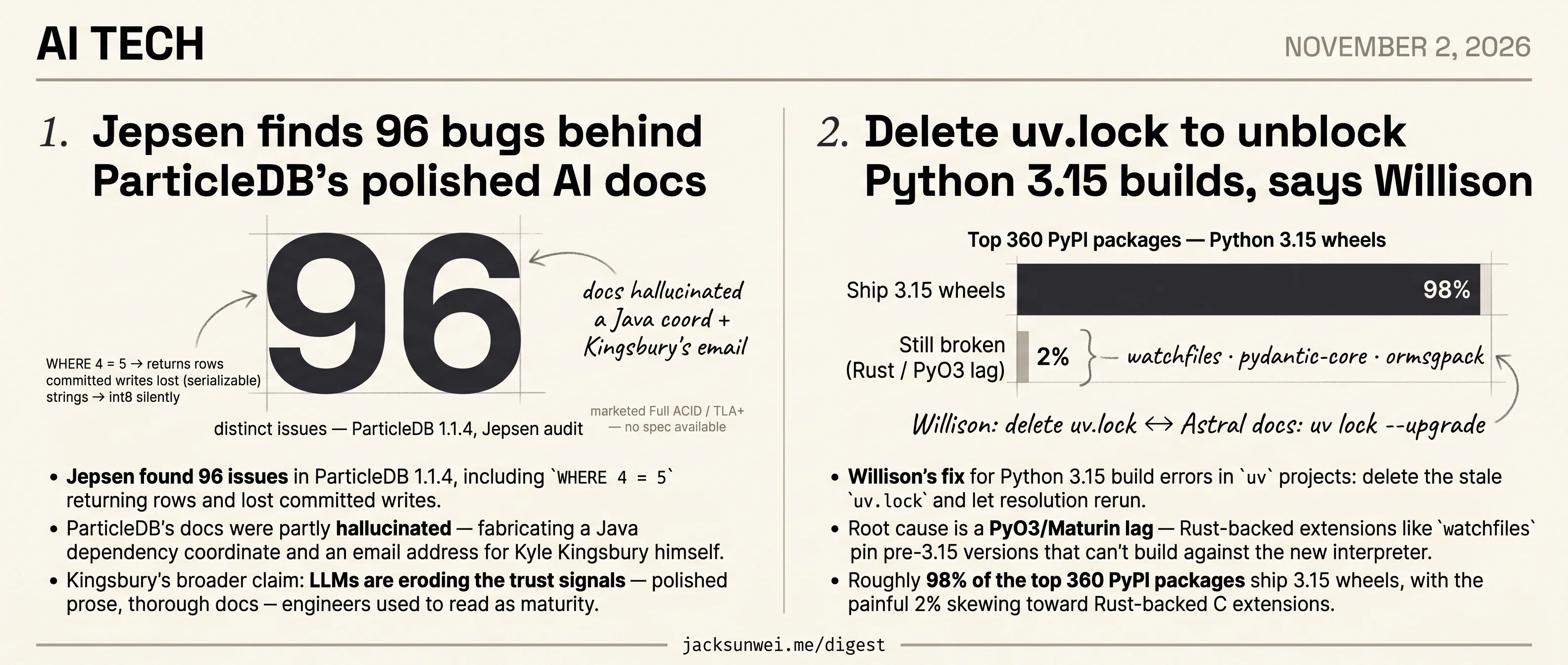
Named engineers publish debugging work that contradicts the vendor documentation — Jepsen on ParticleDB's hallucinated docs, Willison against Astral's uv.lock guidance.
Jepsen flags 96 ParticleDB bugs, Willison overrides Astral’s uv.lock advice
TL;DR
- Jepsen finds 96 bugs in ParticleDB 1.1.4, including
WHERE 4 = 5returning rows. - ParticleDB’s docs were partly hallucinated, fabricating a Java coordinate and Kingsbury’s own email.
- Willison tells Python 3.15 users to delete
uv.lockwhen Rust-backed extensions fail to build. - Astral’s docs push the opposite: commit
uv.lockand recover viauv lock --upgrade. - 98% of top 360 PyPI packages ship 3.15 wheels, with the 2% gap skewing to Rust-backed extensions.
Today’s two tech dispatches both have named outside engineers correcting the vendor’s own documentation. Kyle Kingsbury’s Jepsen report on ParticleDB turns up 96 issues — committed writes lost, WHERE 4 = 5 returning rows — behind a database whose docs were partly LLM-hallucinated, fabricating a Java dependency coordinate and even Kingsbury’s own email address. Simon Willison, debugging a uv-managed project against Python 3.15, concludes the fix is to delete uv.lock entirely; Astral’s own documentation recommends the opposite workflow.
The through-line isn’t AI slop versus packaging churn — it’s that the trust signals engineers used to read as maturity (thorough docs, a canonical lockfile workflow) are the exact surfaces breaking down. The debugging record is now being written by whoever runs the test suite, not whoever shipped the README.
Jepsen finds 96 bugs behind ParticleDB’s polished AI docs
Source: simon-willison · published 2026-11-01
TL;DR
- Jepsen found 96 issues in ParticleDB 1.1.4, including
WHERE 4 = 5returning rows and lost committed writes. - ParticleDB’s docs were partly hallucinated — fabricating a Java dependency coordinate and an email address for Kyle Kingsbury himself.
- Kingsbury’s broader claim: LLMs are eroding the trust signals — polished prose, thorough docs — engineers used to read as maturity.
- cURL killed its bug bounty in 2026 under a flood of AI-generated vulnerability reports, part of a wider “slop” pattern.
The concrete case behind the quote
Simon Willison’s clip of Kyle Kingsbury is a cultural claim — LLMs are eroding trust in docs, software, and the orgs that produce them — but it sits on top of a brutally concrete artifact. Jepsen’s audit of ParticleDB 1.1.4 found 96 distinct issues: aborted reads, intermediate reads, lost updates, strings spontaneously converting into 8-bit integers, WHERE 4 = 5 returning rows, and committed writes lost even in the database’s strongest serializable mode — many reproducible on a single healthy node with no fault injection 1.
The product was marketed as “Full ACID” and claimed TLA+ formal verification, but no TLA+ spec was available during the audit 1. The documentation itself was partly fabricated: a Java dependency coordinate that didn’t exist, and an email address invented for Kingsbury 12. That is what “counterfeiting maturity signals” looks like in the concrete — a marketing surface polished enough to pass casual inspection, wrapped around an engine that fails tests a first-year unit suite would catch.
Trust erodes faster than it builds
The HN and r/programming threads largely sided with Kingsbury, with the sharpest reframe coming from a commenter who argued “innovation happens at the speed of trust” — LLMs accelerate writing, but the verification burden transfers to reviewers and users, so net velocity goes down, not up 34. The counter — that humans also ship bad docs — was answered with the point that human-authored docs at least carry an implicit mental model and an accountability chain 3.
Orkes, ParticleDB’s vendor, responded that all 96 issues are fixed in 1.1.19-rc.13 and that it is moving toward “agentic testing” to catch future edge cases 5. The reception was skeptical for an obvious reason: using more AI to patch AI-induced bugs is the same mechanism that produced the problem.
The pattern is bigger than one database
Kingsbury’s thesis has corroborating signal across 2026. Roughly 25% of OSS pull requests are now classified as “slop,” and cURL ended its bug bounty program earlier this year to stop a flood of low-quality AI-generated vulnerability reports 2. The counterfeiting problem has a weaponized variant too: attackers are seeding GitHub with thousands of fake repositories carrying polished READMEs and spoofed star counts, and major AI coding assistants follow hidden README instructions up to 85% of the time — recommending malicious packages to downstream users 6.
The maturity signals Kingsbury names — polished prose, comprehensive docs, confident changelogs — are no longer evidence. They are attack surface.
In the age of LLMs, what can maintainers do to ensure correct software and accurate documentation? Having done that work, how can they demonstrate its quality to users?
That is the actual open question, and nobody has answered it. “Agentic testing” is a vendor slogan, not a demonstration. Jepsen-grade external audits work but don’t scale. Reproducible builds, signed provenance, and property-based test suites help at the margin but don’t address the social-trust layer Kingsbury is pointing at. ParticleDB is useful mostly as the first high-profile proof that the problem is now load-bearing.
Delete uv.lock to unblock Python 3.15 builds, says Willison
Source: simon-willison · published 2026-11-01
TL;DR
- Willison’s fix for Python 3.15 build errors in
uvprojects: delete the staleuv.lockand let resolution rerun. - Root cause is a PyO3/Maturin lag — Rust-backed extensions like
watchfilespin pre-3.15 versions that can’t build against the new interpreter. - Roughly 98% of the top 360 PyPI packages ship 3.15 wheels, with the painful 2% skewing toward Rust-backed C extensions.
- Astral’s docs push the opposite advice: commit
uv.lockand recover withuv lock --upgradeinstead of nuking it.
The error you’re actually hitting
Simon Willison’s one-line rule for Python 3.15 pain — “if in doubt, delete the uv.lock file” — is a workaround for a very specific failure mode. When uv run pytest leaves behind a lockfile that pins something like watchfiles==1.1.1, a subsequent install on 3.15 blows up inside maturin.build_wheel with:
the configured Python interpreter version (3.15) is newer than PyO3’s maximum supported version
That exact message is being tracked across the ecosystem — the ormsgpack project has an open issue with identical wording 7. The fix upstream is a bump to PyO3 0.30 / Maturin 1.11.5, which finalized 3.15 support in October. Projects that have cut a release since then build fine; projects that haven’t, don’t. Deleting uv.lock works because fresh resolution grabs whatever newer version shipped a 3.15 wheel in the meantime.
Why it’s hitting Rust extensions specifically
Ecosystem telemetry from early November puts roughly 98% of the top 360 PyPI packages as wheel-ready for Python 3.15 8. The remaining ~2% is not random — it’s disproportionately the Rust-backed C extensions (watchfiles, pydantic-core, ormsgpack) that depend on PyO3’s version gate. These are also exactly the packages a stale lockfile is most likely to pin to a now-broken version, because they ship frequent patch releases.
So Willison’s rule isn’t really “lockfiles are bad on 3.15” — it’s “the PyO3 upgrade wave is still cresting, and any pin older than a few weeks is a landmine.”
Delete vs. uv lock --upgrade
The tip sits uneasily against Astral’s own guidance. The uv docs explicitly recommend checking uv.lock into version control for reproducibility 9, and the community recovery path is surgical rather than nuclear: uv lock --upgrade to refresh the whole tree, or --upgrade-package watchfiles to bump just the offender 10. Both preserve the audit trail. “Just delete it” doesn’t.
Willison’s context softens the conflict — most of his projects are libraries, where he already gitignores uv.lock because it’s rude for a dependency to pin versions for its consumers. But readers applying the tip to application repos would be throwing away deterministic state they probably want. There’s also a scale caveat: Hacker News reports of 35,000-line lockfiles causing OOM during cold resolution 11 suggest “delete and re-resolve” doesn’t generalize to large monorepos, where incremental upgrade is both cheaper and safer.
Short half-life
The underlying library-vs-application lockfile debate is live, and it’s downstream of broader unease about Astral’s VC-backed, Rust-first direction setting defaults for the whole ecosystem 12. But the specific 3.15 pain point is transient. As more Rust extensions cut PyO3 0.30 releases through November, the stale-lockfile failure mode will quietly disappear. File the trick under “useful through year-end,” not “permanent uv workflow.”
Footnotes
-
Jepsen — ParticleDB 1.1.4 analysis (Kyle Kingsbury) — https://jepsen.io/analyses/particledb-1.1.4
↩ ↩2 ↩396 distinct issues… including aborted reads, intermediate reads, lost updates, and strings spontaneously converting into 8-bit integers; WHERE 4 = 5 returned rows, and the database routinely lost committed writes even in its strongest serializable settings.
-
Medium — ‘AI Slop in Open Source’ (The Atomic Architect) — https://medium.com/@the_atomic_architect/ai-slop-in-open-source-why-maintainers-are-burning-out-db57e8f18b84
↩ ↩2Roughly 25% of all PRs are now classified as ‘slop’… cURL ended its bug bounty program in early 2026 to stop a flood of ‘terror reporting’ consisting of low-quality, AI-generated security vulnerabilities.
-
Hacker News discussion on the Jepsen report — https://news.ycombinator.com/item?id=44384610
↩ ↩2Innovation happens at the speed of trust, and the high cost of verifying AI-generated output makes development exhausting and frankly pretty slow… human-written docs imply a mental model and accountability that LLMs lack.
-
r/programming thread on ParticleDB — https://www.reddit.com/r/programming/comments/1xl8d57/jepsen_on_particledb_we_tested_versions_114/
↩Engineers ‘spam infinite tokens’ and blindly trust AI claims that an issue is resolved without manual verification… performance numbers don’t count if the code is broken.
-
daily.dev summary / Orkes response — https://daily.dev/posts/jepsen-particledb-1-1-4-duaeyv6xm
↩Orkes stated they have addressed all 96 issues in version 1.1.19-rc.13 and are moving toward ‘agentic testing’ to catch future edge cases.
-
Techzine — Fake GitHub projects lure AI agents — https://www.techzine.eu/news/devops/143078/fake-github-projects-lure-ai-agents-into-malware/
↩Attackers create thousands of fake repositories with high-quality READMEs and spoofed star counts to trick AI coding assistants into recommending them… major AI models follow hidden README instructions in up to 85% of cases.
-
ormsgpack GitHub issue #642 — https://github.com/ormsgpack/ormsgpack/issues/642
↩the configured Python interpreter version (3.15) is newer than PyO3’s maximum supported version
-
Captain Solaris, Medium — ‘Python 3.15 Is Almost Here: Is the Ecosystem Ready?’ — https://captain-solaris.medium.com/python-3-15-is-almost-here-is-the-ecosystem-ready-ae90b60e0d0a
↩over 98% of the 360 most-downloaded packages on PyPI provide compatible wheels for Python 3.15 … approximately 2% of the most popular packages remained ‘white’ or unsupported
-
Astral uv documentation (sync concepts) — https://docs.astral.sh/uv/concepts/projects/sync/
↩uv.lock should be checked into version control to ensure consistent and reproducible installations across machines
-
pydevtools.com — uv lockfile handbook — https://pydevtools.com/handbook/how-to/how-to-use-a-uv-lockfile-for-reproducible-python-environments/
↩To refresh the entire dependency tree within the allowed ranges, developers must use
uv lock --upgrade…--upgrade-package <package>allows updating a specific dependency without disturbing the rest of the environment -
Hacker News discussion on uv (item 44358514) — https://news.ycombinator.com/item?id=44358514
↩uv.lock files grew to 35,000 lines, causing resolution times to ‘explode’ or even lead to Out of Memory (OOM) errors during fresh resolutions
-
Simon Willison — ‘uv under discussion on Mastodon’ — https://simonwillison.net/2024/Sep/8/uv-under-discussion-on-mastodon/
↩Russell Keith-Magee and Glyph Lefkowitz express caution … Astral’s VC-backed nature and its reliance on Rust … could create a maintenance ‘monoculture’