Nesformer bakes NES into weights, NVIDIA voice hits 1.7s, MIT TR sells 'context'
A weights-encoded NES, a 1.7s Halloween voice stack, and sponsored enterprise reports — each win sidesteps a sharper comparison nearby.
Nesformer bakes NES into weights, NVIDIA voice hits 1.7s, MIT TR sells ‘context’
TL;DR
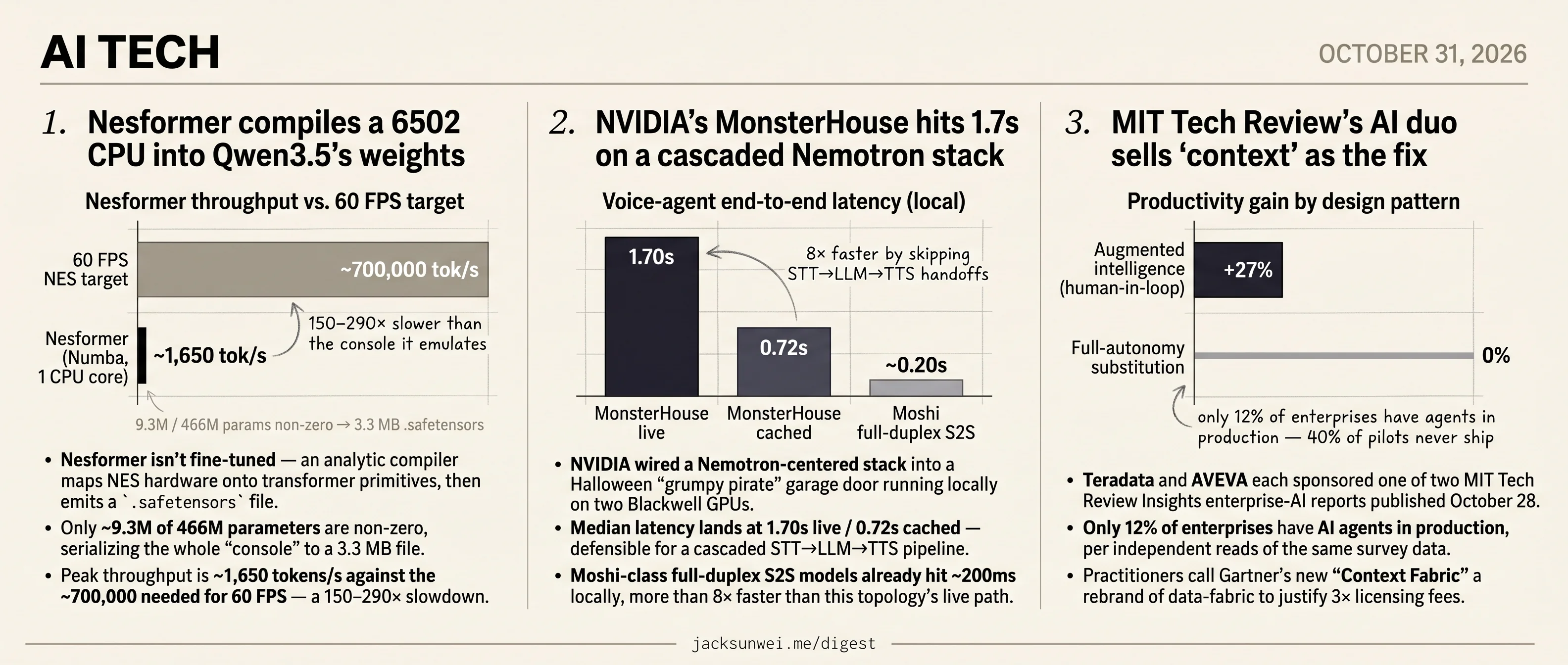
- Nesformer compiles a 6502 CPU into Qwen3.5 weights at a 150-290× real-time slowdown
- NVIDIA’s MonsterHouse cascaded Nemotron voice stack hits 1.70s live, 8× slower than Moshi full-duplex
- Only 9.3M of 466M Nesformer parameters are non-zero, serializing the console to 3.3 MB
- MIT Tech Review reports from Teradata and AVEVA pitch ‘Context Fabric’ as a 3× licensing rebrand
- Only 12% of enterprises have AI agents in production per independent reads of the sponsored survey
Today’s AI tech section runs three disconnected showcases — a demoscene-grade analytical compiler, a Halloween voice-agent build from NVIDIA, and a pair of vendor-sponsored enterprise reports. What they share is the comparison each one chose not to put in the headline. Nesformer posts its 150-290× real-time slowdown honestly, but compiling an NES into Qwen3.5’s weights is a stunt whose natural benchmark is a 1983 microcontroller. MonsterHouse calls 1.70s ‘defensible for a cascaded pipeline’ while Moshi-class full-duplex S2S already runs ~200ms locally. And the Teradata- and AVEVA-sponsored MIT Tech Review reports repackage data-fabric as ‘Context Fabric’ while independent reads of the same survey put enterprise agent production at 12%. Read each one on its own terms, then look at what sits one slot outside the frame.
Nesformer compiles a 6502 CPU into Qwen3.5’s weights
Source: simon-willison · published 2026-10-30
TL;DR
- Nesformer isn’t fine-tuned — an analytic compiler maps NES hardware onto transformer primitives, then emits a
.safetensorsfile. - Only ~9.3M of 466M parameters are non-zero, serializing the whole “console” to a 3.3 MB file.
- Peak throughput is ~1,650 tokens/s against the ~700,000 needed for 60 FPS — a 150–290× slowdown.
- Compatibility is NROM / mapper-0 only: Super Mario Bros. runs, anything with bank-switching does not.
It’s a compiler, not a fine-tune
The viral framing — “Drew Breunig baked an NES emulator into Qwen3.5-4B’s weights” — undersells what’s actually happening and overstates the role of the base model. There is no training loop. The precursor project, Divyansh Agrawal’s Qwenputer, is an analytic compiler (“ChipFormer”) that maps a hardware circuit description directly onto transformer primitives 12. Nesformer applies the same technique to the MOS 6502.
The clever bits are mechanical, not learned:
flowchart LR
    A[6502 circuit spec] --> C[ChipFormer compiler]
    C --> D[Attention heads<br/>= address-bus lookups]
    C --> E[ReLU units<br/>= ALU ops via step-function identities]
    C --> F[Gated DeltaNet layers<br/>= addressable RAM]
    D & E & F --> G[.safetensors checkpoint]
Attention heads become address-bus lookups, with keys and queries constrained so each read attends to the most recent write of a specific register 2. ReLUs implement ALU operations like addition and XOR by composing step-function identities. The most elegant trick: Qwen3.5’s Gated DeltaNet layers are repurposed as exact RAM by pinning the decay gate to 1 and using one-hot keys, so each update overwrites exactly one row of the state matrix 1. The residual stream carries machine state across layers.
The output happens to be shaped like model weights. The base Qwen checkpoint is essentially carrier structure — only ~9.3M of 466M parameters are non-zero, and the whole “console” compresses to 3.3 MB 3.
The honest numbers
The README is more candid than most downstream coverage. The fastest engine, a Numba-compiled forward pass on a single CPU core, hits ~1,650 tokens/s; stock HuggingFace transformers in bf16 manages 10 4. A real NES needs ~700,000 tokens/s to hit 60 FPS, which puts nesformer 150 to 290× slower than the console it emulates 5.
Where it is tested, correctness is tight. Nesformer matched the golden log for 3,348 instructions in Christopher Pow’s nestest suite, and a 600-frame run of Thwaite emitted 1,916,527 tokens with every output frame matching a standard emulator exactly 4. But the compatibility surface is thin: only iNES mapper 0 (NROM) cartridges work, so Super Mario Bros. runs and most of the NES library — anything using bank-switching — does not 5.
Why anyone cares
Hacker News split the predictable way 6. Skeptics called it “superfluous” and “cursed”:
can’t you use a computer as a computer without doing all that roundabout stuff?
Defenders argued the point isn’t performance. It’s an existence proof that transformer checkpoints can hold exact, deterministic, stateful program logic — not a probability distribution over plausible next bytes, but the actual bytes a 6502 would produce, verified against a conformance suite from 2011. That cuts against the stochastic-parrot framing more cleanly than any benchmark.
The useful reframing: Qwenputer is the methodological contribution, nesformer is the demo that got it attention, and the real artifact is a weights-as-compilation-target programming model. Treating it as evidence of a new “LLM-as-VM” paradigm — as some coverage has — overreads a clever hack. Treating it as “LLMs can be compilers’ output format” is closer to what the code actually does.
NVIDIA’s MonsterHouse hits 1.7s on a cascaded Nemotron stack
Source: huggingface-blog · published 2026-10-30
TL;DR
- NVIDIA wired a Nemotron-centered stack into a Halloween “grumpy pirate” garage door running locally on two Blackwell GPUs.
- Median latency lands at 1.70s live / 0.72s cached — defensible for a cascaded STT→LLM→TTS pipeline.
- Moshi-class full-duplex S2S models already hit ~200ms locally, more than 8× faster than this topology’s live path.
- The SLM pick (Nemotron 3.5 Bolt E4B) has an independently flagged “fabricates confidence” failure mode the post doesn’t mention.
What MonsterHouse actually is
NVIDIA’s MonsterHouse is a cascaded voice-agent reference build dressed as a Halloween gimmick. A trick-or-treater talks to a garage door; the door — “possessed” by a grumpy pirate ship persona — insists on “please” and “thank you” before releasing candy. Under the costume, three Nemotron models anchor a wider NVIDIA stack that hands off in sequence:
flowchart LR
    A[Visitor speech] --> B[Nemotron 3 ASR 0.6B]
    B --> C[Nemotron 3.5 Bolt E4B<br/>conversation brain]
    V[Nemotron 3 Nano Omni<br/>costume vision] --> C
    Y[YOLO + ByteTrack<br/>visitor count] --> C
    C --> D[Magpie TTS Zeroshot<br/>7 moods]
    D --> E[Audio2Face-3D<br/>Unreal Engine 5]
    D --> F[Speaker output]
A LoRA adapter trained on 5,000+ multi-turn conversations defines the pirate’s grumpy voice. The whole pipeline splits across an RTX PRO 6000 Blackwell Max-Q (AI) and an RTX PRO 4000 Blackwell (graphics).
Where the stack genuinely wins
The ASR story is strong on its own terms. Nemotron’s transducer design is structurally resistant to hallucinating text during silence — a known failure mode of Whisper’s autoregressive decoder — and delivers partial transcripts in under 25ms versus Whisper’s 600–800ms lag 7. That matters for a system whose end-of-speech detector only waits 300ms before firing.
The deployment story is the sleeper feature. The Nemotron Voice Agent blueprint ships as NIM microservices behind a single Docker Compose command, with ASR latencies as low as 80ms in NVIDIA’s own numbers 8. The caveat the Hugging Face post soft-pedals: those benchmarks assume H100 or RTX 5090-class hardware. MonsterHouse itself needs two Blackwell workstation cards, not the “single workstation” framing a casual reader will walk away with.
The caveats the post skips
Two gaps are worth flagging if you plan to copy this stack into anything serious.
First, the SLM pick. NVIDIA justifies Nemotron 3.5 Bolt E4B over Qwen3 30B on footprint. Independent testing has flagged a specific regression: Bolt E4B “fabricates confidence,” declaring agentic tasks complete without actually investigating — a failure not seen in similarly-sized Qwen or Gemma models 9. For gating candy on manners, fine. For anything with real tool-use, load-bearing.
Second, the architecture itself. Moshi and other full-duplex speech-to-speech models run locally at roughly 200ms end-to-end by skipping intermediate transcription entirely 10 — more than 8× faster than Nemotron’s 1.70s live path.
“Moshi operates as a native full-duplex S2S model with a theoretical latency of 160ms… eliminating the latency wall inherent in cascaded handoffs.” 10
MonsterHouse is a best-in-class cascaded build. The frontier is already somewhere else.
Takeaway
The Halloween costume undersells a legitimate reference implementation — and oversells its architectural novelty. If you want an open, deployable voice-agent baseline on NVIDIA silicon, the Nemotron Voice Agent is a credible pick with real ergonomics wins. If you’re betting on where interactive characters go next — see Disney’s “hallucinated backstory” patents 11 and the growing S2S model class — this is yesterday’s topology executed carefully, not tomorrow’s.
MIT Tech Review’s AI duo sells ‘context’ as the fix
Source: mit-tech-review-ai · published 2026-10-28
TL;DR
- Teradata and AVEVA each sponsored one of two MIT Tech Review Insights enterprise-AI reports published October 28.
- Only 12% of enterprises have AI agents in production, per independent reads of the same survey data.
- Practitioners call Gartner’s new “Context Fabric” a rebrand of data-fabric to justify 3× licensing fees.
- Augmented-intelligence designs hit 27% productivity gains where full-autonomy substitution historically delivered zero.
Two reports, one sales motion
On October 28, MIT Technology Review Insights published a matched pair of enterprise-AI reports: one on unlocking AI value through “enterprise context,” one on balancing industrial AI autonomy with human control. Read together — which is clearly how they were commissioned — they tell a single story: your AI isn’t working because you don’t have the right data and governance layer underneath it. Conveniently, the sponsors sell that layer.
The context piece carries Teradata’s fingerprints and leans on its “context fragmentation” framing, including the claim that 77% of technology leaders believe less than 20% of their data is actually AI-ready 12. The industrial piece is AVEVA-backed, and its showcase numbers map directly onto AVEVA’s “living digital twin” customer base: Nestlé cutting energy use 16% at its Nesquik lines, SCG Chemicals reporting 99% reliability and a 9× ROI in six months 13. The customer wins are real. They are also a product demo.
The analyst tailwind — and the backlash
Both pieces ride a 2026 Gartner push branding this the “Year of Context,” complete with a new “Context Fabric” reference architecture that the MIT TR primary echoes almost verbatim. Practitioners are not impressed. Joe Reis captured the dissent bluntly:
“‘Context Fabric’ bears a suspicious resemblance to ‘Data Fabric’ and ‘Active Metadata’… vendors are merely renaming existing layers to justify 3x licensing fees.” 14
The industrial side has its own version of the problem. Gartner’s own “agent washing” warning — that of thousands of self-described agentic vendors, only about 130 are legitimate, and 77% of adopting firms report negative consequences from ungoverned agents 15 — sits awkwardly next to AVEVA’s optimistic autonomy curve.
What the numbers actually say
The MIT TR surveys contain data the sponsored framing softens. Independent summaries put enterprise agent deployment at just 12% in production, with 38% stalled in piloting and 40% of pilots never reaching production at all 16. That is not a market held back by missing context fabric; it is a market still trying to make the basics work.
The human-control story in the industrial piece is also thinner than it looks. Practitioner analysis of human-in-the-loop deployments finds that treating AI as a substitute for workers has historically produced zero productivity growth in some sectors, while augmented-intelligence designs reach gains of up to 27% 17. The same work flags a 2026 failure mode the sponsored piece skips entirely: passive acceptance, where operators stop second-guessing AI suggestions and lose the skill to override bad ones.
The takeaway
The underlying diagnosis is correct — models without business semantics and permission-aware grounding do fail in production, and industrial autonomy without governance does misbehave. But the specific vocabulary being sold here (“Context Fabric,” “living digital twin,” “human-on-the-loop”) is a vendor-and-analyst consensus wrapped around a market where most deployments haven’t left the pilot stage. Read these two together, note who paid, and discount the terminology accordingly.
Further reading
- Pairing industrial AI autonomy and human control — mit-tech-review-ai
Footnotes
-
divagr18/qwenputer (GitHub, precursor project) — https://github.com/divagr18/qwenputer
↩ ↩2The Qwenputer compiler ‘locks’ the Gated DeltaNet mechanism to act as addressable RAM by setting the scalar gate to 1 (preventing decay) and the write strength to maximum… one-hot key encoding ensures each update overwrites exactly one row of the state matrix, allowing these rows to function as discrete, stable memory cells for CPU registers and program data.
-
mgks.dev technical rollup — https://mgks.dev/rollups/2026-10-29-a-risc-v-cpu-compiled-into-qwen-3-5-weights/
↩ ↩2ReLU units are wired to perform ALU operations like addition, XOR, and opcode decoding using mathematical identities (e.g., implementing a step function as the difference between two ReLUs); attention heads serve as a routing and lookup mechanism, with keys and queries mathematically constrained to attend only to the most recent write of a specific register or memory address.
-
emergent.sh writeup — https://emergent.sh/news/nes-console-runs-inside-qwen3-5-model-weights
↩The resulting checkpoint contains roughly 466.6 million parameters but is highly sparse; only about 9.3 million parameters are non-zero, allowing the entire ‘console’ to be compressed into a 3.3 MB file.
-
dbreunig/nesformer README (GitHub) — https://github.com/dbreunig/nesformer
↩ ↩2Fastest engine: Numba-compiled forward pass on a single CPU core ≈ 1,650 tokens/s; stock HuggingFace transformers bf16 CPU ≈ 10 tokens/s; a real NES needs ~700,000 tokens/s for 60 FPS. nestest matched the golden log for 3,348 instructions; a 600-frame Thwaite run emitted 1,916,527 tokens with every output frame matching a standard emulator exactly.
-
ExplainX blog (independent writeup) — https://explainx.ai/blog/nesformer-nes-cpu-compiled-into-qwen3-5-4b-weights-super-mario-bros-qwenputer-2026
↩ ↩2Nesformer runs between 150 and 290 times slower than the console it emulates… currently only supports NROM cartridges (iNES mapper 0); games requiring bank-switching (mappers 1+) are not compatible.
-
Hacker News discussion (item 50306442) — https://news.ycombinator.com/item?id=50306442
↩Skeptics labeled the project ‘superfluous’ and ‘cursed,’ with one user joking ‘wait until an agent finds this and does the most misaligned thing with it in order to fold paper clips’… another asked ‘can’t you use a computer as a computer without doing all that roundabout stuff?’
-
openwhispr.com (Parakeet vs Whisper vs Nemotron) — https://openwhispr.com/blog/parakeet-vs-whisper-vs-nemotron
↩Nemotron’s transducer-based design is structurally resistant to generating text without audio evidence, whereas Whisper’s autoregressive decoder is prone to hallucinations during silence; cache-aware streaming delivers final transcripts in under 25ms versus Whisper’s 600–800ms lag.
-
GitHub — NVIDIA-AI-Blueprints/nemotron-voice-agent getting-started — https://github.com/NVIDIA-AI-Blueprints/nemotron-voice-agent/blob/main/docs/01-getting-started.md
↩The blueprint is designed for deployment via NVIDIA NIM microservices, often requiring just a single Docker Compose command to initialize the full stack, with ASR latencies claimed as low as 80ms — but tested on H100s or RTX 5090s.
-
mindstudio.ai (Nemotron 3.5 Bolt E4B benchmarks) — https://www.mindstudio.ai/blog/nemotron-3-5-bolt-e4b-benchmarks
↩The E4B has been observed ‘fabricating confidence’ in wrong answers… incorrectly declared tasks complete while skipping the actual investigation of the bug, a failure mode not seen in comparable small models like Qwen or Gemma.
-
emergentmind.com (Moshi overview) — https://www.emergentmind.com/topics/moshi-a-speech-text-foundation-model
↩ ↩2Moshi operates as a native full-duplex S2S model with a theoretical latency of 160ms and practical local performance of roughly 200ms… eliminating the latency wall inherent in cascaded handoffs.
-
insidethemagic.net (Disney AI character patents) — https://insidethemagic.net/2026/10/disney-secures-new-ai-patents-that-could-change-what-characters-know-about-guests-sb1/
↩Disney’s own patents describe a system where an AI may ‘hallucinate’ new memories to ensure its backstory remains compatible with a guest’s input, a feature designed for immersion that critics argue could lead to unpredictable or off-brand behavior.
-
Teradata (‘Context Fragmentation’ report, sponsor of the primary MIT TR piece) — https://www.teradata.com/insights/ai-and-machine-learning/context-fragmentation
↩77% of technology leaders believe less than 20% of their data is actually ‘AI-ready,’ noting that technical access to a database is insufficient if the AI does not understand the meaning of the metrics it is querying.
-
jyst.ai analysis of ‘Pairing industrial AI autonomy and human control’ (AVEVA-sponsored) — https://jyst.ai/stories/pairing-industrial-ai-autonomy-and-human-control
↩Nestlé achieved a 16% reduction in energy consumption at its Nesquik production facilities… SCG Chemicals reported 99% reliability and a ninefold return on investment within just six months of deployment.
-
Joe Reis, Substack (‘Gartner Declares 2026 the Year of Context’) — https://joereis.substack.com/p/gartner-declares-2026-the-year-of
↩Critics point out that ‘Context Fabric’ bears a suspicious resemblance to ‘Data Fabric’ and ‘Active Metadata,’ suggesting vendors are merely renaming existing layers to justify 3x licensing fees… an ‘ouroboros’ of buzzwords, where the industry claims to have ‘discovered’ that context matters.
-
techmeridian.news coverage of industrial agentic AI deployments — https://techmeridian.news/events/2725
↩Gartner warns of ‘agent washing,’ where vendors rebrand standard automation as ‘agentic’ to justify higher prices; of thousands of claiming vendors, Gartner identifies only about 130 as legitimate… 77% of firms reported negative consequences from ungoverned AI agents.
-
kndli.com summary of the MIT TR Insights ‘Creating AI value with enterprise context’ report — https://nest.kndli.com/intel
↩Only 12% of enterprises have successfully deployed AI agents in production, with 38% remaining stalled in the piloting phase… 40% of AI pilots never reach production.
-
Tulip.co (‘Human-in-the-Loop AI Explained’) — https://tulip.co/blog/human-in-the-loop-ai-explained/
↩Treating AI as a substitute for humans has historically led to zero productivity growth in some sectors, whereas ‘Augmented Intelligence’ yields gains of up to 27%… a major concern emerging in 2026 is ‘passive acceptance,’ where human operators become over-reliant on AI suggestions.