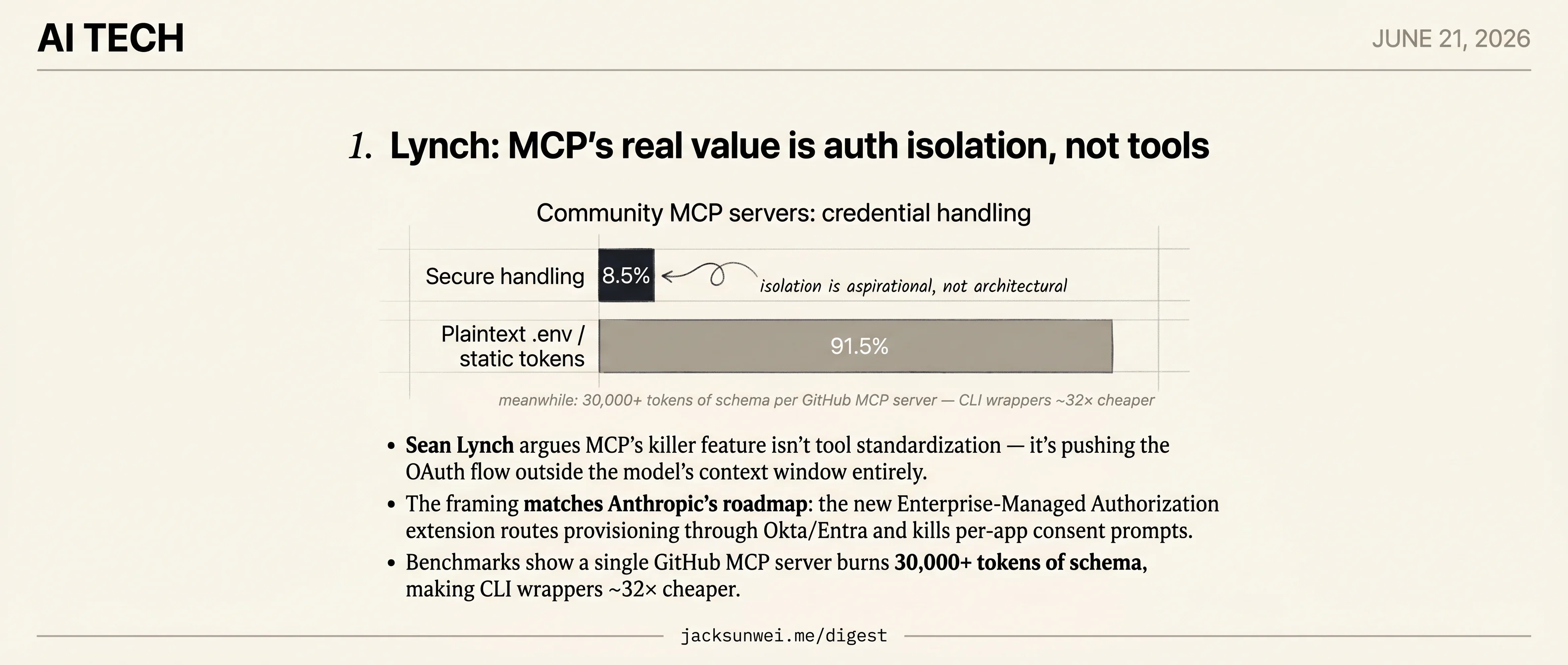
Lynch reframes MCP as an auth boundary; 91.5% of servers fail it
Sean Lynch argues MCP's real win is moving OAuth outside the context window, but only 8.5% of community servers handle credentials safely.
Lynch reframes MCP as an auth boundary; 91.5% of servers fail it
TL;DR
- Sean Lynch reframes MCP’s value as auth isolation, not tool standardization.
- Anthropic’s new Enterprise-Managed Authorization extension routes provisioning through Okta and Entra.
- A single GitHub MCP server burns 30,000+ tokens of schema, making CLI wrappers ~32× cheaper.
- Audits find only 8.5% of community MCP servers handle credentials safely.
Today’s single AI-tech read is Sean Lynch’s argument that the industry has been selling MCP on the wrong feature. The tool-discovery story — uniform schemas, plug-and-play integrations — is the part vendors put on slides. Lynch’s claim is that the actually load-bearing piece is mundane: MCP pushes the OAuth dance outside the model’s context window, so the agent never sees a token, never gets prompted to consent, and never becomes the weak link in a credential flow.
The framing lines up with where Anthropic is steering the spec — the new Enterprise-Managed Authorization extension routes provisioning through Okta and Entra. But the same piece surfaces the gap: a security audit finds only 8.5% of community MCP servers actually isolate credentials correctly, and a single GitHub server burns 30,000+ tokens of schema for what a CLI wrapper does ~32× cheaper. The architecture’s promise is real; the ecosystem hasn’t shipped it yet.
Lynch: MCP’s real value is auth isolation, not tools
Source: simon-willison · published 2026-06-19
TL;DR
- Sean Lynch argues MCP’s killer feature isn’t tool standardization — it’s pushing the OAuth flow outside the model’s context window entirely.
- The framing matches Anthropic’s roadmap: the new Enterprise-Managed Authorization extension routes provisioning through Okta/Entra and kills per-app consent prompts.
- Benchmarks show a single GitHub MCP server burns 30,000+ tokens of schema, making CLI wrappers ~32× cheaper.
- Security audits find only 8.5% of community MCP servers actually handle credentials safely — the isolation is aspirational, not architectural.
The reframe
In a Hacker News comment surfaced by Simon Willison, Sean Lynch makes a pointed claim about the Model Context Protocol: the standardized tool-calling everyone talks about isn’t the win. The win is that MCP keeps the authentication flow outside the agent’s context window — and ideally outside the harness entirely. “Maybe the idealized form of MCP is just an auth gateway for the API and nothing else. That’d still be a win.”
It’s a useful reframing because it shifts MCP’s value proposition from capability (what the agent can reach) to architecture (what the agent is allowed to see). Credentials never enter the prompt; the server does the handshake; the model gets structured results.
Where Lynch is right
The protocol is visibly moving in this direction. Anthropic’s recently shipped Enterprise-Managed Authorization (EMA) extension centralizes server provisioning through corporate identity providers, replacing the “per-user, per-app” OAuth prompts that train employees to rubber-stamp broad permissions 1. Willison himself has argued MCP and Claude Skills are complementary: MCP is the “rigid, deterministic” connectivity-and-auth layer, while Skills are the procedural knowledge layer 2. Lynch is articulating a direction the ecosystem is already steering toward, not a contrarian take.
Where the framing strains
Two problems. First, if auth isolation is the whole pitch, CLI tools wrapped in gh auth or a kubectl config achieve the same isolation more cheaply. Firecrawl’s benchmark found a single GitHub or Kubernetes MCP server can dump 30,000+ tokens of schema into the window before the user types a character, and CLI-based workflows ran up to 32× cheaper than unoptimized MCP setups for standard dev-ops tasks 3. Conceding the tool-discovery story to focus on auth concedes a lot.
Second — and more damning — the isolation is aspirational. An arXiv survey of community MCP servers found ~88% require external authentication but only 8.5% implement secure credential handling; the rest lean on static tokens in plaintext .env files 4. The r/mcp community flags “token passthrough” — servers forwarding raw downstream tokens without validation — as a pervasive anti-pattern that punctures the confused-deputy boundary the protocol is supposed to enforce 5.
Red Hat’s security writeup goes further: tool responses themselves routinely leak session IDs and internal auth metadata back into the conversation, where they then get shipped to third-party LLM provider logs 6. The model may never see the OAuth dance, but it sees the artifacts.
Takeaway
Lynch’s framing is the most honest thing said about MCP in months — strip away the tool-discovery marketing and what remains is genuinely valuable infrastructure for keeping secrets out of prompts. But “auth gateway” is a promise the spec is starting to keep (via EMA) and that implementers are mostly failing to deliver. The elegance of the idea is currently doing more work than the security maturity of the ecosystem. Until the 8.5% number moves, the gateway leaks.
Footnotes
-
Model Context Protocol blog — Enterprise-Managed Authorization — https://blog.modelcontextprotocol.io/posts/enterprise-managed-auth/
↩The Enterprise-Managed Authorization (EMA) extension allows for central provisioning of server access through corporate identity providers… replacing the individual ‘per-user, per-app’ OAuth prompts that often lead to employees granting broad permissions just to bypass repetitive login screens.
-
Simon Willison (Substack) — Claude Skills are awesome — https://simonw.substack.com/p/claude-skills-are-awesome-maybe-a
↩MCP provides a rigid, deterministic way for LLMs to talk to the outside world, [while] Skills function as ‘ephemeral clouds of knowledge’ that teach the model how to perform a procedure.
-
Firecrawl blog — MCP vs CLI benchmarks — https://www.firecrawl.dev/blog/mcp-vs-cli
↩A single GitHub or Kubernetes MCP server can consume upwards of 30,000 tokens before a prompt is even processed… CLI-based workflows can be up to 32x cheaper than unoptimized MCP setups for standard dev-ops tasks.
-
arXiv — AttestMCP / MCP authorization analysis — https://arxiv.org/html/2601.17549v1
↩Analysis of community-developed servers shows… nearly 88% of servers require external authentication, but only 8.5% implement secure credential handling, often relying on static tokens in plaintext .env files.
-
r/mcp — MCP server security thread — https://www.reddit.com/r/mcp/comments/1n3crsv/mcp_server_security/
↩Developers are strongly cautioned against ‘Token Passthrough’—the practice of sending raw downstream tokens to the MCP server—as it breaks audit trails and compromises security boundaries.
-
Red Hat — MCP security implementation — https://www.redhat.com/en/blog/mcp-security-implementing-robust-authentication-and-authorization
↩When an MCP server retrieves data… it may inadvertently return sensitive metadata like session IDs or internal auth keys in the response payload… these secrets become part of the conversation history and place unencrypted secrets into third-party LLM provider logs.