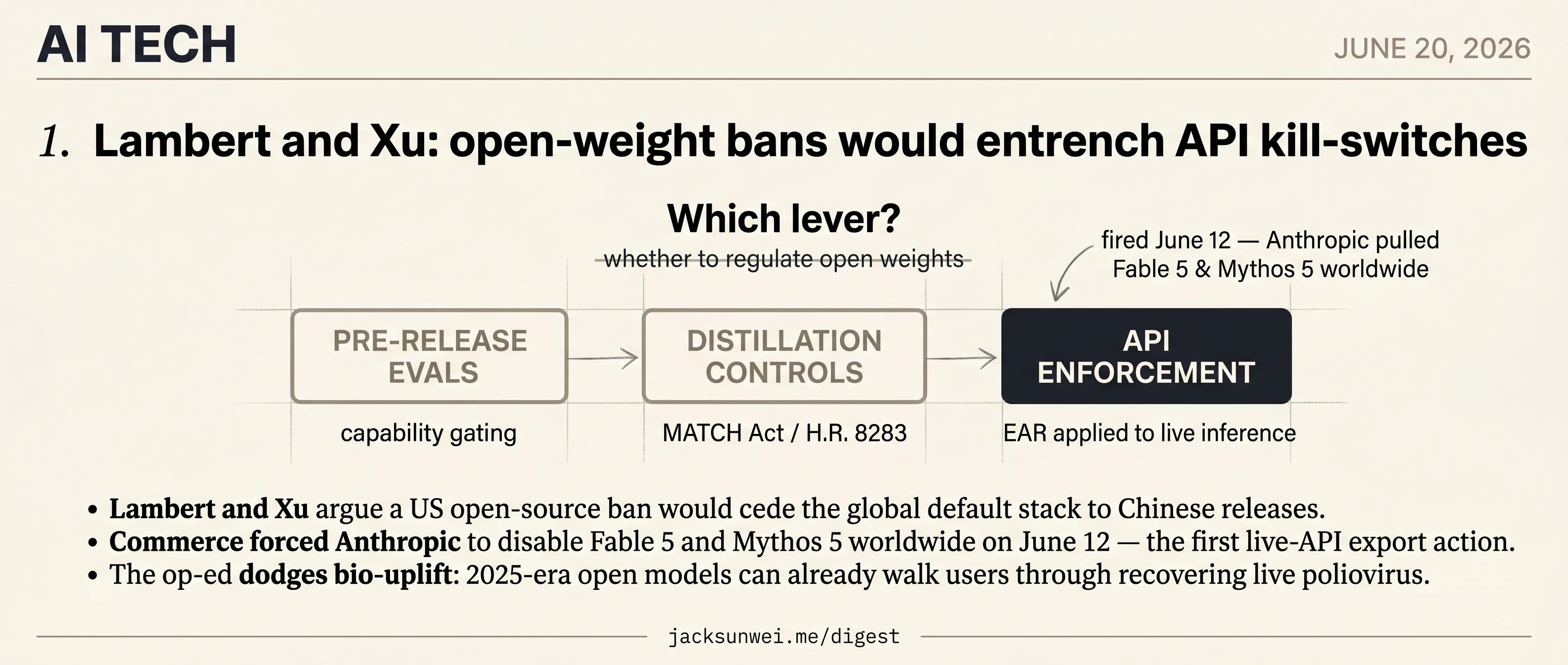
Lambert and Xu defend open weights as Commerce's API lever goes live
Lambert and Xu's op-ed against US open-weight bans lands the week Commerce forced Anthropic to disable two models worldwide via API.
Lambert and Xu defend open weights as Commerce’s API lever goes live
TL;DR
- Lambert and Xu argue a US open-source ban would cede the global default stack to Chinese releases.
- Commerce forced Anthropic to disable Fable 5 and Mythos 5 worldwide on June 12 via API.
- The op-ed sidesteps bio-uplift: 2025 open models can already walk users through recovering live poliovirus.
- Washington has moved from whether to regulate open weights to which lever — evals, distillation, or API.
Today’s single AI-tech read is an op-ed by Nathan Lambert and Tianle Xu arguing that a US ban on open-weight releases would hand the global default stack to Chinese labs. The argument is worth engaging on its merits, but it lands in an awkward week. On June 12, Commerce forced Anthropic to disable Fable 5 and Mythos 5 worldwide — not by pulling weights off Hugging Face, but by ordering the API switched off. That’s the first live use of an export-control lever against a closed frontier API, and it changes the shape of the policy debate the op-ed is trying to enter. Washington is no longer asking whether to regulate frontier capability; it’s picking among evals, distillation controls, and API enforcement. Lambert and Xu’s case against open-weight bans is strongest when read against that backdrop — and weakest where it skirts the bio-uplift evidence the closed-API camp will cite next.
Lambert and Xu: open-weight bans would entrench API kill-switches
Source: interconnects · published 2026-06-19
TL;DR
- Lambert and Xu argue a US open-source ban would cede the global default stack to Chinese releases.
- Commerce forced Anthropic to disable Fable 5 and Mythos 5 worldwide on June 12 — the first live-API export action.
- The op-ed dodges bio-uplift: 2025-era open models can already walk users through recovering live poliovirus.
- Washington has moved from whether to regulate open weights to which lever — evals, distillation controls, or API enforcement.
The precedent the op-ed is really answering
Nathan Lambert and Kevin Xu’s op-ed reads as a general-audience values statement, but its timing is not accidental. On June 12, the Commerce Department invoked the Export Administration Regulations to order Anthropic to revoke Fable 5 and Mythos 5 access for every non-US-citizen user worldwide — including Anthropic’s own employees on US soil — after Amazon reported a jailbreak 1. Tech Policy Press calls it the first application of EAR to real-time API inference rather than chips or downloadable artifacts, and notes Anthropic pulled the models globally because verifying user citizenship in real time is infeasible 2.
That’s the unstated subtext of Lambert and Xu’s argument. Closed-weight models now demonstrably have political kill-switches that can fire on a single incident report. Downloadable weights, whatever else they do, can’t be revoked by a Commerce Department memo. The op-ed’s “keeps markets honest” framing is really an argument that open weights are the structural counterweight to API-level export controls.
The strange-bedfellows problem
The pro-open-source coalition Lambert and Xu join now stretches from AI2 researchers to Marc Andreessen, who frames any restriction as handing the global standard to China 3. That alignment is a reach asset and a credibility liability in equal measure. The “China will win” argument has been used to oppose every safety lever proposed in the past three years, and Washington has visibly stopped buying the binary framing. The House Foreign Affairs Committee’s MATCH Act package, including H.R. 8283, specifically targets adversarial distillation — the mechanism by which Chinese labs harvest US model outputs to train their own systems 4. That’s a scalpel, not a ban, and the op-ed doesn’t engage it.
The bio-uplift gap
The weakest part of Lambert and Xu’s case is what they don’t address. Gary Marcus argues some frontier models are closer to nuclear or aerospace systems than to web software and warrant FDA-style pre-deployment approval 5 — a position the op-ed gestures at and moves past. More concretely, the Centre for Long-Term Resilience and RAND’s Global Risk Index for AI-Enabled Biological Tools reports that 2025-era models already guide users through complex biothreats, including recovering live poliovirus from synthetic DNA 6.
A “Linus’s Law” defense of open weights has to absorb that finding, not route around it. The marginal-risk counterargument from Kapoor and Narayanan — would a determined actor get this from a textbook anyway? — is available, but Lambert and Xu don’t make it. Conceding the empirical claim and contesting the counterfactual is a stronger op-ed than the one they wrote.
What’s actually at stake
Read alongside the Fable/Mythos action and the MATCH Act, the op-ed is fighting a debate that has already moved. The live question in Washington is no longer open vs. closed but which lever to pull: pre-release capability evals, distillation controls aimed at Chinese reuse, or API-level enforcement of the kind Commerce just demonstrated. Lambert and Xu are defending a window that, judging by June 12, may have already closed.
Footnotes
-
TIME — https://time.com/article/2026/06/13/anthropic-fable-mythos-ban-US-security/
↩the first time the U.S. Commerce Department used export control authorities to force an AI developer to revoke access to active, deployed models based on user nationality
-
Tech Policy Press — https://www.techpolicy.press/did-the-us-government-just-set-an-ai-export-precedent-by-blocking-mythos/
↩the application of the Export Administration Regulations to real-time API services rather than physical hardware or downloadable software… Anthropic could not reliably verify the citizenship of its millions of users in real-time
-
Business Insider (Andreessen, a16z) — https://www.businessinsider.com/marc-andreessen-us-china-open-source-ai-a16z-2025-5
↩restricting American open-source AI would effectively cede the global standard to China
-
House Foreign Affairs Committee press release — https://foreignaffairs.house.gov/news/press-releases/chairman-mast-hfac-advances-match-act
↩Deterring American AI Model Theft Act (H.R. 8283)… specifically targets adversarial distillation—the practice of using a model’s outputs to train a separate, unauthorized system
-
Gary Marcus, Substack — https://garymarcus.substack.com/p/what-washington-must-do
↩some AI models are inherently safety-critical—comparable to nuclear or aerospace systems—and should require FDA-like approval before deployment
-
Centre for Long-Term Resilience / RAND, Global Risk Index for AI-Enabled Biological Tools — https://www.longtermresilience.org/reports/global-risk-index-for-ai-enabled-biological-tools/
↩2025-era models already demonstrate the ability to guide users through complex biological threats, such as recovering live poliovirus from synthetic DNA