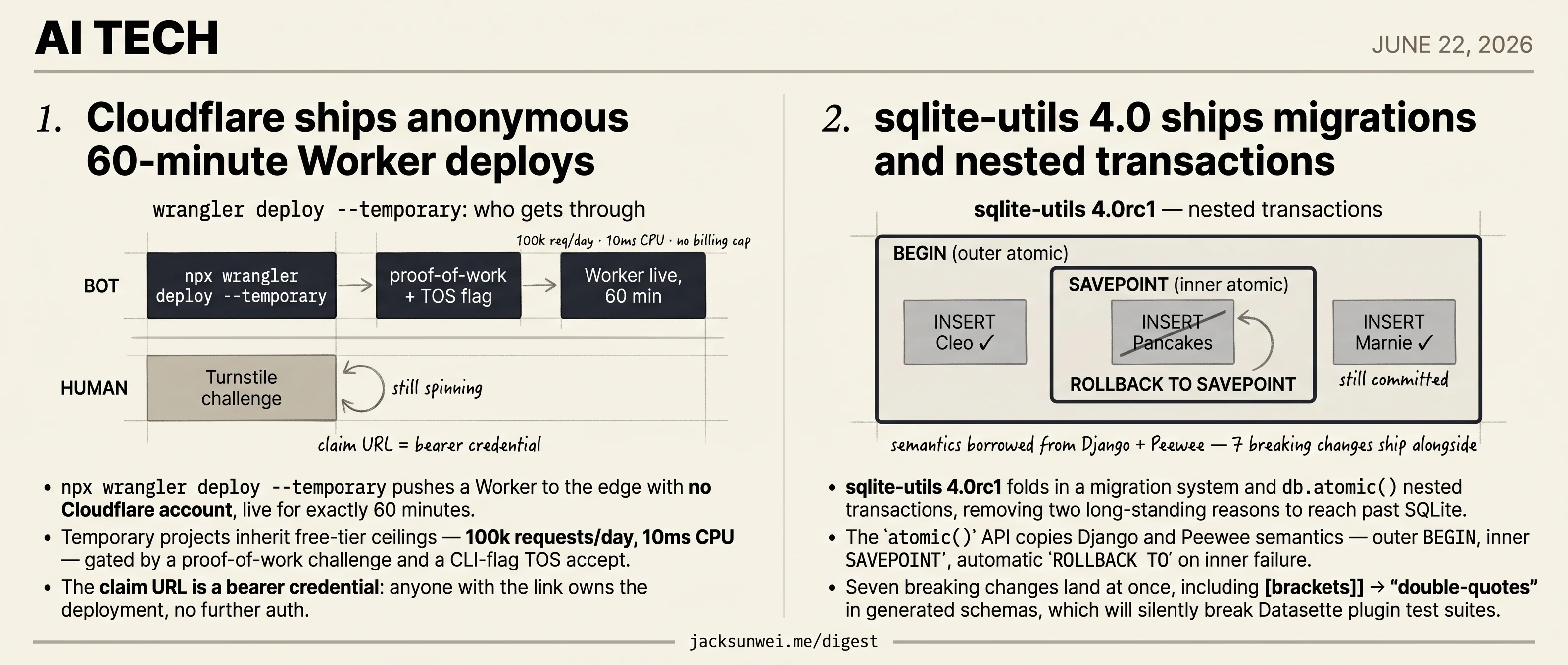
Cloudflare ships anonymous Worker deploys, sqlite-utils 4.0 adds migrations
Cloudflare ships 60-minute anonymous Worker deploys with no account, and sqlite-utils 4.0rc1 lands migrations plus nested transactions.
Cloudflare ships anonymous Worker deploys, sqlite-utils 4.0 adds migrations
TL;DR
- Cloudflare ships
npx wrangler deploy --temporaryfor 60-minute anonymous Worker deploys with no account. - Cloudflare’s claim URL is a bearer credential — anyone with the link owns the deployment.
- sqlite-utils 4.0rc1 adds a migration system and
db.atomic()nested transactions copying Django/Peewee semantics. - Seven breaking changes ship too, including
[brackets]→"double-quotes"that silently breaks Datasette plugin tests.
Today’s two AI-tech reads don’t share a thread. Cloudflare’s new wrangler deploy --temporary finally lets you push a Worker to the edge with no account at all — a real onboarding win, but the claim URL it hands back is a bearer credential, and the proof-of-work gate meant to stop abuse is the kind of challenge bots routinely solve while humans loop on Turnstile. sqlite-utils 4.0rc1, meanwhile, folds a migration system and db.atomic() nested transactions into the core, removing two long-standing reasons developers used to reach past SQLite — alongside seven breaking changes and a quiet gap in the release notes about Python 3.9–3.11’s sqlite3 driver quirks that affect the new atomic() API.
Cloudflare ships anonymous 60-minute Worker deploys
Source: simon-willison · published 2026-06-21
TL;DR
npx wrangler deploy --temporarypushes a Worker to the edge with no Cloudflare account, live for exactly 60 minutes.- Temporary projects inherit free-tier ceilings — 100k requests/day, 10ms CPU — gated by a proof-of-work challenge and a CLI-flag TOS accept.
- The claim URL is a bearer credential: anyone with the link owns the deployment, no further auth.
- Top HN gripe isn’t the feature, it’s that bots skip CAPTCHA and billing caps while humans still hit Turnstile loops.
What actually shipped
A single Wrangler flag now provisions an ephemeral Workers project against Cloudflare’s edge with zero signup. The deployment runs for 60 minutes on a *.workers.dev subdomain; a one-time claim URL converts it into a permanent project tied to a real account, or it gets garbage-collected along with any KV/D1 resources 1. Simon Willison wired GPT-5.5 in Codex Desktop to write an HTTP-redirect resolver and shipped it end-to-end without touching a dashboard — that’s the demo, and it works.
Cloudflare’s framing is “for AI agents.” The mechanism doesn’t care: it’s a frictionless deploy primitive for anyone in a hurry.
The guardrails the post glossed over
The launch post is light on quotas. Cloudflare’s companion abuse-protection write-up adds the missing detail: each provision is gated by a proof-of-work challenge, account creation is rate-limited, and the product surface is deliberately narrowed — smaller D1 ceilings, a KV command subset 2. Independent docs pin the runtime envelope to free-tier limits (100k req/day, 10ms CPU per invocation) and confirm the TOS must be accepted as a literal CLI flag so non-interactive agents can complete the flow 3.
What’s not there: a hard billing cap. The top-voted HN comment lands exactly on this — a guaranteed kill-switch at a dollar threshold remains the feature Cloudflare won’t ship, and frictionless deploys raise the blast radius of a runaway loop 4.
A fresh abuse primitive
Two independent threads sharpen the security picture. Digital Applied notes the 60-minute lifespan cuts both ways: it’s long enough for a targeted phishing burst on the reputationally-trusted workers.dev domain, but shorter than Cloudflare’s own Trust & Safety review cycle, which runs days to weeks 5. By the time abuse is reviewed, the Worker is gone — and so is the account trail.
Microsoft’s mid-June AutoJack disclosure makes this concrete. A hijacked AutoGen agent, prompted via a single malicious page, can execute local shell commands in the developer’s trusted environment. With wrangler deploy --temporary available unauthenticated on that same host, the agent becomes a one-shot deployer of attacker-controlled Workers — data-exfil proxies, C2 nodes — with no API token to revoke 6.
flowchart LR
    A[Malicious web page] -->|prompt injection| B[AutoGen / Codex agent]
    B -->|shell exec| C["wrangler deploy --temporary"]
    C -->|no auth, no account| D[Worker on *.workers.dev]
    D -->|trusted edge, 60 min| E((Exfil / C2 / phishing))
The claim URL adds a second edge: it’s a bearer credential. Leak it into a chat log, a CI artifact, or a screenshot and the deployment is silently taken over 1.
The asymmetry nobody at Cloudflare wants to name
The recurring HN jab is the sharpest editorial frame:
Bots can now spin up accounts while humans remain trapped in endless Turnstile spinner loops. 4
Cloudflare has spent two years tightening friction on human traffic — CAPTCHAs, bot-fight mode, JS challenges — while explicitly loosening it for programmatic clients. --temporary is the cleanest expression yet of that asymmetry. The dev ergonomics are real. So is the trade: anonymous edge compute is now a first-class primitive, and the abuse model hasn’t caught up.
sqlite-utils 4.0 ships migrations and nested transactions
Source: simon-willison · published 2026-06-21
TL;DR
- sqlite-utils 4.0rc1 folds in a migration system and
db.atomic()nested transactions, removing two long-standing reasons to reach past SQLite. - The
atomic()API copies Django and Peewee semantics — outerBEGIN, innerSAVEPOINT, automaticROLLBACK TOon inner failure. - Seven breaking changes land at once, including
[brackets]→"double-quotes"in generated schemas, which will silently break Datasette plugin test suites. - The release notes don’t mention Python 3.9–3.11’s
sqlite3driver quirks around savepoints — only 3.12+ has the clean autocommit fix.
What actually changed
Simon Willison’s sqlite-utils has spent six years as a “higher-level Python on top of stdlib sqlite3” library that deliberately punted on two things real applications need: schema evolution and transaction nesting. The 4.0 release candidate quietly closes both gaps.
Migrations are a port of the standalone sqlite-migrate package Willison shipped years ago and has been running in production via the llm CLI. The design is aggressively minimal — forward-only, no rollback, no autogeneration, just decorated functions that run once and get tracked in a _sqlite_migrations table. If you make a mistake, you ship another migration to fix it.
The bigger conceptual shift is db.atomic(). Previously sqlite-utils handed transactions back to the user via with db.conn:. The new context manager wraps SQLite savepoints into a nestable abstraction:
with db.atomic():
    db.table("dogs").insert({"id": 1, "name": "Cleo"})
    try:
        with db.atomic():            # SAVEPOINT
            db.table("dogs").insert({"id": 2, "name": "Pancakes"})
            raise ValueError("skip this one")  # ROLLBACK TO SAVEPOINT
    except ValueError:
        pass
    db.table("dogs").insert({"id": 3, "name": "Marnie"})  # still committed
Borrowed, not invented
Willison credits the terminology to Django and Peewee, and the semantics are nearly identical. Peewee’s docs describe an internal nesting counter where the outermost call issues BEGIN, inner calls emit SAVEPOINT, and nested.rollback() translates to ROLLBACK TO SAVEPOINT 7. Django’s transaction.atomic auto-generates savepoint IDs and emits RELEASE or ROLLBACK TO based on inner-block exit 8. The novelty isn’t the pattern — it’s bringing a mature ORM idiom down to a thin wrapper that thousands of one-file scripts already use.
Footguns the announcement skips
Two well-known hazards go unmentioned. Python’s stdlib sqlite3 driver has historically interfered with savepoints by implicitly committing before certain DDL — a bug only properly resolved by PEP 249-compliant autocommit in Python 3.12 9. sqlite-utils 4.0 drops 3.8 but still supports 3.9 through 3.11, so users on those versions may hit driver-level edge cases the new docs don’t flag. Second, the documented atomic() API doesn’t expose a BEGIN IMMEDIATE knob — the classic remedy for concurrent-writer deadlocks under SQLite’s deferred locking.
The breaking-change blast radius
The seven 4.x breaking changes look small individually but compound for the Datasette plugin ecosystem. The shift from [square-bracket] to "double-quote" identifier quoting 10 will silently break any test that string-matches CREATE TABLE output, and that’s a common assertion pattern in plugin suites. FLOAT → REAL, mandatory db.view() for views, and default type detection on CSV import each independently break downstream automation. Only the upsert change ships an opt-out (use_old_upsert=True) 11; everything else requires code edits.
Third-party reception is thin so far — daily.dev’s writeup is the main non-Willison coverage and has already surfaced a concrete early bug: plugin installation fails under uv because uv doesn’t bundle pip 12, awkward given Willison promotes uvx as the install path. That’s the kind of friction an RC is for. If you maintain anything downstream of sqlite-utils, this is the week to run your test suite against 4.0rc1.
Further reading
- sqlite-utils 4.0rc1 — simon-willison
Footnotes
-
getaibook.com — deployment walkthrough — https://getaibook.com/blog/how-to-deploy-cloudflare-workers-via-temporary-accounts/
↩ ↩2If the claim link is not used within 60 minutes the account and all associated resources (Workers, KV, D1) are automatically deleted; the claim URL itself is a bearer credential that grants full ownership of the deployment.
-
Cloudflare blog — account-abuse-protection — https://blog.cloudflare.com/account-abuse-protection/
↩The CLI requires a proof-of-work challenge before provisioning a temporary account, combined with strict rate limits on account creation and a restricted set of supported products (e.g., limited D1 database size and KV commands).
-
explainx.ai — Wrangler —temporary deep dive — https://explainx.ai/blog/cloudflare-temporary-accounts-ai-agents-wrangler-2026
↩Temporary workers operate under strict resource constraints equivalent to Cloudflare’s Free tier: 100,000 requests per day and a maximum CPU execution time of 10ms per invocation; deployments require programmatic acceptance of Cloudflare’s Terms of Service passed as a text flag.
-
Hacker News thread #48608394 — https://news.ycombinator.com/item?id=48608394
↩ ↩2jedberg: the most valuable feature would be a guaranteed kill switch to stop traffic once a specific dollar limit is reached… others noted the irony that bots can now spin up accounts while humans remain trapped in endless Turnstile spinner loops.
-
Digital Applied — security analysis — https://www.digitalapplied.com/blog/cloudflare-temporary-accounts-ai-agents-2026-guide
↩A 60-minute window is sufficient for a targeted phishing strike… the Trust & Safety team’s standard review process — which can take days or weeks — is fundamentally incompatible with a one-hour attack window on the trusted workers.dev domain.
-
Microsoft Security blog — AutoJack disclosure — https://www.microsoft.com/en-us/security/blog/2026/06/18/autojack-single-page-rce-host-running-ai-agent/
↩A hijacked AutoGen agent could be instructed via prompt injection to run wrangler deploy —temporary, using the developer’s trusted environment to launch malicious Workers — data-exfiltration proxies or C2 nodes — on Cloudflare’s global edge without an account trail.
-
Peewee documentation (red-dove mirror) — https://docs.red-dove.com/peewee/peewee/database.html
↩The outermost call issues a BEGIN, while subsequent nested calls issue SAVEPOINT commands… with db.atomic() as nested: … nested.rollback() issues ROLLBACK TO SAVEPOINT.
-
Medium write-up on Django transaction.atomic — https://medium.com/@sunilnepali844/djangos-database-transaction-api-allows-developers-to-manage-database-operations-atomically-a56dabe13dd6
↩On the first call, it starts a database transaction. If called again within that block, it automatically generates a savepoint with a unique ID; if the inner block fails, Django issues a ROLLBACK TO SAVEPOINT.
-
Django ticket #29280 (SQLite savepoint behavior) — https://code.djangoproject.com/ticket/29280
↩Python’s sqlite3 driver historically interfered with savepoint management by implicitly committing before certain statements; Python 3.12’s new autocommit mode lets the engine handle transaction state.
-
sqlite-utils changelog (datasette.io) — https://sqlite-utils.datasette.io/en/latest/changelog.html
↩Tables created by this library now wrap table and column names in “double-quotes” in the schema. Previously they would use [square-braces].
-
sqlite-utils GitHub releases — https://github.com/simonw/sqlite-utils/releases
↩use_old_upsert=True opt-in restores the legacy INSERT OR IGNORE + UPDATE behaviour for code that depended on the previous side effects on SQLite <3.24.
-
daily.dev coverage of sqlite-utils 4.0rc1 — https://daily.dev/posts/sqlite-utils-4-0rc1-adds-migrations-and-nested-transactions-vffby2kab
↩Early feedback identified a bug related to plugin installation when using the uv tool, as uv does not bundle pip by default… ‘agentic’ bug reports where AI-driven testers identified edge cases in ambiguous data strings.