Datasette's 1.0 push lands sandbox runtime and stored-query advisory in one tag
Datasette's Claude-assisted 1.0 sprint ships a sandboxed-apps runtime and a stored-query leak advisory in the same release tag.
Datasette’s 1.0 push lands sandbox runtime and stored-query advisory in one tag
TL;DR
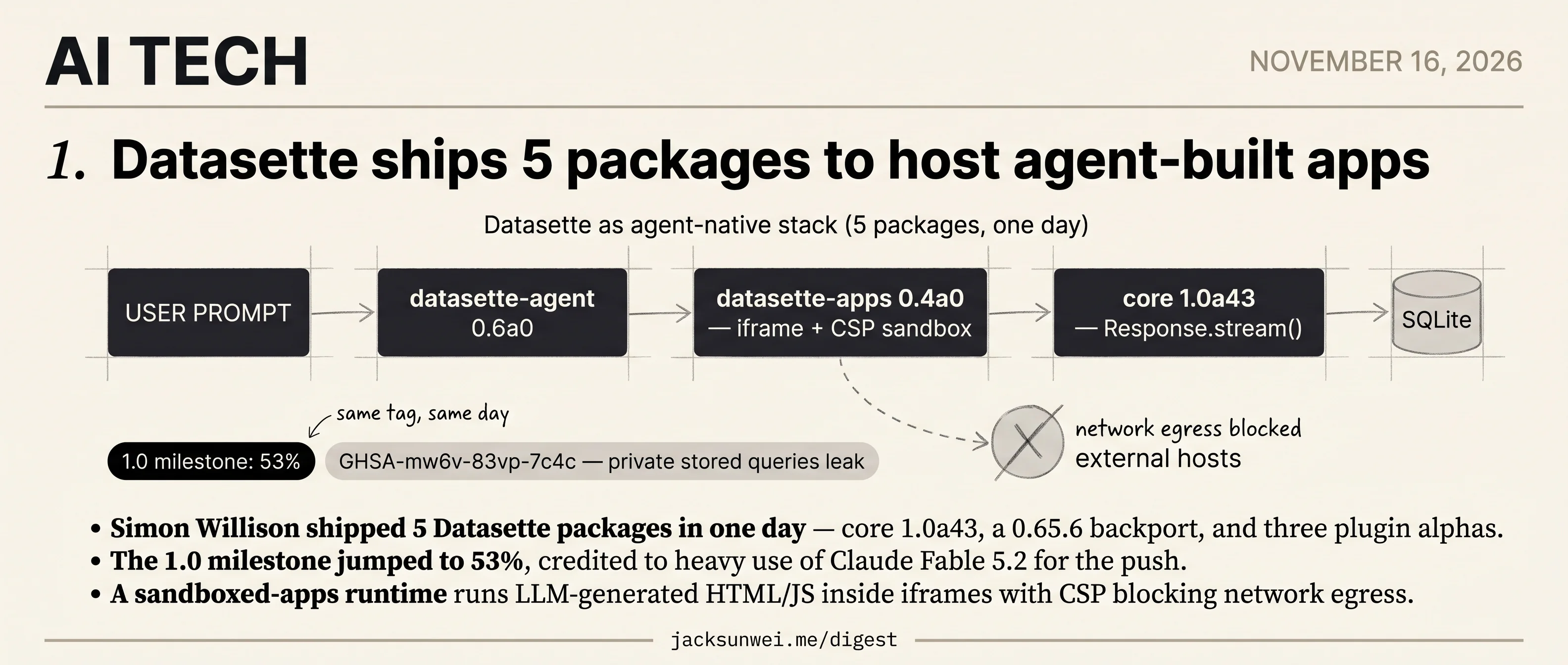
- Simon Willison shipped 5 Datasette packages in one day — core 1.0a43, a backport, 3 plugin alphas.
- 1.0 milestone jumped to 53%, credited to heavy Claude Fable 5.2 use on the push.
- Sandboxed-apps runtime executes LLM-generated HTML/JS in iframes with CSP blocking network egress.
- Same tag ships a GHSA advisory for private stored queries leaking to unauthenticated users.
Today’s AI tech slot is a single story, but it’s the kind that reads like a case study. Simon Willison cut five Datasette releases in one day — core 1.0a43, a 0.65.6 backport, and three plugin alphas — pushing the long-running 1.0 milestone to 53% on the back of heavy Claude Fable 5.2 use.
The same tag ships the headline capability — a sandboxed-apps runtime that runs LLM-generated HTML/JS inside iframes with a CSP blocking network egress — and a GHSA advisory for private stored queries leaking to unauthenticated users. Capability and vulnerability, agent-built, in the same release. The vibe-engineering tradeoff in miniature.
Datasette ships 5 packages to host agent-built apps
Source: simon-willison · published 2026-11-15
TL;DR
- Simon Willison shipped 5 Datasette packages in one day — core 1.0a43, a 0.65.6 backport, and three plugin alphas.
- The 1.0 milestone jumped to 53%, credited to heavy use of Claude Fable 5.2 for the push.
- A sandboxed-apps runtime runs LLM-generated HTML/JS inside iframes with CSP blocking network egress.
- Same release, same tag also ships a GHSA advisory for private stored queries leaking — the vibe-engineering tradeoff in miniature.
One event, not five releases
Read individually, each of Sunday’s Datasette posts is minor. Read together, they’re a platform pivot: Datasette is repositioning as an agent-native environment where LLMs both build the apps and inhabit the data they run against. Core 1.0a43 contributes the plumbing — streaming output renderers via a new Response.stream() method that finally lets CSV/TSV exports walk million-row tables without OOMing 1. datasette-apps supplies the runtime: sandboxed iframes with allow-scripts allow-forms, a Content Security Policy that blocks external network egress, and a read-only datasette.query() JavaScript API that gives app code SQL access without host cookies or storage 23. datasette-agent is the glue — a chat panel that prompts apps into existence and references them with # autocompletion. datasette-maplibre swaps the aging Leaflet cluster-map stack for WebGL. And 0.65.6 is a stable-branch security backport for users not yet on the alpha.
The point of shipping them together is that none of the pieces makes sense alone. An agent that writes apps needs a sandbox to run them in. A sandbox needs a data API. A data API needs streaming to be useful at scale. Willison has been building toward this since the June datasette-apps introduction 2; this drop is where the stack snaps into place.
flowchart LR
    U[User prompt] --> A[datasette-agent]
    A -->|writes HTML/JS| APP[datasette-apps iframe<br/>sandbox + CSP]
    APP -->|datasette.query SQL| CORE[Datasette core 1.0a43<br/>Response.stream]
    CORE --> DB[(SQLite DB)]
    APP -. egress blocked .-x EXT((External hosts))
    CORE --> MAP[datasette-maplibre<br/>WebGL rendering]
Velocity, and what it costs
Willison has written openly about how agentic coding with Claude Code and Codex changed his sense of what counts as a “reasonable” plugin — ideas previously too small to justify the overhead are now worth an afternoon 4. Five simultaneous releases is what that looks like in practice. The 53%-to-1.0 claim is downstream of the same shift.
The counter-evidence ships in the same tag. GHSA-mw6v-83vp-7c4c patches a bug where private stored queries could leak their title and SQL to unauthorized viewers — a feature added in 1.0a31 needing a fix by 1.0a43, with a separate ACL bypass covered in the 0.65.6 backport. Practitioner audits of AI-generated code put vulnerability rates in the 40–62% range and warn of “vibe debugging” tails where hours of generation produce days of cleanup 5. Others flag cognitive debt: maintainers losing architectural grip on code they didn’t personally author 6.
The real test is the sandbox
The interesting attack surface nobody outside Willison has stress-tested yet is datasette-apps’ isolation model against indirect prompt injection — specifically, an agent that writes an app that reads user-controlled database rows and then executes instructions hidden in them. CSP blocks egress to arbitrary hosts, but the same-origin datasette.query() API is the point. If that boundary holds under adversarial load, Datasette has a genuinely novel answer to “where do agent-generated applications live?” If it doesn’t, the 0.65.6 backport pattern is going to repeat.
Either way, the shape of the bet is clear: small, composable, LLM-written apps on top of baked data, with the server as the trust boundary.
Further reading
- datasette 0.65.6 — simon-willison
- datasette-agent 0.6a0 — simon-willison
- datasette-apps 0.4a0 — simon-willison
- datasette-maplibre 0.1a0 — simon-willison
Footnotes
-
Datasette official documentation — https://docs.datasette.io/en/latest/
↩Response.stream() lets plugins register as capable of streaming every row in a table in one go, which the built-in CSV and TSV exporters now use to avoid memory bottlenecks on large exports.
-
Simon Willison — ‘Introducing Datasette Apps’ (June 2026) — https://simonwillison.net/2026/Jun/18/datasette-apps/
↩ ↩2Datasette Apps hosts sandboxed HTML/JS inside iframes with a restrictive Content Security Policy, exposing a datasette.query() JavaScript API for read-only SQL — effectively turning the server into a backend-as-a-service for small, ‘baked data’ applications.
-
datasette/datasette-apps GitHub repository — https://github.com/datasette/datasette-apps
↩Apps run inside iframes with sandbox=“allow-scripts allow-forms” and are prevented from accessing host cookies or storage; network egress is blocked by default via CSP, enabling multi-tenant hosting of untrusted apps within a shared Datasette instance.
-
Simon Willison monthly newsletter (Oct 2025) — https://simonwillison.net/newsletters/monthly-2025-10-october/
↩Agentic coding with Claude Code and Codex has changed what counts as a ‘reasonable’ plugin to build — small ideas that were previously too small to justify the overhead are now worth doing in an afternoon.
-
newly.app — ‘Vibe Coding Limitations’ — https://newly.app/guides/vibe-coding-limitations
↩Statistical analyses suggest 40–62% of AI-generated code contains security vulnerabilities such as XSS, and ‘vibe debugging’ can turn a two-hour feature into twenty days of remediation.
-
codeculture.store — ‘Is Vibe Coding Bad?’ — https://codeculture.store/blogs/developer-culture/is-vibe-coding-bad
↩Cognitive debt accumulates when maintainers must reason about systems they didn’t personally author; the risk is not the code itself but the loss of long-term architectural understanding.