Datasette moves execution off the server: local LLMs and browser plugins
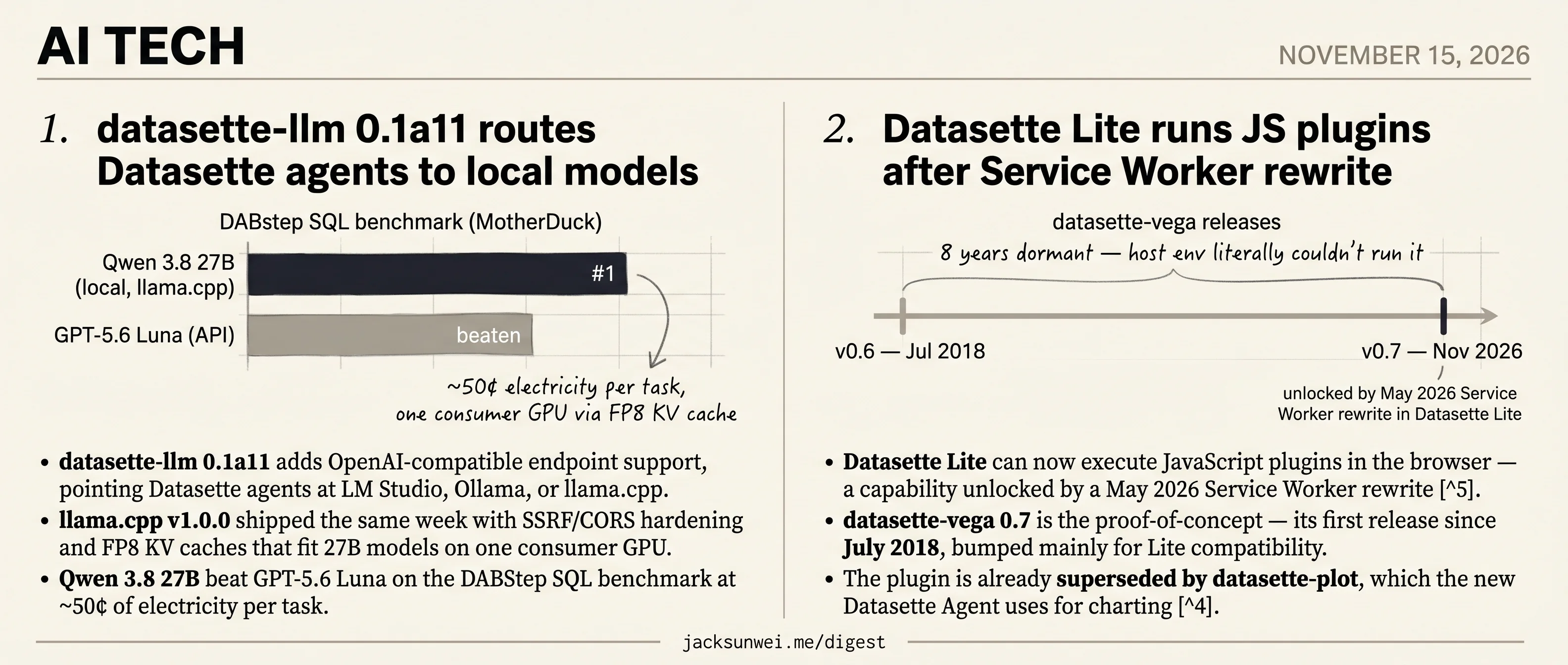
Two Datasette releases today move execution off the server, routing agents to local LLM runners and running plugins inside the browser.
Datasette moves execution off the server: local LLMs and browser plugins
TL;DR
- datasette-llm 0.1a11 routes Datasette agents to local LM Studio, Ollama, or llama.cpp via OpenAI-compatible endpoints.
- Datasette Lite now executes JavaScript plugins in-browser, enabled by a May 2026 Service Worker rewrite.
- llama.cpp v1.0.0 ships SSRF/CORS hardening and FP8 KV caches, fitting 27B models on one consumer GPU.
- datasette-vega 0.7 is the Lite proof-of-concept, its first release since July 2018 and already superseded.
- 0.1a10 patched an allowlist bypass 10 days earlier that let the public demo invoke non-approved models.
Datasette shipped two extensions this week that each move code execution out of the server process. datasette-llm 0.1a11 adds OpenAI-compatible endpoint support, so a Datasette agent can route its inference to a local LM Studio, Ollama, or llama.cpp instance instead of a hosted API. Datasette Lite — the browser build — can now run JavaScript plugins at all, a capability unlocked by a Service Worker rewrite earlier this year.
Neither release is clean. The LLM router’s previous alpha shipped with an allowlist bypass, patched 10 days ago on the public demo. The Lite plugin story debuts with datasette-vega 0.7, a proof-of-concept whose core complaints — no type inference, no custom Vega specs — haven’t moved since 2018, and which is already superseded by datasette-plot. The runtime surface is genuinely wider today; the code demonstrating it is older than the ambition.
datasette-llm 0.1a11 routes Datasette agents to local models
Source: simon-willison · published 2026-11-14
TL;DR
- datasette-llm 0.1a11 adds OpenAI-compatible endpoint support, pointing Datasette agents at LM Studio, Ollama, or llama.cpp.
- llama.cpp v1.0.0 shipped the same week with SSRF/CORS hardening and FP8 KV caches that fit 27B models on one consumer GPU.
- Qwen 3.8 27B beat GPT-5.6 Luna on the DABstep SQL benchmark at ~50¢ of electricity per task.
- 0.1a10 patched an allowlist-bypass 10 days earlier that let users invoke non-approved models on the public demo.
The release
The 0.1a11 bump is small on paper: datasette-llm, the intermediate plugin that other Datasette plugins (notably datasette-agent) use to resolve model config, now accepts any OpenAI-compatible api_base. A one-liner uvx invocation is enough to launch a Datasette agent pointed at a local LM Studio server:
uvx --with datasette-agent datasette --root --secret 1 \
  -s plugins.datasette-llm.default_model '{
    "model": "lmstudio-qwen",
    "model_name": "qwen/qwen3.8-27b",
    "api_base": "http://localhost:1234/v1"
  }' content.db
In Willison’s screenshot, that stack correctly introspects a schema, writes a nested COUNT(*) SQL query, executes it, and summarises the result in prose — all without an API key leaving the machine.
Why it’s credible now and not six months ago
The “point it at localhost” story only works if the thing on the other end of the socket is stable. llama.cpp’s v1.0.0, which landed the same week, is the piece that makes this claim load-bearing. The v1.0.0 server hardens against SSRF, CORS misconfig and DNS-rebinding attacks, and moves its default port from the crowded 8080 to 9931 1. It also ships FP8 (E4M3) KV caches and a Mixture-of-Experts expert cache that spills to system RAM — the two changes that drop 27B-class models into single-consumer-GPU territory 2.
The model matters as much as the runtime. MotherDuck’s independent benchmarking puts Qwen 3.8 27B at the top of its weight class for text-to-SQL, beating GPT-5.6 Luna on DABstep at roughly 50 cents of electricity per task 3. For a local-first database agent, that’s the number that decides whether “run it on your laptop” is a toy or a workflow.
The governance asterisk
The less comfortable half of the story is that datasette-llm is the single enforcement point for which models a Datasette deployment is allowed to call — and that enforcement code is young. On November 4, version 0.1a10 patched an allowlist-bypass on the public agent.datasette.io demo that let users invoke models outside the operator-defined list 4. That’s exactly the class of bug you don’t want in the component that gates cost, data residency, and API-key scope.
The sibling datasette-agent plugin at least defaults to the right posture: a recursive agentic loop that must request explicit user permission before running write queries or generating new applications 5. That read-only-by-default stance looks better in context — 2026 has been rough on LangChain, whose stateful checkpointing layer took CVEs for both SQL injection and remote code execution, prompting enterprise teams to migrate toward local-first stacks like DuckDB 6.
Takeaway
Treat 0.1a11 as connective tissue, not as a feature. Three independently-maturing pieces — a hardened llama.cpp runtime, a genuinely capable open-weight SQL model, and a Datasette agent with a sane permission model — just became composable with one JSON blob. The open question isn’t whether the local stack works. It’s whether the thin plugin now holding the allowlist is trustworthy enough to be the one thing standing between an agent and your data.
Further reading
- datasette-llm 0.1a11 — simon-willison
Datasette Lite runs JS plugins after Service Worker rewrite
Source: simon-willison · published 2026-11-14
TL;DR
- Datasette Lite can now execute JavaScript plugins in the browser — a capability unlocked by a May 2026 Service Worker rewrite 7.
- datasette-vega 0.7 is the proof-of-concept — its first release since July 2018, bumped mainly for Lite compatibility.
- The plugin is already superseded by datasette-plot, which the new Datasette Agent uses for charting 8.
- Long-standing complaints — no type inference, no custom Vega specs — are untouched in 0.7 9.
The real announcement is Lite, not Vega
Simon Willison shipped datasette-vega 0.7 this week, the first update to the Vega-Lite charting plugin in over eight years. On its own that’s a footnote. The reason it matters: it’s the first legacy JavaScript plugin to run inside Datasette Lite, the WebAssembly build of Datasette that executes entirely in the browser.
That capability is new. Datasette Lite migrated from a Web Worker to a Service Worker model in May 2026, which finally allowed <script> tags inside plugin-generated HTML to execute — a limitation that had blocked plugins like datasette-vega and datasette-cluster-map from working in the browser build at all 7. The eight-year dormancy wasn’t neglect; the host environment literally couldn’t run it. Willison’s teaser that he’ll “write more about that soon” is the actual headline: Lite is now a real plugin target.
Vega-Lite’s shrinking niche
Within the Datasette ecosystem, the charting story has already moved on. datasette-plot is positioned as the “spiritual successor,” built on Observable Plot, and it’s what datasette-agent-charts — the charting module for the new Datasette Agent — is built on 8. The split is philosophical as much as technical:
| Vega-Lite (datasette-vega) | Observable Plot (datasette-plot) | |
|---|---|---|
| Spec format | Portable JSON | Idiomatic JavaScript |
| Data prep | Built-in expression compiler | Pair with Arquero / Arrow 10 |
| Strength | Sandbox-safe, URL-shareable 11 | Sane defaults, fast exploration 11 |
| Datasette Agent uses it? | No | Yes 8 |
Vega-Lite’s remaining advantage is portability: a JSON spec survives being embedded in a URL fragment, which is exactly how the new Lite demo works — lite.datasette.io/?install=datasette-vega&csv=...#g.mark=bar&g.x_column=airline... reconstructs the full chart state from the hash. That’s a genuine niche Plot doesn’t fill as cleanly.
What 0.7 didn’t fix
The release is life-support, not a revival. The two loudest Hacker News complaints about the plugin are both still true in 0.7: it doesn’t infer sensible defaults from column types (users want it to “take an informed guess” based on what’s in the table), and it’s locked to bar, line, and scatter with no escape hatch for custom Vega specifications 9. Users who hit those walls have historically migrated to forks like datasette-vega-dashboards or to datasette-dashboards for multi-chart layouts.
Takeaway
Read datasette-vega 0.7 as Willison stress-testing the Lite plugin pipeline with the oldest, crustiest JS plugin in the drawer. If an unmaintained 2018 Vega-Lite integration runs cleanly in a browser-only Datasette, the harder plugins will too. The chart plugin you’ll actually want to install is still datasette-plot — but the delivery mechanism, a URL that spins up a full Datasette-plus-plugin stack with zero backend, is what’s quietly shifted.
Further reading
- datasette-vega 0.7 — simon-willison
Footnotes
-
mlq.ai on llama.cpp v1.0.0 — https://mlq.ai/news/llamacpp-reaches-version-10-and-promises-a-stable-api-for-local-ai-apps/
↩The v1.0.0 server implements new protections against Server-Side Request Forgery (SSRF), Cross-Origin Resource Sharing (CORS) misconfigurations, and DNS-rebinding attacks… defaults to port 9931 (moving away from the common 8080).
-
Medium (Data Science in Your Pocket) — llama.cpp v1.0.0 — https://medium.com/data-science-in-your-pocket/llama-cpp-v1-0-0-local-ai-finally-gets-a-stable-foundation-8587fb5619ba
↩It adds support for FP8 (E4M3) key-value caches, which significantly reduces the VRAM required for long-context windows… For Mixture of Experts (MoE) models, a new expert cache allows weights to spill into system RAM.
-
MotherDuck — Agentic SQL with Qwen3.8-27B — https://motherduck.com/blog/Agentic-SQL-for-Free-with-Qwen3.8-27B-and-DuckDB/
↩In the DABstep SQL benchmark, it surpassed models like GPT-5.6 Luna in accuracy while operating at a fraction of the cost—roughly 50 cents in electricity per task.
-
cloudaitradingagent.com — datasette-llm allowlist bypass — https://watch.cloudaitradingagent.com/
↩On the agent.datasette.io demo environment, this allowed users to select and invoke LLMs that were not explicitly included in the restricted allowlist… patched on November 4, 2026, with the release of datasette-llm version 0.1a10.
-
datasette.io blog — Datasette Agent — https://datasette.io/blog/2026/datasette-agent/
↩A recursive ‘agentic loop’ to inspect schemas, generate SQL queries, and provide human-readable summaries… the agent must request explicit user permission before executing ‘write’ queries or creating new applications.
-
MotherDuck — LangChain SQL agent + DuckDB — https://motherduck.com/blog/langchain-sql-agent-duckdb-motherduck/
↩LangChain faced significant scrutiny in early 2026 due to several high-profile CVEs involving SQL injection and remote code execution in its stateful checkpointing layer… many enterprise teams moved toward DuckDB’s local-first architecture.
-
datasette.io — Datasette Lite Service Worker migration — https://datasette.io/news
↩ ↩2The May 2026 migration from a Web Worker to a Service Worker model solved a long-standing limitation where JavaScript in
-
datasette.io news — https://datasette.io/news
↩ ↩2 ↩3datasette-plot, released as a ‘spiritual successor’ to the older Vega plugin, is the recommended standard… the Datasette Agent utilizes the datasette-agent-charts plugin, which is powered specifically by Observable Plot.
-
Hacker News discussion — https://news.ycombinator.com/item?id=27041415
↩ ↩2An ideal implementation would ‘take an informed guess’ based on the data types present in a table… the plugin only supports a fixed set of visualizations (bar, line, and scatter) and does not allow custom Vega specifications, which has driven more advanced users toward alternative tools.
-
Observable — Plot library docs — https://observablehq.com/@observablehq/plot
↩Observable Plot encourages a JS-first approach, often pairing with data-wrangling libraries like Arquero or Apache Arrow to process data before it hits the charting layer — more efficient for large datasets because it avoids the overhead of a proprietary expression parser.
-
Observable — Plot vs Vega-Lite comparison — https://observablehq.com/@observablehq/plot-vega-lite
↩ ↩2Vega-Lite uses a high-level JSON schema while Observable Plot uses idiomatic JavaScript functions… Vega-Lite’s declarative JSON makes it highly portable across polyglot environments, but Plot is often praised for ‘sane defaults’ that make it faster for exploratory work.