llama.cpp 1.0 hardens server, Claude Duet drains quota, Datasette fixes referer
Three AI tech updates each surface an operational flaw: a server hardened at 1.0, a background quota drain, a referer fix.
llama.cpp 1.0 hardens server, Claude Duet drains quota, Datasette fixes referer
TL;DR
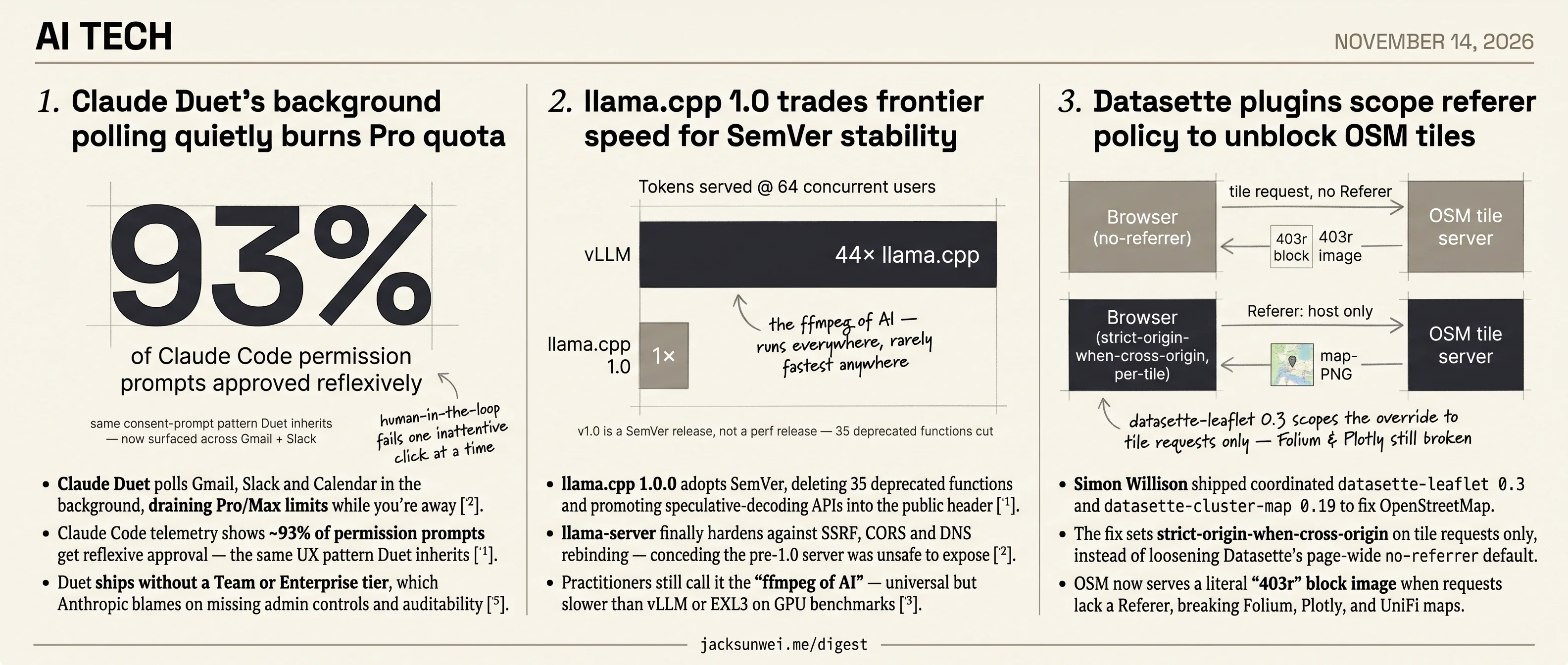
- Claude Duet polls Gmail, Slack and Calendar in the background, draining Pro/Max quota while users are away.
- llama.cpp 1.0.0 hardens
llama-serveragainst SSRF, CORS, DNS rebinding — conceding pre-1.0 unsafe. - Simon Willison scopes
strict-origin-when-cross-originonto Datasette tile requests to unblock OpenStreetMap. - OSM now serves a literal 403r block image when tile requests arrive without a Referer header.
- Claude Code telemetry shows ~93% of permission prompts get reflexive approval, the same UX Duet inherits.
Today’s AI tech coverage reads as three admissions. llama.cpp’s 1.0 release finally hardens llama-server against SSRF, CORS and DNS rebinding — a tacit concession that the pre-1.0 server wasn’t safe to expose in the first place. The Claude Duet review documents a product that polls Gmail, Slack and Calendar in the background and burns Pro/Max quota while the user is away, shipping without the Team tier that would make the drain auditable. And Simon Willison scopes strict-origin-when-cross-origin onto Datasette’s tile requests because OpenStreetMap now serves a literal 403r block image to anything without a Referer, breaking Folium and Plotly downstream.
None of these are capability launches. They’re the moment a shipped tool’s quiet failure mode becomes the story — a server hole conceded at version 1.0, a quota meter running in the background, a referer policy that was always wrong for maps.
Claude Duet’s background polling quietly burns Pro quota
Source: the-verge-ai · published 2026-11-13
TL;DR
- Claude Duet polls Gmail, Slack and Calendar in the background, draining Pro/Max limits while you’re away 1.
- Claude Code telemetry shows ~93% of permission prompts get reflexive approval — the same UX pattern Duet inherits 2.
- Duet ships without a Team or Enterprise tier, which Anthropic blames on missing admin controls and auditability 3.
- A Nov 13 outage across claude.ai, Code and Console stalled Duet’s background workflows the same day the review ran 4.
The “neurotic” trait is a UX anti-pattern
The Verge’s hands-on reads Duet as a jittery over-checker that’s “surprisingly helpful” once you adjust to its asking-permission-for-everything vibe. The broader reviewer conversation reframes that same behavior less generously. Internal Claude Code metrics circulated by developers show users approve roughly 93% of permission prompts, typically without reading them 2. That telemetry is from Code, not Duet — but Duet is built on the same consent-prompt pattern, aimed at a less technical audience, and now surfacing those prompts across Gmail and Slack instead of a terminal. The compulsive “are you sure?” posture isn’t a safety rail so much as a conditioning exercise — the mechanism that trains users to rubber-stamp the one prompt that actually matters. One commenter summarized it bluntly:
Human-in-the-loop safety fails one inattentive click at a time.
The hidden meter
The detail The Verge glosses is the economics. Because Duet proactively checks connected accounts every few hours in the background, it consumes Pro and Max plan usage even when the user isn’t prompting it 1. Several testers now recommend manually throttling check-in frequency to avoid getting rate-limited mid-workday — an odd tax for a product pitched as “ambient.” Claire Vo, who ran 12 agents through a chief-of-staff bakeoff for Fast Company, landed on a related verdict: Duet is “beautifully designed” and strong on sales pipeline and triage, but she kept forgetting it existed 5. She called the pattern “agent fatigue.” Proactive polling was supposed to solve exactly that — if it doesn’t, the user is paying for background calls that produce no behavioral change.
What’s missing at launch
Duet lands into a crowded proactive-agent field — OpenAI’s Dots, Meta’s Muse, xAI’s Grok Bot — and notably arrives consumer-only. Anthropic attributes the absence of a Team or Enterprise SKU to missing admin controls and auditability 3, which is a meaningful gap given that enterprise accounts drive the bulk of its revenue. Reliability is also unproven: a November 13 incident (same day as The Verge’s piece) hit claude.ai, Claude Code and the Console, stalling Duet’s polling loops and triggering what one writeup called a “collective existential crisis” among users who’d already offloaded triage to it 4.
The launch is also landing inside a louder credibility argument about Anthropic’s safety posture. Casey Newton has publicly called the company’s Mythos/Glasswing restricted-release program “deeply uncomfortable”; Simon Willison defended it as a “reasonable trade-off” 6. Duet’s permission-prompt theater is a smaller instance of the same question: is the friction doing safety work, or is it decorative?
Takeaway
The Verge captures Duet’s personality accurately. The wider reviewer evidence turns that personality into a product critique: reflexive approvals, silent quota drain, forgotten-tool syndrome, and a missing enterprise tier in the market segment Anthropic usually wins. Duet is novel. The moat isn’t obvious yet — and the neurotic charm wears off faster when you notice it’s billable.
llama.cpp 1.0 trades frontier speed for SemVer stability
Source: huggingface-blog · published 2026-11-13
TL;DR
- llama.cpp 1.0.0 adopts SemVer, deleting 35 deprecated functions and promoting speculative-decoding APIs into the public header 7.
- llama-server finally hardens against SSRF, CORS and DNS rebinding — conceding the pre-1.0 server was unsafe to expose 8.
- Practitioners still call it the “ffmpeg of AI” — universal but slower than vLLM or EXL3 on GPU benchmarks 9.
- A new host-memory MoE cache lets llama.cpp spill oversized Mixture-of-Experts models from VRAM into system RAM 10.
A governance release, not a performance release
After three and a half years of daily b-XXXX tags, Georgi Gerganov’s project finally has a version number downstream packagers can pin against. v1.0.0 commits libllama and libggml to Semantic Versioning: major bumps mean breaking C ABI changes in ./include, minor bumps add model support, patches fix bugs. For Ollama, LM Studio, llama-cpp-python and the long tail of wrappers that ride on top, that’s the headline — a stable contract instead of a moving target.
The cut wasn’t cosmetic. The release deleted 35 deprecated functions — including llama_set_warmup and the defrag_thold context fields — and pulled the NextN and speculative-decoding APIs out of llama-ext.h into the main public header 7. Wrappers that hadn’t already migrated to the modern API surface will break on recompile. That’s the price of a public contract.
llama-server also got the security pass it badly needed: explicit hardening against SSRF, CORS and DNS rebinding, a default-port move from the collision-prone 8080 to 9931, and a new OpenAI-compatible /v1/audio/speech endpoint 8. The fixes implicitly concede that the pre-1.0 server was unsafe to expose, and the RPC server and llama-cpp-python wrapper — the latter sitting on a CVSS 9.6 server-side template injection — remain the weak links most ML engineers actually touch 11.
The “ffmpeg of AI” trade is now explicit
Hacker News commenters keep reaching for the same analogy: llama.cpp is the ffmpeg of local inference — runs everywhere, rarely the fastest anywhere 9. On high-end NVIDIA or AMD silicon under concurrent load, vLLM and EXL3 win single-stream latency and crush it on throughput, with benchmarks in that thread showing vLLM serving up to 44× more tokens at 64 concurrent users. v1.0.0 doesn’t change that ranking.
What it does change is the memory story. The FP8 (E4M3) KV cache and a new host-memory MoE cache let users park a configurable share of experts in CPU RAM, making llama.cpp the only engine that reliably runs Mixture-of-Experts models exceeding local VRAM 10. If you’re on a single workstation trying to fit a 200B-parameter MoE, the universality argument stops being a hedge and starts being the point.
The real risk is velocity, not stability
The sharpest dissent in the HN thread isn’t about APIs or kernels — it’s about merge latency. Projects like Unsloth and EXL3 routinely ship zero-day support for new architectures (GLM 5.3 Flash was the example), while llama.cpp’s stricter review process can take a month or more to land mainline support. One commenter warned the lag could “doom its widespread usage” among users chasing frontier releases 12.
That’s the tension v1.0.0 doesn’t resolve and arguably deepens. The SemVer discipline enterprise users want is the same discipline that slows frontier-model merges. Gerganov is betting that a stable foundation is worth more than first-day support for every new architecture drop. For the Docker/Debian/Homebrew distribution story and the new macOS and Windows Llama desktop apps, that’s almost certainly right. For researchers running whatever shipped last Tuesday, it’s exactly the wrong trade.
Datasette plugins scope referer policy to unblock OSM tiles
Source: simon-willison · published 2026-11-13
TL;DR
- Simon Willison shipped coordinated
datasette-leaflet 0.3anddatasette-cluster-map 0.19to fix OpenStreetMap tiles blocked by referer enforcement. - The fix sets
strict-origin-when-cross-originon tile requests only, instead of loosening Datasette’s page-wideno-referrerdefault. - OSM now serves a literal “403r” block image when requests lack a Referer, breaking Folium, Plotly, and UniFi maps.
- Libraries without a
referrerPolicyhook on their tile layers — Folium, Plotly — are the next to break.
The event, not the plugin
Willison’s two-plugin release is a small node in a much larger scramble. OpenStreetMap’s operations team has started enforcing its long-standing Tile Usage Policy by returning a “403r” tile — an actual PNG that reads “Access blocked. Referer is required by tile usage policy of OpenStreetMap’s volunteer-run servers” — whenever a request arrives without a valid Referer or identifying User-Agent 1314. The OSM wiki names the two referrer policies that will get you blocked (no-referrer, same-origin) and prescribes strict-origin-when-cross-origin as the fix 14. That is exactly the value datasette-leaflet 0.3 now sets.
Datasette’s table pages ship Referrer-Policy: no-referrer by default, which is the right call for a tool that frequently exposes query strings and row-level URLs you don’t want leaking to third parties. The naive fix — relax the whole page — would also leak table paths to every embedded asset. Willison’s patch instead scopes the override to the tile requests themselves, passing OSM the host origin and nothing else. datasette-cluster-map 0.19 picks up the dependency and inherits the fix, which is why both shipped on the same day.
Why this is a web-stack problem
The same bug is surfacing across projects that have nothing to do with Datasette, which is what makes this release worth paying attention to. Folium users report OSM tiles failing silently in Jupyter notebooks and static HTML exports, with no built-in way to set referrerPolicy on a TileLayer — the current workaround is monkey-patching the generated HTML 15. Plotly’s px.scatter_map and scatter_mapbox return blank tiles under the default open-street-map style for the same reason, because Plotly doesn’t forward a referrer policy to the underlying MapLibre request 16. Even Ubiquiti’s UniFi Network UI got caught: admins started seeing the 403r overlay on their site maps and are now asking Ubiquiti to either set a referrer or switch providers 17.
flowchart LR
    A[Browser page<br/>Referrer-Policy: no-referrer] -->|tile request<br/>no Referer| B{OSM tile server}
    B -->|403r block image| A
    C[Browser page<br/>per-tile strict-origin-<br/>when-cross-origin] -->|tile request<br/>Referer: host only| B
    B -->|map tile PNG| C
In each case the fix is the same shape as Willison’s — expose referrerPolicy at the tile-layer level, default it to strict-origin-when-cross-origin. Libraries that only let you configure the page’s Referrer-Policy header are forcing users to choose between broken maps and leaking URLs.
The compliance fix doesn’t scale
Worth saying out loud: a correct Referer header buys you access, not headroom. OSM’s own policy forbids “heavy use” without prior permission and treats the tile server as a courtesy for small deployments 13. Stadia Maps’ Leaflet tutorial is blunter, framing OSM’s servers as unsuitable for anything beyond “modest” traffic and pitching a 200k-credit free tier with hard-stop billing as the production answer 18. A datasette-cluster-map demo plotting hundreds of thousands of points against OSM tiles is exactly the kind of workload the enforcement is designed to surface.
The referer fix keeps today’s demos working. The next shoe is the tile bill.
Further reading
- datasette-cluster-map 0.19 — simon-willison
Round-ups
NVIDIA SimReady assets power robot pick-and-place sim tutorial
Source: huggingface-blog
A new Hugging Face walkthrough shows how to assemble a robot pick-and-place simulation using NVIDIA’s SimReady assets, standardized 3D objects with physics and semantic metadata baked in. The guide targets developers prototyping manipulation policies before moving them onto real hardware.
Footnotes
-
Kishore Tanwar, Medium — https://medium.com/@kishoretanwar/claude-duet-watches-your-gmail-and-slack-your-usage-limit-sets-how-often-it-looks-f8b82f42e47a
↩ ↩2Because Duet proactively checks connected accounts every few hours in the background, it consumes the user’s Pro or Max plan limits even when they are not actively prompting the model.
-
r/ClaudeCode thread on permission prompts — https://www.reddit.com/r/ClaudeCode/comments/1t5fe77/claude_code_users_approve_93_of_permission/
↩ ↩2Internal metrics indicate that users approve approximately 93% of permission prompts, often reflexively… human-in-the-loop safety mechanism fails ‘one inattentive click at a time.’
-
Dealroom launch brief — https://dealroom.co/news/164918-anthropic-launches-claude-duet-a-proactive-agent-app-taking-on-meta-s-mu/
↩ ↩2Duet directly challenges OpenAI’s Dots, Meta’s Muse, and xAI’s Grok Bot… Anthropic did not include a Team or Enterprise version at launch, citing a lack of administrative controls and auditability.
-
Studio1HQ incident writeup — https://www.studio1hq.com/blog/claude-duet
↩ ↩2A November 13, 2026 incident caused elevated errors across claude.ai, Claude Code, and the Claude Console… users reported being unable to authenticate or experiencing stalled requests, leading to a ‘collective existential crisis.‘
-
Claire Vo via Fast Company (‘I tested 12 AI agents’) — https://www.fastcompany.com/91633218/i-tested-12-ai-agents-to-see-if-they-could-become-my-personal-chief-of-staff
↩Claude Duet is ‘beautifully designed’ yet ultimately prone to ‘agent fatigue’—she often forgot to use the tool despite its high performance on sales pipeline and triage tasks.
-
Marc Bara, Medium (on Mythos/Glasswing) — https://medium.com/@marc.bara.iniesta/what-mythos-means-elite-cyberattacks-just-got-much-cheaper-983d736b1a1e
↩Casey Newton argued the Mythos initiative is built on a ‘deeply uncomfortable premise’… Simon Willison countered that the restricted release is a ‘reasonable trade-off’ for measuring threats forming independently of Anthropic.
-
ai-tldr.dev release digest — https://ai-tldr.dev/releases/llama-cpp-v1-0-0/
↩ ↩235 deprecated functions removed, including llama_set_warmup and defrag_thold fields; NextN and speculative-decoding API promoted from llama-ext.h into the main public header.
-
ai-tldr.dev release digest — https://ai-tldr.dev/releases/llama-cpp-v1-0-0/
↩ ↩2llama-server received hardening against SSRF, CORS and DNS rebinding attacks, and the default port was moved from 8080 to 9931 with a new OpenAI-compatible /v1/audio/speech endpoint.
-
Hacker News discussion (news.ycombinator.com) — https://news.ycombinator.com/item?id=50493062
↩ ↩2llama.cpp aims for rock-solid performance across nearly any hardware, so it loses out to engines with kernels specifically optimized for high-end GPUs such as vLLM or EXL3 — the ‘ffmpeg of AI’ comparison was frequently cited.
-
Medium: ‘llama.cpp v1.0.0 — Local AI Finally Gets a Stable Foundation’ — https://medium.com/data-science-in-your-pocket/llama-cpp-v1-0-0-local-ai-finally-gets-a-stable-foundation-8587fb5619ba
↩ ↩2FP8 (E4M3) KV caches and a host-memory Mixture-of-Experts cache let users run massive MoE models by caching a configurable share of experts in CPU RAM — the only engine that reliably handles spillover for MoE models exceeding VRAM.
-
GitHub security advisories (llama.cpp fork) — https://github.com/ExpTechTW/llama.cpp/security
↩A CVSS 9.6 server-side template injection vulnerability was identified in the llama-cpp-python wrapper, and the RPC server remains ‘fragile and insecure’ — it should never be exposed to open networks.
-
Hacker News commenter on model-support lag — https://news.ycombinator.com/item?id=50493062
↩Projects like Unsloth or EXL3 often provide zero-day support for new architectures (e.g. GLM 5.3 Flash), while llama.cpp can take a month or longer to merge mainline support — this lag may ‘doom its widespread usage’ among users who prioritize the latest research.
-
OpenStreetMap Foundation — Tile Usage Policy — https://operations.osmfoundation.org/policies/tiles/
↩ ↩2Heavy use (e.g. distributing an app that uses tiles from openstreetmap.org) is forbidden without prior permission… Valid HTTP Referer or User-Agent identifying application required; fake, generic or spoofed values not permitted.
-
OpenStreetMap Wiki — Blocked tiles — https://wiki.openstreetmap.org/wiki/Blocked_tiles
↩ ↩2A ‘403r’ tile is served when the request lacks a valid Referer header… Setting Referrer-Policy to no-referrer or same-origin on your site will cause tiles to be blocked; strict-origin-when-cross-origin is the recommended value.
-
folium GitHub issue #2215 — https://github.com/python-visualization/folium/issues/2215
↩OSM tiles return 403 ‘Referer required’ in notebooks and static exports — folium has no built-in way to set referrerPolicy on the TileLayer, so users must monkey-patch the generated HTML.
-
plotly.py GitHub issue #5562 — https://github.com/plotly/plotly.py/issues/5562
↩px.scatter_map and scatter_mapbox using the default open-street-map style are now returning blank tiles because Plotly does not forward a referrerPolicy to the underlying Mapbox/MapLibre tile request.
-
Ubiquiti community forum thread — https://community.ui.com/questions/ec8205a6-63ff-49e2-a53a-db25c89eca0f
↩UniFi Network’s site maps stopped loading — tiles show ‘403 Access blocked. Referer is required by tile usage policy of OpenStreetMap’s volunteer-run servers.’ Users are asking Ubiquiti to either set a referrer or switch providers.
-
Stadia Maps — Raster Maps with Leaflet tutorial — https://docs.stadiamaps.com/tutorials/raster-maps-with-leaflet/
↩If your traffic exceeds the modest limits of the OSM volunteer tile servers, or you need an SLA, use a commercial provider. Stadia offers 200,000 free credits/month for non-commercial use and a hard-stop default to prevent overage billing.