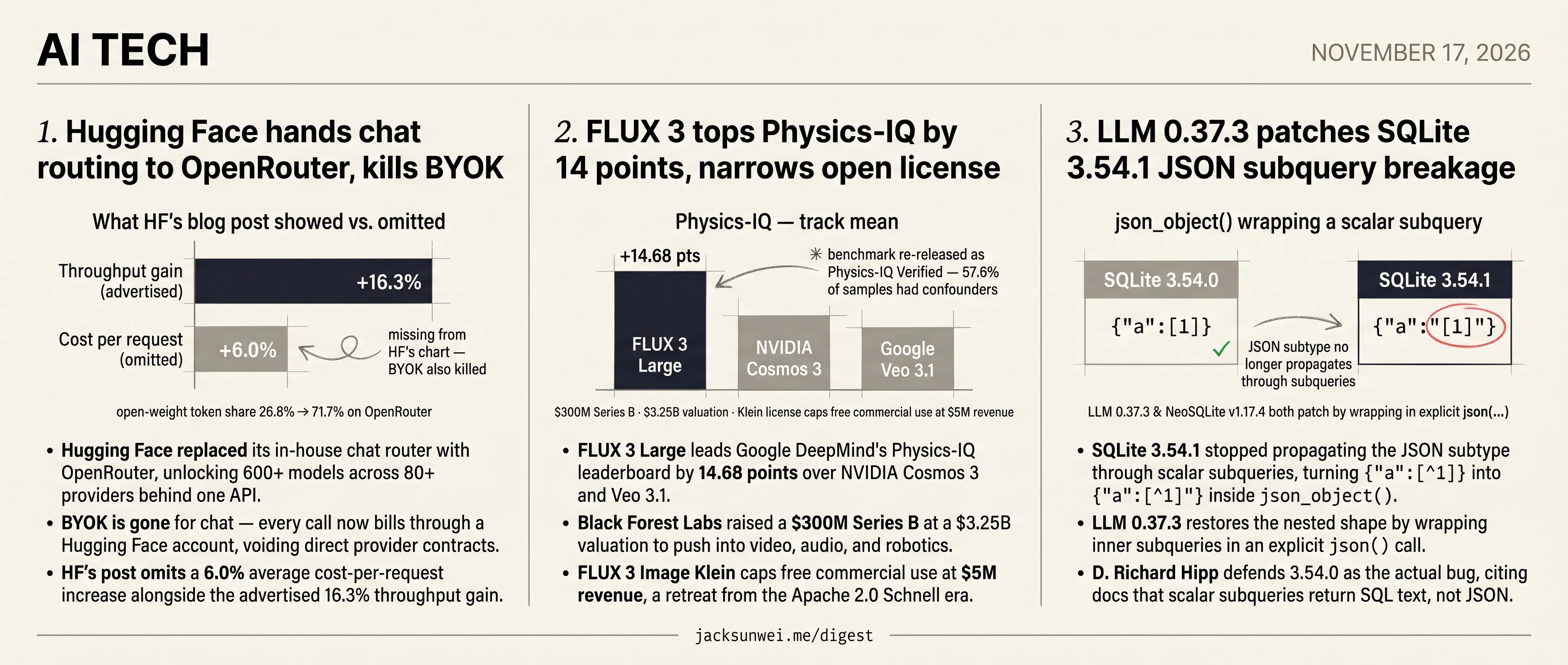
Hugging Face outsources routing, FLUX 3 caps license, LLM patches SQLite
Three releases pick three stances on dependency: Hugging Face outsources routing, FLUX 3 tightens its license, LLM patches around SQLite.
Hugging Face outsources routing, FLUX 3 caps license, LLM patches SQLite
TL;DR
- Hugging Face swapped its chat router for OpenRouter, killing BYOK and billing every call through HF.
- FLUX 3 Large leads Physics-IQ by 14.68 points over NVIDIA Cosmos 3 and Veo 3.1.
- FLUX 3 Image Klein caps free commercial use at $5M revenue, retreating from Apache 2.0.
- LLM 0.37.3 restores JSON subtype propagation after a SQLite 3.54.1 scalar-subquery regression.
- Go Proverbs resurface on Hacker News, led by a little copying beats a little dependency.
Today’s AI tech releases pick three different stances on the same question: how much of your stack do you let someone else own? Hugging Face takes the maximalist answer — it tears out its in-house chat router, hands the job to OpenRouter, and kills BYOK in the trade, so every call now bills through an HF account against direct provider contracts. Black Forest Labs takes the opposite tack: a leaderboard win on Google DeepMind’s Physics-IQ and a $300M Series B arrive alongside a narrower license that caps free commercial use at $5M revenue — a retreat from the Apache 2.0 Schnell era. And LLM 0.37.3 shows the cost of the question when the vendor makes the choice for you, patching around a SQLite 3.54.1 JSON subtype regression that D. Richard Hipp is defending as spec-correct. The Go Proverbs brief landing in today’s round-up — a little copying beats a little dependency — is almost on the nose.
Hugging Face hands chat routing to OpenRouter, kills BYOK
Source: huggingface-blog · published 2026-11-16
TL;DR
- Hugging Face replaced its in-house chat router with OpenRouter, unlocking 600+ models across 80+ providers behind one API.
- BYOK is gone for chat — every call now bills through a Hugging Face account, voiding direct provider contracts.
- HF’s post omits a 6.0% average cost-per-request increase alongside the advertised 16.3% throughput gain.
- Open-weight token share on OpenRouter jumped from 26.8% to 71.7% in a year, led by Chinese labs.
What actually changed
Hugging Face swapped its internal routing layer for OpenRouter’s, giving its users a single endpoint that picks a provider per request based on live latency, price, and reliability signals. HF reports a 46% drop in capacity errors, 16.9% faster time-to-first-token, and 16.3% higher throughput, plus cache-aware routing via an X-HF-Session-Id header and :fastest / :cheapest / :provider suffixes for manual control.
That’s the clean version. The breaking change the blog post soft-pedals: Bring-Your-Own-Key for chat routes is dead. Every chat inference call now bills through a Hugging Face account, invalidating direct enterprise contracts developers held with upstream providers 1. Superpower Daily also flags a number missing from HF’s chart — the 16.3% throughput gain came with a 6.0% average cost-per-request increase 1.
Practitioners on Hacker News are blunter. One widely circulated anecdote claims $100 of direct-provider credit lasted a week, while the same $100 on OpenRouter was exhausted in two days 2. The aggregator layer can also silently cap context windows — a model advertised at 128k may be served at 12k by whichever backend wins the auction — and some providers ignore seeds, which quietly breaks reproducibility 2.
The growth chart needs an asterisk
The 26.8% → 71.7% open-weight token share is real but not representative. Thaki Cloud’s read is that OpenRouter structurally over-indexes on cost-sensitive, multi-sourcing developers and under-counts enterprises locked into direct multi-year deals with OpenAI or Google 3. Proprietary labs still dominate revenue even where they’re losing token volume.
The causal mechanism sits underneath: ReadSignal estimates ~76% of OpenRouter traffic is now agentic, and Chinese labs — DeepSeek, MiniMax, Qwen — jumped from under 2% to over 60% of volume in a year 4. The open-weights surge is really an agent-economy surge, and agents pick whatever is cheapest per token at acceptable quality. That’s the context for HF’s DeepSeek V4.1 Flash leaderboard flex and the Kimi K3.1 Pro vs. Claude Fable 5.2 pitch (46 vs. 65 on Intelligence Index, at roughly one-seventh the per-task cost).
The plumbing layer is consolidating
This deal doesn’t land in a vacuum. Stripe acquired OpenRouter for roughly $8B in August 2026, and Nvidia’s $12.9B bid for Hugging Face is under DOJ antitrust review 5. The “neutral” router HF just handed its chat traffic to is now a Stripe subsidiary feeding usage telemetry to a soon-to-be Nvidia-owned hub. Competing gateways are repositioning: LiteLLM leads on breadth (53k+ GitHub stars) but adds >50ms per request, Kong markets an 859% throughput edge, and Portkey leans on governance 6.
HF’s move is less a partnership than a concession: the chat-routing layer isn’t worth building in-house when two or three players are about to own it anyway. The open question for developers isn’t whether open weights win — it’s whether the pipe they flow through stays priced like a commodity once the rollup finishes.
FLUX 3 tops Physics-IQ by 14 points, narrows open license
Source: latent-space · published 2026-11-16
TL;DR
- FLUX 3 Large leads Google DeepMind’s Physics-IQ leaderboard by 14.68 points over NVIDIA Cosmos 3 and Veo 3.1.
- Black Forest Labs raised a $300M Series B at a $3.25B valuation to push into video, audio, and robotics.
- FLUX 3 Image Klein caps free commercial use at $5M revenue, a retreat from the Apache 2.0 Schnell era.
- A 2026 audit found FLUX-derived LoRAs generate sexualized deepfakes in under 15 minutes on consumer hardware.
The pitch: pixels, motion, sound as one signal
In Latent Space’s conversation with Andreas Blattmann (co-inventor of Latent Diffusion) and Dustin Podell (lead author of SDXL), Black Forest Labs frames FLUX 3 as a bet that “visual intelligence” — an implicit grasp of trajectory, contact, and 3D permanence — falls out of training on pixels, motion, and sound jointly rather than bolting modalities together after the fact. The ball-tossing analogy does real work: humans catch without solving kinematics, and BFL wants models that generate contact sounds synchronized to visual impact for the same reason.
The architectural claims are concrete. A shared backbone powers both generation and upscaling, which BFL credits for killing the “shimmering” artifacts that plague independently-upscaled video frames. Camera pans force the model to “owe” the viewer a consistent back-of-head, pressuring it toward spatial permanence instead of 2D frame prediction. And FLUX Kontext — the editing variant — learns from a small curated set of relational captions (“dog wearing a hat”) to make local edits without degrading the rest of the image.
The benchmarks back the thesis — mostly
The headline numbers are real. FLUX 3 Large sits atop Physics-IQ with a 14.68-point lead over NVIDIA Cosmos 3 and Google Veo 3.1 7. More striking: the 7B FLUX 3 Action outscores the 16B Cosmos 3 Nano on RoboLab-120 (42.9% vs. 36.8%) while running up to 3.95× faster in FP8, and BFL reports that video pretraining accounts for over 95% of the robotics model’s intelligence 8 — a direct vindication of the “pixels teach physics” story.
The asterisks are substantial. Physics-IQ was quietly re-released as “Physics-IQ Verified” after an audit found 57.6% of samples and 34.8% of prompts contained confounding factors, and the reference-based scoring penalizes physically plausible continuations that simply diverge from the one recorded ground truth 9. Runway’s 27B MoE “Praxis-1” has reportedly already pushed past FLUX 3 Action on RoboLab-120 at 46.2% 8, so the parameter-efficiency lead is live but contested.
The “open” retreat the interview skips
The $300M Series B co-led by Salesforce Ventures and AMP values BFL at $3.25B and funds the video/audio/world-action expansion 10. It also helps explain the licensing shift the founders don’t dwell on: FLUX 3 Image Klein ships under a tiered license that caps free commercial use at $5M annual revenue, a sharp departure from the Apache 2.0 Schnell models 11. The same terms bind FLUX 3 Action, pushing larger robotics labs onto paid enterprise agreements. Community reaction on r/StableDiffusion has been pointed — developers accuse BFL of using open-source goodwill as a funnel to a proprietary API 11.
The safety gap at the LoRA layer
BFL’s red-teaming numbers describe the base model. The ecosystem tells a different story: a 2026 AI Forensics audit found 7 of 9 top image-editing tools could produce sexualized deepfakes from a single prompt, with 95% of targets being women, and named FLUX as a primary engine for sub-15-minute LoRA-based deepfakes on consumer hardware 12. Base-model safety eval and fine-tune-layer reality are not the same number, and the interview does not acknowledge the gap.
The technical case for learning physics from pixels is holding up on the leaderboards BFL chose to compete on. The “open” and “safe” framings are doing more work than the evidence supports.
LLM 0.37.3 patches SQLite 3.54.1 JSON subquery breakage
Source: simon-willison · published 2026-11-16
TL;DR
- SQLite 3.54.1 stopped propagating the JSON subtype through scalar subqueries, turning
{"a":[^13]}into{"a":"[^13]"}insidejson_object(). - LLM 0.37.3 restores the nested shape by wrapping inner subqueries in an explicit
json()call. - D. Richard Hipp defends 3.54.0 as the actual bug, citing docs that scalar subqueries return SQL text, not JSON.
- NeoSQLite v1.17.4 shipped the identical mitigation, confirming the breakage reaches well beyond LLM.
A one-line patch with an ecosystem behind it
On the surface, LLM 0.37.3 is a Homebrew-driven bug-fix release: the newly bottled SQLite 3.54.1 broke llm logs, and Simon shipped a patch the same week. The actual story is upstream. SQLite 3.54.1 landed October 16, 2026 primarily as a security release — a 32-bit heap buffer overflow and CVE-2026-119376 stack exhaustion via chained COLLATE operators 13 — which means pinning to 3.54.0 isn’t a realistic workaround. The JSON subtype change rode along as a correctness fix, and downstream projects had to absorb it.
The failure mode in LLM was ugly. llm logs crashed with AttributeError: 'str' object has no attribute 'get', but only on legacy rows containing tool-call results with attachments. CI never flagged it because the CI Python was linked against an older SQLite that still carried the JSON subtype through scalar subqueries 14. Classic silent-breakage shape: new behavior, no error raised, only historical data triggers the crash.
What actually changed
In 3.54.0, this query:
select json_object('a', (select json_array(1)))returned {"a":[^13]}. In 3.54.1, it returns {"a":"[^13]"} — the inner array is now an escaped string literal rather than a nested structure. D. Richard Hipp’s defense on the SQLite forum is unambiguous: scalar subqueries are documented to return SQL text, and the previous behavior was the byte-code generator failing to sanitize subquery outputs. “3.54.1 behavior is correct and 3.54.0 was a bug.” 15
Forum reaction was less unanimous. Developers pushed back that behavior consistent for years being quietly removed in a point release constitutes a breaking change regardless of what the docs technically say 16. This is a recurring SQLite tension between strict spec adherence and de facto API stability, and this round landed hard on the strict side.
LLM isn’t the only casualty
NeoSQLite shipped v1.17.4 flagging a “critical correctness regression” where $push and $pull array updates produced double-encoded, stringified JSON for the same root cause 17. The pattern is uniform: anywhere a json_object(...) or json_group_array(...) wraps a scalar subquery, the inner value now arrives as an escaped string, silently.
The mitigation is also uniform. Wrap the inner subquery in an explicit json():
select json_object('a', json((select json_array(1))))This re-tags the text with the JSON subtype in the outer context and is backward-compatible to older SQLite versions, so no version gating is needed 18. Simon also moved LLM’s CI to build SQLite from upstream tags rather than trust the system library — a worthwhile generalization for any project with SQLite JSON in its query path.
Takeaway
The practical lesson for anyone running a SQLite-backed logging or document store isn’t “upgrade llm.” It’s “grep your codebase for json_object and json_group_array wrapping a SELECT, and wrap those subqueries now — before Homebrew does it for you.”
Round-ups
Go Proverbs resurface: “a little copying beats a little dependency”
Source: simon-willison
The Go Proverbs collection is making the rounds again on Hacker News, led by its most-quoted line favoring duplication over premature abstraction. The aphorisms, originally compiled by Rob Pike, remain a compact style guide for engineers weighing dependency sprawl against a few copied lines.
Footnotes
-
Superpower Daily — https://superpowerdaily.com/posts/hugging-face-switches-ai-routing-to-openrouter-ending-custom-keys-for-chat
↩ ↩2Users can no longer ‘bring their own’ API keys for specific inference providers; instead, all billing is consolidated through Hugging Face accounts… the 16.3% increase in throughput came with a 6.0% average increase in cost per request.
-
Hermes AI (HN-aggregated commentary) — https://hermes-ai.net/news/hugging-face-drops-its-chat-router-and-hands-control-to-openrouter/
↩ ↩2Providers may silently ignore seeds or cap context windows at 12k tokens even when the base model supports 128k… one Hacker News comment noted that $100 spent directly with a provider lasted a week, whereas the same budget on OpenRouter was exhausted in two days.
-
Thaki Cloud analysis — https://thakicloud.com/tech-blog/en/news/openrouter-china-model-share-vendor-neutral/
↩OpenRouter naturally attracts a specific subset of the AI ecosystem: developers seeking to avoid vendor lock-in or those prioritizing cost-sensitive, automated workloads… significantly under-representing enterprises on direct, multi-year contracts with single providers like OpenAI or Google.
-
ReadSignal market report — https://www.readsignal.io/article/chinese-open-weight-models-openrouter-token-dominance-2026
↩Labs such as DeepSeek, MiniMax, and Qwen collectively captured over 60% of OpenRouter’s total token volume by July 2026, a massive leap from less than 2% a year prior… autonomous agents now consume an estimated 76% of all tokens on OpenRouter.
-
BigGo finance dossier — https://finance.biggo.com/influencer/clement-delangue/dossier
↩Stripe’s acquisition of OpenRouter for approximately $8 billion in August 2026… Nvidia’s $12.9 billion agreement to buy Hugging Face, currently under DOJ antitrust review.
-
Lyzr AI gateway comparison — https://www.lyzr.ai/blog/best-llm-gateways-feature-comparison/
↩Kong is 228% faster than Portkey and 859% faster than LiteLLM… LiteLLM leads in community adoption with 53,000+ GitHub stars but is noted for higher latency overhead (often >50ms per request).
-
AlphaSignal — https://alphasignal.ai/news/black-forest-labs-flux-3-beats-sora-2-and-veo-3-1-on-physics
↩FLUX 3 [Large] currently holds the top position on Google DeepMind’s Physics-IQ leaderboard… leading the track mean by 14.68 percentage points, notably outperforming NVIDIA’s Cosmos 3 and Google’s Veo 3.1.
-
Hugging Face blog — FLUX 3 Action — https://huggingface.co/blog/black-forest-labs/flux-3-action
↩ ↩2BFL’s 7B model outscored the 16B Cosmos 3 Nano on the RoboLab-120 benchmark (42.9% vs. 36.8%), running up to 3.95x faster in FP8… video pretraining accounts for over 95% of the model’s intelligence.
-
Physics-IQ Verified project site — https://physics-iq.github.io/
↩An audit revealed that 57.6% of the original samples and 34.8% of the prompts contained confounding factors or lacked sufficient conditioning… metrics may penalize a model for generating a physically plausible continuation simply because it does not match the specific recorded outcome.
-
TechCrunch — https://techcrunch.com/2025/12/01/black-forest-labs-raises-300m-at-3-25b-valuation/
↩Black Forest Labs secured $300 million in Series B funding, co-led by Salesforce Ventures and AMP, which valued the company at $3.25 billion.
-
r/StableDiffusion thread on FLUX license — https://www.reddit.com/r/StableDiffusion/comments/1llywl4/flux_dev_license_clarification_confirmed/
↩ ↩2FLUX 3 Image Klein is released under a tiered ‘open weights’ license that limits free commercial use to individuals and companies with less than $5 million in annual revenue… a departure from the ‘democratization’ mission originally promised by BFL.
-
Engadget / AI Forensics audit — https://www.engadget.com/2224899/hugging-face-reportedly-plagued-with-deepfakes/
↩Seven out of nine top image-editing tools could generate sexualized deepfakes from a single prompt, with 95% of targets being women… FLUX is identified as a primary engine for accessible deepfake generation via LoRA, allowing highly realistic replicas in under 15 minutes on consumer hardware.
-
SQLite 3.54.1 release notes (sqlite.org) — https://www.sqlite.org/releaselog/3_54_1.html
↩3.54.1 shipped October 16, 2026 primarily as a security/correctness patch — fixing a heap buffer overflow on 32-bit builds and CVE-2026-119376 (stack exhaustion via chained COLLATE), alongside the subquery-subtype correction.
-
GitHub simonw/llm issue #1879 — https://github.com/simonw/llm/issues/1879
↩The bug surfaces as an AttributeError: ‘str’ object has no attribute ‘get’ when llm logs encounters legacy tool results with attachments; CI missed it because the CI Python was linked against an older SQLite that still carried the JSON subtype through scalar subqueries.
-
D. Richard Hipp, SQLite forum post — https://sqlite.org/forum/forumpost/fa6f64e3dc1a5d97
↩Per the documentation, (SELECT json_array(…)) returns SQL text, not JSON. Hence the 3.54.1 behavior is correct and 3.54.0 was a bug… the byte-code generator was failing to properly sanitize subquery outputs.
-
SQLite forum thread (forumpost/8687d4ad36b14ce9) — https://sqlite.org/forum/forumpost/8687d4ad36b14ce9
↩Affected developers argued that since subtype propagation had been consistent for years, its sudden removal constitutes a major breaking change — a split between those viewing it as necessary hardening and those seeing it as disruption to established JSON patterns.
-
NeoSQLite v1.17.4 release notes (GitHub) — https://github.com/cwt/neosqlite/blob/main/documents/releases/v1.17.4.md
↩Critical correctness regression: complex array updates ($push, $pull) were generating stringified, double-encoded JSON because SQLite 3.54.1 no longer recognizes subquery results as valid JSON structures.
-
Simon Willison TIL — subqueries in SELECT — https://til.simonwillison.net/sqlite/subqueries-in-select
↩The workaround is to wrap the subquery in an explicit json() call: select json_object(‘a’, json((select json_array(1)))) — this re-tags the text with the JSON subtype in the outer context.