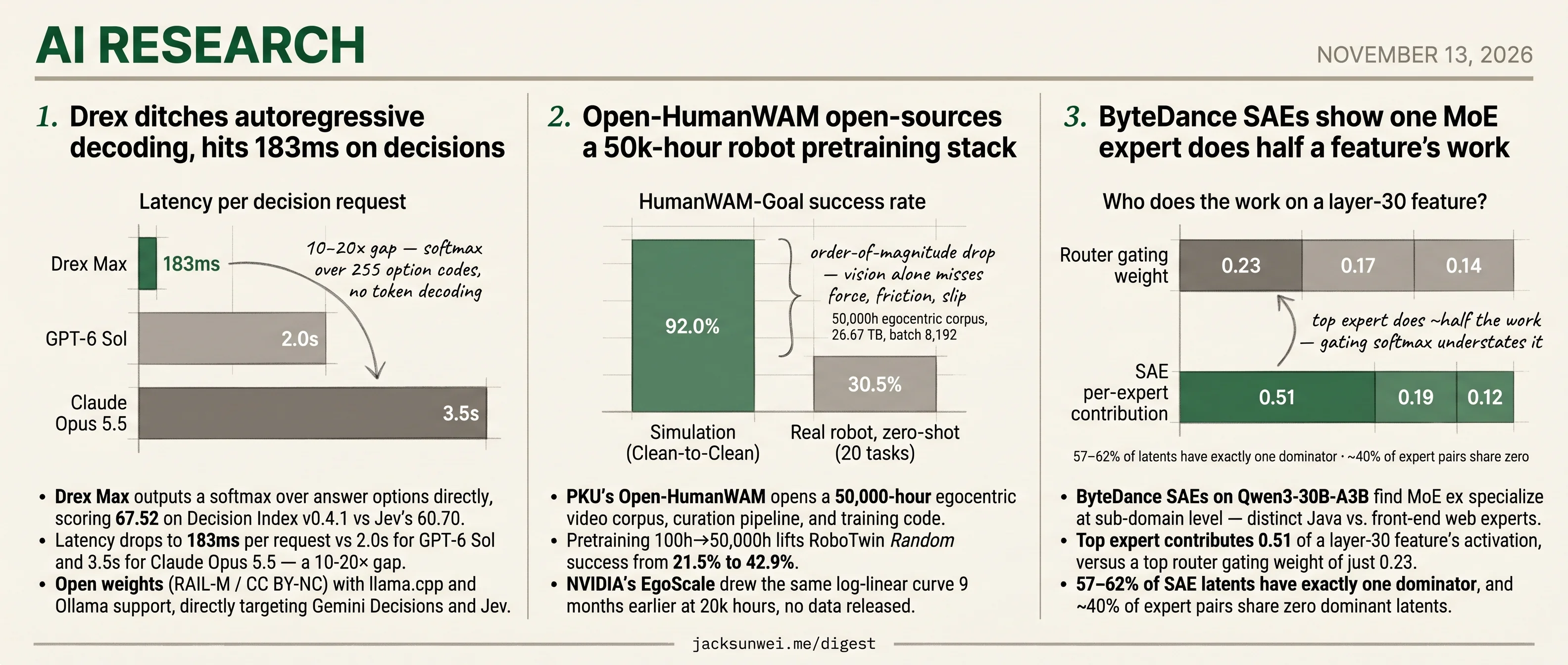
Drex drops decoding, PKU opens 50k robot hours, ByteDance SAEs beat routers
Drex replaces autoregressive decoding, PKU open-sources the 50k-hour robot corpus NVIDIA kept private, and ByteDance SAEs find MoE experts dominate more than routers show.
Drex drops decoding, PKU opens 50k robot hours, ByteDance SAEs beat routers
TL;DR
- Drex Max direct-softmax decoding scores 67.52 on Decision Index at 183ms per request.
- PKU’s Open-HumanWAM releases 50,000 hours of egocentric video plus curation and training code.
- Open-HumanWAM lifts RoboTwin Random from 21.5% to 42.9% as pretraining scales 500×.
- ByteDance SAEs on Qwen3-30B-A3B find one expert contributes 0.51 of a feature versus the router’s 0.23.
- OpenFrontiers finds live-web LLM science gains mostly trace to retrieving published solutions.
Today’s three research wins each show a default mechanism was understating what lies underneath it. Drex Max throws out autoregressive decoding for a direct softmax over answer options and scores 67.52 on Decision Index at 183ms — 10–20× faster than GPT-6 Sol and Claude Opus 5.5, with no quality tax except under quantization. PKU’s Open-HumanWAM opens the 50,000-hour egocentric corpus and training stack NVIDIA kept private nine months ago, redrawing the same log-linear scaling curve in public. ByteDance’s SAE study on Qwen3-30B-A3B finds a single MoE expert contributes 0.51 of a layer-30 feature versus a router gating weight of just 0.23 — the router’s own number was understating specialization all along.
In the round-ups, OpenFrontiers finds live-web LLM rediscovery gains trace mostly to retrieving published solutions, and a separate paper shows pretraining random seeds — not data recipes — fingerprint which jailbreaks work. Two robotics briefs (DreamFree, HeLM) and an agent-efficiency pair (latent context compression, SwarmEvolve) round out the day.
Drex ditches autoregressive decoding, hits 183ms on decisions
Source: hf-daily-papers · published 2026-11-04
TL;DR
- Drex Max outputs a softmax over answer options directly, scoring 67.52 on Decision Index v0.4.1 vs Jev’s 60.70.
- Latency drops to 183ms per request vs 2.0s for GPT-6 Sol and 3.5s for Claude Opus 5.5 — a 10-20× gap.
- Open weights (RAIL-M / CC BY-NC) with llama.cpp and Ollama support, directly targeting Gemini Decisions and Jev.
- Independent testers warn quantization destroys calibration on decision tasks in ways it doesn’t for coding or prose.
The architecture bet
Drex is a family of four open decision models from Nace.AI that treat classification as a first-class output, not a side effect of text generation. Instead of decoding tokens, the flagship 27B Drex Max encodes the full context with non-causal attention and reads out a vector of 255 logits — one per option code (A, B, C…) — through a bias-free linear head. The smaller “pointer” variants (an 8B diffusion LM, a 9B Gated DeltaNet hybrid, and a 35B/3B-active MoE) cache the context once and score each option via dot products against a query vector emitted at a <decide> token.
The training recipe is where the real work happens: SFT with consistency losses that penalize distribution shifts under option permutation, followed by Reinforcement Learning from Adjusted Feedback (RLAF), which blends verified ground-truth rewards with a judge model’s probability assignments. Ablations credit RLAF with +2.0 points on Decision Index and the consistency losses with cutting the option-reorder flip rate from 6.3% to 4.2%.
Numbers that mostly hold up
Artificial Analysis’s independent Decision Index v2 corroborates the leaderboard story: Drex Max v1.1 posts a 73, narrowly ahead of Fastino’s GLiDE and Mammoth, with the benchmark explicitly weighting calibration alongside correctness 1. The latency claim also survives contact with the field — Google’s Gemini Decisions API clocks 150-250ms end-to-end at $0.10/M input tokens with free outputs 2, and Jev 1.13 posts a 290ms median on the independent “jevman” Pac-Man probe 3. Drex isn’t uniquely fast; it’s competitive in a crowded fast-decision category, and its structural differentiator is open weights, not raw throughput.
The dissent is sharper than the paper admits
Several practitioners question whether modifying a 27B LLM torso is even the right substrate. Commentary summarized by Towards Data Science argues that dedicated bidirectional encoders — ModernBERT or linear heads over static embeddings — hit sub-20ms latency with better stability for narrow classification, roughly a 10× speedup over Drex Max for the tasks that matter in production 4. Head-to-head on IMDb sentiment, fine-tuned ModernBERT reaches ~95% vs Jev’s ~96.5%; the real gap is Jev’s RLCD calibration (ECE ~0.028), not the backbone 5.
If the load-bearing contribution is RLAF-style calibration training, then the dense 27B readout model is doing less work than the paper’s framing suggests.
The deployment story has a second footgun. Community notes on Vals.ai warn that Q8-vs-BF16 quality gaps are materially larger for decision tasks than for coding or prose, because quantization preserves argmax rank but not the precise probability mass that calibration depends on 6. Combined with the paper’s own 4.2% option-reorder flip rate, Drex Max in a cheap local Q4 configuration likely loses much of the calibration edge that justifies the architecture in the first place.
What’s actually at stake
Drex is the clearest open-weights entry yet in the “foundation decision model” category Gemini Decisions and Jev have been defining commercially. The leaderboard numbers are real. But the interesting question the paper dodges is whether the readout architecture matters once you’ve invented RLAF — and whether anyone deploying locally at Q4 will see the calibration that the benchmarks reward.
Open-HumanWAM open-sources a 50k-hour robot pretraining stack
Source: hf-daily-papers · published 2026-11-09
TL;DR
- PKU’s Open-HumanWAM opens a 50,000-hour egocentric video corpus, curation pipeline, and training code.
- Pretraining 100h→50,000h lifts RoboTwin Random success from 21.5% to 42.9%.
- NVIDIA’s EgoScale drew the same log-linear curve 9 months earlier at 20k hours, no data released.
- Real-robot zero-shot hits only 30.5% vs. the headline 92% in simulation.
The contribution is the stack, not the curve
Open-HumanWAM’s headline claim — that robot success scales log-linearly with hours of egocentric human video pretraining — is not new. NVIDIA’s EgoScale established the same regime in February 2026 on 20,854 hours of MANUS-glove capture, with an R²=0.9983 fit and a 54% average lift over no-pretraining baselines on 22-DoF dexterous hands 7. PKU’s team pushes the horizon 2.5× further to 50k hours but narrows the action space to a 16-D bimanual end-effector representation and explicitly drops locomotion 8.
What’s actually new is the release. EgoScale kept its corpus private; Open-HumanWAM ships the 50k-hour Open-HumanScale-50K dataset, curation pipeline, training recipe, and HumanWAM-Vanilla/Goal checkpoints under one repo 8. That makes this the first open counterpart to a scaling-law result that was previously only reproducible inside a well-funded industrial lab.
The numbers, and where they soften
The scaling evidence is clean inside the sim. On RoboTwin 2.0’s Scene-OOD split, Isolated-Attention success grew from 25.2% at 100h to 58.1% at 10,000h; the IDM variant went from 21.5% to 42.9% on the harder Random split at 50k. HumanWAM-Goal hits 92.70% on Clean-to-Clean and 84.60% on Clean-to-Random. Pretrained models reach higher success with 5 demonstrations than non-pretrained models reach with 50 — the sample-efficiency story is the most practically useful finding in the paper.
Real robots tell a quieter story. Adding 45.9k hours of human data to a fixed robot dataset moved zero-shot success across 20 real-world tasks from 20.0% to 30.5%. That’s a real gain, but it sits an order of magnitude below the sim scores. The RoboTwin-Phys extension, from the same conference cycle, found that leading models “degrade markedly” when mass, friction, and joint damping are varied — current SOTA is “visually robust but physically fragile” 9. A broader human-to-robot transfer survey makes the mechanism explicit:
Vision alone fails to capture contact details such as force, friction, and slip; policies become entangled with human-specific visual features like skin tone or clothing rather than task-relevant interactions. 10
The reproducibility tax
The “fully open recipe” framing deserves an asterisk. The corpus is 26.67 TB, and the 50k-hour recipe uses batch size 8,192 — a scale very few academic labs can actually retrain 11. Naming is inconsistent across surfaces (open-humanscale on GitHub, open-humanwam on Hugging Face, HumanWAM in checkpoints), which breaks automated pipelines 11. The Wan2.2-TI2V-5B backbone is the genuinely accessible piece: Apache 2.0, ~16 GB VRAM for 720p inference on an RTX 4090 12. So the realistic downstream use isn’t scaling-law replication — it’s fine-tuning the released checkpoints on your own robot.
What this leaves open
Log-linear scaling on egocentric video is now a confirmed regime with two independent data points. The hard problems the paper doesn’t touch — physics generalization, contact-rich force modeling, bimanual-to-dexterous transfer, and whole-body locomotion — are the ones the next recipe has to solve.
ByteDance SAEs show one MoE expert does half a feature’s work
Source: hf-daily-papers · published 2026-11-05
TL;DR
- ByteDance SAEs on Qwen3-30B-A3B find MoE experts specialize at sub-domain level — distinct Java vs. front-end web experts.
- Top expert contributes 0.51 of a layer-30 feature’s activation, versus a top router gating weight of just 0.23.
- 57–62% of SAE latents have exactly one dominator, and ~40% of expert pairs share zero dominant latents.
- RouterInterp independently hits 81% recall predicting expert selection from SAE features on gpt-oss-20b, corroborating the specialization story.
What the paper actually measures
The clever move is an exact decomposition. Because an MoE layer output is a weighted sum of expert outputs and an SAE encoder is affine, the activation of any SAE latent splits into per-expert contributions with no approximation. ByteDance trains SAEs with 2²⁰ latents and TopK=100 on layers 4, 30, and 46 of Qwen3-30B-A3B (128 experts, top-8 routing), then defines an expert’s “dominant set” as the latents where it contributes more than 20% of activation.
The resulting bipartite graph is strikingly sparse. Median Jaccard overlap between expert dominant sets sits near 10⁻⁴, and roughly 40% of expert pairs share zero dominant latents. GPT-5.5-generated labels recover themes like “Java syntax” or “front-end HTML/CSS” for individual experts, and when asked whether sampled latents match an expert’s assigned theme, agreement hits 86.7% for the Java expert versus 1.9–6.7% for random latents from other experts.
The headline reframe: router gating weights systematically understate how concentrated expert work actually is. If you only looked at gating softmax, you’d think the top three experts split work 0.23/0.17/0.14. The SAE-based contribution says 0.51/0.19/0.12 — one expert often does the majority of a feature’s computation.
Convergent evidence, but two live debates
The specialization claim doesn’t rest on one lab. RouterInterp attacks the same question from the router-input side and finds SAE features linearly predict expert selection with 65–77% higher accuracy than n-gram baselines, reaching 81% recall on gpt-oss-20b 13. Two methods, opposite ends of the layer, same anti-”one-expert-per-domain” conclusion.
What the symmetric dominance picture misses is structural asymmetry. Separate work on Qwen3-30B-A3B shows that pruning just 3 of 6,144 experts causes a ~93% collapse in reasoning performance by destroying attention sinks 14. These “Super Experts” act through residual-stream outliers that SAE dominance graphs are poorly positioned to surface.
Routing is an emergent property of the model’s hidden state geometry rather than a functional domain division.
That dissent, from a buildfastwithai explainer arguing deep-layer experts show near-identical activation patterns on semantically unrelated inputs 15, is a direct challenge to reading dominant-latent clusters as evidence of functional expertise rather than geometric clustering.
The SAE-as-ground-truth problem
The bigger methodological risk is feature absorption. NeurIPS 2025 work shows the SAE sparsity objective itself incentivizes granular latents to absorb general feature directions, producing latents that look clean on activating contexts but fail on valid inputs the SAE never sees fire 16. ByteDance’s auto-interpretation pipeline — GPT-5.5 labeling from activating contexts — is exactly the regime where absorbed features look crisp but are pathological. Feature splitting is acknowledged as a caveat; absorption is not quantified. MoE-X goes further, arguing intrinsically-sparse routing architectures beat post-hoc SAEs on interpretability 17, which would make part of ByteDance’s result an artifact of Qwen3’s design.
One operational footnote: an accidentally committed upload.py exposed internal ByteDance storage paths before the community flagged it 18. The SAEs and analysis code are now public on GitHub.
Round-ups
OpenFrontiers benchmark shows LLMs rediscover little without retrieval
Source: hf-daily-papers
OpenFrontiers pairs a corpus of open research problems with a graded benchmark of solved mathematics to test scientific rediscovery by LLM agents. Closed-book performance is weak, and live-web gains trace mostly to agents retrieving the published solutions rather than reasoning them out.
Pretraining seeds, not data, decide which jailbreaks work
Source: hf-daily-papers
Identically trained language models break on different prompts depending on their pretraining random seed, a study finds. The seeds leave identifiable fingerprints in non-refusal rates that survive safety post-training, meaning jailbreak vulnerability traces back to pretraining randomness rather than data recipe choices.
Latent context compression cuts agent tool-call token overhead
Source: hf-daily-papers
Rather than feeding tool observations back as text, this method compresses them into continuous latent tokens in the input embedding space. Action-Preserving Training keeps next-action distributions intact, cutting token use and runtime for web-search agents while lifting task success over text summarization baselines.
DreamFree turns a 14B video diffusion model into a robot encoder
Source: hf-daily-papers
Instead of generating future frames, DreamFree distills a frozen 14B video diffusion backbone into a predictive visual encoder paired with an action module. The approach skips iterative denoising to enable real-time closed-loop control while keeping the video prior’s grounding for manipulation.
HeLM gives VLA robots written memory for long-horizon tasks
Source: hf-daily-papers
Vision-language-action models typically assume Markovian state, failing on tasks that need history. HeLM writes task-relevant events into explicit natural-language memory through factorized event detection and triggered updates, lifting non-Markovian manipulation success while using less memory and runtime than keyframe baselines.
SwarmEvolve runs hundreds of latent-space agents for evolutionary search
Source: hf-daily-papers
LLM-guided program search usually waits on long textual chains of thought each round. SwarmEvolve instead deploys hundreds of low-cost agents per round that reason in latent space without decoding, maintaining population diversity for math and code discovery at a fraction of the generation cost.
PLatour bridges frozen LLMs via prefill-to-autoregressive transfer
Source: hf-daily-papers
PLatour wires a prefill model into an autoregressive generator through zero-initialized linear bridges trained on task rewards, enabling large-small model collaboration without finetuning either side. A companion test, PACT-Check, isolates how much improvement comes from real sender signal versus receiver-only adaptation.
Footnotes
-
Artificial Analysis — Decision Index v2 — https://artificialanalysis.ai/articles/decision-index-v2
↩Drex Max v1.1 achieved a score of 73, narrowly leading competitors like GLiDE and Mammoth by rewarding both correctness and ‘calibrated confidence’.
-
apidog — Gemini Decisions API vs OpenAI Decisions API — https://apidog.com/blog/gemini-decisions-api-vs-openai-decisions-api/
↩Google bills only for input at $0.10 per million tokens, with zero charge for the structured decision outputs … end-to-end latency between 150 and 250 milliseconds, which remains relatively flat even as the number of questions increases.
-
GreenNode — What is Jev — https://greennode.ai/blog/what-is-jev
↩Jev is priced at roughly $0.042 per million input tokens with free output, while Drex Max is slightly higher at $0.06 per million … independent tests like the ‘jevman’ Pac-Man benchmark clocked Jev 1.13 at a median of 290 ms, compared to 179 ms for GPT-6 Luna.
-
Towards Data Science — Jev vs LLMs — https://towardsdatascience.com/jev-vs-llms-when-ai-moves-from-generation-to-decision-making/
↩Experts remain skeptical of using general-purpose LLM torsos for these tasks, arguing that for critical paths, a dedicated bidirectional encoder like ModernBERT or a tuned linear classifier on top of static embeddings often provides better stability and lower latency (sub-20ms) than a modified LLM.
-
daily.dev — Jev vs BERT — https://daily.dev/posts/jev-vs-bert-what-s-actually-different—9ngceslfr
↩Fine-tuned ModernBERT reaches ~95% accuracy, comparable to the closed-source Jev model (~96.5%) … Jev uses a proprietary RLCD method to achieve superior calibration (ECE ~0.028) compared to the raw ModernBERT baseline.
-
Vals.ai — decision_drex-max model page — https://www.vals.ai/models/decision_drex-max
↩Practitioners have noted that quantization (e.g., Q8 vs. BF16) significantly degrades decision accuracy compared to coding or prose tasks, as quantization preserves outcome rank but not the precise probabilities required for calibrated decisions.
-
NVIDIA GEAR Lab — EgoScale project page — https://research.nvidia.com/labs/gear/egoscale/
↩As egocentric human data increases from 1,000 to over 20,000 hours, model prediction error on human actions decreases log-linearly, directly correlating with real-world robotic performance; EgoScale demonstrated a 54% average improvement over no-pretraining baselines on 22-DoF dexterous hands.
-
Sharpa Research blog on EgoScale — https://www.sharpa.com/blogs/research/egoscale-20-000-hours-of-video-grow-a-robot-hand-opening-the-scaling-law-era-of-dexterous-manipulation
↩ ↩2EgoScale established the first ‘scaling law era’ for dexterous manipulation in February 2026 using MANUS gloves for high-fidelity finger articulation — nine months before Open-HumanWAM, which expanded the regime to 50,000 hours but with a lower-DoF bimanual action space that explicitly excludes locomotion.
-
RoboTwin-Phys extension (PMLR v306) — https://raw.githubusercontent.com/mlresearch/v306/main/assets/chen26j/chen26j.pdf
↩While leading models maintain high success rates under visual randomization, their performance degrades markedly when physical parameters — mass, friction, joint damping — are varied; current state-of-the-art models are visually robust but physically fragile.
-
Cornell eCommons survey on human-to-robot transfer — https://ecommons.cornell.edu/entities/publication/5a41a8c4-4602-40e9-ae07-631fb258259f
↩Vision alone fails to capture contact details such as force, friction, and slip; directly imitating human trajectories often results in infeasible behaviors, and policies become entangled with human-specific visual features like skin tone or clothing rather than task-relevant interactions.
-
ExplainX.ai technical review — https://explainx.ai/blog/open-humanscale-50k-humanwam-robotwin-egocentric-pku-2026
↩ ↩2Naming drift across platforms — the GitHub branch is ‘open-humanscale’, Hugging Face collections use ‘open-humanwam’, and internal checkpoints use a ‘HumanWAM’ prefix — complicates automated reproducibility, and the 26.67 TB corpus poses a ‘reproducibility tax’ very few academic labs can afford.
-
Hugging Face — Wan2.2-TI2V-5B model card — https://huggingface.co/Wan-AI/Wan2.2-TI2V-5B-Diffusers
↩Wan2.2-TI2V-5B is released under Apache 2.0 and runs 720p@24fps inference on a single RTX 4090 using ~16GB VRAM in bf16/FP8, though full-precision fine-tuning requires up to 40GB — making the backbone itself unusually accessible even if the 50k-hour pretraining is not.
-
RouterInterp (sparai.org preprint) — https://library.sparai.org/attachments/reports/recV8o9W90yz8KHHk/interpreting-mixture-of-experts-routing-through-sparse-autoencoders-z8khhk.pdf
↩RouterInterp… introduces the Superposed Specialisation Hypothesis… achieves 65–77% higher routing-detection accuracy than unigram/bigram baselines and reaches up to 81% recall predicting expert selection on gpt-oss-20b
-
emergent.sh — Super Experts analysis — https://emergent.sh/news/bytedance-saes-reveal-expert-specialization
↩Pruning as few as three out of 6,144 experts can trigger a catastrophic collapse… a 93% drop in reasoning task performance; these Super Experts induce attention sinks essential to Qwen3-30B-A3B’s structural stability
-
buildfastwithai — ‘Myth of Expert Specialization’ — https://blog.buildfastwithai.com/mixture-of-experts-moe-explained
↩Routing is an emergent property of the model’s hidden state geometry rather than a functional domain division… deeper layers often exhibit near-identical expert activation patterns even for semantically unrelated inputs
-
NeurIPS 2025 — Feature Absorption in SAEs — https://proceedings.neurips.cc/paper_files/paper/2025/hash/764ff7477b8e24dbe01531f6791e8bdf-Abstract-Conference.html
↩The SAE’s sparsity objective incentivizes ‘absorbing’ general feature directions into more granular latents, producing interpretability illusions where a feature appears monosemantic but fails to activate on valid inputs
-
MoE-X (arxiv 2503.07639) — https://arxiv.org/html/2503.07639v1
↩MoE-X proposes an intrinsically interpretable MoE architecture that redesigns routing to prioritize experts with high activation sparsity, reportedly achieving interpretability that surpasses standard SAE-based methods
-
aimodeling.com community report — https://www.aimodeling.com/en/news/slug/sae-interprets-moe-qwen3-expert-specialization
↩An accidentally published upload.py script contained ByteDance’s internal storage paths and checkpoint locations… community members advised the team to squash the repository history