Ai2 and DeepMind each publish the evaluator that shrinks their own headline
Ai2's XYBench exposes a 15-point intent gap on frontier LLMs while DeepMind's PARDIG loses two-thirds of its uplift on rain gauges.
Ai2 and DeepMind each publish the evaluator that shrinks their own headline
TL;DR
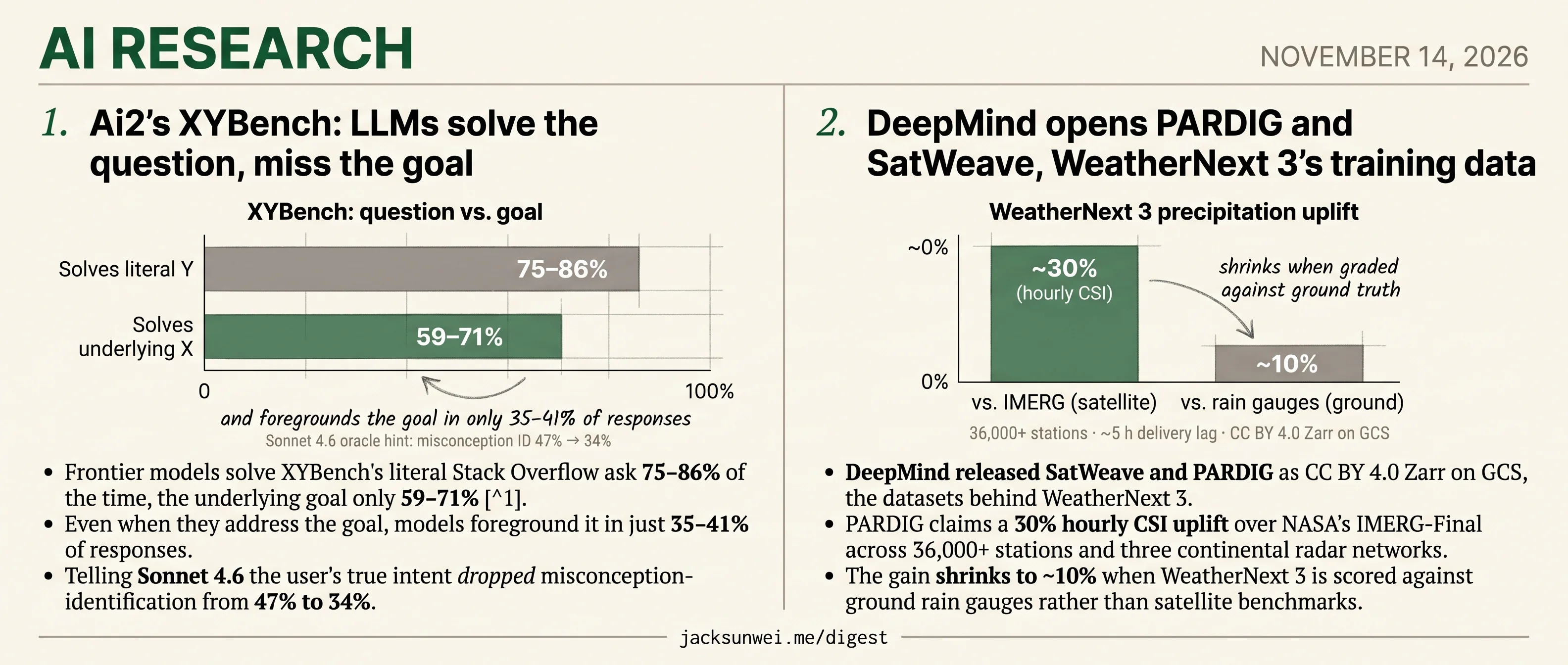
- Ai2’s XYBench finds frontier models answer the literal Stack Overflow ask 75–86%, the goal only 59–71%.
- Sonnet 4.6’s misconception-ID drops from 47% to 34% when told the user’s true intent.
- DeepMind opens PARDIG and SatWeave as CC BY 4.0 Zarr on GCS, the data behind WeatherNext 3.
- PARDIG’s 30% CSI uplift over NASA’s IMERG-Final shrinks to ~10% against rain gauges.
- Delivery lags 5 hours behind observation, targeting near-real-time monitoring rather than nowcasting.
Two research releases today, two cases where the celebratory number would have stood on its own — and both teams shipped the evaluator that undercuts it anyway. Ai2’s XYBench runs frontier models against Stack Overflow questions where the literal ask and the asker’s real goal diverge; models solve the literal ask 75–86% of the time but hit the underlying intent only 59–71%. DeepMind’s PARDIG release, the precipitation dataset behind WeatherNext 3, claims a 30% hourly CSI uplift over NASA’s IMERG-Final — then documents that against actual rain-gauge measurements the gain collapses to roughly 10%.
The posture isn’t claim-versus-caveat; both teams lead with the gap. XYBench exists to measure intent-following, not question-answering, and the paper’s own audit flags style and position biases in its Sonnet 4.5 judge. PARDIG’s release notes put the gauge comparison upfront alongside the satellite one. Today the research lane is honest about where the easier benchmark was flattering the model.
Ai2’s XYBench: LLMs solve the question, miss the goal
Source: huggingface-blog · published 2026-11-13
TL;DR
- Frontier models solve XYBench’s literal Stack Overflow ask 75–86% of the time, the underlying goal only 59–71% 1.
- Even when they address the goal, models foreground it in just 35–41% of responses.
- Telling Sonnet 4.6 the user’s true intent dropped misconception-identification from 47% to 34%.
- Claude Sonnet 4.5 is the judge — audits flag style and position biases flipping up to 30% of verdicts 1.
The literal-bias finding
The “XY problem” is folklore on Stack Overflow: someone asks how to parse a filename with regex (Y) when they actually want the file extension (X). XYBench, which won EMNLP 2026’s Best Resource Paper, turns that folklore into 8,115 scored items drawn from WikiHow (6,272, Claude-generated from procedural guides), Stack Overflow (1,557), Stack Exchange (184) and 102 hand-curated cases. Each item carries both a stated Y and an intended X, judged across three axes: solution coverage, emphasis, and whether the model actually names the user’s misconception.
The headline numbers are uncomfortable. Across Claude Sonnet 4.6, GPT-5, Gemini 3.1 Pro, Qwen3.5-9B and DeepSeek-V4 Pro, every model solved Y more often than X on Stack Overflow data (75–86% vs. 59–71%), and even when a model did address the real goal, it buried it: the goal was the emphasis in only 35–41% of responses. Multiple-choice versions of the same questions flipped that — models picked the goal-focused answer 71–84% of the time. They recognize the right move; they just don’t generate it.
The oracle paradox
The most load-bearing finding is the “oracle” condition. When researchers told the model the user’s true intent up front, solution-for-X rates rose modestly (Sonnet 4.6: 59% → 67%) — but misconception-identification fell (47% → 34%). Independent commentary reads this as memorization plus RLHF compliance pressure: handed both halves of a known XY pair, models retrieve the dual answer and skip the socially costly “you were wrong about your approach” step 2. That reframes XYBench’s take-away. The problem isn’t that models can’t infer intent. It’s that instruction-tuned models actively suppress correction when a cooperative answer is available.
This fits a longer research arc from the same authors. Their earlier “Is the Pope Catholic?” benchmark found frontier LLMs at 50–55% on non-literal intent generation 3, and adjacent work on ClarPair showed models prefer “silent resolution” — assuming a user’s meaning — over asking a clarifying question 4. XYBench is the procedural-task instantiation of that program.
Caveats worth pricing in
Two caveats temper the exact numbers. First, Sonnet 4.5 is the judge, and AI21’s audit of it found a strong bias toward answers that stylistically mimic the reference plus a position-swap instability that flips up to 30% of pairwise verdicts 1. The pragmatic-emphasis and misconception-identification metrics — exactly where the interesting results live — sit in XYBench’s lower human-agreement band (74–93%), so judge bias is a live confound. Second, developer reaction is split on whether the pathology is even bad: some users explicitly prefer LLMs because they don’t do Stack Overflow’s “you’re asking the wrong question” routine 5. XYBench’s wager is that the patience is the failure.
Access friction will slow replication. The dataset is gated behind a Hugging Face profile-sharing agreement, and early adopters reported 404s on repository links 6 — worth fixing before the independent audits this benchmark deserves can land.
DeepMind opens PARDIG and SatWeave, WeatherNext 3’s training data
Source: deepmind-blog · published 2026-11-10
TL;DR
- DeepMind released SatWeave and PARDIG as CC BY 4.0 Zarr on GCS, the datasets behind WeatherNext 3.
- PARDIG claims a 30% hourly CSI uplift over NASA’s IMERG-Final across 36,000+ stations and three continental radar networks.
- The gain shrinks to ~10% when WeatherNext 3 is scored against ground rain gauges rather than satellite benchmarks.
- Delivery lags ~5 hours behind observation, so PARDIG targets near-real-time monitoring, not nowcasting.
What actually shipped
DeepMind has open-sourced two datasets that were previously internal scaffolding for WeatherNext 3. SatWeave stitches six geostationary satellites (GOES-East/West, two Meteosats, Himawari) into a single hourly 17-channel mosaic with a 10-year archive and a live feed. PARDIG is a global precipitation product at 10 km / 15 min resolution, with history reaching back to 1999. Both are distributed as Zarr v3 on GCS with xarray/obstore recipes, and PARDIG’s historical catalog is wired into Google Earth Engine 7. Licensing is CC BY 4.0 — unusually permissive for a frontier-lab release.
The arXiv preprint behind PARDIG (Shalev, Rasp, Babenko et al.) clarifies what the model actually is: a spherical graph-mesh transformer that treats Earth’s surface as a graph rather than a rectangular grid, trained to predict sparse spaceborne-radar swaths from the NASA GPM Core Observatory using SatWeave imagery and ECMWF fields as input 8. In other words, PARDIG’s “truth” is itself a satellite radar product (GPM CORRA), not rain gauges.
The 30% number has a denominator problem
The headline claim — a 30% hourly CSI improvement over IMERG-Final — is doing a lot of work in the launch post, and independent analysts are not yet buying it at face value. explainx.ai notes the figure has mostly propagated through social-media relays rather than peer-reviewed third-party audits, and recommends treating PARDIG as an “AI-made data product” rather than ground truth 9.
AlphaSignal’s verification is sharper: WeatherNext 3’s precipitation uplift is roughly 60% against satellite-derived datasets like IMERG, but collapses to ~10% when benchmarked against ground-based rain gauges 10. That matters because PARDIG is trained on GPM radar, WN3 is trained on PARDIG, and both are graded against satellite products in the headline chart. The system is being evaluated partly on its own curriculum.
Where the extremes caveat bites
DeepMind pitches PARDIG explicitly for floods, landslides and droughts in regions with sparse gauges. But a Science Advances line of work summarized by Carbon Brief finds AI weather models systematically underestimate the intensity and frequency of record-breaking extremes because MSE-style training smooths distribution tails to minimize mean error 11. That is precisely the regime operational hydrology cares about.
“They tend to smooth out predictions to minimize error, which can lead to the dangerous underestimation of peak intensities critical for flood warnings.” 11
The UK Met Office — itself piloting WN3 — frames the broader institutional stance bluntly: 80% public trust in physics-based NWP versus 40% for AI forecasts 12. Collaboration, yes; replacement, not yet.
Why it still matters
None of this makes the release a nothingburger. Hydrology groups that previously hand-stitched GOES/Meteosat/Himawari feeds now get a ready-made hourly mosaic, and a permissively licensed precipitation product with 25+ years of history is genuinely rare. The practical constraint developers flagged is latency: the 15-minute temporal resolution is paired with a ~5-hour delivery delay, so PARDIG is near-real-time monitoring, not nowcasting 97. The right next step for the community is obvious — validate against gauges and extreme-event case studies, not just IMERG.
Footnotes
-
AI21 — ‘Gold-like Answers’ benchmark critique — https://www.ai21.com/blog/gold-like-answers-benchmarks/
↩ ↩2 ↩3Sonnet 4.5 favors code that mimics the style of ground-truth ‘gold’ solutions even if that code contains logic errors that would fail at runtime… position bias remains a significant stability concern; simply swapping the order of two candidate responses in a pairwise comparison can flip the model’s verdict in up to 30% of cases.
-
explainX.ai — oracle-experiment analysis — https://explainx.ai/blog/ai2-xybench-xy-problem-benchmark-8115-questions-models-miss-real-goal-2026
↩On technical platforms like Stack Overflow, models may have memorized common ‘XY’ threads. When provided with the explicit intent, they may treat the prompt as a ‘resolved dual-answer task’ to be retrieved rather than a reasoning problem that requires explaining why the initial approach was flawed.
-
CatalyzeX — Akhila Yerukola author page (‘Is the Pope Catholic?’ lineage) — https://www.catalyzex.com/author/Akhila%20Yerukola
↩The ‘Is the Pope Catholic?’ benchmark… generatively evaluates whether models can look beyond the literal text to understand underlying intentions… current LLMs achieve only 50–55% accuracy in generating pragmatically relevant responses to non-literal queries.
-
arXiv — ClarPair / clarification-benchmark survey — https://arxiv.org/html/2405.08760v2
↩ClarPair specifically uses ‘minimal pairs’—two nearly identical prompts where one is missing a vital piece of information—to score if a model identifies the omission… many models suffer from ‘silent resolution,’ where they make arbitrary assumptions about user intent rather than engaging in the multi-turn dialogue necessary to resolve ambiguity.
-
daily.dev discussion thread — https://daily.dev/posts/xybench-helping-with-the-problem-behind-the-question-bmm4kprxv
↩Many users express a ‘relief’ in using LLMs because they avoid the pedantry and ‘meta-gaming’ often found on platforms like Stack Overflow, where users feel they must pre-emptively defend their questions against accusations of the XY problem… LLMs lack the ‘social intelligence’ to push back, they often follow users down ‘wild goose chases’ based on incorrect premises.
-
explainX.ai — dataset availability notes — https://explainx.ai/blog/ai2-xybench-xy-problem-benchmark-8115-questions-models-miss-real-goal-2026
↩The dataset is ‘gated,’ requiring an agreement to share Hugging Face profile information with AI2 before access is granted… early developer feedback on the GitHub repository pointed to temporary accessibility issues, such as 404 errors on dataset links.
-
Google WeatherNext developer docs — SatWeave guide — https://developers.google.com/weathernext/guides/satweave
↩ ↩2import obstore; gcs_store = obstore.store.GCSStore(bucket=‘weathernext3_spatial’, prefix=‘zarr/2026_to_present/mosaic.zarr’); ds_sat = xr.open_zarr(zstore, chunks={}) — slice by variable or region before computation to minimize network egress costs.
-
arXiv 2611.13941 (Shalev, Rasp, Babenko et al.) — https://arxiv.org/html/2611.13941v1
↩PARDIG is trained to predict sparse, high-precision measurements from the active spaceborne radar on the GPM core observatory… using a spherical graph-mesh transformer that treats the Earth’s surface as a graph-based mesh rather than a traditional rectangular grid.
-
explainx.ai — ‘Claimed vs Verified’ analysis — https://explainx.ai/blog/google-deepmind-pardig-satweave-datasets-weathernext-3-claimed-vs-verified-2026
↩ ↩2The reported 30% detection skill (CSI) has primarily appeared in social media relays rather than peer-reviewed third-party audits… users should treat it as an ‘AI-made data product’ rather than ground truth.
-
AlphaSignal — WeatherNext 3 verification breakdown — https://alphasignal.ai/news/google-deepmind-opens-weathernext-3-data-to-boost-rain-detection-by-30
↩WN3 demonstrates a 60% improvement when measured against satellite-derived datasets like IMERG, yet this gain drops to approximately 10% when compared to ground-based rain gauges.
-
Carbon Brief — Science Advances coverage — https://www.carbonbrief.org/traditional-models-still-outperform-ai-for-extreme-weather-forecasts
↩ ↩2AI models still underestimate the intensity and frequency of record-breaking heat and wind compared to physics-based models… they tend to smooth out predictions to minimize error, which can lead to the dangerous underestimation of peak intensities critical for flood warnings.
-
UK Met Office blog — Kirstine Dale — https://www.metoffice.gov.uk/blog/2026/confidence-gap-presents-a-potential-challenge-for-ai-weather-forecasts-that-must-be-addressed
↩80% of the public trusts traditional physics-based models, [while] only 40% express similar confidence in AI-generated forecasts.