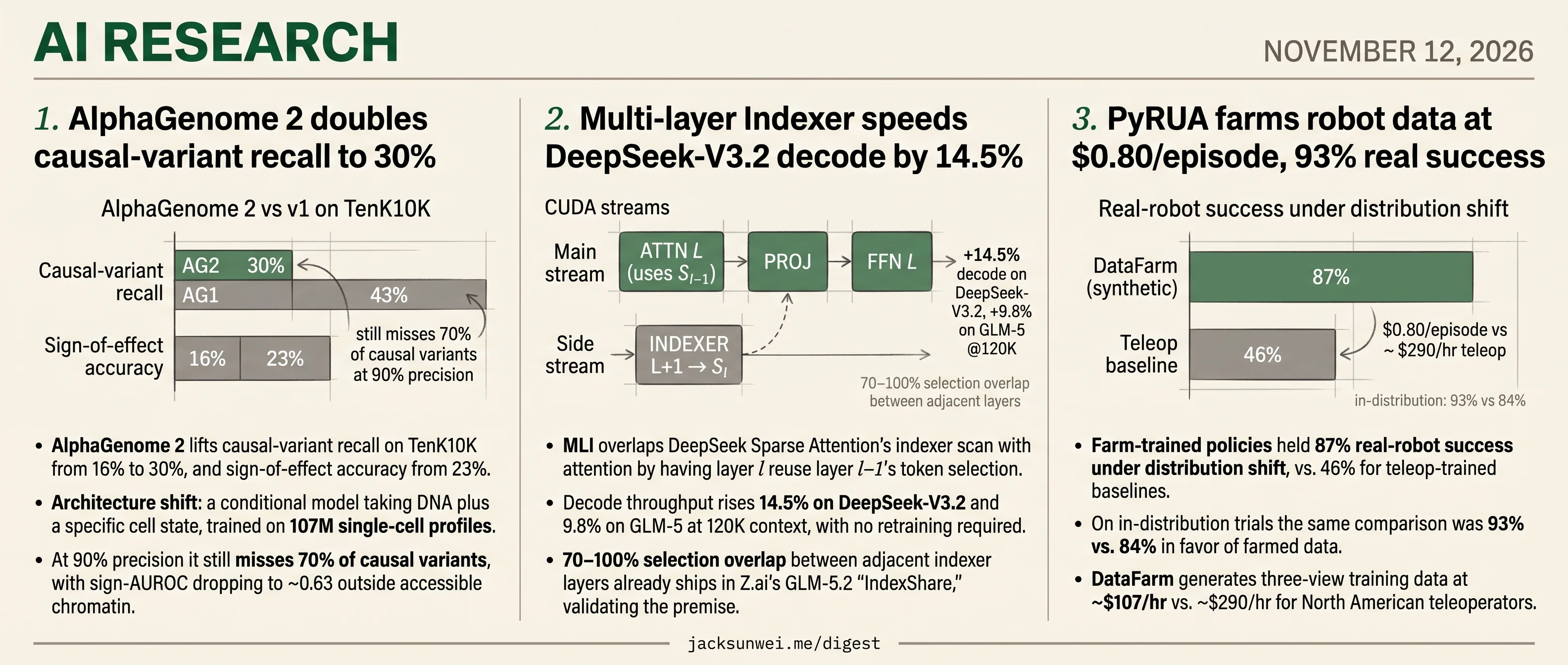
AlphaGenome 2 hits 30% recall, MLI lifts decode 14.5%, PyRUA farms at $0.80
Three research results undercut costlier baselines today: cell-state genomics, reused indexer selections, and simulated robot-data farms.
AlphaGenome 2 hits 30% recall, MLI lifts decode 14.5%, PyRUA farms at $0.80
TL;DR
- AlphaGenome 2 doubles causal-variant recall from 16% to 30% on TenK10K via cell-state conditioning.
- MLI overlaps DeepSeek’s indexer with attention, lifting decode throughput 14.5% with no retraining.
- PyRUA farm-trained policies hit 87% real-robot success under distribution shift, vs 46% for teleop.
- DataFarm generates three-view robot training data at $107/hr vs $290/hr for teleoperators.
- FrontierPhysics evaluates agents across 56 end-to-end physics tasks from literature review to manuscript.
Three results today each replace a costly research baseline with a cheaper substitute. DeepMind’s AlphaGenome 2 swaps per-individual retraining for a conditional model that reads cell state, doubling causal-variant recall on TenK10K from 16% to 30%. MLI avoids running DeepSeek-V3.2’s indexer as its own stage, reusing the prior layer’s token selection to hand decode throughput a 14.5% lift at 120K context. PyRUA’s DataFarm generates three-view training data at roughly a third the cost of North American teleoperators, with farmed policies holding 87% real-robot success under distribution shift versus 46% for teleop baselines.
Each substitute lives at a specific operating point — AG2 still misses 70% of causal variants at 90% precision, MLI’s gains collapse under bandwidth saturation, PyRUA degrades from 93% in-distribution to 87% under shift. The round-ups extend the efficiency thread: SIMPLE predicts LLM inference energy from four parameters, D3D and SpecOPD push speculative decoding further, and FrontierPhysics turns 56 full-loop physics tasks into an agent benchmark.
AlphaGenome 2 doubles causal-variant recall to 30%
Source: deepmind-blog · published 2026-11-11
TL;DR
- AlphaGenome 2 lifts causal-variant recall on TenK10K from 16% to 30%, and sign-of-effect accuracy from 23% to 43%.
- Architecture shift: a conditional model taking DNA plus a specific cell state, trained on 107M single-cell profiles.
- At 90% precision it still misses 70% of causal variants, with sign-AUROC dropping to ~0.63 outside accessible chromatin.
- Random Forest and Elastic Net beat AG2 when trained directly on individual-level personal genomes.
- Delivery is hosted API only, non-commercial, capped at ~100 requests/day on the free tier.
The architecture change is the real news
AlphaGenome 1 predicted thousands of experimental readouts in parallel from a DNA sequence, which diluted its ability to distinguish closely related cell types. AlphaGenome 2 inverts that: it takes a million-letter sequence and a target biological condition — a specific cell type, tissue, or activation state — and conditions on that state at every layer of the network. A separate cell encoder lets a researcher upload gene-activity data from as few as a few dozen cells and adapt predictions to a cell state the model has never seen. Training spanned 107 million single-cell profiles across 68 human and mouse tissues, and the model now predicts DNA methylation alongside expression and chromatin accessibility.
The headline numbers — 30% causal-variant recall on the TenK10K immune-cell benchmark vs. 16% for v1, and 43% vs. 23% directional accuracy — are a genuine step change. Expert reactions collected by the Science Media Centre back the framing: Sarah Teichmann called the no-retraining adaptation to new single-cell data “exciting,” and Peter Donnelly’s Genomics plc is already wiring AG2 into its Mystra drug-discovery platform 1.
The ceiling the press release skips
The same expert pool is careful. One SMC commenter noted “the ideas aren’t novel but the engineering… is quite impressive” and stressed AG2 “doesn’t remove the need for experiments” 1. Independent readouts sharpen the caveat: at a 90% precision threshold AG2 still misses 70% of causal variants, and sign-prediction AUROC falls to roughly 0.63 outside accessible chromatin regions 2. Distal regulation and closed chromatin are where human genetics actually gets hard, and AG2’s advantage there is smaller than the top-line recall suggests.
More awkwardly for the personalized-medicine arc: AG2 underperforms Random Forest and Elastic Net when those baselines are trained directly on individual-level personal genomes 3. It learns population-level regulatory grammar well; it does not yet learn you. That pattern isn’t unique — Geneformer and scGPT have been repeatedly matched or beaten by 2,000-highly-variable-gene selection on zero-shot perturbation tasks 4 — and it leaves the whole single-cell foundation-model paradigm with an unresolved generalization question that AG2’s conditional architecture improves on but does not close.
Closed weights change what you can do with it
Arc Institute’s Evo 2 ships full weights, training code, and datasets; AG2 is hosted API only, non-commercial research, with commercial use in private preview 5. The license is tighter than casual readers notice: outputs cannot be used to train or enhance other ML models, clinical and diagnostic use is explicitly prohibited, and the free tier is reportedly capped at ~100 requests per day 6.
The TenK10K benchmark numbers come from DeepMind, on a model nobody outside DeepMind can retrain.
That closes off the standard academic workflow of fine-tuning on a proprietary cohort, blocks downstream model distillation, and complicates independent reproducibility audits — a notable asymmetry when the field’s other frontier genomics model is fully open. AG2 is a real engineering leap. It is also a leap readers can only rent.
Multi-layer Indexer speeds DeepSeek-V3.2 decode by 14.5%
Source: hf-daily-papers · published 2026-11-01
TL;DR
- MLI overlaps DeepSeek Sparse Attention’s indexer scan with attention by having layer l reuse layer l-1’s token selection.
- Decode throughput rises 14.5% on DeepSeek-V3.2 and 9.8% on GLM-5 at 120K context, with no retraining required.
- 70–100% selection overlap between adjacent indexer layers already ships in Z.ai’s GLM-5.2 “IndexShare,” validating the premise.
- Gains collapse under bandwidth saturation at large batch sizes, where there’s no idle HBM capacity to hide the scan in.
The bottleneck MLI targets
In DeepSeek Sparse Attention (DSA), each layer’s “lightning indexer” scores every previous token to pick the top-k for sparse attention. The scoring is cheap per token but has O(L²) complexity, and at long contexts it overtakes the attention op itself as the dominant cost 7. That’s the pain point a cluster of recent papers — IndexCache 8, MLIPS 9, and now MLI — are all swinging at.
MLI’s contribution is narrower than the others: it doesn’t eliminate indexer work, it hides it. The authors notice that adjacent-layer selections overlap heavily, so layer l can safely attend to the selection produced by layer l-1’s indexer. Once that dependency is broken, the indexer for layer l+1 can run on a side CUDA stream while layer l’s attention, projection, and FFN execute on the main stream.
How the scheduling trick works
flowchart LR
    I0[Indexer L0] --> A0[Attention L0]
    A0 --> F0[FFN L0]
    F0 --> A1[Attention L1<br/>uses S0]
    I1[Indexer L1<br/>side stream] -.produces S1.-> A2[Attention L2<br/>uses S1]
    A1 --> F1[FFN L1]
    F1 --> A2
    I2[Indexer L2<br/>side stream] -.produces S2.-> A3[Attention L3]
Only the very first layer’s indexer remains on the critical path. Two implementations ship: a deferred-stream scheduler that works anywhere, and a fused decode kernel for DeepSeek-V3.2 that packs the sparse attention and the indexer’s prefix scan into a single kernel launch, using the same streaming multiprocessors.
To offset “staleness” from using a previous layer’s picks, the authors add a lightweight distillation step that retrains only the indexer weights (~0.5% of the model) with a Plackett–Luce ranking loss, so each indexer learns to produce selections optimal for its future consumer.
Where it sits in a crowded stack
MLI arrives inside a two-month flurry of DSA serving optimizations. The complementary technique, IndexCache, drops indexers entirely in “Shared” layers for up to 1.82× prefill speedup on a 30B DSA model 8. MLIPS, posted two weeks earlier, has a producer layer build a candidate pool of size M > K that consumer layers re-score, reporting 1.14–1.40× speedup and 14.8–27.4% energy reduction on DeepSeek-V4-Flash 9. MLI is explicitly designed to compose with IndexCache — the paper’s headline result is that at 128K context, V3.2 with MLI at 1/4 retention hits 1.32× base throughput, beating IndexCache-alone at the more aggressive 1/8 retention.
The underlying overlap observation is not speculative: Raschka’s write-up on GLM-5.2’s IndexShare reports 70–100% selection overlap across adjacent layers and a 2.9× per-token FLOP reduction at 1M context in production 10. Quality holds on standard long-context suites — LongBench stays within 0.8 points of base, needle retrieval stays at 1.00 down to 1/8 retention — and the paper was accepted to the NeurIPS 2026 LCFM workshop 11.
The caveats the benchmarks won’t surface
Two external threads qualify the “drop-in, no accuracy loss” framing. SemiAnalysis’s GLM-5.3 analysis argues DSA itself introduces an information bottleneck that measurably regresses hard multi-hop benchmarks like HMMT 2025 and GPQA-Diamond, even when agentic and coding tasks reach parity 12. Staleness from MLI plausibly compounds for that same task class, and LongBench/RULER won’t catch it.
The gain from MLI is derived from using idle HBM bandwidth during attention.
Which means: in high-concurrency serving where memory bandwidth is already saturated, there’s no idle capacity to hide the scan in, and the speedup evaporates. The fused-kernel path, meanwhile, is DeepSeek-V3.2-only — GLM-5’s smaller indexer heads leave nothing to hide inside the attention kernel 11. MLI is a single-request / moderate-batch win on the right architecture, not a universal one.
PyRUA farms robot data at $0.80/episode, 93% real success
Source: hf-daily-papers · published 2026-11-04
TL;DR
- Farm-trained policies held 87% real-robot success under distribution shift, vs. 46% for teleop-trained baselines.
- On in-distribution trials the same comparison was 93% vs. 84% in favor of farmed data.
- DataFarm generates three-view training data at ~$107/hr vs. ~$290/hr for North American teleoperators.
- PyRUA-REAL’s recursive loop cuts five-block stacking error from 2.69mm to 0.44mm on a Franka.
One pipeline, two papers
The PyRUA cluster is really a single industrial-scale pitch split across two drops: DataFarm replaces the human teleoperator with a coding agent that reconstructs a task in simulation from one calibration episode, renders it photorealistically, and spits out real-ready trajectories; REAL then takes a Franka into the physical world and recursively rewrites its own Python skills until they’re reliable enough to freeze. The novelty isn’t any single number — it’s the end-to-end commoditization of robot skill acquisition.
flowchart LR
    A[1 calibration episode] --> B[DataFarm: LLM rebuilds task in sim]
    B --> C[Photoreal render<br/>$0.80/episode]
    C --> D[Policy training]
    D --> E[REAL: Franka trial]
    E --> F{Success?}
    F -- no --> G[Engineer agent<br/>diagnoses + rewrites code]
    G --> E
    F -- yes --> H[Frozen agent-free skill<br/>4.6-5x faster deploy]
The economics are the load-bearing claim. DataFarm quotes ~$107/hr of three-view data inclusive of fees, with subsequent episodes averaging $0.80 each after a $21 API + $5 render setup 13. For comparable North American teleop labor, the authors cite ~$290/hr. More interesting than cost: farm-trained policies reportedly maintained 87% success under distribution shift (new tablecloths, lighting) where teleop-trained models collapsed to 46% 14. If that holds up, it inverts the usual sim-to-real intuition — synthetic variation beats real human demonstrations at generalization.
Where REAL earns its keep
REAL’s contribution is treating skills as code that can be refined, not neural weights that must be retrained. A Researcher agent sets objectives and manages a persistent experience store (facts, memory, implementation); an Engineer agent writes the Python, reads back video + joint trajectories, and patches the controller. On RoboDojo’s 42-task sim benchmark it reports 84.4% — against GPT-6-Astra’s 22.5% baseline and the previous PyRUA-Lean’s 50.4%. Precision tasks saw the biggest jump (74.0% vs. 38.3%).
Worth flagging: RoboDojo itself is contested. BenchLM’s public leaderboard lists Claude Fable 5.2 at 64.9% as current top and warns that most entries are provider self-reports with limited community supervision 15. PyRUA sits in a lineage with Code-as-Policies and Eureka — the latter outperforming human experts on 83% of its own benchmarks 16 — a reminder that robotics-paper benchmarks rarely survive independent reruns intact.
The caveats the authors own
To their credit, the PyRUA team is unusually candid. Ethernet insertion — the kind of sub-millimeter contact-rich task that defeats most agentic stacks — still required online “thinking” to succeed; fully frozen programs could not close the loop. Human choices of vision backbone (SigLIP, SAM) “significantly shaped” skill quality 17. And when the same agent writes both the controller and the success judge, criteria exposure becomes a real risk: LLM-based simulators are already known to be overly cooperative and overstate system quality 18, and nothing in REAL’s recursive loop forces monotone improvement on a held-out set.
The headline economics and robustness gains are striking — but no independent group has reproduced them yet.
Treat PyRUA as a credible direction, not a settled result. The pipeline shape — cheap synthetic data, persistent skill library, frozen deployment — is probably where industrial robotics is headed. The specific numbers are the authors’ to defend.
Further reading
- PyRUA-DataFarm: LLM Agent as a Cost-Efficient Teleoperator for Real-Ready Robot Data — hf-daily-papers
Round-ups
SIMPLE law predicts LLM inference energy with 4 parameters
Source: hf-daily-papers
A four-parameter analytical model forecasts LLM inference energy across architectures, exposing quadratic prefill costs and savings from grouped-query attention. The law also flags super-linear energy growth as reasoning budgets expand and agentic serving stacks compound per-request work.
D3D uses diffusion drafters for asynchronous speculative decoding
Source: hf-daily-papers
Instead of a small autoregressive draft model, D3D trains a blockwise diffusion drafter with autoregressive supervision. It denoises the next block while the target model verifies the previous one, overlapping draft and verify for large decoding speedups.
SpecOPD parallelizes on-policy draft training for speculative decoding
Source: hf-daily-papers
SpecOPD trains speculative-decoding drafters with on-policy distillation split across independent branches, using tree masks and an E2E-TV surrogate. The branch-parallel setup lifts acceptance length and training throughput on GQA, linear-attention, and sparse-attention targets alike.
On-policy distillation matches teachers but erodes OOD generalization
Source: hf-daily-papers
Multi-teacher on-policy distillation hits teacher-level in-distribution scores on Qwen3 while quietly degrading out-of-distribution reasoning. The authors trace the loss to spectrally concentrated updates and propose geometry-based patching plus base-preserving replay to retain extrapolation with minimal in-distribution cost.
Halley control plane anticipates optical failures in AI data centers
Source: hf-daily-papers
Optical networks linking AI accelerators lose goodput to laser, switch, and microring faults. Halley predicts these failures across layers and reroutes ahead of time, raising effective training-step goodput and cutting the spare capacity operators must provision.
Microsoft’s Hybrid Computer Use fuses code, AX, and vision for agents
Source: hf-daily-papers
Desktop agents gain a unified interface that combines programmatic APIs, accessibility trees, and screen pixels, letting them pick the cheapest channel per step. Microsoft reports higher success and efficiency on OSWorld 2.0 versus vision-only or AX-only baselines.
FrontierPhysics benchmarks agents on 56 end-to-end research tasks
Source: hf-daily-papers
The benchmark puts AI agents through the full physics research loop — literature review, planning, experimentation, and manuscript writing — across 56 expert-designed tasks. Scoring combines deterministic verifiers with expert rubrics, pushing beyond single-step QA toward evaluating sustained scientific workflows.
Footnotes
-
Science Media Centre expert reactions (via AIWeekly) — https://aiweekly.co/alerts/deepmind-launches-alphagenome-2-for-dna-variant-prediction
↩ ↩2Prof. Sarah Teichmann: ‘What makes AlphaGenome 2 exciting is how it adapts directly to new single-cell data without retraining…’ Sir Peter Donnelly (Genomics plc) called it ‘an impressive advance’ and said his company ‘plans to incorporate the model into its Mystra platform.’ Another expert cautioned: ‘the ideas aren’t novel but the engineering… is quite impressive… I don’t think it removes the need for experiments.’
-
The Neuron — https://www.theneuron.ai/news/googles-alphagenome-2-wants-to-find-where-disease-begins/
↩At a 90% precision threshold, AlphaGenome 2 still misses 70% of causal variants, leaving substantial room for improvement in sensitivity… its performance remains lower outside of accessible chromatin regions, with sign prediction AUROC dropping to approximately 0.63 in some contexts.
-
Unite.AI review — https://www.unite.ai/google-deepminds-alphagenome-2-predicts-cell-state-variant-effects/
↩AlphaGenome 2 significantly underperforms compared to simpler models like Random Forest or Elastic Net when those are trained directly on individual-level personal data… the model captures the general ‘grammar’ of the human genome [but] struggles to account for the unique, individual-specific variation required for truly personalized medicine.
-
evo-byte.com (scFM critique) — https://evo-byte.com/from-scgpt-to-scconcept-models-for-single-cell-biology/
↩Both Geneformer and scGPT were consistently matched or beaten by basic feature selection techniques such as the 2,000 most highly variable genes… Ahlmann-Eltze et al. demonstrated that scFMs do not yet outperform deliberately simple linear baselines for predicting the outcomes of genetic perturbations.
-
Remio.ai — AlphaGenome vs Evo 2 comparison — https://www.remio.ai/post/alphagenome-released-deepmind-s-1mb-context-ai-for-gene-regulation
↩Evo 2 is fully open-source, providing weights, training code, and datasets… AlphaGenome 2, conversely, is restricted to a hosted API for non-commercial research. While this ‘closed-weight’ API model offers centralized oversight… it limits the ability of labs to fine-tune the model on private or sensitive datasets.
-
cellcog.ai license analysis — https://cellcog.ai/blog/alphagenome-2/
↩A critical clause prevents users from using AlphaGenome outputs to train or enhance other machine learning models… The model is not validated for medical use; the terms explicitly prohibit using outputs for clinical decision-making or diagnostic advice. Free tier standardized at 100 requests per day.
-
Greg Robison, Medium — DeepSeek-V3.2-Exp architectural analysis — https://gregrobison.medium.com/architectural-efficiency-in-large-language-models-a-comprehensive-analysis-of-deepseek-v3-2-exp-e9802adfcdbd
↩While its operations are computationally cheap at a 128K context, the indexer itself still possesses O(L^2) complexity because it must score every previous token; as context windows scale into the millions, this scoring stage will eventually become a performance-limiting factor.
-
IndexCache paper (arXiv 2603.12201) — https://arxiv.org/abs/2603.12201
↩ ↩2IndexCache partitions Transformer layers into Full (F) layers that compute fresh top-k indices and Shared (S) layers that reuse indices from the preceding F-layer, removing up to 75% of indexer computations and delivering up to 1.82× prefill speedup at 200K context on a 30B DSA model, with 1.2–1.3× end-to-end acceleration on the 744B GLM-5.
-
MLIPS: Multi-Layer Indexer Pool Sharing (arXiv 2610.27438) — https://arxiv.org/abs/2610.27438
↩ ↩2A producer layer performs a full scan to identify a broad candidate pool of size M > K, and consumer layers select from this restricted pool; experiments on DeepSeek-V4-Flash report 1.14×–1.40× speedup and 14.8–27.4% GPU energy reduction, with accuracy drops up to −1.49 pp when sharing is too aggressive.
-
Sebastian Raschka — ‘GLM-5.2 IndexShare’ blog — https://sebastianraschka.com/blog/2026/glm-5-2-indexshare.html
↩GLM-5.2 reuses the selected token positions from a single indexer across four consecutive transformer layers; nearby layers show 70–100% selection overlap, and Z.ai reports a 2.9× reduction in per-token FLOPs at 1M context lengths compared to standard sparse attention.
-
NeurIPS 2026 LCFM workshop listing — https://neurips.cc/virtual/2026/loc/atlanta/173747
↩ ↩2Accepted at the NeurIPS 2026 Long-Context Foundation Models workshop; the paper confirms MLI maintains accuracy within a few percentage points on LongBench and RULER, with the fused kernel providing no benefit to GLM-5 due to smaller feed-forward window and fewer index heads.
-
SemiAnalysis — ‘Sparse Savings, Persistent Demand: Inside GLM-5.3’ — https://newsletter.semianalysis.com/p/sparse-savings-persistent-demand-inside-glm53
↩DSA introduces an information bottleneck that over-prunes subtle long-range dependencies for multi-hop reasoning, yielding measurable regressions on high-difficulty benchmarks like HMMT 2025 and GPQA-Diamond even while most agentic and coding tasks reach parity.
-
OpenTrain.ai paper summary of PyRUA-DataFarm — https://www.opentrain.ai/papers/pyrua-datafarm-llm-agent-as-a-cost-efficient-teleoperator-for-real-ready-robot-d—arxiv-2611.05320/
↩one hour of three-view training data for approximately $107, inclusive of all fees… a one-time task adaptation fee of roughly $21 in API usage and a $5 rendering contract. Subsequent data episodes cost an average of $0.80 each
-
hamidun.com — ‘A coding agent replaces the teleoperator: 93 successes out of 100’ — https://news.hamidun.com/en/news/15116/a-coding-agent-replaces-the-teleoperator-93-successes-out-of
↩policies trained on ‘farmed’ data achieved 93% success in real-robot trials, compared to 84% for those trained on traditional teleoperated data… farm-trained policies maintained an 87% success rate [under distribution shift], while teleoperation-trained models plummeted to 46%
-
BenchLM RoboDojo Sim leaderboard — https://benchlm.ai/benchmarks/robodojosim
↩Claude Fable 5.2 currently holds the top position with a success rate of 64.9%, followed by models like GPT-6 Astra and Gemini 4 Argon… a majority of leaderboard entries are provider self-reports, which may lack community supervision
-
Eureka project page (comparison baseline) — https://eureka-research.github.io/
↩Eureka… produces reward functions that outperform human experts on 83% of tested robotic benchmarks, enabling simulated robots to perform rapid, high-fidelity movements such as pen spinning
-
arXiv HTML of PyRUA-REAL (2611.06768) — authors’ own limitations section — https://arxiv.org/html/2611.06768v1
↩Precise tasks like Ethernet insertion proved extremely difficult for fully ‘agent-free’ programs. Successful trials still required online agent assistance… human guidance in selecting primitive skills or suggesting specific vision models significantly shaped the quality of the acquired skills
-
Qualitati blog — ‘LLM user simulators and the sim2real gap (2026)’ — https://qualitati.com/blog/llm-user-simulators-sim2real-gap-2026
↩LLM-based user simulators are common, they tend to be overly cooperative and uniform, often overstating the quality of the systems they test