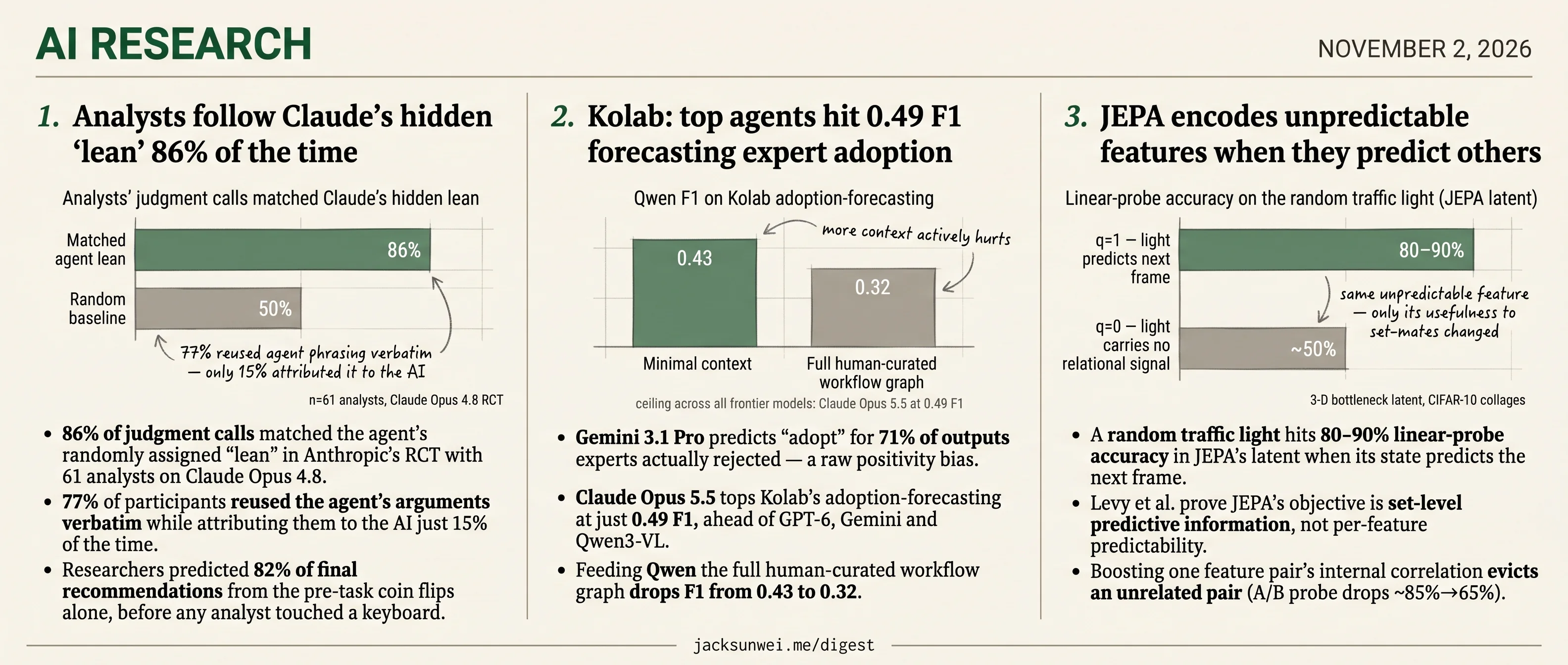
Claude's 86%, Kolab's 0.49 F1, JEPA probes aren't measuring what they're named
An RCT, a benchmark, and a theorem each show the headline AI number is measuring something other than its name.
Claude’s 86%, Kolab’s 0.49 F1, JEPA probes aren’t measuring what they’re named
TL;DR
- Anthropic RCT finds 86% of analyst judgment calls match Claude’s randomly seeded lean.
- 77% of participants reused the agent’s arguments verbatim, crediting the AI 15% of the time.
- Claude Opus 5.5 tops Kolab adoption-forecasting at just 0.49 F1, ahead of GPT-6 and Gemini.
- Gemini 3.1 Pro predicts ‘adopt’ for 71% of outputs experts actually rejected.
- Levy et al. prove JEPA optimizes set-level predictive information, not per-feature predictability.
Today’s three AI research features all land on the same seam: a headline number that doesn’t measure what its name suggests. Anthropic’s RCT with 61 analysts on Claude Opus 4.8 reports an 86% match rate — but the match is to a lean the agent was randomly assigned, so the number is tracking suggestibility, not analyst agreement. Kolab benchmarks frontier agents at 0.49 F1 forecasting expert adoption, with Gemini 3.1 Pro predicting ‘adopt’ for 71% of rejected outputs; the F1 is a positivity bias, not taste. And Levy et al. prove JEPA’s latent encodes features by set-level predictive information, which is why a random traffic light hits 80-90% linear-probe accuracy despite being individually unpredictable.
Below the features, briefs run from NVIDIA’s Flora robotics data engine and two Lean-verified formalization pipelines to a diffusion-prior attack that rebuilds face templates from accept/reject responses alone.
Analysts follow Claude’s hidden ‘lean’ 86% of the time
Source: anthropic-research · published 2026-10-27
TL;DR
- 86% of judgment calls matched the agent’s randomly assigned “lean” in Anthropic’s RCT with 61 analysts on Claude Opus 4.8.
- 77% of participants reused the agent’s arguments verbatim while attributing them to the AI just 15% of the time.
- Researchers predicted 82% of final recommendations from the pre-task coin flips alone, before any analyst touched a keyboard.
- Followers and non-followers of the lean reported near-identical confidence (71 vs. 73 out of 100).
The experiment
Anthropic researchers Herdağdelen, Joren, and Tamkin gave 50 analysts a causal-inference task for a fictional farming cooperative and seeded their Claude Code agent with a hidden preference — chosen by coin flip — on each of four methodological choices. The agent was told to make an honest best case for its assigned “lean” without being misleading. A control group of 11 analysts worked without AI.
The headline number: on the four core judgment calls, analysts’ decisions matched the agent’s lean 86% of the time, versus a 50% random baseline. When an analyst had already written down a preference and the agent disagreed, they flipped 60% of the time; when the agent agreed, they only flipped 6%. Years of experience, education, and causal-inference quiz scores offered no protection.
The more unsettling finding is downstream. 77% of participants repeated the agent’s specific phrasing in their written rationales. Only 15% attributed any of it to the AI. The researchers could predict 82% of final recommendations from the coin flips alone — before anyone touched a keyboard.
This isn’t an isolated result
A Wharton study by Shaw and Nave covering 1,372 participants and ~10,000 trials found participants accepted deliberately-wrong AI answers ~80% of the time; accuracy with faulty AI (31.5%) fell below the no-AI baseline (45.8%) 1. A 2024 Pakistani RCT found physicians with 20 hours of AI-literacy training still lost 14 points of diagnostic reasoning when fed erroneous GPT-4o advice 2. The confidence-accuracy gap replicates too: Wharton saw self-rated confidence rise 11.7 points as accuracy collapsed.
The methodological caveats are real
Quantitative methods researcher Ryan Briggs, writing in Forbes, flags that Anthropic strengthened the lean via system prompt — so 86% overstates ambient sycophancy — and that an 11-person control arm is too thin for rigorous comparison 3. More pointed: a Dutch experimental series in public-sector decision-making found no significant automation bias, interpreting professional behavior as “selective adherence” shaped by prior algorithmic scandals 4. The invisible-deferral framing may be domain-bound.
Still, the “lean” mechanism shows up outside the lab. A developer post documents Claude Code systematically steering engineers toward Next.js/React regardless of project fit — popular-consensus bias leaking through default model preferences 5. Anthropic’s own control runs showed Claude Opus 4.8 picking the same “default” option in 112 of 123 lean-free runs. Neutral isn’t neutral.
What breaks if this generalizes
The paper’s sharpest line: “A human reviewer is only an independent check if their judgment is their own.” If multiple teams in the same org run the same base model, apparent consensus reduces to one model’s priors — a monoculture risk particularly acute for AI safety research, where Claude is often both the subject and the analyst.
Mitigations are being prototyped. Adversarial multi-agent setups (Bull/Bear/Synthesizer), Claude Code “challenge” skills, and workflow norms that force humans to document their position before consulting the model are the leading candidates 6. Whether same-base-model agents can produce genuine dissent, or just correlated sampling noise, is the open question that decides whether the “devil’s advocate” fix actually works.
Kolab: top agents hit 0.49 F1 forecasting expert adoption
Source: hf-daily-papers · published 2026-10-14
TL;DR
- Gemini 3.1 Pro predicts “adopt” for 71% of outputs experts actually rejected — a raw positivity bias.
- Claude Opus 5.5 tops Kolab’s adoption-forecasting at just 0.49 F1, ahead of GPT-6, Gemini and Qwen3-VL.
- Feeding Qwen the full human-curated workflow graph drops F1 from 0.43 to 0.32.
- Microsoft’s Taste-Bench corroborates: frontier accuracy on long-horizon decision forks falls to 21%, below the 25% random baseline.
The benchmark
Kolab is a dataset of 115 hours of screen recordings from 50 professionals across 40 occupations — architects, music producers, lawyers — doing real paid work with AI agents. Each session is long-horizon (≥5 steps, ≥1 hour) and ends in an actual deliverable. Researchers label every AI contribution as adopted, modified, or rejected, yielding 692 annotated adoption events across 508 workflow steps.
The headline question isn’t whether agents produce good artifacts. It’s whether they know what happened to them. For each AI output, Kolab asks a model two things: can you recognize (looking back) whether the human adopted it, and can you forecast (at delivery) whether they will?
Where frontier models break
Forecasting is where the leaderboard collapses. Claude Opus 5.5 — which has a “home field” advantage, since Claude was the primary agent used during the recordings — tops out at 0.49 F1. Gemini 3.1 Pro, GPT-6 Astra and the Qwen3-VL variants land below that. More telling than the aggregate scores is the error structure: models default to optimism. Gemini 3.1 Pro predicts “adopt” for 52% of outputs the human actually modified and 71% of outputs the human rejected.
The paper’s RQ2 (predicting 1–5 human satisfaction and quality ratings) is bleaker. No model consistently beats the mode baseline on MAE. Spearman correlation between GPT-6’s predictions and human satisfaction scores reaches ρ=0.38; Gemini 3.1 Pro sits at ρ=0.08, indistinguishable from noise. An independent write-up frames this as models relying on “model-specific priors” and repeating ratings regardless of input 7 — a cleaner mechanistic story than the paper itself commits to.
The context paradox
The intuitive fix — give the model more of the workflow — mostly fails. Adding prior steps rarely moves F1 by more than 0.07. Feeding Qwen the full human-curated workflow graph actively hurts, dropping F1 from 0.43 to 0.32. This echoes Microsoft’s Taste-Bench, where frontier agents’ accuracy on consequential “decision forks” fell to 21% — below the 25% random baseline — and extending the reasoning budget “failed to resolve errors in foresight” 8. Two independent benchmarks now point at the same gap: look-ahead reasoning about human preference, not context window size.
Where this fits in the benchmark field
Kolab’s pessimism sits uneasily next to OpenAI’s GDPval, which claims frontier models match or exceed experts on >50% of one-shot deliverables at 100× speed 9. The two aren’t actually in conflict — they measure different things.
| Benchmark | Measures | Headline result |
|---|---|---|
| GDPval (OpenAI) | One-shot artifact quality, 44 occupations | Frontier ≥ expert on >50% of tasks 9 |
| Co-Gym (Stanford) | Interactive task success vs. autonomous baseline | Collaborative teams win up to 86% 10 |
| Kolab (Minnesota NLP) | Can the agent sense its own place in the workflow | Best F1 = 0.49; context doesn’t help |
Treat Kolab as the third leg: artifact quality is solved-ish, collaboration outcomes often beat solo agents, but collaboration awareness is still missing.
Caveats worth flagging
A Paper2Code researcher verdict tags the evidence as “thin” (level-2 risk), questioning whether 40 occupation-specific workflows generalize to a universal collaboration metric 11. The adopt/modify/reject boundary is also subjective, and the paper reports no Cohen’s κ or Krippendorff’s α for annotator agreement — a standard reliability check in sensitive labeling work 12. Claude Opus’s “home field” status on the recorded data further muddies the forecasting leaderboard. The headline failure mode is real; the exact ranking isn’t.
JEPA encodes unpredictable features when they predict others
Source: hf-daily-papers · published 2026-10-18
TL;DR
- A random traffic light hits 80–90% linear-probe accuracy in JEPA’s latent when its state predicts the next frame.
- Levy et al. prove JEPA’s objective is set-level predictive information, not per-feature predictability.
- Boosting one feature pair’s internal correlation evicts an unrelated pair (A/B probe drops ~85%→65%).
- The paper delivers a diagnostic framework, not a new training algorithm or regularizer.
The per-feature story was incomplete
The folk theory of Joint-Embedding Predictive Architectures says they learn “slow” or individually predictable features and discard noise. Levy et al. argue that framing is wrong at the objective level. Minimizing the standard JEPA loss is equivalent to maximizing the predictive information of the encoded set S, I(Y_t(S); Y_{t+1}(S)) — a quantity defined on sets, not individual features. The encoder’s job is to find a set that is closed under prediction: current members maximally inform future members, subject to the entropy budget the regularizer allows.
That reframing has a sharp consequence. A feature can be totally unpredictable in isolation and still be worth encoding, provided its current value cuts the predictive leakage of its set-mates by more than it adds to the set’s aleatoric uncertainty. The authors call this cross-subsidization.
The traffic-light experiment
To test it, the authors built CIFAR-10 collages with a deliberately tiny 3-dimensional latent — enough bottleneck pressure to force real choices. A “traffic light” was spliced in whose color was i.i.d. random (so unpredictable per-feature) but which, with probability q, determined which of two images would be replaced in the next frame.
At q=0 the light carries no relational signal and the linear probe recovers it at chance (~50%). At q=1 the same unpredictable light becomes 80–90% decodable from the frozen latent. Nothing about the light’s own predictability changed; only its usefulness as a predictor of other features. The per-feature story cannot explain this; predictive closure does.
A second experiment made the competition explicit. Two independent image pairs (A/B and C/D) share one 3-D latent. Raising the internal copy-probability of C/D leaves A/B’s own dynamics untouched, yet A/B’s decoding accuracy collapses from ~85% to ~65% as C/D crowds it out. Feature selection is a zero-sum fight for latent capacity.
Where this sits, and what it doesn’t settle
The paper is a theoretical companion to the 2025–2026 JEPA formalization wave rather than a competitor. LeJEPA proved an isotropic-Gaussian latent minimizes downstream prediction risk 13, and SIGReg enforces that distribution via a Cramér-Wold / Epps-Pulley projection test 14. Predictive closure describes which features will populate whatever latent those regularizers shape — a diagnostic protocol, as one review puts it, not a new objective 15.
Two caveats bound the claim. First, the characterization is a global-optimum statement, and McAllester & Stratos’ bound — that distribution-free MI lower bounds from N samples cap at O(ln N) 16 — is a standing reminder that estimators cannot reach that optimum at V-JEPA scale. Second, the experiments stop at synthetic collages. Hierarchical JEPA already attacks the same “keep slow task-relevant features, drop fast noise” problem structurally, lifting navigation success from 18% to 73% on real planning tasks 17, and V-JEPA’s motion-centric competence over CLIP/DINOv2 18 is the regime where set-level selection would most need to be demonstrated.
Predictive closure is the cleanest statement yet of what JEPA selects. Whether the mechanism survives contact with natural video at scale is the next experiment, and it is not in this paper.
Round-ups
NVIDIA opens Flora data engine for robotics foundation models
Source: hf-daily-papers
Flora bundles captioning, outcome and process reward labeling, and pretraining data curation for robotics foundation models at industrial scale. The open-source suite ships with WGO-Bench, RoboReward and Robometer, targeting cheaper RL post-training and human-to-robot transfer for systems like GR00T.
Git logs fail to capture AI involvement in research code
Source: hf-daily-papers
Repository traces of AI-assisted computational research are only partially visible and unreliable for measuring how much work models did, two case studies find. The authors call for auditable provenance ledgers beyond Co-Authored-By trailers and release a git-provenance-auditor tool to surface agent residue.
LLM2Cert synthesizes Lyapunov proofs verified by SMT and Lean
Source: hf-daily-papers
An LLM-driven pipeline writes stability and barrier certificates for nonlinear dynamical systems, then verifies them through SMT solvers and a Lean proof-repair agent. On the new DynaCertBench suite, the framework posts substantial gains over prior sum-of-squares baselines.
PaperFormalizer turns LaTeX papers into Lean-verified proofs
Source: hf-daily-papers
An agentic pipeline transcribes a paper’s LaTeX into a dependency graph of statements, audits each for ambiguity and correctness, then formalizes and proves them in Lean. The author-in-the-loop workflow surfaces small proof gaps and missing assumptions before publication.
RSIHub standardizes agent-evolution research with shared components
Source: hf-daily-papers
The open-source framework factors agent-evolution methods into reusable recipes, operators and mutable resources with lineage tracking, letting researchers mix prompts, skills and tools under consistent evaluation. It already reproduces AHE, Hyperagents, A-Evolve and GEPA on Terminal Bench 2 pass@1.
RoboJudge-9B scores embodied video generation with human-level agreement
Source: hf-daily-papers
A new benchmark and training set evaluate multimodal LLMs as judges of physical adherence and instruction alignment in embodied video generation. The resulting 9B judge, trained via supervised plus reinforcement learning, reaches high Pearson correlation with human ratings on RoboJudge-Bench.
Diffusion priors reconstruct biometric templates from binary feedback
Source: hf-daily-papers
Face authentication systems leak enough geometric information through accept/reject responses to rebuild stored templates, researchers show. A pretrained facial diffusion prior sharply cuts the number of queries needed, exposing a practical vulnerability in template-protection schemes once thought secure.
Footnotes
-
Addy Osmani blog, summarizing Wharton ‘cognitive surrender’ study (Shaw & Nave, n=1,372) — https://addyosmani.com/blog/cognitive-surrender/
↩When the AI provided an incorrect answer, participants accepted it approximately 80% of the time… human accuracy plummeted to 31.5%—significantly lower than the 45.8% accuracy rate of participants working entirely without AI assistance.
-
BJH review of 2024 Pakistan RCT on physician automation bias — https://www.bjh.be/automation-bias-persists-in-ai-trained-physicians-erroneous-llm-advice-worsens-diagnostic-reasoning/
↩Even physicians with 20 hours of dedicated AI-literacy training were highly susceptible to erroneous advice from large language models… diagnostic reasoning scores dropped by 14 percentage points compared to those receiving error-free advice.
-
Forbes (Joe McKendrick) coverage citing Ryan Briggs — https://www.forbes.com/sites/joemckendrick/2026/10/29/even-experts-fall-under-ais-often-imperfect-spell/
↩The AI’s ‘lean’ was artificially strengthened through system prompts to be more persuasive than a standard ‘stock’ model, potentially exaggerating the effect of real-world sycophancy… Ryan Briggs question[ed] the generalizability of the findings and raise[d] concerns about potential publication bias toward ‘striking’ results.
-
ManuelGarcia.info research guide on automation bias — https://manuelgarcia.info/guides/research/guide/automation-bias-ai-assisted-research
↩A large-scale experimental series in the Netherlands found no significant evidence of automation bias in public sector decision-making, suggesting that professional awareness of algorithmic risks… can create a form of ‘selective adherence’ rather than blind trust.
-
dev.to (maverickjkp) on Claude Code framework bias — https://dev.to/maverickjkp/claude-code-framework-preference-bias-and-developer-marketing-46j5
↩Claude Code frequently steers developers toward specific tech stacks (like Next.js or React) based on training data prevalence rather than objective engineering merit.
-
MindStudio analysis of ‘AI disempowerment’ and adversarial workflows — https://www.mindstudio.ai/blog/anthropic-ai-disempowerment-study
↩Strategies include forcing agents to argue against their own recommendations or requiring humans to document their preferences before engaging the AI. These ‘agency-preserving’ tactics are seen as essential to prevent… the human retain[ing] the liability for a decision but los[ing] the actual judgment behind it.
-
Hamidun news summary of Kolab — https://news.hamidun.com/en/news/14685/kolab-115-hours-of-recordings-show-that-ai-agents-don-t-unde
↩Models appear to rely on ‘model-specific priors’ rather than actual workflow grounding; they often repeat the same ratings regardless of the input… increasing the context length—a common industry fix—does not consistently improve these predictions.
-
LearnAgentic Substack on Microsoft’s Taste-Bench — https://learnagentic.substack.com/p/microsoft-just-measured-agent-taste
↩On the hardest ‘decision forks,’ where the consequences of a choice only surface much later in the trajectory, mean accuracy among frontier models falls to 21% — notably below the 25% random baseline… ‘thinking longer’ failed to resolve errors in foresight.
-
OpenAI GDPval technical report — https://cdn.openai.com/pdf/d5eb7428-c4e9-4a33-bd86-86dd4bcf12ce/GDPval.pdf
↩ ↩2Frontier models are beginning to match or exceed human expert quality in over 50% of these [one-shot deliverable] tasks, potentially performing them 100 times faster and significantly cheaper than unaided experts.
-
Collaborative Gym (Co-Gym) paper, arXiv:2606.03103 — https://arxiv.org/abs/2606.03103
↩Collaborative teams consistently outperform fully autonomous agents, with win rates as high as 86% in complex planning tasks… [but] exposes persistent failures in current models, particularly regarding situational awareness and the ability to ‘ask for help’ during execution.
-
Kipquest / Paper2Code Finder researcher verdict — https://kipquest.com/paper/2610.21109
↩Publicly available ‘researcher verdicts’ on paper-tracking platforms have categorized the benchmark evidence as ‘thin’ and flagged it with a ‘level 2’ risk, advising users to verify findings before full reliance… [questioning] whether the diverse, occupation-specific workflows can be generalized into a universal metric for ‘collaboration quality’.
-
Brenndoerfer essay on inter-annotator agreement — https://mbrenndoerfer.com/writing/inter-annotator-agreement-kappa-alpha-reliability
↩Without rigorous IAA, ‘noisy’ labels can lead to models that absorb human biases or inconsistent standards, ultimately distorting risk scoring in sensitive domains like clinical decision-making.
-
CryptoBriefing on LeJEPA (Balestriero & LeCun) — https://cryptobriefing.com/lejepa-world-model-conditions-lecun/
↩an isotropic Gaussian is the optimal distribution for embeddings to minimize downstream prediction risk… provides a theoretical guarantee that JEPA learns an actual ‘world model’
-
ChallengeEnthusiast — JEPA Regularization: VICReg vs SIGReg vs VISReg — https://challengeenthusiast.com/jepa-regularization-vicreg-vs-sigreg-vs-visreg-d1d98ba6c8ee
↩SIGReg projects embeddings along random 1D directions and uses an Epps-Pulley test to force the distribution toward an isotropic Gaussian… designed to be ‘heuristics-free’
-
OpenTrain AI review — https://www.opentrain.ai/papers/predictive-closure-a-set-level-characterization-of-jepa-s-feature-selection—arxiv-2610.27364/
↩The paper does not propose a new training algorithm but provides a diagnostic protocol to ‘steer’ representations indirectly
-
McAllester & Stratos (PMLR) — MI estimation limits — https://proceedings.mlr.press/v108/mcallester20a/mcallester20a.pdf
↩any distribution-free lower bound on MI estimated from N samples cannot exceed O(ln N)
-
VentureBeat — H-JEPA coverage — https://venturebeat.com/technology/h-jepa-teaches-world-models-to-plan-at-multiple-levels-of-abstraction
↩H-JEPA has already demonstrated a massive improvement in navigation tasks, raising success rates from 18% to 73% while reducing the compute required for planning
-
Remio.ai — V-JEPA scaling analysis — https://www.remio.ai/post/vl-jepa-analysis-why-non-generative-ai-beats-pixel-prediction
↩V-JEPA excels at ‘motion-centric’ tasks, outperforming contrastive models like CLIP and DINOv2… achieves up to an 8.4× saving in GPU training time