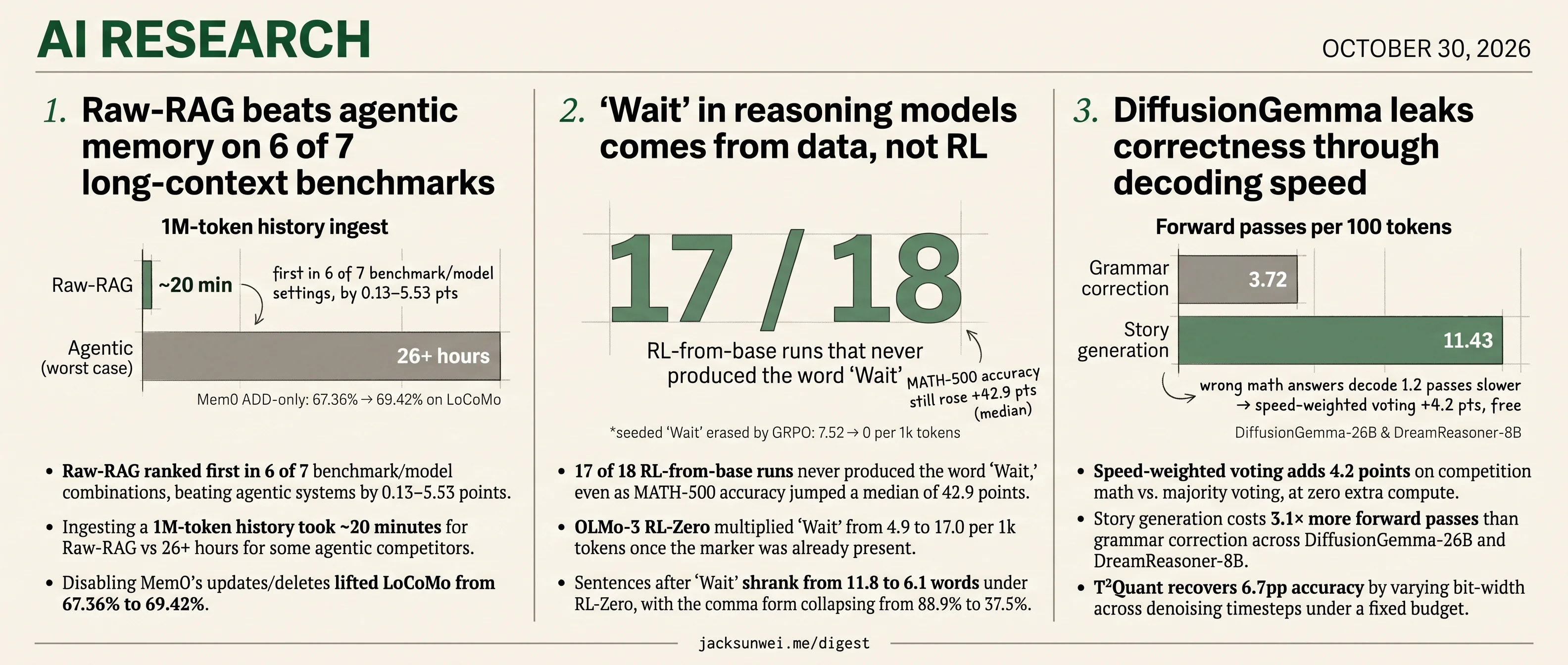
Raw-RAG tops agents, 'Wait' predates RL, DiffusionGemma leaks via speed
Three research gains each credit a mechanism their own setup didn't isolate: the baseline, the pretraining data, the single-request budget.
Raw-RAG tops agents, ‘Wait’ predates RL, DiffusionGemma leaks via speed
TL;DR
- Raw-RAG wins 6 of 7 long-context combos, beating agentic memory by 0.13–5.53 points.
- 17 of 18 RL-from-base runs never produced ‘Wait,’ localizing the marker to pretraining data.
- Speed-weighted voting adds 4.2pp on DiffusionGemma math at zero extra single-request compute.
- Ingesting 1M tokens takes ~20 minutes for Raw-RAG versus 26+ hours for agentic competitors.
- T²Quant recovers 6.7pp by varying bit-width across denoising timesteps under a fixed budget.
Today’s three research features each post a clean benchmark win, and each one’s lift turns out to live somewhere the paper didn’t fully isolate. Raw-RAG tops agentic memory on 6 of 7 long-context combos — but Zep and Mem0 argue the benchmark skips fact supersession, the production failure the agentic designs were built for. The ‘Wait’ marker in reasoning traces, long treated as an RL-induced reflection habit, fails to appear in 17 of 18 RL-from-base runs; the behavior lives in the pretraining corpus, with RL only amplifying or erasing what’s already there. And DiffusionGemma’s speed-weighted voting adds 4.2 points at zero extra single-request compute — a win that may collapse once production batching equalizes the FLOPs.
The briefs round out the day with an agent-safety result worth flagging — Agent Mosaic shows LLM agents leak secrets by aggregating individually-safe documents past standard guardrails — plus a latent-world-model cluster for robotics, OpenDS-World’s live-web deep-search benchmark, and new work on neurosymbolic policy compilation and Lean-verified chemical reasoning.
Raw-RAG beats agentic memory on 6 of 7 long-context benchmarks
Source: hf-daily-papers · published 2026-10-21
TL;DR
- Raw-RAG ranked first in 6 of 7 benchmark/model combinations, beating agentic systems by 0.13–5.53 points.
- Ingesting a 1M-token history took ~20 minutes for Raw-RAG vs 26+ hours for some agentic competitors.
- Disabling Mem0’s updates/deletes lifted LoCoMo from 67.36% to 69.42%.
- Zep and Mem0 counter that LoCoMo under-tests fact supersession — the production failure mode Raw-RAG ignores.
The result that reframes the debate
The paper’s central move is to run the dumbest possible long-term memory baseline — chunk the raw transcript, dense-retrieve, rerank, hand the top snippets to the reader — and show it beats the agentic systems that spend an LLM call summarizing, graphing, or mutating every incoming turn. Raw-RAG took first place in six of seven benchmark-model combinations across LoCoMo, LongMemEval, MEME, MemoryAgentBench and PersonaMem-v2, outperforming the strongest agentic competitors by up to 5.53 points 1.
The efficiency gap is the more uncomfortable number. Flowtivity’s independent write-up clocks Raw-RAG ingesting a million-token history in roughly 20 minutes, against 26+ hours for some agentic pipelines — a ratio that reframes “agentic memory” from an accuracy question into an operational one 1. Takara’s summary attributes the quality win to evidence coverage: raw transcripts preserve the relational and temporal detail that summarization throws away, letting a capable reader reconstruct multi-hop reasoning paths that a distilled “atomic fact” store has already flattened 2.
The mutation ablation is the knife twist. On Mem0’s own LoCoMo setup, the authors found that only 1.34–1.90% of add/update/delete decisions actually changed persisted text — and switching to an ADD-only policy improved accuracy from 67.36% to 69.42%. The LLM-driven memory manager was, on net, doing harm.
Where the critique bites
Zep’s founder, quoted in Agently’s 2026 memory roundup, doesn’t dispute the retrieval numbers so much as reject the benchmark: if a user moves from Munich to Tokyo, cosine similarity will happily return both facts, and only a bi-temporal graph can mark the old one invalid 3. The implicit charge is that LoCoMo-style dialogues are internally consistent by construction and don’t stress fact churn — Raw-RAG wins the benchmark and loses the production failure mode.
The “6/7” headline is also noisier than it looks. MemMachine reports 0.9169 on LoCoMo and 93.0% on LongMemEval by expanding retrieved hits with surrounding dialogue turns 4, and EmergentMind notes that scores above 95% on LongMemEval are routinely “gamed” via Oracle variants or inflated top-k 5. Every number in this subfield deserves a reproduction before it’s load-bearing — Raw-RAG’s included.
The reader-size caveat the paper understates
Raw-RAG’s architecture prepends system prompts and retrieved snippets, pushing evidence toward the middle of the context window — exactly where weak readers collapse. Databricks evaluations have Mixtral-Instruct and Llama-3.1-8B degrading at 4–8k tokens, and Phi-2 shows lost-in-the-middle failures inside 700–1,300 tokens 6. The paper’s wins ride on GPT-4o-mini, DeepSeek-V4-Flash and Qwen3.5-class readers; the approach probably doesn’t transfer to the open-weight 7–8B tier without much more aggressive reranking.
| Approach | LoCoMo win | 1M-token ingest | Handles supersession |
|---|---|---|---|
| Raw-RAG | first in 6/7 settings 1 | ~20 min 1 | Reader-dependent |
| Mem0 (mutate) | 67.36% | hours–days 1 | Explicit, mostly no-op |
| MemMachine | 0.9169 4 | n/a | Context expansion |
| Zep / Graphiti | n/a | n/a | Bi-temporal graph 3 |
The honest reading: if your reader is strong and your workload looks like LoCoMo, the “memory tax” is real and you should stop paying it. If your users actually change their minds, don’t throw the graph away yet.
‘Wait’ in reasoning models comes from data, not RL
Source: hf-daily-papers · published 2026-10-22
TL;DR
- 17 of 18 RL-from-base runs never produced the word “Wait,” even as MATH-500 accuracy jumped a median of 42.9 points.
- OLMo-3 RL-Zero multiplied “Wait” from 4.9 to 17.0 per 1k tokens once the marker was already present.
- Sentences after “Wait” shrank from 11.8 to 6.1 words under RL-Zero, with the comma form collapsing from 88.9% to 37.5%.
- A GRPO run erased a seeded “Wait” marker entirely (7.52 → 0 per 1k tokens) while accuracy still improved.
- Whether that deletion is universally safe is contested — NOWAIT says yes, reflection-token surveys say it depends on lineage.
The “aha moment” was oversold
Kou et al. treat 120 model checkpoints as a diachronic corpus and borrow methods from historical linguistics to track where the word “Wait” actually comes from in reasoning models. The answer: not from reinforcement learning. In 17 of 18 “Zero-RL” runs starting from base models that didn’t already use the marker — Qwen2.5-Math, Mistral, and others — “Wait” stayed below 0.05 occurrences per 1k tokens even after RL lifted MATH-500 accuracy by a median of 42.9 points. Reasoning gains and reflection vocabulary are decoupled.
This isn’t an isolated result. Sea AI Lab’s audit of DeepSeek-V3-Base found “Superficial Self-Reflection” patterns already present at Epoch 0, before any RL was applied — the model would emit reflection tags while still getting the answer wrong 7. An ACL Findings study arrives at the same conclusion from the output side: RL mostly improves first-answer correctness, not reflection-driven recovery 8. Three independent methodologies, same verdict.
RL as amplifier and eroder
What RL does do, when a marker is already present, is reshape it. In OLMo-3 RL-Zero, “Wait” frequency climbed from 4.9 to 17.0 per 1k tokens. The formal “Wait,” (with comma) collapsed from 88.9% of occurrences to 37.5%. Sentences following the marker shrank from 11.8 to 6.1 words. The paper calls this grammaticalization — markers losing lexical substance as they become more functional.
A likely mechanism sits one layer down. The standard GRPO objective includes a length-normalization term that “inadvertently rewards longer incorrect responses by making them cost less than short ones” 9. A verbosity-biased optimizer meeting a cheap, pre-existing filler token has an obvious equilibrium: emit the token more, shorter, everywhere.
The injected-error alarm test confirms the token is becoming less meaningful, not more. After RL-Zero, “Wait” fires 73.7% of the time following an injected arithmetic error (up from 47.1% at base) — but also 25.4% of the time after correct steps (up from 19.9%). More sensitive, more liberal, less diagnostic.
Can you safely delete “Wait”?
If the marker is parasitic, dropping it should be free. The NOWAIT intervention does exactly that, suppressing “Wait/Hmm/Alternatively” logits at decode time and cutting chain-of-thought length by 27–51% across ten benchmarks with no accuracy loss 10. Kou’s own GRPO experiment goes further: starting from a model seeded with “Wait” via SFT, RL erased it entirely (7.52 → 0 per 1k tokens) while accuracy still rose.
But the deletion story isn’t universal. A survey of reflection-token research counters that these tokens are “structurally load-bearing” in some lineages — suppression degrades reasoning, and budget-forcing a “Wait” can produce a more accurate second attempt 11. The reconciliation is probably about provenance: markers deeply integrated into an SFT-trained policy (o1-style) carry weight; the RL-Zero markers Kou dissects do not.
Everyone thought RL taught models to say “Wait.” It was already in the data. 12
The practical takeaway for anyone training a reasoning model: if you want reflection, put it in the SFT mix. RL is a reshaper, not an inventor — and if your evaluation of “self-correction” rests on counting “Wait” tokens, you are measuring your training data, not your algorithm.
DiffusionGemma leaks correctness through decoding speed
Source: hf-daily-papers · published 2026-10-19
TL;DR
- Speed-weighted voting adds 4.2 points on competition math vs. majority voting, at zero extra compute.
- Story generation costs 3.1× more forward passes than grammar correction across DiffusionGemma-26B and DreamReasoner-8B.
- T²Quant recovers 6.7pp accuracy by varying bit-width across denoising timesteps under a fixed budget.
- Production batching may erase single-request wins because parallel refinement needs more total FLOPs than AR baselines.
The convergent claim: fixed schedules waste signal
Three diffusion-LM papers landed in the same week and, read together, make one argument: the number of forward passes, the precision of each pass, and the order in which tokens get committed are all signals about the content being generated — and treating them as fixed hyperparameters leaves accuracy on the table.
The headline result comes from Fayyaz et al. at UCLA and LMU Munich, who measure “forward passes per 100 tokens” across DiffusionGemma-26B and DreamReasoner-8B. The spread is dramatic: 3.72 passes for grammar correction versus 11.43 for story generation. A simple metric — novelty (fraction of output not copied from input) times surprisal (word rarity within the task) — explains most of the variance, correlating at r=+0.76 and r=+0.85 across the two models. The practical payoff is a correctness signal: on math problems, incorrect answers decode 1.2 passes slower per 100 tokens, and weighting candidates by decoding speed instead of taking a majority vote adds 4.2 points of accuracy for free 13.
T²Quant extends the same adaptivity logic from steps to precision, using a label-free sensitivity signal to redistribute bit-width across the denoising trajectory and recovering up to 6.7pp accuracy over fixed-precision baselines under identical budgets 14. The third paper studies learned unmasking policies — making the order of token commitment itself a task-conditional, learned quantity. The common thread: adaptive-everything beats fixed-everything.
Where the gains actually land
Independent deployment reports narrow the applicability window sharply. A Google Cloud-adjacent comparison recommends DiffusionGemma for latency-critical “System One” tasks — typed, probabilistic APIs returning in ~70ms — but warns that state-buffer VRAM makes high-concurrency serving fragile and OOM-prone 15. JetBrains’ AI team is enthusiastic about non-linear code editing (DiffuCoder-7B skipping parameters mid-function and circling back feels native to how humans write) but flags KV-cache reuse and remasking overhead as real throughput killers 16. The primary paper’s own caveat is consistent: only two models were adaptive enough to study at all.
Dissent: the speedup has a QPS tax
Techniques like NCM are up to 4× faster for single requests but often perform worse than standard AR models in high-volume production environments. 17
Two findings push back hard on the free-lunch framing. A Clover 35B review reports the diffusion model “claimed to fix bugs without actually modifying the code,” dropping ~4 HumanEval points for its 2× speedup — evidence that Fayyaz’s correctness signal on verifiable math may not survive the move to agentic coding where outputs must execute 18. An OpenReview critique raises the structural problem: parallel refinement costs more total FLOPs per answer, so single-request latency wins collapse — or invert — once batches fill up 17.
The cluster’s real contribution is architectural: DLMs expose uncertainty in a way AR models can’t. The practical caveat is that today’s gains concentrate in single-user, latency-bound, verifiable-answer regimes. If diffusion LMs are going to matter in serving, somebody has to solve the batching problem next.
Further reading
- Different Tasks, Different Timesteps: Temporal Task-Aware Quantization for Diffusion Language Models — hf-daily-papers
- What Makes a Good Unmasking Policy? A Controlled Study of Learned Unmasking in Diffusion Language Models — hf-daily-papers
Round-ups
Agent Mosaic shows LLM agents leak secrets by aggregating documents
Source: hf-daily-papers
LLM agents stitch together conclusions from several individually-safe documents, producing confidential disclosures that classification headers, refusals, and standard inference controls fail to block. The Agent Mosaic benchmark measures these mosaic-effect leak rates and shows current safeguards do not stop cross-document aggregation attacks.
Three papers push latent world models for robot planning
Source: hf-daily-papers, hf-daily-papers, hf-daily-papers
The trio advances latent world and action models for robotics: a language-conditioned model trained jointly on simulation, robot, and video data for model-predictive planning; self-distilled future-video representations that lift long-horizon policy performance; and a skeleton-grounded decomposition splitting latent actions into kinematic and residual components for controllable motion transfer.
OpenDS-World benchmarks deep search agents on the live web
Source: hf-daily-papers
OpenDS-World evaluates autonomous deep-search agents against real browser interactions, multi-step evidence gathering, and long-horizon tool coordination rather than static corpora. Frontier models trail human performance by wide margins, exposing weaknesses in planning and evidence synthesis under live-web conditions.
SCOPE compiles natural-language policies into neurosymbolic guardrails
Source: hf-daily-papers
SCOPE turns compound natural-language policies into neurosymbolic programs built from neural predicates, refined by adversarial counterexample generation. The compiled guardrails beat LLM-as-a-judge setups on accuracy, stability, and interpretability while running on cheap base models rather than frontier ones.
Heartbeat Thinking lets voice agents prep tool calls mid-speech
Source: hf-daily-papers
Heartbeat Thinking runs speculative reasoning and tool execution on partial transcripts while the user is still talking, interrupting generation when updates arrive. On SpeechFCEval, FDBench v3, and AudioCRAG the method raises tool coverage and cuts final-response latency versus SHANKS-style windowed baselines.
MolLean verifies chemical reasoning with a Lean-based kernel
Source: hf-daily-papers
MolLean grounds chemistry chain-of-thought in explicit molecular states checked by a Lean-based kernel and a typed witness protocol, with an MCP tool interface for interactive feedback. Whole-trace refinement cuts hallucinations across molecule generation and reaction prediction tasks.
IQuest-Q1 trains sparse MoE foundation model for agentic CLI coding
Source: hf-daily-papers
IQuest-Q1 targets agentic command-line coding with a sparse Mixture-of-Experts architecture trained across pre-training, mid-training, and post-training stages. The recipe combines Stable SplitNorm, a two-stage curriculum, multi-scaffold SFT, and domain-specialized RL plus model merging to lift general and tool-use skills together.
Footnotes
-
Flowtivity blog — ‘Naive RAG vs Agentic Memory’ — https://flowtivity.ai/blog/naive-rag-vs-agentic-memory/
↩ ↩2 ↩3 ↩4 ↩5Raw-RAG… ranked first in six of seven settings, outperforming the strongest agentic competitors by up to 5.53 points… ingestion cost for naive RAG was found to be significantly lower, processing a million-token history in roughly 20 minutes compared to over 26 hours for some agentic systems.
-
Takara.ai TLDR of arXiv 2610.30755 — https://tldr.takara.ai/p/2610.30755
↩Raw-RAG’s success is attributed to its high ‘evidence coverage,’ which preserves original interaction traces that allow an LLM to reconstruct reasoning paths more accurately than ‘transformed’ memory stores.
-
Agently.dev — ‘Best AI Agent Memory 2026’ — https://agently.dev/blog/best-ai-agent-memory-2026
↩ ↩2Zep’s founder has argued that naive RAG fails in production because it cannot distinguish between historical and current facts — for instance, if a user moved from Munich to Tokyo, a vector search might return both as equally relevant. Zep utilizes Graphiti, a bi-temporal knowledge graph that explicitly marks facts as ‘invalid’ when new information contradicts them.
-
Dataaspirant — ‘Mem0 vs Letta vs Zep’ — https://dataaspirant.com/blog/mem0-vs-letta-vs-zep/
↩ ↩2MemMachine has published top-tier results on the LoCoMo benchmark, achieving a 0.9169 score, and 93.0% on LongMemEval… instead of simple semantic matches, it expands the retrieved data by including surrounding dialogue turns to preserve the original intent.
-
EmergentMind — LongMemEval benchmark page — https://www.emergentmind.com/topics/longmemeval-benchmark
↩Specialized memory agents like Agent Zero Memory and OMEGA have pushed reported scores above 95%, though experts warn that these figures are frequently ‘gamed’ by reporting Oracle scores or manipulating retrieval parameters (e.g., setting an excessively high top-k).
-
GetMaxim.ai — ‘Solving Lost-in-the-Middle’ — https://www.getmaxim.ai/articles/solving-the-lost-in-the-middle-problem-advanced-rag-techniques-for-long-context-llms/
↩The SLM Phi-2 exhibited prominent ‘lost-in-the-middle’ effects even within short ranges (700–1,300 tokens)… In Databricks evaluations, models like Mixtral-Instruct and Llama-3.1 8B began to saturate or degrade at just 4,000 to 8,000 tokens.
-
Sea AI Lab — ‘Understanding R1-Zero-Like Training: A Critical Perspective’ — https://www.researchgate.net/publication/390214020_Understanding_R1-Zero-Like_Training_A_Critical_Perspective
↩Superficial Self-Reflection (SSR) patterns were already present at Epoch 0 in base models like DeepSeek-V3-Base… the model might use self-reflection tags without actually reaching a correct answer.
-
ACL Findings EMNLP 2025 — first-answer correctness study — https://aclanthology.org/2025.findings-emnlp.394.pdf
↩RL primarily improves ‘first-answer correctness’ rather than the ability to fix an initially wrong answer through reflection.
-
Mir Sazzat Hossain — explainer on Dr. GRPO — https://mirsazzathossain.me/articles/dr-grpo-group-relative-policy-optimization-done-right
↩A verbosity bias (length-normalization term) inadvertently rewards longer incorrect responses by making them ‘cost’ less than short ones, artificially bloating response length without improving reasoning.
-
Wang et al. — ‘Wait, We Don’t Need to Wait!’ (NOWAIT), arXiv 2507.04742 — https://arxiv.org/html/2507.04742v2
↩Across ten benchmarks covering textual, visual, and video reasoning, NOWAIT reduced chain-of-thought trajectory lengths by 27% to 51% [without harming accuracy].
-
EmergentMind — survey of reflection tokens — https://www.emergentmind.com/topics/reflection-tokens
↩These tokens are ‘structurally load-bearing’; suppressing them during inference typically degrades reasoning performance, while forcing the model to ‘wait’ can sometimes lead to a more accurate second attempt.
-
Medium (codetodeploy) — popularization of the paper — https://medium.com/codetodeploy/everyone-thought-rl-taught-models-to-say-wait-it-was-already-in-the-data-186a66bbd1ac
↩Everyone thought RL taught models to say ‘Wait’. It was already in the data.
-
AI Weekly (‘Found First’ newsletter) — https://aiweekly.co/editors-blog/found-first-wrong-answers-need-more-passes-diffusion-lms-beat-majority-voting-by
↩In diffusion language models, wrong answers on math problems require more forward passes per token than correct ones… weighting candidates by decoding speed beats majority voting by up to 4.2 points at no extra compute cost.
-
AIModeling.com (T²Quant coverage) — https://www.aimodeling.com/en/news/slug/t2quant-task-aware-diffusion-llm-quantization
↩T²Quant achieved accuracy gains of up to 6.7 percentage points compared to existing baselines under identical bit-width constraints, using a label-free sensitivity signal to predict precision requirements across the denoising trajectory.
-
Medium / Google Cloud (DiffusionGemma vs Gemma comparison) — https://medium.com/google-cloud/when-to-use-a-diffusion-llm-i-compared-diffusiongemma-and-gemma-4-0e5704b67458
↩DiffusionGemma is best suited for ‘System One’ decision engines—typed, probabilistic APIs that return in as little as 70ms—rather than open-ended generation, where VRAM state buffers can trigger OOM errors if concurrency isn’t limited.
-
JetBrains AI blog — https://blog.jetbrains.com/ai/2025/11/why-diffusion-models-could-change-developer-workflows-in-2026/
↩Developers have reported DiffuCoder-7B ‘skipping’ parameters mid-function and circling back to fill them in—non-linear behavior that feels more human than left-to-right generation—but engineers cite KV-cache reuse and remasking overhead that can negate the parallel-decoding speed benefit.
-
OpenReview (production-scaling critique) — https://openreview.net/pdf?id=aTyV6Omm6m
↩ ↩2Parallel refinement requires more total FLOPs per answer, which saturates hardware quickly when multiple requests are batched together; techniques like NCM are up to 4x faster for single requests but often perform worse than standard AR models in high-volume production environments.
-
MindStudio.ai benchmark review (Clover 35B) — https://www.mindstudio.ai/blog/clover-35b-benchmark-test-results
↩The diffusion-based Clover 35B showed parity on synthetic logic puzzles but repeatedly failed real-world debugging tasks, claiming to ‘fix’ bugs without actually modifying the code—dropping nearly 4 points in HumanEval accuracy for a 2x speed gain.