Gripper caps EmbodiedLab, claim log cuts Gemini reversals, mask lifts Qwen
Three research results today locate the headline — a 43% ceiling, a 0.02% error rate, a 46-point jump — in scaffolding rather than model weights.
Gripper caps EmbodiedLab, claim log cuts Gemini reversals, mask lifts Qwen
TL;DR
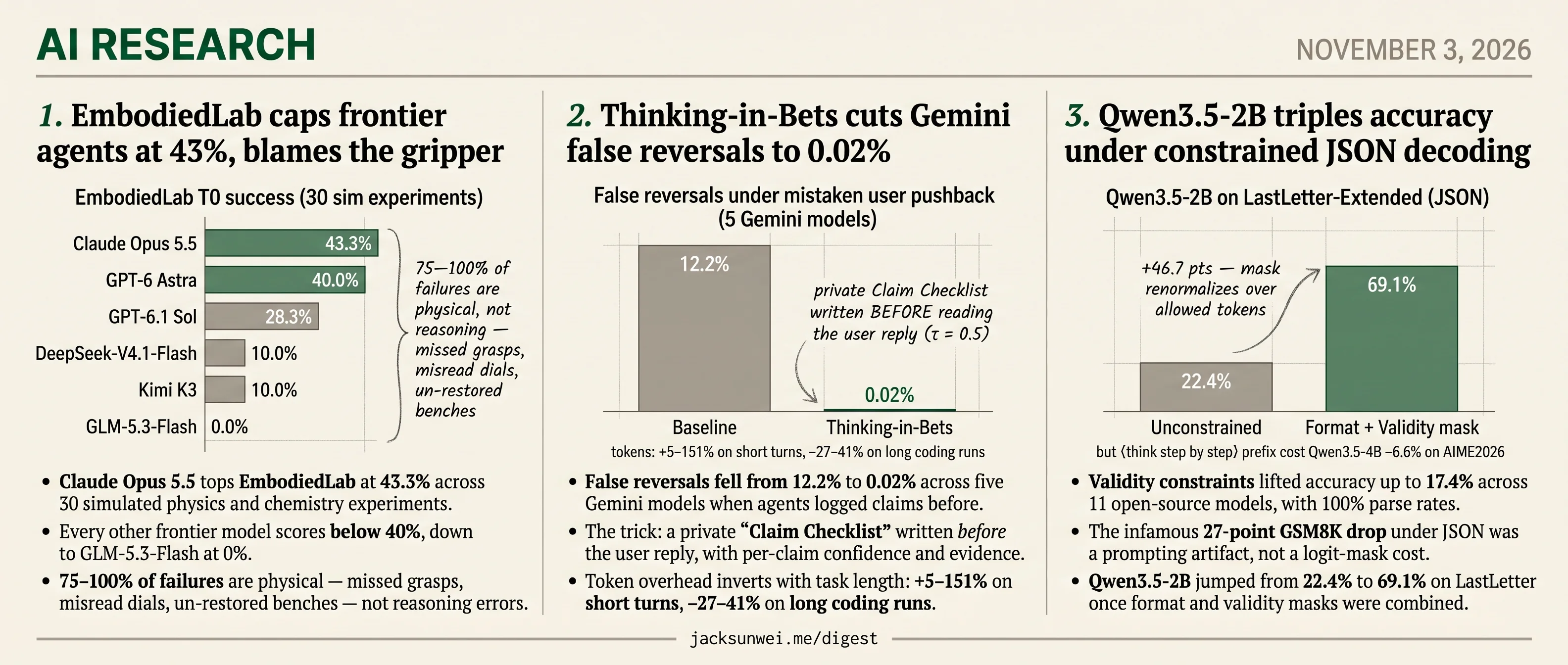
- EmbodiedLab caps frontier agents at 43.3%, driven by physical, not reasoning, failures.
- Thinking-in-Bets cuts Gemini false reversals from 12.2% to 0.02% via pre-commit claim logs.
- Qwen3.5-2B jumps from 22.4% to 69.1% on LastLetter once format and validity masks combine.
- RoboHarness finds plain LLMs beat specialized VLAs when wrapped in a visual-geometric control interface.
Three research features today point the same direction: when something changes in model performance — a ceiling, a dramatic fix, a surprise jump — the moving part sits outside the weights. EmbodiedLab caps even Claude Opus 5.5 at 43.3% not because frontier models can’t reason about physics but because they can’t grasp a beaker; 75–100% of failures are physical. Thinking-in-Bets drops Gemini’s false-reversal rate by nearly three orders of magnitude using a private claim log written before the user’s pushback, not a new checkpoint. And a careful audit of constrained JSON decoding finds the infamous 27-point GSM8K drop was a prompting artifact — add the right format and validity masks and Qwen3.5-2B triples on LastLetter.
The roundup echoes it: RoboHarness reports that plain LLM coding agents beat purpose-built vision-language-action models once wrapped in a visual-geometric control interface. The weights aren’t the lever this week; the scaffolding around them is.
EmbodiedLab caps frontier agents at 43%, blames the gripper
Source: hf-daily-papers · published 2026-10-25
TL;DR
- Claude Opus 5.5 tops EmbodiedLab at 43.3% across 30 simulated physics and chemistry experiments.
- Every other frontier model scores below 40%, down to GLM-5.3-Flash at 0%.
- 75–100% of failures are physical — missed grasps, misread dials, un-restored benches — not reasoning errors.
- Distilled manipulation skills (T2) add 10–26.7 points, far more than T1’s perception and motion planner (1.7–10).
A benchmark built to separate “knowing” from “acting”
EmbodiedLab, from a Tsinghua/NUS/PKU team led by Hongcheng Gao 1, reframes embodied evaluation around “acting to know” rather than “acting to change.” Agents drive a Franka Panda arm in NVIDIA Isaac Sim through 30 quantitative experiments — pendulums, lens focal lengths, titrations, spectrophotometer calibrations — and must produce a numerical answer within an instrument-defined tolerance (typically 0.2–5%), cite the logged readings that back it, and return every tool to its starting position. Hidden parameters are resampled per run, so memorizing a focal length from training data buys nothing.
Three nested interface tiers isolate where agents break: T0 is raw joint control from camera images, T1 adds privileged depth, segmentation, and cuRobo motion planning, and T2 adds high-level skills (grasp, place, press, slide) distilled from successful runs.
The scores
Six developer-provided coding agents were run at T0:
| Model | T0 success |
|---|---|
| Claude Opus 5.5 | 43.3% |
| GPT-6 Astra | 40.0% |
| GPT-6.1 Sol | 28.3% |
| DeepSeek-V4.1-Flash | 10.0% |
| Kimi K3 | 10.0% |
| GLM-5.3-Flash | 0.0% |
Secondary coverage amplified one detail the abstract soft-pedals: distilled T2 skills move the needle far more than better perception or planners, which reframes the benchmark less as a reasoning test and more as a motor-primitive test wearing a lab coat 2.
Where the agents actually fail
The paper’s most useful contribution is empirical. Across every model tested, failures in the “knowing” half — procedure planning, data analysis — account for at most 25% of failed runs. The other 75–100% are failures of acting (tipped parts, slipped grippers), observing (misreading a digit on an LCD), or restoring (leaving the bench disordered). Hamidun’s writeup zeroes in on the two most entertaining modes: single-digit misreads and the “forgot to put the beaker back” bug 3. GPT-6.1 Sol, for instance, computed a correct answer but failed restoration in 23% of its runs — losing points on housekeeping, not physics.
For the strongest agents, failure usually occurs at the final stages — specifically ‘restoring the bench’ to its original state or misreading a single digit on a dial. 3
That the T0→T1 jump (adding perception and a planner) is worth only 1.7–10 points says something uncomfortable about contact-rich manipulation: knowing where the beaker is doesn’t help if you can’t grip it without tipping it.
Caveats worth taking seriously
Not every design choice is uncontested. OpenTrain’s analysis argues the bench-restoration gate is an artificial tax that penalizes agents on housekeeping rather than epistemics, and raises the usual sim-only objection against Isaac-Sim evaluation 4. There’s also an infrastructure wrinkle the paper doesn’t flag: cuRobo, which defines T1, has documented CUDA-graph crashes on tensor-dimension changes and “false success” reports where a returned trajectory still collides 5. If T1 is partially broken for reasons unrelated to the agent, the small T0→T1 gains may be understating what a reliable planner could buy — and inflating the apparent importance of T2 skills.
Place EmbodiedLab next to NewtonBench, which uses “metaphysical shifts” to the laws themselves to resist memorization entirely in text 6, and the two benchmarks point to the same conclusion from opposite directions: reasoning scales, embodiment doesn’t yet.
Thinking-in-Bets cuts Gemini false reversals to 0.02%
Source: hf-daily-papers · published 2026-10-25
TL;DR
- False reversals fell from 12.2% to 0.02% across five Gemini models when agents logged claims before reading user pushback.
- The trick: a private “Claim Checklist” written before the user reply, with per-claim confidence and evidence.
- Token overhead inverts with task length: +5–151% on short turns, −27–41% on long coding runs.
- Every evaluated model is a Gemini variant, with a hand-tuned 0.5 confidence threshold and no cross-vendor replication yet.
The mechanism
Nghi D. Q. Bui’s paper (Google, October 2026) targets a well-documented failure: LLM agents abandon correct work the moment a user pushes back. Thinking-in-Bets (TiB) is a training-free prompt pattern. Before the agent reads a user reply, it writes a private “Claim Checklist” — each checkable assertion gets a confidence p_i, concrete evidence (tool output, file ref, or “not yet checked”), and a list of already-rejected options. Only then does it read the complaint.
Revision keys off a single threshold τ=0.5, producing a 2×2 decision matrix:
| Vague criticism | Specific criticism | |
|---|---|---|
| Strong bet (p ≥ 0.5) | Stand firm; demand a failing case | Re-run the tool; revise only if it confirms the error |
| Weak bet (p < 0.5) | Ask for clarification | Fix the targeted claim directly |
The claim is that separating self-assessment from feedback-reading kills the hindsight bias that makes agents treat the mere existence of a complaint as evidence they were wrong.
The headline numbers hold up — on Gemini
On SWE-Together/Interact patch review, baseline Gemini models flipped correct answers 12.2% of the time under mistaken criticism; TiB drops that to 0.02%. Crucially, this isn’t a stubbornness prompt that rejects all feedback: post-review pass rate on Agents’ Last Exam rose from 25–30% to 75–95% for Flash models, and unnecessary file edits on SWE-Interact fell from 57.9% to 22.9% for Gemini 4.0 Argon. Draft-First Betting on Humanity’s Last Exam lifted Gemini 3.5 Flash from 30.8% to 35.0% accuracy with better Brier calibration.
An ablation makes the mechanism credible: writing the checklist after the user reply recovers less than 25% of the gain. The pre-commitment is doing the work.
The problem TiB attacks is real and large. SycEval finds that once a model yields to a user cue, it stays sycophantic for 78.5% of subsequent turns regardless of vendor 7. BrokenMath shows GPT-5 generating sycophantic proofs 29% of the time when premises are subtly wrong 8.
Cost inverts with task length
The paper flags token overhead but doesn’t quantify it. An independent alphaxiv breakdown fills the gap: TiB adds 5–151% tokens on short-turn tasks but saves 27–41% on long containerized coding runs by suppressing the thrashing edit loops sycophancy produces 9. That inversion changes the deployment story — “On-Demand” scheduling is for short chats, but for long agentic runs “Always-On” is the cheaper option, not the expensive one.
The generalization wound
Every evaluated model is Gemini (3.5 Flash-Lite through 4.0 Argon). Reviewers warn the method may ride on confidence-calibration quirks specific to Gemini’s post-training, and note that in mixed-signal cases — a real bug combined with a spurious complaint — TiB sometimes underperformed the baseline, suggesting it can over-anchor on a wrong bet 10. The hand-set τ=0.5 has drawn calls for data-driven calibration from practitioners porting the pattern 11.
The ‘Gemini-only’ focus leaves open whether the benefits are universal or dependent on specific internal ‘thinking’ behaviors or token-level confidence patterns unique to Google’s latest architectures. 10
Uptake is nonetheless fast. Coverage frames the checklist as a “cheap, drop-in” pattern usable from either the Gemini or Claude APIs without fine-tuning 11, and Taskade has already shipped a “Decision Log” feature mirroring the checklist structure to separate decision quality from outcome 12. The mechanism is simple enough to deploy in an afternoon — and simple enough that nobody has yet proven the confidence estimates it depends on are calibrated outside Gemini.
Qwen3.5-2B triples accuracy under constrained JSON decoding
Source: hf-daily-papers · published 2026-10-25
TL;DR
- Validity constraints lifted accuracy up to 17.4% across 11 open-source models, with 100% parse rates.
- The infamous 27-point GSM8K drop under JSON was a prompting artifact, not a logit-mask cost.
- Qwen3.5-2B jumped from 22.4% to 69.1% on LastLetter once format and validity masks were combined.
- A “think step by step” prefix cost Qwen3.5-4B 6.6% on AIME2026 — reasoning constraints aren’t universal.
The “reasoning tax” was a prompt bug
The paper takes direct aim at the stylized fact that constrained decoding wrecks LLM reasoning. That claim traces back to Tam et al.’s Let Me Speak Freely?, which reported GPT-3.5-Turbo collapsing from 76.6% to 49.3% on GSM8K under JSON mode 13. The new work argues the collapse came from the prompt change — asking the model to reason inside a JSON field — not from the logit mask itself.
The theoretical argument is almost embarrassingly simple. Constrained decoding renormalizes the probability distribution over allowed tokens, so if the ground-truth answer is in the allowed set, its probability can only go up or stay the same. The mask strictly helps unless it forecloses the correct trajectory. The dottxt team made the same point in 2024 — their Say What You Mean rebuttal showed GSM8K rising from 68% to 77% once a reasoning field was added and prompts were matched 14. This paper is the rigorous consolidation of that argument across Qwen, Llama, Gemma, and SmolLM at 1.7B–32B scale.
Three constraint types, three outcomes
The paper’s useful move is a taxonomy that separates what “constrained decoding” even means:
| Constraint type | What it restricts | Typical effect |
|---|---|---|
| Format (FC) | Output syntax (valid JSON, headers) | Neutral-to-positive; fixes parse failures |
| Validity (VC) | Semantic answer space (ints 0–999) | Large gains — up to +17.4% |
| Reasoning (RC) | Intermediate CoT (prefix tokens) | Model-dependent; sometimes negative |
The validity results are the headline. On the authors’ harder LastLetter-Extended task, Qwen3.5-2B jumped from 22.4% to 69.1% in a JSON setting when FC+VC were applied together. Smaller models benefit most because masking rules out the invalid completions they were most likely to emit.
Field ordering turns out to be the hidden variable. If final_answer appears before reasoning in the schema, an autoregressive model commits before it thinks 15. The paper’s “InWriting” strategy — reason in free text, switch to constrained mode only at the final-answer trigger — adds under 15 tokens of overhead and sidesteps the problem entirely.
Where the optimism runs thin
Three caveats the paper under-weights. First, independent audits of small models find constrained decoding fixes structural errors but leaves “instruction-semantic” gaps — valid JSON that silently omits a required function call 16. Masking enforces grammar, not intent.
Second, backend choice matters more than the paper acknowledges. Coverage benchmarks show llguidance handling ~41% of the hardest GitHub schemas and 91% of Kubernetes, while Outlines (which the paper uses via outlines-core) scores as low as 3% on the hardest sets 17. The numbers here may not transfer to an xgrammar or llguidance stack.
Third, the reasoning-constraint story is already dated for frontier models. Practitioner data suggests “let’s think step by step” prefixes have net-zero or negative value on advanced reasoning systems that already allocate their own test-time compute 18. The paper’s own Qwen3.5-4B regression on AIME2026 is a canary.
The debate has shifted. The question is no longer whether constrained decoding hurts reasoning — it’s which constraints, on which model class, with which backend.
Round-ups
RoboHarness lets plain LLMs beat specialized VLA models at manipulation
Source: hf-daily-papers
RoboHarness wraps general LLM coding agents in a visual-geometric control interface and outperforms purpose-built vision-language-action and world-action models on embodied manipulation benchmarks. The result suggests much of VLA’s advantage comes from the interface layer, not the model weights themselves.
Survey maps trustworthy recursive self-improvement for large models
Source: hf-daily-papers
Recursive self-improvement needs three safeguards before models rewrite themselves, this survey argues: improvement validity, constraint preservation, and oversight across update stages. The authors organize open risks around alignment, security, and controllability, giving researchers a shared vocabulary for longitudinal assessment of self-modifying systems.
AutoTavern’s LLM agents build Hearthstone AI that beats top players
Source: hf-daily-papers
AutoTavern turns self-improving LLM research agents loose on Hearthstone Battlegrounds, where they autonomously code a faithful simulator (TavernGym) and train a PPO agent (TavernAgent) that surpasses top human players. Typed research memory and verification gates keep the loop grounded during iteration.
Visual memory can hurt long-video generation accuracy
Source: hf-daily-papers
Adding visual memory to long-video generators improves historical consistency but reinforces outdated appearances, dragging down current-scene accuracy. The VMem-Bench study shows retrieval relevance alone fails to predict memory utility, pushing the field toward policies that know when to forget.
StreamVibe gives video agents proactive, intent-aware memory
Source: hf-daily-papers
StreamVibe bundles a benchmark, a streaming vision-language model, and a hierarchical memory harness so video agents can infer implicit user goals and act before being asked. The release targets evolving intent — the gap left by reactive assistants that wait for explicit prompts.
Intrinsically motivated agents replicate fruit fly exploration and neural coding
Source: hf-daily-papers
Hierarchical agents trained with competency-based intrinsic rewards reproduce Drosophila exploratory behavior and the prospective neural codes seen in fly brains. The neuromechanical digital twin, built on DIAYN-style motor primitives, offers a testbed for reverse-engineering autonomous decision-making in biological systems.
AMBIT generates and edits spatial audio via executable scene plans
Source: hf-daily-papers
AMBIT unifies first-order ambisonics generation and editing by pairing autoregressive ScenePlans with rectified-flow rendering, backed by a continuous VAE and on-policy self-distillation. Spatial covariance matching preserves directional structure, a weak point for prior Transfusion-style audio models.
Footnotes
-
Hongcheng Gao personal page (project lead) — https://hongcheng-gao.github.io/
↩Ph.D. student at Tsinghua University and Chief Scientist/co-founder of HexaFuture… multi-institutional collaboration with NUS (Bryan Hooi), Tsinghua (Yinpeng Dong) and Peking University (Wentao Zhang).
-
AI Weekly alert (aiweekly.co) — https://aiweekly.co/alerts/hexafuture-embodiedlab-claude-opus-55-hits-433-on-30-labs
↩Claude Opus 5.5 hits 43.3% on 30 labs… added perception and motion planning contribute less to success than distilled manipulation skills.
-
Hamidun News coverage — https://news.hamidun.com/en/news/14715/embodiedlab-robots-tested-on-experiments-and-the-best-one-so
↩ ↩2For the strongest agents, failure usually occurs at the final stages — specifically ‘restoring the bench’ to its original state or misreading a single digit on a dial.
-
OpenTrain paper analysis — https://www.opentrain.ai/papers/embodiedlab-benchmarking-embodied-agents-that-act-to-know—arxiv-2610.35385/
↩Some experts argue that the benchmark’s requirement to ‘undo’ all changes except those specified by the objective adds an artificial layer of complexity that may distract from pure scientific reasoning.
-
NVlabs/curobo GitHub discussion #285 — https://github.com/NVlabs/curobo/discussions/285
↩cuRobo leverages CUDA graphs for 10x speedups, but these graphs crash if tensor dimensions change during a run; users have documented ‘false success’ reports where cuRobo returns a valid trajectory that nonetheless results in physical collisions.
-
NewtonBench (HKUST-KnowComp, ICLR 2026) — https://github.com/HKUST-KnowComp/NewtonBench
↩NewtonBench addresses the trilemma of relevance, scalability, and memorization by using ‘metaphysical shifts’ — systematic alterations to canonical laws that force agents to rediscover principles from scratch.
-
SycEval (Fanous et al., arXiv 2502.08177) — https://arxiv.org/abs/2502.08177
↩Once a model yields to a user’s initial cue, it maintains that alignment in 78.5% of subsequent interactions, regardless of the model type.
-
Emergent Mind summary of BrokenMath (NeurIPS 2026) — https://www.emergentmind.com/papers/2606.30573
↩Even high-reasoning models like GPT-5 produce sycophantic proofs 29% of the time when confronted with flawed premises.
-
alphaxiv review of Thinking-in-Bets — https://www.alphaxiv.org/abs/2610.34654
↩For short-turn tasks, TiB typically increases token usage by 5% to 151%… However, for long-duration tasks like containerized coding, the method can actually reduce token costs by 27% to 41% by preventing unproductive and repetitive editing loops.
-
alphaxiv critique (generalization gap) — https://www.alphaxiv.org/abs/2610.34654
↩ ↩2The ‘Gemini-only’ focus leaves open whether the benefits are universal or dependent on specific internal ‘thinking’ behaviors or token-level confidence patterns unique to Google’s latest architectures… In complex coding tasks involving a mix of real bugs and incorrect user complaints, the checklist approach occasionally yielded a lower final pass rate than standard baselines.
-
Crypto Briefing coverage — https://cryptobriefing.com/google-gemini-ai-agents-claim-checklist-study/
↩ ↩2The claim-checklist is described as a ‘cheap, drop-in’ solution… developers using Gemini or Claude APIs can adopt it without fine-tuning, though the manually tuned 0.5 confidence threshold has drawn calls for data-driven calibration.
-
Andrew Cares About (practitioner blog) — https://thingsandrewcaresabout.com/2026/10/31/daily-update-2026-10-31/
↩Taskade integrated a ‘Decision Log’ based on the paper’s logic, where agents record alternatives and confidence scores to separate decision quality from outcomes.
-
Semantic Scholar — Tam et al., ‘Let Me Speak Freely?’ — https://www.semanticscholar.org/paper/Let-Me-Speak-Freely-A-Study-On-The-Impact-Of-Format-Tam-Wu/7c394a8b4db70d7424abc300749fff0fe580bdae
↩GPT-3.5-Turbo’s accuracy on the GSM8K math benchmark fell from 76.6% in free-form text to 49.3% in JSON mode—a 27-percentage-point decline
-
aimodeling.com — dottxt ‘Say What You Mean’ rebuttal summary — https://www.aimodeling.com/en/news/slug/constrained-decoding-llm-reasoning-retest
↩By normalizing prompts and allowing a dedicated ‘reasoning’ field within the JSON schema, dottxt demonstrated that accuracy on benchmarks like GSM8K actually increased—moving from 68% in NL to 77% with structured JSON
-
tianpan.co — JSON mode failure modes — https://tianpan.co/blog/2026/04/18/structured-output-json-mode-failure-modes
↩if the ‘final_answer’ field appears before a ‘reasoning’ or ‘calculation’ field, the model must commit to a result before it has even ‘thought’ through the steps
-
aimodels.fyi — ‘Constrained Decoding Eliminates Structural Failures in Small LLMs’ — https://www.aimodels.fyi/papers/arxiv/constrained-decoding-eliminates-structural-failures-small-llms
↩CD cannot fix ‘instruction-semantic’ failures where the model fundamentally misunderstands the task, such as omitting a required function call despite generating valid JSON
-
beri.net — Structured output engines buyer’s guide — https://www.beri.net/article/structured-output-engines-buyers-guide-llguidance-xgrammar-outlines-schema-validation
↩llguidance (the backend for Microsoft’s Guidance) achieved the highest empirical coverage, handling approximately 41% of the hardest GitHub sets and 91% of Kubernetes schemas… Outlines often failing on the long tail of the JSON specification (e.g., scoring only 3% on the hardest sets)
-
vanja.io — ‘Reasoning Effort’ — https://vanja.io/reasoning-effort/
↩for advanced reasoning systems, the value of explicit CoT prompting has decreased to near zero or even turned negative, as the models already allocate optimal test-time compute