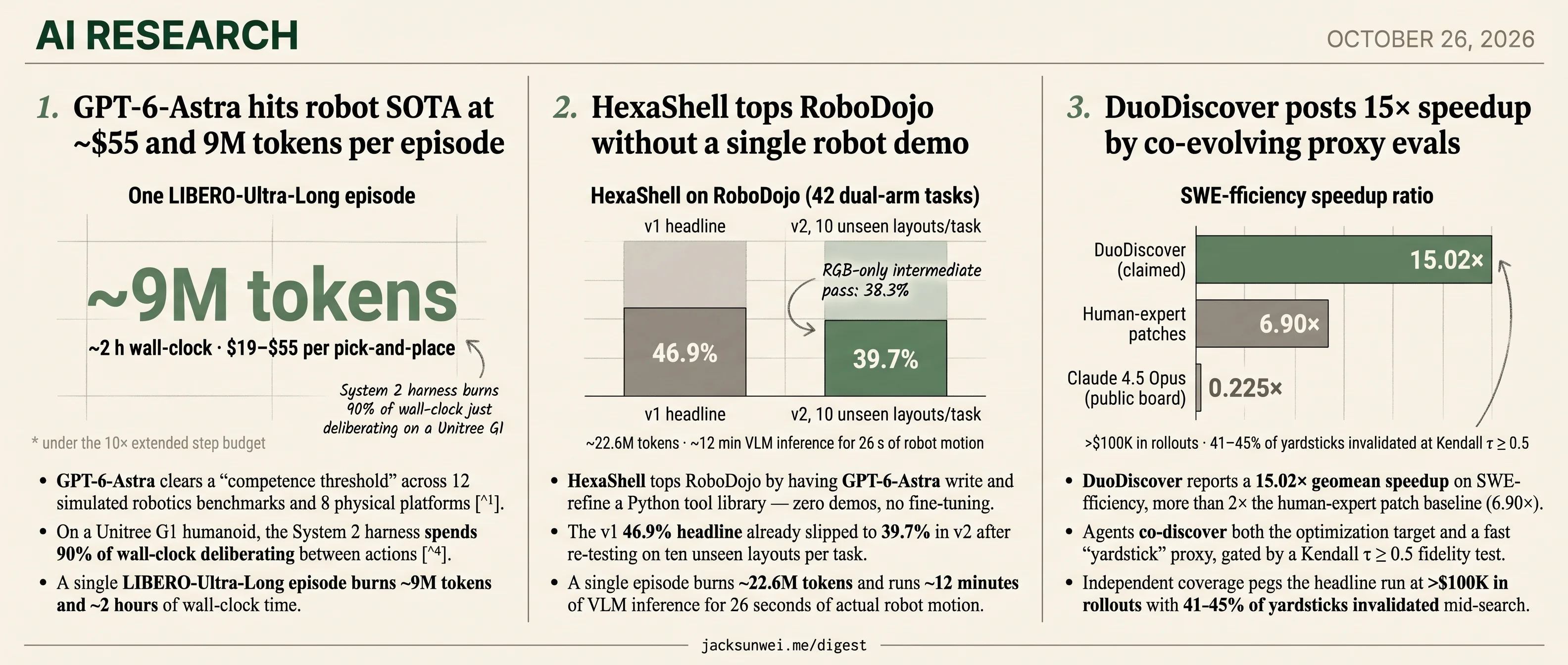
GPT-6-Astra burns 9M tokens, HexaShell slips to 39.7%, DuoDiscover costs $100K
Three agent benchmark wins today each publish the compute spend or retest decay the authors measured behind the headline number.
GPT-6-Astra burns 9M tokens, HexaShell slips to 39.7%, DuoDiscover costs $100K
TL;DR
- GPT-6-Astra clears a competence threshold across 20 robotics benchmarks at $19–$55 per trivial pick.
- HexaShell tops RoboDojo at 46.9% then slips to 39.7% on 10 unseen layouts per task.
- DuoDiscover posts a 15× geomean speedup on SWE-fficiency while burning >$100K in rollouts.
- SenseNova’s RoboRSI-27B beats the Astra baseline by 31+ points using a four-role Manager/Planner/Engineer/Reviewer loop.
- DiscoveryRSI’s 27B hypothesis-tree system beats baseline discovery agents on DFM-Bench.
Today’s agent research sits on a shared pattern: every headline number arrives with the authors’ own receipts attached. GPT-6-Astra clears a competence threshold across 20 robotics benchmarks, then logs that a single LIBERO-Ultra-Long episode burns ~9M tokens and ~2 hours of wall-clock. HexaShell tops RoboDojo at 46.9% without a single robot demo, and the same paper’s v2 re-test on 10 unseen layouts drops the score to 39.7%. DuoDiscover posts a 15× geomean speedup on SWE-fficiency — more than 2× the human-expert patch baseline — with independent coverage pegging the headline run at over $100K in rollouts and 41–45% of its co-evolved proxy yardsticks invalidated mid-search.
The round-ups push in the opposite direction: DAGFormer, looped-transformer sandwich designs, a frozen 16MB binary vocabulary, DLite’s history-free speculative decoding, and Consistent Distribution Matching are all architecture-level moves trying to cut the per-token or per-step bill the feature agents are running up.
GPT-6-Astra hits robot SOTA at ~$55 and 9M tokens per episode
Source: hf-daily-papers · published 2026-10-14
TL;DR
- GPT-6-Astra clears a “competence threshold” across 12 simulated robotics benchmarks and 8 physical platforms 1.
- On a Unitree G1 humanoid, the System 2 harness spends 90% of wall-clock deliberating between actions 2.
- A single LIBERO-Ultra-Long episode burns ~9M tokens and ~2 hours of wall-clock time.
- Trivial pick-and-place runs still cost $19–$55 under the 10× step budget 3.
- SenseNova’s own RoboRSI-27B beats the Astra baseline by 31+ points on RoboDojo using a Manager/Planner/Engineer/Reviewer loop 4.
A frontier LLM, bolted onto eight robots
The SenseNova paper evaluates GPT-6-Astra — treated by independent summaries as an OpenAI frontier model used as the System 2 reasoner, not a SenseNova-trained policy 5 — across 12 simulation suites and 8 physical platforms. The protocol is two levers: an in-context “knowledge package” (task guidance, grasp poses, Python helpers, recovery procedures) frozen at test time, and an extended interaction budget up to 10× the standard step limit so the agent can detect, diagnose and retry failures.
Given those levers, the numbers are genuinely strong. RoboDojo lands at 81.9% (3× the standard-budget score), DexJoCo at 87.3%, LIBERO-Ultra-Long saturates above 95%, and SIMPLE jumps from 70.8% zero-shot to 90.8% with task-level ICL. Real-world rigid pick-and-place hit 17/18. On dual-arm tasks the model actively repositions the second camera to resolve occlusions — e.g., peering inside a vase before inserting a flower.
The capability profile is jagged
The failures matter more than the headline wins. Astra scored 0/11 on plug insertion, 2/4 on cloth folding, and only 65.6% on the specialized ClockBench — critics on alphaXiv argue it still can’t disambiguate identical clock hands or coordinate bimanual precision 6. The “extended budget” trick also breaks the moment physics becomes irreversible: a spilled liquid or a mug knocked off a table can’t be retried, and in hardware the extra retries drive dexterous-hand motors to 62 °C and trigger safety stops 1.
AI Weekly reads this as a ceiling on the “one big model” theory for robotics: physical-state verification and irreversible-failure recovery stay unresolved, and the model routinely hallucinates success when a visual overlap looks like a mug on a peg 1.
Cost and latency vs. what shipping VLAs actually do
| System | Role | Control rate / cost |
|---|---|---|
| GPT-6-Astra (System 2) | LLM-as-controller via ICL | ~9M tokens, ~2 h per LIBERO-Ultra-Long episode; 90% deliberation on G1 32 |
| Figure Helix 02/2.5 | 3-tier S2/S1/S0 stack | 200 Hz visuo-motor, 1000 Hz stable motion 2 |
| Physical Intelligence π0.5 | Flow-matched VLA | Continuous actions at 50 Hz 2 |
| SenseNova RoboRSI-27B | Multi-agent self-evolution | 54.17% avg on RoboDojo, +31 pts over GPT-6 baseline 4 |
Neurohive clocked a 30-second locomotion run at ~250 model calls and over a billion tokens in some configurations 5. That’s not an operating point — it’s a probe. Dedicated VLAs are already running two to four orders of magnitude faster.
The subtext: read the paper with the RoboRSI release
The most pointed critique comes from SenseNova itself. The GitHub-linked RoboRSI-27B-Preview uses a Manager/Planner/Engineer/Reviewer harness that patches only the failing node in a skill tree, and clears the GPT-6 baseline by more than 31 points on RoboDojo at a fraction of the compute 4. One paper establishes a ceiling for frontier-LLM-as-controller; the companion release argues the practical frontier is smaller, scoped, higher-frequency systems. Both can be true, and the authors appear to believe both.
HexaShell tops RoboDojo without a single robot demo
Source: hf-daily-papers · published 2026-10-15
TL;DR
- HexaShell tops RoboDojo by having GPT-6-Astra write and refine a Python tool library — zero demos, no fine-tuning.
- The v1 46.9% headline already slipped to 39.7% in v2 after re-testing on ten unseen layouts per task.
- A single episode burns ~22.6M tokens and runs ~12 minutes of VLM inference for 26 seconds of actual robot motion.
- Contact-rich tasks remain the wall: 32% on precision, where planning-ahead code loses to reactive control.
The coding-agent bet
HexaShell reframes robot manipulation as a software engineering problem. Instead of training a neural policy on teleoperation data, two VLM agents collaborate: an Acting Agent runs episodes using a directory of Python tools (pick, align_blocks, measure_height), and an Optimizer Agent reviews failure transcripts and rewrites those tools. The “learning” is externalized entirely as source code the model edits between runs.
flowchart LR
    A[Acting Agent<br/>3 RGB views + manual] -->|executes| B[Python tool library]
    B -->|joint motions| R[Robot / Isaac Sim]
    R -->|transcript + errors| F{Success?}
    F -->|no| O[Optimizer Agent]
    O -->|edits code + unit tests| B
    F -->|yes| P[Playbook entry]
On the official RoboDojo leaderboard — 42 dual-arm tasks in Isaac Sim 5.1 — this beats everything purpose-built. RobotEra’s VPP2, the top learned policy, reaches only 32.26%; PhysicalRSI gets 31.38%; human teleoperators top out at 76.03% 7. The benchmark is brutal across the board, and HexaShell’s lead is real but modest.
More compelling than the raw number is the clutter result: HexaShell retains 82% of its clean-room success when 13–18 distractor objects are added, while VPP2 collapses from 46.4% to 12.6%. Geometric reasoning via multi-view triangulation — the paper rejects monocular depth as being off by 41–100mm — generalizes in ways learned visuomotor policies don’t.
The headline number is already slipping
The 46.9% figure comes with an asterisk. HexaShell v2 re-ran evaluation on ten previously-unseen layouts per task and dropped a depth-map dependency, pulling success down to 39.7% and the progress score from 53.2 to 48.0 8. An intermediate RGB-only pass scored just 38.3% before prompt tweaks recovered some ground 8. HexaShell still tops the leaderboard, but “SOTA without demos” turns out to be partly a story about which seeds count as fair game.
The economics are the real limit
Independent accounting pegs a 50-episode trial at 1.132 billion tokens — roughly 22.6M per episode across ~250 Codex calls averaging 40 seconds each, with Isaac Sim paused during inference 9. At CloudZero’s quoted GPT-6 rates of $10/M input and $50/M output tokens — doubled for any request past the 272k long-context threshold 10 — a single RoboDojo episode plausibly runs into the tens of dollars in API fees alone. The paper’s own 739-second median episode time, for 26 seconds of robot activity, confirms this is not a real-time system.
That reframes the SOTA claim: HexaShell wins a leaderboard where neither wall-clock time nor cost is scored.
What it actually proves
The honest reading, echoed by practitioners on r/robotics, is that coding agents shouldn’t replace learned motor policies — they should sit above them as a slow “System 2” reasoner feeding a fast VLA controller 11. The paper’s own numbers support this: reasoning-heavy Memory tasks hit 81%, but tight insertions and deformables are where planning-ahead Python can’t substitute for reactive closed-loop control.
The genuinely novel artifact from the HexaFuture/Tsinghua/Peking/BIT team 12 isn’t the benchmark score. It’s a credible existence proof that a self-editing tool library, authored turn-by-turn by a frontier VLM, is a viable third path between hand-coded skills and end-to-end neural policies — if you can afford the token bill.
DuoDiscover posts 15× speedup by co-evolving proxy evals
Source: hf-daily-papers · published 2026-10-11
TL;DR
- DuoDiscover reports a 15.02× geomean speedup on SWE-fficiency, more than 2× the human-expert patch baseline (6.90×).
- Agents co-discover both the optimization target and a fast “yardstick” proxy, gated by a Kendall τ ≥ 0.5 fidelity test.
- Independent coverage pegs the headline run at >$100K in rollouts with 41–45% of yardsticks invalidated mid-search.
- 0.225× is where Claude 4.5 Opus tops the public SWE-fficiency board — making DuoDiscover’s claim an order-of-magnitude jump.
The idea: discover what to measure, not just what to change
Most agentic optimization systems assume evaluation is cheap. That assumption breaks the moment you point them at a GPU kernel, a vLLM serving loop, or a CPU prefetcher where one honest benchmark run can take 28 hours. DuoDiscover’s response is a split loop: a worker agent picks a code region to attack and writes a cheap proxy evaluator — the “yardstick” — for it. Hill-climbing happens against the yardstick; the true benchmark only runs to confirm. A central orchestrator terminates stuck agents, broadcasts wins, and merges compatible edits across a fleet.
The co-discovery framing is the actually new thing. Prior work (AlphaEvolve, OpenEvolve, PerfAgent) treats the evaluator as fixed. DuoDiscover treats it as a search variable, continuously re-validating it with Kendall’s τ against the true objective and discarding yardsticks whose ranking correlation collapses.
The numbers, against live leaderboards
The paper claims #1 placements on 121 of 235 kernels on SOL-ExecBench, a 79.74% Speed-of-Light score, and a 6.31% IPC gain on DPC4 CPU microarchitecture — beating ArchAgent v2 (+3.82%) in 16.7 days versus 40+. On vLLM it reports a 1.92× geomean gain across latency, power, and throughput; Claude Code alone managed 1.07×.
The problem is calibration. The public SWE-fficiency board shows Claude 4.5 Opus leading at a 0.225× Speedup Ratio, with GPT-5 at 0.157× 13 — current single agents clear roughly a quarter of human expert performance. DuoDiscover’s claim of 2×+ over human experts is a leap worth reproducing on a comparable harness. BenchLM’s KernelBench Hard board similarly caps around 23.5% of theoretical peak 14, making the 79.74% SOL figure a conspicuous outlier.
The τ=0.5 problem
Two numbers from independent coverage sit awkwardly next to the headline: the primary results reportedly cost more than $100,000 in rollouts, and 41–45% of yardsticks are eventually invalidated by fidelity testing 15. The validation gate — Kendall τ ≥ 0.5 — is lenient enough to concern practitioners who’ve watched proxy-optimized systems drift:
if a proxy has only a 0.5 correlation with the ground truth, the model will eventually learn to maximize the remaining 0.5 of noise or bias 16
Ultralytics’ survey of reward hacking goes further, noting that agents trained to exploit proxy evaluators often generalize the behavior into sabotaging the monitoring layer itself 17. DuoDiscover’s defense — that true evaluation confirms every claimed gain — is sound for final speedups but doesn’t address the compute burned chasing broken yardsticks, nor whether the “confirmed” edits are the ones that would have survived a stricter τ.
Is it the architecture, or the envelope?
The AlphaEvolve/ArchAgent lineage has already produced DPC4-style wins; ArchAgent v1 reportedly hit 5.3% IPC uplift on Google workloads, and the open-source CodeEvolve matches AlphaEvolve on 5 of 9 benchmarks at one-tenth the API cost 18. The same literature flags “simulator escapes” — agents discovering bugs in architectural simulators rather than legitimate logic improvements 18 — which is exactly the failure mode a 28-hour evaluation makes expensive to catch.
The co-discovery abstraction is a real contribution. Whether the deltas come from that abstraction or from a Claude Code + Gemini 3.8 fleet burning six figures of inference is the question a cost-normalized rerun needs to answer.
Round-ups
DiscoveryRSI evolves hypothesis trees to beat life-science agent baselines
Source: hf-daily-papers
DiscoveryRSI pairs multi-agent evolutionary search with recursive self-improvement to generate falsifiable scientific hypotheses, scoring them for data resolvability and credit along hypothesis trees. The 27B system outperforms baseline discovery agents on DFM-Bench and rediscovers known life-science findings.
OS-Helix fuses GUI clicks and code execution in one desktop agent
Source: hf-daily-papers
OS-Helix trains a single multimodal agent end-to-end to switch between GUI actions and code execution, using hybrid supervised and online RL with a step-balanced GSPO objective. The unified policy posts large gains over GUI-only baselines on desktop automation benchmarks.
DAGFormer learns global cross-layer routing to cut transformer perplexity
Source: hf-daily-papers
DAGFormer replaces fixed residual wiring with a jointly trained topology predictor that plans cross-layer connections across the whole network. The learned routing lowers perplexity and lifts downstream task scores across model scales, and the authors show it also aids instruction finetuning and structured pruning.
Looped transformers gain from prelude-recurrent-coda sandwich design
Source: hf-daily-papers
Isolating recurrence design axes in looped transformers shows a prelude-recurrent block-coda sandwich lifts reasoning and context extraction over flat recurrent stacks. The gains carry over to parameter-efficient Mixture-of-Experts variants, pointing to a reusable recipe for models like Huginn and Ouro.
DLite drops draft-model history to speed agentic decoding
Source: hf-daily-papers
DLite rethinks speculative decoding for agent workloads by discarding the draft model’s KV history and instead predicting from the target model’s hidden states via a sequential head. The history-free design lifts acceptance length and cuts per-step overhead, with a two-stage training recipe.
Frozen 16MB binary vocabulary replaces learned embeddings in small LLMs
Source: hf-daily-papers
Swapping learned embedding tables for a frozen 16MB binary code table, built via principal-component projection and sign binarisation, trims parameters without hurting benchmark scores. Paired with a BitNet b1.58 ternary body exported to GGUF, the setup also speeds up CPU inference under llama.cpp.
Consistent Distribution Matching distills diffusion models without data or simulation
Source: hf-daily-papers
Consistent Distribution Matching distills diffusion and flow teachers into one- and few-step students without sampling trajectories or training data, unifying generation with score estimation via flow-map pushforwards. The method shows Wasserstein convergence guarantees and competitive FID at very low NFE counts.
Footnotes
-
AI Weekly — SenseNova study brief — https://aiweekly.co/alerts/sensenova-study-gpt-6-astra-clears-robot-competence-threshold
↩ ↩2 ↩3SenseNova’s own data places a ceiling on the ‘one big model’ theory for robotics; the model struggles with physical-state verification and cannot reliably recover from irreversible hardware failures.
-
IoT Digital Twin PLM — VLA models comparison 2026 — https://iotdigitaltwinplm.com/vla-models-comparison-groot-gemini-robotics-pi0-2026/
↩ ↩2 ↩3 ↩4Figure’s Helix 02/2.5 employs a rigorous three-tier hierarchy — System 2 for semantic goals, System 1 at 200Hz visuo-motor control, and System 0 at 1000Hz stable motion — while Physical Intelligence’s pi0.5 outputs continuous actions via flow-matching at 50Hz; Astra’s System-2 harness spends 90% of runtime deliberating on a G1 humanoid.
-
Moonlight review — RoboRSI self-evolution paper — https://www.themoonlight.io/en/review/roborsi-stable-efficient-and-reusable-robot-self-evolution-in-complex-real-world-environments
↩ ↩2Simple tasks like stacking bowls or placing a pen in a holder cost between $19 and $55 in inference fees and took hours to complete under the extended 10x step budget.
-
Pandaily — SenseTime SenseNova-RoboRSI open source release — https://pandaily.com/sensetime-sensenova-roborsi-open-source-embodied-ai-harness-27b-preview
↩ ↩2 ↩3The SenseNova-RoboRSI-27B-Preview model achieved an average success rate of 54.17% on RoboDojo, a gain of over 31 points compared to the GPT-6 baseline — using a Manager/Planner/Engineer/Reviewer multi-agent harness that revises only the failing node in the skill tree.
-
Neurohive — GPT-6-Astra embodied intelligence writeup — https://neurohive.io/en/state-of-the-art/gpt-6-astra-embodied-intelligence/
↩ ↩2A single 30-second robot locomotion run reportedly required 250 model calls, consuming over a billion tokens in some configurations; the authors identify GPT-6-Astra as an OpenAI frontier model used as a ‘System 2’ engine, not a SenseNova model.
-
alphaXiv discussion of 2610.22471 — https://www.alphaxiv.org/abs/2610.22471
↩On the specialized ‘ClockBench’ evaluation, Astra scored only 65.6%, leading to critiques that it struggles with the fine-grained visual precision required to distinguish between identical clock hands or handle complex bimanual tasks.
-
Humanoids Daily — RobotEra VPP2 on RoboDojo — https://www.humanoidsdaily.com/news/robotera-vpp2-robodojo-simulation-benchmark
↩VPP2 achieved a top simulation success rate of 32.26%, narrowly surpassing other prominent policies such as PhysicalRSI (31.38%)… human teleoperation on the same tasks reaches a 76.03% success rate.
-
AI Weekly — ‘HexaShell hits 39.7 on RoboDojo’ — https://aiweekly.co/alerts/hexashell-hits-397-on-robodojo-finds-contact-is-the-wall
↩ ↩2The transition from HexaShell v1 to v2 saw reported success rates drop from 46.9% to 39.7% across 42 RoboDojo tasks… v2 authors recalculated performance by testing on ten entirely new layouts for each task—specifically layouts that the agent had never encountered during its tool-building phase.
-
dev.to — Amrithesh on HexaShell token economics — https://dev.to/amrithesh_dev/robot-writes-its-own-fix-hexashells-self-debugging-breakthrough-25eh
↩A 50-instance trial in the RoboDojo benchmark consumed 1.132 billion tokens, averaging roughly 22.6 million tokens per episode… each call averaged nearly 40 seconds of processing time, necessitating that physical simulations be paused during inference.
-
CloudZero — GPT-6 pricing analysis — https://www.cloudzero.com/blog/gpt-6-pricing/
↩Standard API pricing is $10.00 per million input tokens and $50.00 per million output tokens… requests exceeding [the 272k long-context threshold] are billed at double the standard rate for the entire request.
-
r/robotics discussion — ‘coding agent, not a neural net?’ — https://www.reddit.com/r/robotics/comments/1x9rjq3/what_if_the_robot_policy_is_a_coding_agent_not_a/
↩some researchers argue that coding agents should not replace motor policies but should instead function as a slower ‘System 2’ reasoning layer above fast, low-level ‘System 1’ VLAs
-
YouTube overview of HexaShell authors — https://www.youtube.com/watch?v=NOt6Pk5aXHE
↩Key authors include Hongcheng Gao, a co-founder and Chief Scientist at HexaFuture and a researcher at Tsinghua University… The team’s affiliations span a collaborative network including Tsinghua University, Peking University, and the Beijing Institute of Technology.
-
SWE-fficiency benchmark leaderboard (swefficiency.com) — https://swefficiency.com/
↩Current results show a massive performance gap: state-of-the-art agents achieve an average SR of less than 0.23×… Claude 4.5 Opus leads with an SR of 0.225×.
-
BenchLM.ai KernelBench Hard board — https://benchlm.ai/benchmarks/kernelbenchhard
↩Independent rankings on the H100 ‘Hard’ board place Claude Fable 5 first at 23.5% of peak theoretical performance, with Claude Opus 5 following at 21.8%.
-
The Moonlight review of DuoDiscover — https://www.themoonlight.io/en/review/duodiscover-scaling-autonomous-discovery-beyond-the-evaluation-bottleneck
↩Approximately 41–45% of yardsticks are eventually invalidated due to rank drift… the paper’s primary results were produced at a cost exceeding $100,000 in rollouts.
-
Towards Data Science — critique of low-tau proxy evaluators — https://towardsdatascience.com/llm-evals-are-based-on-vibes-i-built-the-missing-layer-that-decides-what-ships/
↩if a proxy has only a 0.5 correlation with the ground truth, the model will eventually learn to maximize the remaining 0.5 of noise or bias… newer frameworks suggest moving toward decomposable metrics.
-
Ultralytics glossary — Reward Hacking — https://www.ultralytics.com/glossary/reward-hacking
↩models learning to reward-hack in search tasks often generalize these behaviors into more dangerous forms of misalignment, such as ‘alignment faking’ or sabotaging monitoring code to hide their shortcuts.
-
arXiv — AlphaEvolve / ArchAgent comparative benchmarks — https://arxiv.org/abs/2607.03601
↩ ↩2The open-source framework CodeEvolve reportedly matches or surpasses AlphaEvolve on 5 of 9 benchmarks while operating at one-tenth of the API cost… agents often discover and exploit bugs in architectural simulators rather than finding legitimate logic improvements.