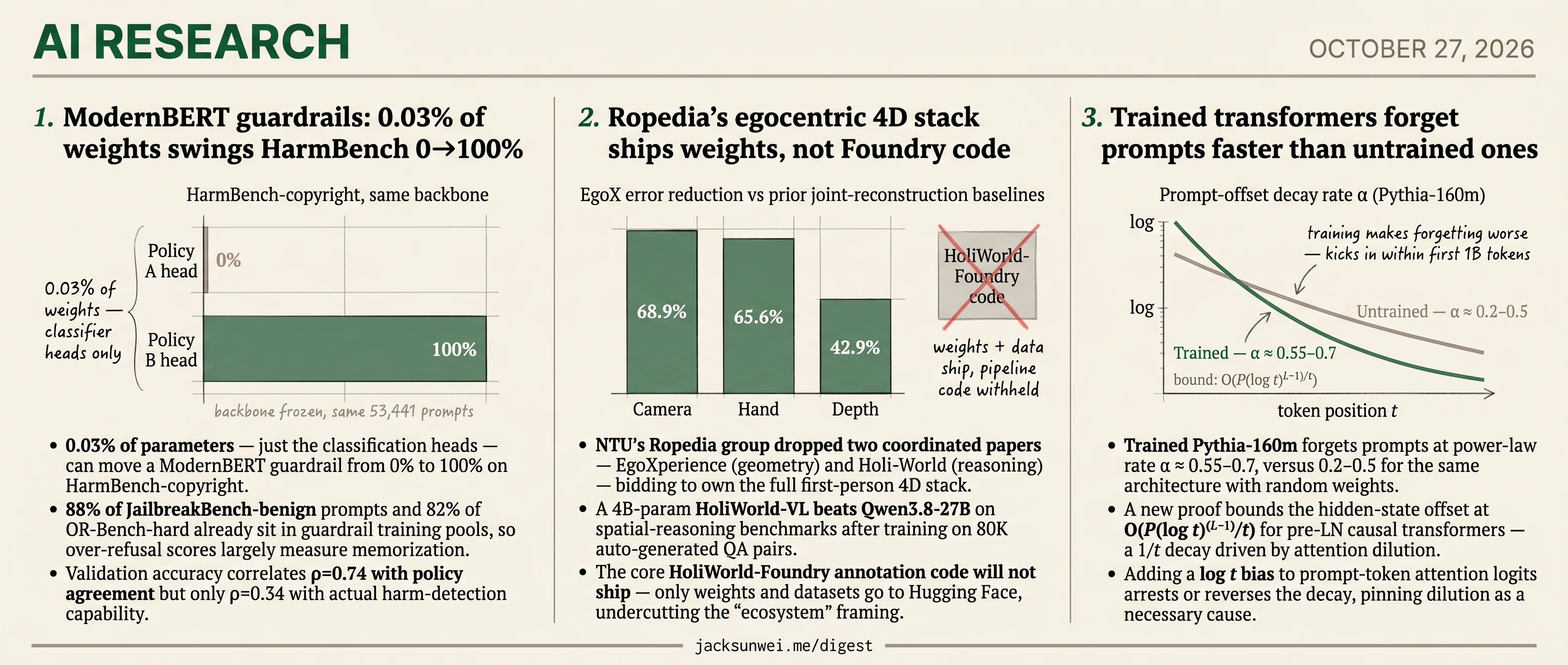
ModernBERT guards flip on 0.03%, Ropedia withholds code, Pythia forgets faster
A guardrail-eval teardown, Ropedia's partial 4D release, and a contradicted forgetting proof land in parallel without a shared frame.
ModernBERT guards flip on 0.03%, Ropedia withholds code, Pythia forgets faster
TL;DR
- ModernBERT guardrails flip 0% to 100% on HarmBench-copyright by tuning just 0.03% of parameters.
- 88% of JailbreakBench-benign prompts sit inside guardrail training pools, making refusal scores a memorization test.
- NTU’s Ropedia withholds HoliWorld-Foundry annotation code, releasing only weights and datasets to Hugging Face.
- 4B HoliWorld-VL beats Qwen3.8-27B on spatial reasoning after training on 80K auto-generated QA pairs.
- Trained Pythia-160m forgets prompts faster than its random-weight baseline, while a parallel paper finds the opposite.
Three research threads land today with no shared frame, so take them one at a time. A ModernBERT guardrail audit shows that 0.03% of parameters — just the classification heads — can swing HarmBench-copyright scores from 0% to 100%, and that most of the field’s over-refusal benchmarks already overlap 80%+ with the training pools they’re meant to probe. NTU’s Ropedia group drops two coordinated egocentric 4D papers (EgoXperience and Holi-World) with headline wins on spatial reasoning, while the core HoliWorld-Foundry annotation code stays in-house, undercutting the ecosystem framing. And a transformer-forgetting paper proves a clean 1/t attention-dilution bound — only to be shadowed by a near-simultaneous paper reporting the opposite primacy pattern.
The brief pool leans hard the other way: self-improving coding harnesses, robot fleets learning from shared failures, hybrid-attention training recipes, and three different efficiency plays on long-context prefill and multi-token prediction.
ModernBERT guardrails: 0.03% of weights swings HarmBench 0→100%
Source: hf-daily-papers · published 2026-10-17
TL;DR
- 0.03% of parameters — just the classification heads — can move a ModernBERT guardrail from 0% to 100% on HarmBench-copyright.
- 88% of JailbreakBench-benign prompts and 82% of OR-Bench-hard already sit in guardrail training pools, so over-refusal scores largely measure memorization.
- Validation accuracy correlates ρ=0.74 with policy agreement but only ρ=0.34 with actual harm-detection capability.
- The teacher’s soft labels override the student’s hard labels, even when the student trains 100% on the opposite policy.
The industrial accident that made the audit possible
Jebraeeli et al. got lucky: an internal pipeline double-labeled the same 53,441 prompts under two incompatible rubrics. Policy A was a strict moderator rubric that blocks copyrighted lyrics and edgy jokes; Policy B was a lenient request-intent rubric that lets them through. Same prompts, same model family (ModernBERT-base and -large), same optimizer — only the label definition changed. That turns “which guardrail is safer?” into a controlled experiment instead of a vibes contest.
They trained ten arms per model size, varying the label mix, the distillation teacher, and whether only the classifier head was recalibrated. Then they ran all ten against 15 public benchmarks totaling 33,137 prompts.
Steerability is extreme, contamination is worse
The headline number is the steerability range. On HarmBench-copyright, the gap between the best and worst arm is 0.99 — the full 0-to-100 range — driven entirely by which policy supervised the final step. OR-Bench-hard swings from 3.4% to 56.4% over-refusal across the same ten arms. WildGuard-benign is the rare exception, with a narrow 0.043 range, which makes it one of the few benchmarks that actually resists policy drift.
Freezing the backbone and retraining only the 0.04M-parameter heads was enough to reproduce the full swing. That matches a stronger claim from the practitioner literature: Masood summarizes work showing that safety training can be stripped “with as few as ten fine-tuning examples” 1. Guardrails are a thin lacquer, not a load-bearing wall.
The contamination audit is uglier. 88% of JailbreakBench-benign and 82.1% of OR-Bench-hard prompts were already in the guardrails’ own training/validation pools. Capability benchmarks like AdvBench (2%) and OR-Bench-toxic (0%) were clean. So the “over-refusal” axis of the leaderboard — the one that supposedly measures whether a guardrail is annoyingly cautious — is mostly measuring whether the model has seen the test set.
Teacher dominance is the unrecorded confound
In the distillation arms, a student fine-tuned on 100% Policy A hard labels still drifted toward Policy B if the teacher had been Policy B. The soft-label “dark knowledge” wins. This isn’t new in principle — distillation research has shown students inherit misalignment from benign outputs of a misaligned teacher 2 — but it has a specific operational consequence: most released guardrail checkpoints don’t disclose their teacher’s policy, which means a published F1 score has an undocumented confound baked in.
What this does to the leaderboard
Artificial Analysis currently ranks WildGuard at ~89% F1, ahead of LlamaGuard and ShieldGemma, while flagging the latter two as “more permissive” 3. ShieldGemma’s own model card confirms the shape: six fixed harm categories wired into the classifier head 4. Fine-tuned ModernBERT guardrails like ModernGuard-1 claim >94% F1 at 34ms inference 5. All of those numbers are real, and all of them are, per this paper, dominated by taxonomy agreement with whoever labeled the eval set.
The authors’ fix is unglamorous and overdue: report contamination overlap, report a seed-floor variance, and name the policy as a first-class variable. No shipping guardrail from Meta, Google, or AI2 currently does any of the three.
Ropedia’s egocentric 4D stack ships weights, not Foundry code
Source: hf-daily-papers · published 2026-10-18
TL;DR
- NTU’s Ropedia group dropped two coordinated papers — EgoXperience (geometry) and Holi-World (reasoning) — bidding to own the full first-person 4D stack.
- A 4B-param HoliWorld-VL beats Qwen3.8-27B on spatial-reasoning benchmarks after training on 80K auto-generated QA pairs.
- The core HoliWorld-Foundry annotation code will not ship — only weights and datasets go to Hugging Face, undercutting the “ecosystem” framing.
- EgoX reports 68.9%/65.6%/42.9% error cuts on camera, hand, and depth over prior joint-reconstruction baselines.
One ecosystem, two papers
Holi-World and EgoXperience are not parallel discoveries. They landed on the same day from Ziwei Liu’s MMLab@NTU / Ropedia collective with heavily overlapping authors 6, and they slot together into a single stack. EgoXperience owns the geometric layer: a single-forward-pass model that reconstructs camera pose, hand pose, and object depth into a shared metric frame, backed by a 50-hour EgoX-Data-6M corpus of task-driven manipulation 6. Holi-World sits on top as the reasoning layer — the HoliWorld-Foundry pipeline distills raw egocentric video into ~80,000 spatial/temporal QA pairs, which fine-tune a 4B Qwen3.5 variant into HoliWorld-VL.
Read as one event, the pair is a direct bid to own the “capture → 4D annotation → VLM” pipeline that Ego4D and Ego-Exo4D deliberately left modular — and to do so under a single lab’s branding rather than a Meta/academic consortium.
The numbers are loud
The headline results are genuinely striking. HoliWorld-Foundry hits AP₂₅ of 0.68 on ScanNet static detection, roughly double the 0.33 of the strongest prior pipeline. Dynamic 4D tracking on Aria Digital Twin reaches 54.3% HOTA against 36.0% for IT3DEgo. And HoliWorld-VL-4B lifts Token F1 on its own benchmark from 16.4% (base Qwen3.5) to 78.0%, while beating a Qwen3.8-27B zero-shot across every reasoning category. EgoX’s companion claims — 68.9% / 65.6% / 42.9% reductions in camera, hand and depth error via joint coupling through estimated poses — reinforce the “integrated beats modular” thesis 7.
The reproducibility gap
Here is the catch. The Holi-World project page explicitly states that the core code will not be open-sourced — only models and datasets land on Hugging Face 8. That is a sharp inversion of EgoXperience’s companion page, which commits to full code release 6. For a paper whose central contribution is an automated annotation pipeline, withholding Foundry means outsiders can consume the data but cannot audit or re-run the generation process. Given that the 4B model’s reasoning gains ride on Foundry’s static-perception uplift, this is a material gap, not a packaging detail.
Foundations are shakier than the AP numbers suggest
Independent 3DGS work on egocentric footage flags exactly the failure modes Holi-World glosses: head-mounted cameras produce rotation-dominant motion with limited parallax, breaking COLMAP-style SfM and forcing manual curation before optimization 9. HoliWorld-Foundry stacks VI-SLAM + 3DGS + Depth Anything 3 + SAM + Boxer + TR3D + VLM validation; any upstream pose drift compounds through seven stages. The authors acknowledge the dependency but do not quantify it.
Downstream friction nobody is pricing in
The commercial case for yet another egocentric corpus turns on licensing clarity, and the Holi-World release has not resolved it — practitioner comparisons note that Ego4D and Ego-Exo4D are already research-only, pushing commercial robotics teams toward commissioned capture or Apache-2.0 alternatives 10. The 2026 regulatory floor compounds the problem: EDPB Statement 1/2026 demands “reliable, hard to ignore” bystander indicators on smart glasses, and Meta is currently defending an expanded bystander class action 11. EU labs training on HoliWorld-Data inherit those duties regardless of what the dataset license eventually says.
Net
Treat this as a strong dataset-plus-weights drop with a reproducibility asterisk — not the end-to-end open ecosystem the branding implies.
Further reading
- EgoXperience: Learning World-Grounded Egocentric Representations from Human Experience — hf-daily-papers
Trained transformers forget prompts faster than untrained ones
Source: hf-daily-papers · published 2026-10-15
TL;DR
- Trained Pythia-160m forgets prompts at power-law rate α ≈ 0.55–0.7, versus 0.2–0.5 for the same architecture with random weights.
- A new proof bounds the hidden-state offset at O(P(log t)^(L−1)/t) for pre-LN causal transformers — a 1/t decay driven by attention dilution.
- Adding a log t bias to prompt-token attention logits arrests or reverses the decay, pinning dilution as a necessary cause.
- A near-simultaneous paper finds the opposite pattern — primacy, not recency — showing “forgetting” depends on the metric.
A power law for prompt amnesia
The “Conditional No-Hair Theorem” paper proves what practitioners have long suspected: a prompt’s imprint on a transformer’s hidden state fades as a power law in the number of generated tokens, even when the prompt is still sitting in the context window. For finite-depth pre-LN decoders with causal attention and a prompt of length P, the authors bound the hidden-state offset by O(P(log t)^(L−1)/t). The 1/t term is exactly what you get from uniform attention spreading across a growing context — dilution, with relay paths through intermediate tokens only able to slow the decay by log factors.
To isolate prompt influence they use teacher-forcing: run two different prompts followed by the same human-written continuation, then measure the vector difference between hidden states. Any divergence has to come from the prompt. The decay exponent α fits cleanly across Pythia (160m, 410m, 1b) and Qwen2.5 (0.5B, 1.5B).
Training makes it worse, and that’s the interesting part
The counterintuitive result: trained models forget faster. Untrained Pythia-160m holds a prompt’s geometric signal with α ≈ 0.2–0.5; after training, α climbs to 0.55–0.7. An independent GitHub implementation of the toolkit reproduces the same split 12. Forgetting kicks in within the first 1 billion tokens of training — well before attention sinks form, so sinks aren’t the cause, though the attention-sink literature suggests they later amplify the same dynamic by dumping leftover softmax mass onto semantically empty BOS-like tokens 13.
The authors’ intervention makes the mechanism concrete. Applying a log t bias to the prompt’s attention logits — exactly compensating for the 1/t dilution — arrests the decay in early training. This also offers a geometric explanation for why “prompt nudges” work so well in practice: independent long-context testing shows that telling a model “the most relevant sentence is below” can lift retrieval accuracy from 27% to 98%, and that effective context is typically 25–30% of advertised length 14. Those nudges are fighting the 1/t term directly.
Where it clashes with other recent work
The theorem is a clean formal result, but the framing is contested. Chattaraj & Raj’s “Transformers Remember First, Forget Last,” evaluated across 39 models, finds the opposite behavioral pattern: under 300 conflicting updates, first-seen values are retrieved at ~27% accuracy while the most recent value collapses to 2% 15. The two aren’t strictly contradictory — Xiang measures geometric offset in hidden states, Chattaraj & Raj measure retrieval — but together they say “forgetting” isn’t one phenomenon.
Hacker News discussion flagged a sharper methodological objection: the teacher-forcing pairing (z_t, z_{t+Δ}) is “causal cheating,” because in real generation the prompt causes its continuation, and forcing identical continuations across different prompts measures something other than operational forgetting 16. The paper partially concedes this — surviving prompt properties like output language must be “carried by the text” itself, not by any persistent internal memory 17.
flowchart LR
    P[Prompt tokens] -->|direct path| Q[Query at position t]
    P -->|relay via earlier tokens| C[Continuation tokens]
    C -->|relay path| Q
    Q --> H[Hidden state offset ~ 1/t]
The paper won an Outstanding Paper award at the NeurIPS 2026 LP4FM workshop 17. The least-disputed contribution is the practical one: if your long prompt is losing grip, a log t attention bias is a principled fix.
Round-ups
Coding agents co-evolve their harness and policy to cut cost and raise success
Source: hf-daily-papers, hf-daily-papers
Two papers push recursive self-improvement for coding agents by jointly optimizing the harness and the policy. Self-HPO alternates reinforcement learning on each to target evolving failure modes, while HarnessPro evolves harnesses without labels using trajectory diagnosis and Pareto weighting to trade off accuracy against execution cost.
Observational scaling law maps limits of physical self-improvement in VLM agents
Source: hf-daily-papers
Vision-language agents acting as policies are probed for physical recursive self-improvement using a five-axis metric, scaling analysis, and workspace interventions. The resulting Physical Barrel Hypothesis identifies which capability axis caps improvement speed and which experience actually transfers across tasks.
Robot fleets share failure trajectories to fine-tune policies without new demos
Source: hf-daily-papers
A collective learning paradigm lets robots pool execution experience across a fleet, retrieving past failures to guide policy fine-tuning through a fault-tolerant asynchronous training system. The approach reaches high task success without additional expert corrections, turning deployment logs into the main source of improvement.
Staged training fixes recurrence-vs-attention tug-of-war in hybrid LLMs
Source: hf-daily-papers
Hybrid language models that mix linear-time recurrence with softmax attention suffer from competing learning between the two layer types, degrading retrieval. A staged training procedure, backed by layer attribution analysis, trains each component in sequence and lifts retrieval and overall benchmark performance. Code is released by THUNLP.
ECHO folds multi-token prediction into the backbone via self-recursion
Source: hf-daily-papers
Instead of bolting auxiliary heads onto a transformer for multi-token prediction, ECHO reuses the backbone recursively with dynamic depth sampling to produce multi-horizon forecasts. The design improves pretraining efficiency and gives better draft-target alignment for speculative decoding at inference, with code released by Ernie Research.
KronLSTM uses a Kronecker delta rule to stabilize long-context linear attention
Source: hf-daily-papers
Linear-attention models struggle to update associative memory cleanly over long contexts. KronLSTM introduces a Kronecker Delta Rule, derived from Markov chain steady-state analysis, to revise matrix memories without extra normalization. The xLSTM-style variant improves long-context modeling while keeping linear complexity.
TokenGate prunes unimportant tokens to speed up long-context prefill
Source: hf-daily-papers
TokenGate adds a lightweight learnable module that gates attention over input tokens during prefill, skipping those deemed unimportant for the query. Styled after mixture-of-experts routing and tuned parameter-efficiently, it cuts prefill latency and memory in hybrid-attention transformers handling long contexts.
Footnotes
-
Adnan Masood, ‘The State of AI Guardrails’ (Medium) — https://medium.com/@adnanmasood/the-state-of-ai-guardrails-what-they-stop-and-what-they-miss-ceb668f693bc
↩Guardrails cannot act as a true security boundary… safety training can often be removed with as few as ten fine-tuning examples.
-
ResearchGate figure: ‘Students trained on benign outputs generated by a misaligned teacher produce misaligned…’ — https://www.researchgate.net/figure/Students-trained-on-benign-outputs-generated-by-a-misaligned-teacher-produce-misaligned_fig3_403849732
↩Students trained on benign outputs generated by a misaligned teacher produce misaligned behaviour, demonstrating subliminal inheritance via soft labels.
-
AlphaSignal / Artificial Analysis guardrail ranking — https://alphasignal.ai/news/artificial-analysis-ranks-20-ai-safety-guards-and-wildguard-wins
↩WildGuard leads in detection quality at ~89% F1, while LlamaGuard and ShieldGemma are noted for being more ‘permissive’ with lower over-refusal rates.
-
Google ShieldGemma model card — https://ai.google.dev/gemma/docs/shieldgemma/model_card
↩ShieldGemma focuses on six primary harm types — sexually explicit, hate speech, dangerous content, harassment, violence, and obscenity — baked into the classifier head.
-
gallon.me — ‘AI Guardrails: unreasonable effectiveness of finetuned ModernBERTs’ — https://gallon.me/1-ai-guardrails-the-unreasonable-effectiveness-of-finetuned-modernberts-diego-carpentero
↩Fine-tuned ModernBERT classifiers like ModernGuard-1 achieve ~34ms inference while maintaining >94% F1 on prompt security leaderboards.
-
EgoXperience project page (Ropedia) — https://ropedia.github.io/EgoXperience/
↩ ↩2 ↩3EgoX-Data-6M… 50 hours of task-driven manipulation and locomotion; EgoX-Bench provides a one-hour high-quality subset for joint reconstruction evaluation
-
hamidun.com — EgoX writeup — https://news.hamidun.com/en/news/13171/egox-merges-camera-hands-and-objects-into-one-3d-scene-with
↩EgoX reduces camera, hand, and depth errors by 68.9%, 65.6%, and 42.9% respectively… couples predictions by transforming positions through estimated camera poses in a single forward pass
-
Holi-World GitHub/project page — https://ropedia.github.io/holi-world/
↩Core code will not be open-sourced; only models and datasets will be released on Hugging Face
-
Purdue (EgocentricSplat / 3DGS critique) — https://hammer.purdue.edu/ndownloader/files/64346427
↩Rotation-dominant head motion creates limited parallax and severely degrades COLMAP; curation-first frameworks must manually remove erroneous structures before optimization
-
robgence.com — 2026 egocentric dataset comparison — https://robgence.com/blog/25-egocentric-datasets-for-robotics-a-2026-comparison
↩Ego4D and Ego-Exo4D are released under research-only agreements, forcing commercial robotics teams to turn to commissioned capture providers or Apache-2.0 datasets
-
nixondigital.io — privacy regulation roundup — https://www.nixondigital.io/blog/us-state-privacy-laws/
↩EDPB Statement 1/2026 demands ‘reliable, hard to ignore’ visual and audio indicators on smart glasses; a Meta bystander class action was expanded in September 2026
-
GitHub: yiheinchai/attention-dilution — https://github.com/yiheinchai/attention-dilution
↩independent repository implementing attention-dilution measurement; the no-hair toolkit decomposes forgetting into ‘direct’ attention paths and ‘relay’ paths and reports α≈0.55–0.7 for trained Pythia-160m vs. 0.2–0.5 for untrained.
-
Ultralytics glossary on attention sinks — https://www.ultralytics.com/glossary/attention-sinks
↩models ‘dump’ unused attention into these sinks to satisfy the softmax requirement that weights sum to one, effectively turning semantically meaningless tokens into computational shortcuts… attention sinks could serve as an attack surface for ‘backdoor’ triggers.
-
llm-stats.com — ‘The Position of Your Context Matters for LLMs’ — https://llm-stats.com/blog/research/the-position-of-your-context-matters-for-llms
↩adding precise ‘prompt nudges’—such as telling a model ‘the most relevant sentence is below’—can boost retrieval accuracy from 27% to 98%… models’ ‘effective’ context window is often only 25-30% of their advertised capacity.
-
alphaXiv — Chattaraj & Raj, ‘Transformers Remember First, Forget Last’ — https://www.alphaxiv.org/abs/2603.00270v2
↩Under high-interference conditions (300 conflicting updates), model accuracy for the first-seen value remained at approximately 27.4%, while accuracy for the most recent value plummeted to just 2%… models exhibit a memory profile diametrically opposed to human cognition.
-
TessFeed aggregation of Hacker News discussion — https://www.tessfeed.net/
↩Critics argue that thinking of transformers as simple key-value lookup tables is ‘tenuous’ because self-attention layers operate on deeply stacked representations… Significant technical dissent focused on a potential ‘causal cheating’ error in the paper’s pairing operation (z_t, z_{t+Δ}).
-
RoboticsCenter.ai paper summary — https://www.roboticscenter.ai/research/papers/a-conditional-no-hair-theorem-for-transformers-how-language-models-forget-their-prompt-2610
↩ ↩2received an Outstanding Paper Award at the NeurIPS 2026 Workshop on Linguistic Principles for Foundation Models… any surviving prompt properties must be ‘carried by the text’ itself rather than persistent internal memory.