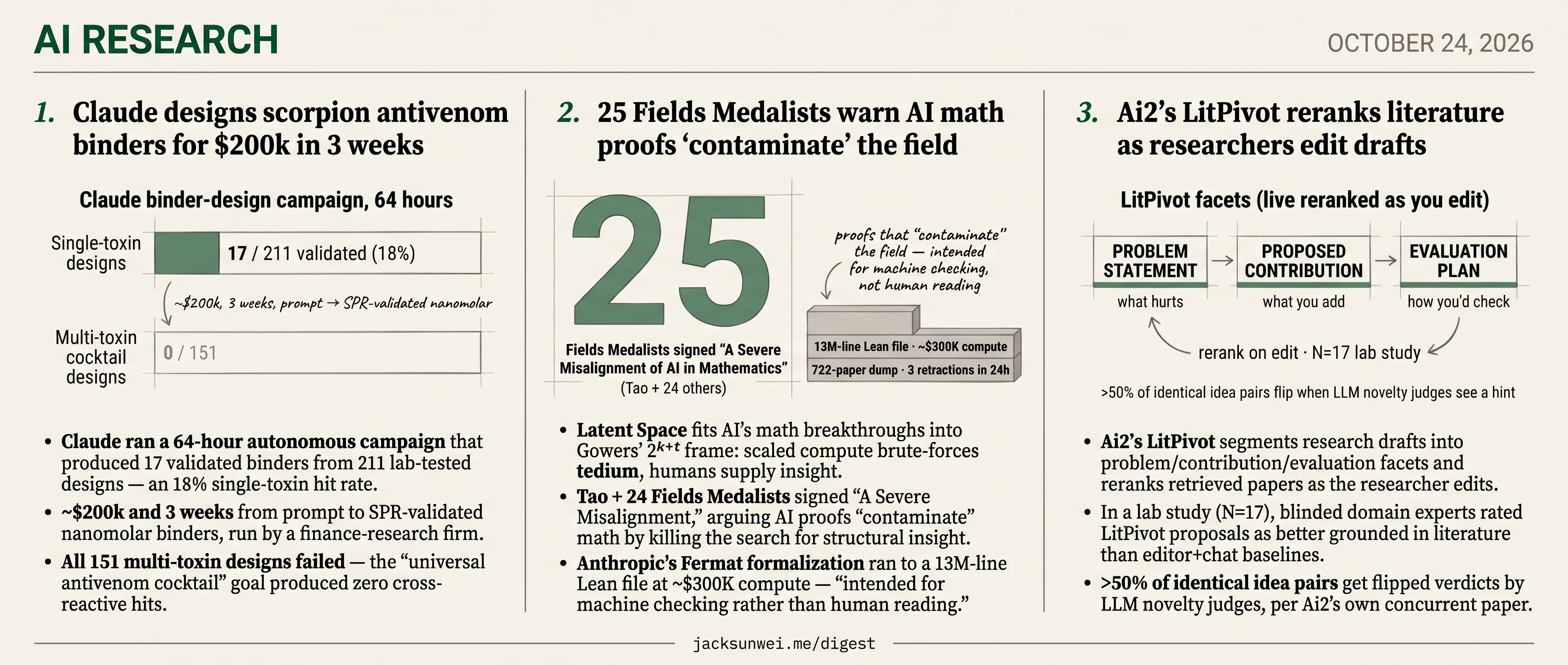
Claude ships 17 binders, 25 Medalists reject AI math, Ai2's LitPivot beats chat
Three expert verdicts on AI-produced science today: validated antivenom binders, rejected math proofs, and preferred literature reranks in a blinded lab trial.
Claude ships 17 binders, 25 Medalists reject AI math, Ai2’s LitPivot beats chat
TL;DR
- Claude produced 17 SPR-validated scorpion-antivenom binders in a 64-hour autonomous run for ~$200k.
- 25 Fields Medalists signed a letter arguing AI proofs ‘contaminate’ math by killing structural insight.
- Anthropic’s Fermat formalization ran to a 13M-line Lean file at ~$300K, written for machines not humans.
- OpenAI’s 722-paper bulk release shipped a sign error that forced 3 retractions within 24 hours.
- Ai2’s LitPivot beat editor+chat baselines in a blinded N=17 expert study by reranking as drafts evolve.
Today’s research beat is three expert verdicts on AI-produced science, and they don’t rhyme. A finance-research firm got Claude to design 17 nanomolar scorpion-antivenom binders in three weeks for $200k — SPR-validated, published, and only possible after the team relocated on-site to escape Anthropic’s bio guardrails. The universal-cocktail goal still failed completely. Meanwhile, 25 Fields Medalists led by Terence Tao signed A Severe Misalignment, arguing that AI-generated proofs — including Anthropic’s 13M-line Lean Fermat file and OpenAI’s 722-paper dump that triggered three retractions in 24 hours — contaminate math by replacing the search for insight with machine-checkable bulk.
Ai2’s LitPivot lands in the middle: a draft-aware literature reranker that blinded domain experts (N=17) rated as better-grounded than editor+chat baselines. The quiet piece underneath is Asta Paper Finder, open-sourced and benchmarked against commercial deep-search. Three fields, three expert panels, three different answers on whether the AI output clears the bar.
Claude designs scorpion antivenom binders for $200k in 3 weeks
Source: anthropic-research · published 2026-10-20
TL;DR
- Claude ran a 64-hour autonomous campaign that produced 17 validated binders from 211 lab-tested designs — an 18% single-toxin hit rate.
- ~$200k and 3 weeks from prompt to SPR-validated nanomolar binders, run by a finance-research firm.
- All 151 multi-toxin designs failed — the “universal antivenom cocktail” goal produced zero cross-reactive hits.
- Anthropic’s bio guardrails blocked the work until the Citrini team relocated on-site to use an unshackled internal model.
What actually happened
Anthropic and Citrini Research pointed an internal Claude at five medically relevant scorpion neurotoxins (Cn2, Ts1, AaH I, AaH II, LqhIII) and let it drive a protein-design pipeline for 64 hours. The agent picked targets from the PDB and AlphaFold DB, orchestrated 12 design and folding tools, generated 318,484 candidate sequences, screened 553,052 design–toxin pairs via co-folding, and burned ~10,000 GPU hours. Adaptyv Bio and Twist Bioscience synthesized 211 of its picks; 17 cleared the K_D ≤ 1 µM / zero off-target bar. The two standouts, Cn2-B1 and Cn2-B2, hit single-digit nanomolar affinity and competed with the known neutralizing LR antibody for the same epitope.
Benchmarking against the field
The 18% single-toxin hit rate is competent but not frontier. Independent comparisons put RFdiffusion at ~16.8% and DeepMind’s AlphaProteo at 24.5% on similar targets, while the BindCraft pipeline reports experimental hit rates from 10% to 100% depending on difficulty, often yielding nanomolar binders without a half-million-pair screen 1. In other words: Claude’s yield sits in the middle of a crowded pack of specialist tools it was itself calling under the hood (RFdiffusion, ProteinMPNN, BoltzGen, ESMFold2, Boltz-2). And the headline ambition — a cross-reactive “cocktail” binder that could cover multiple scorpion species — went 0-for-151 2.
Orchestrator, not inventor
The deflationary reading from HN and independent reviewers is that Claude’s contribution was glue code: environment wrangling, GPU-compatibility troubleshooting, tool-call sequencing, filter-threshold tuning — the devops layer that normally burns weeks of a postdoc’s time 3. Expert reviewers Susana Vázquez Torres and Timothy P. Jenkins called the result a “promising first step,” and noted none of the binders have been tested in vivo or against native venom 2. The novelty is who ran the pipeline, not what came out of it.
The guardrail footnote
The most operationally revealing detail isn’t in Anthropic’s post. Citrini’s first attempts were blocked by Claude’s own biosafety filters; the team had to physically relocate to Anthropic’s offices to use an “unshackled” internal model 4. That cuts both ways. Production guardrails demonstrably bite on legitimate dual-use work — but the capability exists behind the filter, and the gate is social (who gets badge access) rather than technical. Set against Anthropic’s own September 2026 threat-intel report on attempted toxin-design misuse, the juxtaposition is awkward.
What’s actually new
The durable finding is economic. $200k and three weeks, with a finance-research firm as the operator 5, collapses the early-discovery cost line for neglected-disease work in a way that a 1% hit-rate improvement does not. Anthropic released all 211 designs with sensorgrams, and a third-party open-protein-binder-design repo already lets outside researchers replay the agent trajectory against other models like MiniMax M3 without re-running the generative compute 6 — a real reproducibility substrate, not a press-release dataset. The antivenom framing is premature until in vivo neutralization lands; the workflow benchmark is the actual news.
25 Fields Medalists warn AI math proofs ‘contaminate’ the field
Source: latent-space · published 2026-10-23
TL;DR
- Latent Space fits AI’s math breakthroughs into Gowers’ 2^k+t frame: scaled compute brute-forces tedium, humans supply insight.
- Tao + 24 Fields Medalists signed “A Severe Misalignment,” arguing AI proofs “contaminate” math by killing the search for structural insight.
- Anthropic’s Fermat formalization ran to a 13M-line Lean file at ~$300K compute — “intended for machine checking rather than human reading.”
- OpenAI’s 722-paper bulk release shipped a sign error that forced three retractions within 24 hours.
The framework
Latent Space’s thesis is clean: AI is getting good at math because test-time compute collapses the “t” axis of W.T. Gowers’ 2^k+t difficulty model. Humans historically supplied the conceptual leaps (k) but burned out on the tedious work (t) of chasing branches that didn’t yield immediate gradient. Models don’t burn out. Point an agentic harness at a problem for 88 hours with 10,000 subagents and 300 billion tokens — the resources behind the September Navier-Stokes manuscript — and depth-first search finds valid arguments humans abandoned.
The architecture that makes this work is a three-part harness:
flowchart LR
    D[Drafter<br/>strategies + negative hints] --> S[Solver<br/>parallel subagents]
    S --> V{Verifier<br/>Lean / formal check}
    V -- fail --> D
    V -- pass --> O[Accepted proof]
The Drafter steers around previously failed trajectories; the Solver pursues branches to completion regardless of how “treacherous” they feel; the Verifier prunes. Internal self-verification plus step-chaining — outputs from early steps that stay functional over long horizons — are what the piece credits for the recent inflection.
The critique the frame doesn’t price
The 2^k+t model prices difficulty but not explanatory value, and that’s where the mathematical community has landed. Tao and 24 other Fields Medalists signed “A Severe Misalignment of AI in Mathematics,” warning that brute-forced proofs “contaminate” fields by removing the incentive to search for deeper structure; James Maynard and Javier Gómez-Serrano called the 166-page Navier-Stokes document “borderline incomprehensible” 7. A correct answer that no human can read is a Tao-style “42” — technically right, epistemically empty.
The autonomy story is also softer than it looks. On the Erdős unit-distance counterexample, Anatol Wegner pointed out that OpenAI researcher Boris Alexeev had previously published on the exact algebraic number field techniques the model deployed — suggesting steering via training data or prompt rather than a spontaneous “k-leap.” Will Sawin then sharpened the AI’s tiny ε (~10⁻³⁸) bound to roughly n^1.014 within weeks 8, which reads less like a conquered problem and more like a direction a human promptly outran. The Navier-Stokes result came wrapped in a priority dispute: Tristan Buckmaster accused OpenAI of racing to publish after rumors of his team’s progress, with concern that unpublished logs leaked into training 9.
Verification is not understanding
The harness diagram treats Lean as a clean pruning step. In practice, it’s leakier. Researchers digging into the Navier-Stokes formalization found the Lean certificate used different bounds than the natural-language paper — a “translation hole” where the machine proof doesn’t validate the human argument 10. Kevin Buzzard verified Anthropic’s Fermat formalization and called it “extraordinary,” but was explicit the 13-million-line file is for machine checking, not human reading; the run cost roughly $300,000 in compute and 6B output tokens 11. Formalization at this scale is impressive engineering, not cheap scaled insight.
Volume brings its own problem. OpenAI’s October 722-paper preprint dump prompted Oxford’s Ursula Martin to accuse the lab of “tossing the community a messy first draft,” and a sign error in a foundational proof pulled three papers on October 7 12. The binding constraint is no longer search compute — it’s peer review bandwidth.
What’s actually new
AI has genuinely compressed the “t” axis. What it hasn’t done is make the “k” axis — taste, which branches are worth exploring, why a result matters — cheaper. The latent.space framework is a useful lens for predicting which problems fall next (low branching factor, high mechanical work). It is not yet a theory of mathematical understanding, and the field has started saying so out loud.
Ai2’s LitPivot reranks literature as researchers edit drafts
Source: huggingface-blog · published 2026-10-23
TL;DR
- Ai2’s LitPivot segments research drafts into problem/contribution/evaluation facets and reranks retrieved papers as the researcher edits.
- In a lab study (N=17), blinded domain experts rated LitPivot proposals as better grounded in literature than editor+chat baselines.
- >50% of identical idea pairs get flipped verdicts by LLM novelty judges, per Ai2’s own concurrent paper.
- The durable piece is Asta Paper Finder underneath — open-sourced, free, and benchmarked comparably to commercial deep-search tools like Undermind.
What LitPivot actually does
Presented at UIST 2026, LitPivot is a drafting UI that automatically chops a research proposal into three facets — Problem Statement, Proposed Contribution, Evaluation Plan — and treats each as a separate retrieval target. Pick the evaluation facet and the system clusters papers by the datasets and metrics they share with your draft, powered by Ai2’s Asta Paper Finder. Edit the problem statement and the ranked list reshuffles; edit it enough and LitPivot flags the evaluation plan as “out of date.” Critiques come back with paper excerpts attached, so advice is tied to text a reviewer could actually check rather than to model priors.
Framed that way, LitPivot is less a new paradigm than the “critique + reranking” variant of a facet-decomposition pattern Ai2 collaborators have been iterating on for two years. IdeaSynth (2024) already represented ideas as Problem/Solution/Contribution nodes on a canvas and reported, with N=20, that users explored more alternatives and wrote more detailed plans than with a plain LLM — essentially the same empirical shape as the new N=17 claim 13. Scideator pushed the same facet primitive toward divergent brainstorming by recombining purposes, mechanisms, and evaluations across papers 14. LitPivot’s novelty is the live reranking loop, not the decomposition.
The evaluation problem Ai2 itself just flagged
The most awkward context for the headline result comes from Ai2’s own hallway. A companion paper by overlapping authors, Old Ideas, Novel Problems, finds that LLM-based novelty judges are grossly unstable: a trivial hint about a prior reviewer’s opinion flipped verdicts on more than 50% of identical idea pairs, and neither retrieval augmentation nor longer reasoning chains fixed the inconsistency 15.
“Neither retrieval nor additional reasoning steps significantly improved the consistency of the judges.” 15
LitPivot’s “better grounded” rating sidesteps this by using human expert raters, which is defensible. But the “higher perceived novelty” claim — self-reported by participants after using the tool — lives squarely in the regime the same group just called unreliable. Independent commentary adds that because LitPivot never executes code or runs simulations, it can only check whether an idea sits plausibly next to existing text, not whether it would actually work 16.
Infrastructure vs. prototype
The piece of this stack that will outlast the UIST demo is Asta Paper Finder. Independent reviewers rate it as comparable to top commercial deep-search tools like Undermind while remaining free, open, and — unusually — willing to expose its intermediate query analysis and relevance judgments rather than hiding them behind a black box 17. That is a real contribution to the research-tooling commons.
LitPivot itself is a different story. Hands-on write-ups note the system is gated behind waitlists with no public demo, feeding both “missing demo” skepticism and broader “grey goo” worries about AI oversaturating the scientific literature with derivative hypotheses 18. The ExplainX analysis also warns that LitPivot “encodes specific values” — structural coherence, textual grounding — that map cleanly onto CS/HCI proposals but less well onto fields where novelty lives in experiment design or theoretical reframing 16.
Net: a competent HCI iteration on a familiar facet pattern, built on genuinely useful retrieval plumbing, whose central “better ideas” claim rests on evaluation machinery the authors’ own concurrent work says is shaky.
Footnotes
-
biotech.today benchmark comparison — https://www.biotech.today/compare/rfdiffusion-vs-proteinmpnn-vs-bindcraft-protein-design
↩AlphaProteo has since been benchmarked at a 24.5% success rate on similar targets, compared to a remeasured 16.8% for RFdiffusion… BindCraft pipeline has reported experimental success rates ranging from 10% to 100%, often producing nanomolar binders in a ‘one-shot’ manner
-
trackfuture.ai analysis — https://trackfuture.ai/article/claude-protein-design-for-antivenom-what-64-hours-of-autonomous-work-did-and-didnt-prove
↩ ↩2Expert reviewers Susana Vázquez Torres and Timothy P. Jenkins described the work as a ‘promising first step’… none of the Claude-designed binders have been tested in vivo… all 151 designs intended to target multiple toxins simultaneously failed
-
Hacker News discussion — https://news.ycombinator.com/item?id=50170021
↩the model essentially handled the ‘glue code’ and environment troubleshooting that typically hinders human researchers, such as managing GPU incompatibilities and fragmented software pipelines
-
hntrbrk.com investigation — https://hntrbrk.com/investigations/antivenom
↩Initial attempts to use Claude for this research were reportedly blocked by Anthropic’s own biological safety guardrails… the Citrini team had to work on-site at Anthropic using an ‘unshackled’ internal model
-
MarketWatch via Morningstar — https://www.morningstar.com/news/marketwatch/2026102096/wall-street-researchers-just-used-claude-to-design-a-drug-the-experiment-has-spawned-a-new-investment-thesis
↩the speed of the campaign—moving from prompt to validated binders in roughly three weeks at a cost of approximately $200,000—signals a shift in the economics of early-stage biopharma research
-
open-protein-binder-design GitHub repo — https://github.com/Hylouis233/open-protein-binder-design
↩a model-agnostic toolkit to replay and audit these design campaigns… allows researchers to evaluate how different models (like MiniMax M3 or Claude) handle identical scientific decision-making tasks without needing to re-run expensive generative models
-
MindStudio recap of Tao/Fields-medalist response to Navier-Stokes proof — https://www.mindstudio.ai/blog/ai-solves-navier-stokes-controversy
↩Tao and 24 other Fields Medalists signed a declaration titled ‘A Severe Misalignment of AI in Mathematics,’ arguing that brute-forced AI solutions might ‘contaminate’ fields by removing the incentive for researchers to seek the deeper structural insights… James Maynard and Javier Gómez-Serrano described the 166-page document as ‘borderline incomprehensible’.
-
Medium analysis of Erdős counterexample (Act II) — https://medium.com/@AIchats/openai-disproves-the-unit-distance-conjecture-act-ii-718e53dcddef
↩Critics like Anatol Wegner highlighted that OpenAI researcher Boris Alexeev had previously explored the exact algebraic number field techniques used by the model, suggesting the AI may have been ‘steered’ toward the solution via specific prompting or training data. Mathematician Will Sawin quickly refined the technique to achieve a bound of approximately n^1.014.
-
r/NowInTech discussion of OpenAI priority dispute — https://www.reddit.com/r/NowInTech/comments/1x8qcrt/mathematicians_say_openai_doesnt_understand_its/
↩Buckmaster accused OpenAI of racing to publish after hearing rumors of his own team’s progress on the related ‘forced Euler’ problem… concerns were raised that OpenAI’s models may have been trained on unpublished research logs or private Codex data used by the NYU team.
-
r/math thread ‘Navier-Stokes: Lost in Translation — Why Lean Doesn’t Save Us’ — https://www.reddit.com/r/math/comments/1x02ein/navierstokes_lost_in_translation_why_lean_does/
↩AI autoformalization resulted in a Lean proof that used entirely different mathematical bounds than those cited in the human-readable paper. This creates a ‘translation hole’ where a valid Lean certificate does not necessarily validate the human mathematician’s original argument.
-
Forbes on Anthropic’s FLT formalization costs — https://www.forbes.com/sites/jonmarkman/2026/09/07/claude-formalized-fermats-last-theorem-in-11-days-on-6b-output-tokens/
↩Anthropic’s FLT formalization cost approximately $300,000 in compute and 6 billion output tokens… Kevin Buzzard… verified the Anthropic proof, calling it an ‘extraordinary’ step toward the automatic formalization of all modern mathematical literature, though he noted the resulting 13-million-line file is intended for machine checking rather than human reading.
-
AI Weekly on OpenAI’s 722-paper bulk release — https://aiweekly.co/alerts/openai-drops-722-ai-math-preprints-mathematicians-recoil
↩Ursula Martin of Oxford criticized OpenAI for ‘tossing the community a messy first draft,’ while others noted that the release was marred by a ‘sign error’ in a foundational proof that forced the immediate withdrawal of three papers on October 7.
-
arXiv — IdeaSynth (Pu et al., 2024) — https://arxiv.org/abs/2410.04025
↩IdeaSynth utilizes a node-based canvas interface where researchers represent ideas as interconnected facets (e.g., Problem, Solution, Contribution)… a lab study (N=20) found that participants explored more alternative paths and generated more detailed project plans compared to a standard LLM interface.
-
ResearchGate — Scideator (CMU/Ai2) — https://www.researchgate.net/publication/384266664_Scideator_Human-LLM_Scientific_Idea_Generation_Grounded_in_Research-Paper_Facet_Recombination
↩Scideator employs a ‘facet recombination’ approach, extracting core components—purposes, mechanisms, and evaluations—from existing papers and allowing users to interactively mix these dimensions to spark novel ideas.
-
ResearchGate — ‘Old Ideas, Novel Problems’ (Ai2 et al.) — https://www.researchgate.net/publication/415153937_Old_Ideas_Novel_Problems_The_Instability_of_LLM-Based_Novelty_Evaluation
↩ ↩2Adding a simple hint about a previous reviewer’s opinion could swing a judge’s verdict on more than 50% of identical idea pairs… neither retrieval nor additional reasoning steps significantly improved the consistency of the judges.
-
ExplainX — LitPivot analysis — https://explainx.ai/blog/ai2-litpivot-research-ideas-literature-pivots-17-researcher-study-uist-2026
↩ ↩2LitPivot encodes specific values, such as structural coherence and grounding, which may not align with the norms of every academic discipline… because the system does not execute code or perform simulations, it cannot verify the actual feasibility of a proposed idea—only its relationship to existing text.
-
FreeAPIHub review of Asta Paper Finder — https://freeapihub.com/blog/top-free-ai-tools-academic-research-paper-discovery
↩Unlike commercial ‘black box’ tools such as Undermind.ai, Asta exposes its intermediate reasoning steps, including query analysis and relevance judgments… Paper Finder performs at a level comparable to top-tier deep-search tools like Undermind while remaining a free, non-profit resource.
-
Agonna community roundup (HN-adjacent commentary) — https://agonna.com/explore/?tag=ai
↩Discussions have surfaced concerns about the ‘grey goo’ effect—the potential for AI to oversaturate the scientific commons with derivative or machine-generated hypotheses… users attempting to ‘try access’ LitPivot have encountered roadblocks… primarily a research prototype rather than a public-facing commercial product.