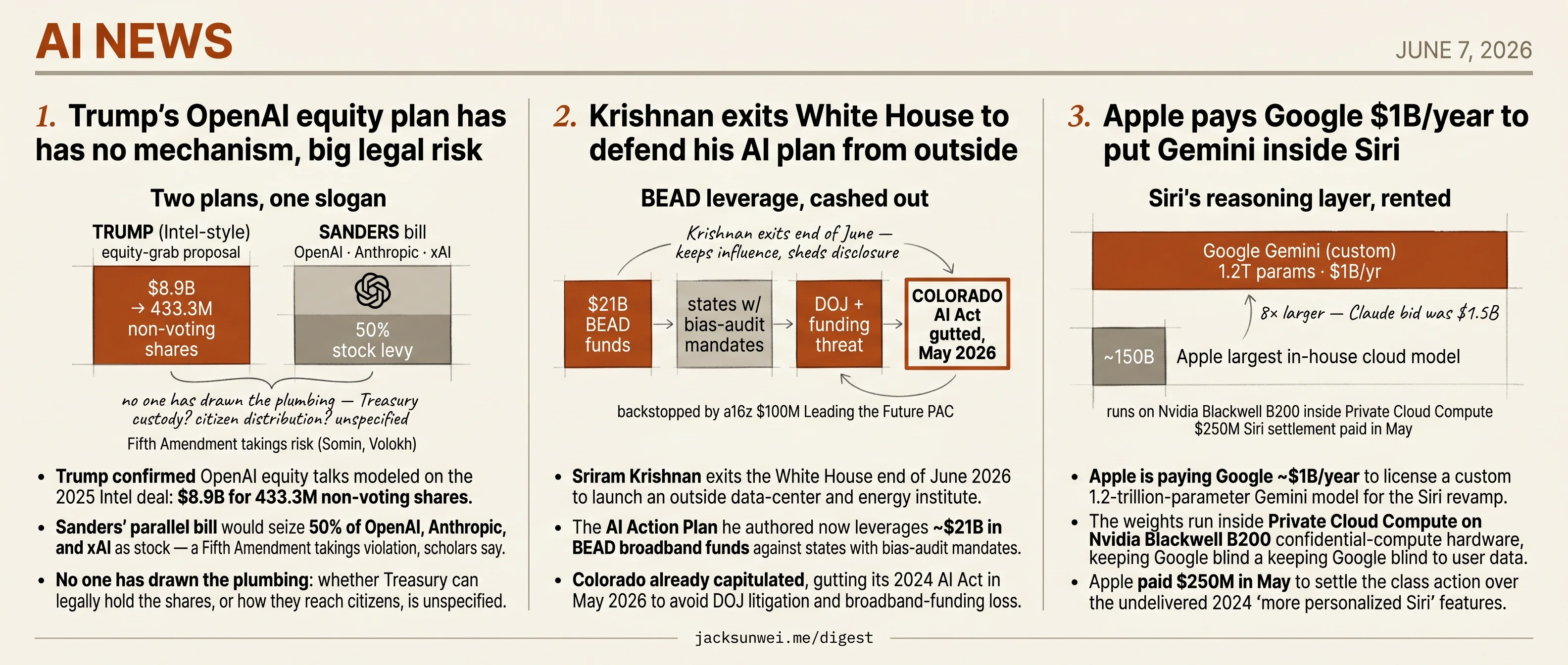
Trump pitches OpenAI equity, Krishnan exits White House, Apple licenses Gemini
Three unrelated AI leads today: Trump's OpenAI equity talks, Krishnan's exit from the White House, and Apple's $1B Gemini license for Siri.
Trump pitches OpenAI equity, Krishnan exits White House, Apple licenses Gemini
TL;DR
- Trump confirmed $8.9B OpenAI equity talks modeled on the 2025 Intel deal.
- Sanders’ bill would seize 50% of OpenAI, Anthropic, and xAI as non-voting stock.
- Sriram Krishnan exits the White House end of June to run an outside AI-policy institute.
- Colorado gutted its 2024 AI Act in May to avoid losing $21B in BEAD broadband funding.
- Apple pays Google ~$1B/year to license a custom 1.2T-parameter Gemini for Siri 2.0.
Three unrelated AI-policy and industry leads share the top of today’s AI News. Trump confirmed talks to take an $8.9B non-voting equity stake in OpenAI on the 2025 Intel template, with no plumbing yet drawn for how Treasury would hold the shares — or how a parallel Sanders bill seizing 50% of OpenAI, Anthropic, and xAI would survive a Fifth Amendment challenge. Sriram Krishnan is leaving the White House at end of June to run an outside data-center and energy institute, after authoring an AI Action Plan that uses ~$21B in BEAD broadband funds to push states off bias-audit mandates — Colorado already capitulated. And Apple is paying Google ~$1B/year to license a custom 1.2-trillion-parameter Gemini for the Siri revamp, running it on Nvidia Blackwell B200 inside Private Cloud Compute so Google stays blind to user data.
Trump’s OpenAI equity plan has no mechanism, big legal risk
Source: techcrunch-ai · published 2026-06-06
TL;DR
- Trump confirmed OpenAI equity talks modeled on the 2025 Intel deal: $8.9B for 433.3M non-voting shares.
- Sanders’ parallel bill would seize 50% of OpenAI, Anthropic, and xAI as stock — a Fifth Amendment takings violation, scholars say.
- No one has drawn the plumbing: whether Treasury can legally hold the shares, or how they reach citizens, is unspecified.
- OpenAI’s own Public Wealth Fund pitch commits none of the company’s equity, revenue, or assets.
Two plans, one slogan, incompatible coercion
President Trump’s June 6 comments that “the American people can benefit from the success of AI” mark the first time the administration has publicly tied OpenAI to the Intel-style equity model it deployed in 2025. The framing is voluntary partnership, seeded by OpenAI’s own April 2026 white paper Industrial Policy for the Intelligence Age, which proposed a “Public Wealth Fund” capitalized by frontier labs.
That rhetorical premise — public ownership of AI upside — is now shared across the aisle. Bernie Sanders’ American AI Sovereign Wealth Fund Act would impose a one-time 50% stock levy on OpenAI, Anthropic, and xAI 1. The Cato Institute argues this is no accident: the Intel precedent, in which roughly $8.9 billion in CHIPS Act grants was converted into 433.3 million non-voting shares, gave Sanders the political cover to demand the same mechanism with sharper teeth 1.
The constitutional and mechanical gaps
The Sanders version runs straight into the Fifth Amendment. Ilya Somin at Reason/Volokh calls a mandatory equity transfer a textbook taking without just compensation, and notes that even a “voluntary” Trump-style deal extracted under regulatory pressure invites the same litigation 2. Manifold markets put the Sanders bill’s odds of passage in the low single digits.
The Trump version has a different problem: no one has written down how it works. The Next Web reports that legal experts cannot identify a mechanism for distributing shares to individuals versus holding them in trust, and current federal law does not obviously authorize Treasury to hold and manage corporate equity at this scale 3. Floating proposals include funding “Trump Accounts” for newborns, but none has a statutory home.
Dissent from inside the tent
The loudest internal critic is David Sacks, Trump’s own former AI and crypto czar. Sacks has warned that a state-controlled AI apparatus would wield “totalistic power” over information flows and compared the proposals to a “CCP-style social credit system” 4. Gizmodo notes the awkward subplot that Sacks himself holds hundreds of AI-adjacent stakes that senators have flagged as a conflict — but the structural point stands: a government that owns OpenAI is disincentivized from regulating or breaking it up.
The labs themselves are not aligned either. Anthropic has explicitly told reporters it is not participating in the White House equity talks, even as Sanders’ bill names it for the 50% levy 5. And Tech Policy Press calls OpenAI’s white paper “doublespeak” — the Public Wealth Fund pitch never commits OpenAI’s own equity, revenue, or assets, leaving lawmakers to source the redistributed shares from somewhere else 6.
What’s actually at stake
Strip the populist framing and the proposal is a vehicle in search of a chassis. The Intel deal proved Washington can take equity; it did not prove Washington can distribute it, govern it, or avoid the regulatory-capture trap that follows. With OpenAI, Anthropic, and xAI all telegraphing 2026 IPOs, the window to settle those questions before the equity becomes liquid — and the political stakes ten times larger — is narrow.
Krishnan exits White House to defend his AI plan from outside
Source: techcrunch-ai · published 2026-06-06
TL;DR
- Sriram Krishnan exits the White House end of June 2026 to launch an outside data-center and energy institute.
- The AI Action Plan he authored now leverages ~$21B in BEAD broadband funds against states with bias-audit mandates.
- Colorado already capitulated, gutting its 2024 AI Act in May 2026 to avoid DOJ litigation and broadband-funding loss.
- Safety groups call it textbook capture: Krishnan keeps influence without disclosure, backed by a16z’s $100M PAC.
Not an exit, a relocation
The TechCrunch framing — White House AI advisor resigns — undersells what’s happening. Krishnan is leaving the building to start an engineer-staffed institute on data-center buildout and grid capacity, and David Sacks has already publicly framed him as a continuing “critical asset” and outside advisor 7. He’s moving from drafting the framework inside government to defending it from outside.
The preemption fight he leaves behind
The most consequential thing Krishnan worked on isn’t in the source article at all: a federal-vs-state preemption campaign that is producing concrete wins. The NTIA is wielding roughly $21 billion in remaining BEAD non-deployment funds as leverage against states with “onerous” AI laws — defined to include high-risk testing and anti-bias mandates 8. That threat already cashed out. In May 2026, Colorado replaced its landmark 2024 AI Act with a much narrower disclosure regime, explicitly to avoid federal litigation and the loss of broadband funding 9 — weeks before the original law was set to take effect.
A bipartisan companion vehicle, the Great American AI Act from Reps. Jay Obernolte (R-CA) and Lori Trahan (D-MA), would lock in a three-year federal moratorium on state laws governing AI development 10. Krishnan’s new institute lands in the middle of this live fight, not after it — well-positioned to lobby Congress to turn administrative leverage into permanent statute.
The funding stack and the dissent
flowchart LR
    A[a16z principals] -->|seeds| B[Leading the Future PAC]
    B -->|primary threats| C[Congress]
    A -.alumnus.-> D[Krishnan inside WH]
    D --> E[AI Action Plan + EOs]
    E -->|BEAD conditionality| F[State legislatures]
    F -->|Colorado SB 26-189| G[Mandates repealed]
    D ==>|June 2026 exit| H[Outside institute]
    H -.advises.-> E
Edges, with sources: PAC seeding $100M 11; BEAD conditionality $21B 8; Colorado repeal 9.
Independent reporting makes the funding pipeline more explicit than TechCrunch lets on. Marc Andreessen and Ben Horowitz seeded a $100 million “Leading the Future” super PAC designed to support industry-friendly candidates and punish lawmakers who push safety guardrails 11. Encode AI’s Sunny Gandhi calls that apparatus a “$100 million dragon” capable of immense pressure on policy 12.
Safety advocates — Encode AI, Public Citizen, POGO, the Revolving Door Project — read Krishnan’s move as a transparency downgrade: he keeps the influence and sheds the financial-disclosure obligations. The complaint is sharper than usual revolving-door rhetoric because the receipts are already on the table. Colorado’s gutted AI Act 9 and BEAD conditionality 8 show the framework Krishnan leaves behind has teeth. His next job is keeping them in.
Apple pays Google $1B/year to put Gemini inside Siri
Source: the-verge-ai · published 2026-06-06
TL;DR
- Apple is paying Google ~$1B/year to license a custom 1.2-trillion-parameter Gemini model for the Siri revamp.
- The weights run inside Private Cloud Compute on Nvidia Blackwell B200 confidential-compute hardware, keeping Google blind to user data.
- Apple paid $250M in May to settle the class action over the undelivered 2024 “more personalized Siri” features.
- Siri 2.0 reportedly requires A17 Pro and 8GB of RAM, stranding the base iPhone 15 and every older device.
The deal under the keynote
The Verge and TechCrunch previews frame WWDC 2026 as Apple’s chance to relaunch Siri as a slower, privacy-first answer to Copilot and Gemini. The financial reporting underneath that narrative tells a blunter story: Apple is renting its reasoning layer from a competitor.
Independent reporting pegs the arrangement at roughly $1 billion a year for a custom 1.2-trillion-parameter Gemini model — about eight times the size of Apple’s largest in-house cloud model — with weights running inside Private Cloud Compute on Nvidia Blackwell B200 hardware configured for confidential computing 13. Mark Gurman’s bake-off reporting notes Anthropic’s Claude was the quality favorite but quoted closer to $1.5B/year. Gemini wasn’t only the best fit; it was the cheaper one.
That reframes the “Apple chose Google for privacy” story. The model is Google’s, the silicon is Nvidia’s, and Apple’s contribution is the isolation envelope and the UX shell around it.
flowchart LR
    A[iPhone user query] --> B[On-device Siri / Apple Foundation Models]
    B -->|hard queries| C[Private Cloud Compute]
    C --> D[Nvidia Blackwell B200<br/>confidential compute]
    D --> E[Google Gemini 1.2T<br/>custom weights]
    E -. Google blind to data .- F((Google))
Why ‘again’ carries legal weight
The Verge’s “new Siri again” line undersells the overhang. In May 2026 Apple agreed to a $250 million preliminary settlement covering iPhone 16 and iPhone 15 Pro buyers from June 2024 through March 2025, with payouts of $25–$95 per device for the undelivered “more personalized Siri” features 14. The NAD had already ruled the original “available now” Siri ads deceptive. That settlement — not vague “AI fatigue” — is why Apple is leaning so hard on the responsible-rollout framing this year.
The hardware story complicates the apology. Siri 2.0 reportedly requires an A17 Pro chip and at least 8GB of RAM, cutting off the base iPhone 15 and everything older 15 — an awkward gate for a company that just paid out for over-promising AI to iPhone 15 buyers.
Wall Street, Brussels, and the dependency problem
Investors are pricing the upside aggressively. Wedbush’s Dan Ives holds a $400 target attributing $75–$100 per share to AI-Siri monetization, and Morgan Stanley’s $440 bull case is explicitly conditional on a live agentic demo at WWDC, not a recorded one 16.
Two dissenting threads barely surface in the previews. Brussels is one: the EU’s DMA forces Apple to open system-wide AI access points — custom wake words, on-screen context — to rival assistants by late 2026, and Apple has joined Google in opposing the mandate 17. That is an uncomfortable posture for a privacy-first pitch, and the US DOJ is separately eyeing the Gemini-Siri deal as a potential successor to the Google search-default arrangement.
The strategic critique cuts the other direction:
Paying Google roughly $1 billion annually for model access creates a ‘mutual dependency’ that erodes Apple’s long-term software independence — a ‘band-aid’ that ends Apple’s pursuit of AI sovereignty. 18
Net read
WWDC 2026’s Siri segment is less a confident second try than a forced accommodation: cheaper than Claude, legally necessary after the $250M settlement, hardware-gated to the newest phones, and structurally dependent on a rival whose access to iOS Apple must itself regulate under the DMA. The keynote will sell it as restraint. The contract underneath says otherwise.
Further reading
- What to expect from WWDC 2026: Siri’s highly anticipated revamp and Apple Intelligence updates — techcrunch-ai
Round-ups
Meta AI support agent tricked into handing over Instagram accounts
Source: mit-tech-review-ai
Attackers asked Meta’s customer support agent to relink Instagram accounts to attacker-controlled email addresses, and it complied. One hijacked the dormant Obama White House account to post pro-Iran content, exposing how agentic permissions, not model jailbreaks, drive real-world AI security failures.
OpenAI launches Lockdown Mode to blunt ChatGPT prompt injection attacks
Source: techcrunch-ai
Lockdown Mode restricts what ChatGPT can do with sensitive data when processing untrusted content, lowering the odds that a prompt injection exfiltrates secrets. OpenAI concedes the feature does not eliminate the attack class but aims to shrink its blast radius.
Meta AI app adds a ‘For You’ feed of AI-generated clickbait
Source: the-verge-ai
Meta’s standalone AI app now serves a ‘For You’ stream where topics, images, and text are all machine-generated. The move turns Facebook’s long-running clickbait problem into a first-party product, with article quality already drawing scrutiny from early users.
Shelbyville mayor insults opponents of $2B Indiana data center
Source: the-verge-ai
Mayor Scott Furgeson was caught on camera saying ‘No Data Center’ signs only appear at ‘shitty houses,’ inflaming a fight over a proposed $2 billion build in the small Indiana city. The remark has turned a zoning dispute into a national political flashpoint.
Google recaps May 2026 AI launches across Gemini, Search, and DeepMind
Source: google-ai-blog
Google’s monthly roundup compiles May updates spanning Gemini apps and models, Search, Android, Cloud, DeepMind research, Quantum, Health, Fitbit, and Shopping. The post serves as a single index for developers tracking what shipped across the company’s AI surface area last month.
Ben’s Bites rounds up Codex Sites launch and new open models
Source: bens-bites
The newsletter spotlights OpenAI’s Codex Sites, which lets developers generate full web apps from prompts, alongside a wave of fresh open-weight model releases. The throughline: builders shipping tools that make it cheaper and faster to ship more tools.
Footnotes
-
Cato Institute — ‘Trump Opened the Door to Sanders’s Sovereign Wealth Fund’ — https://www.cato.org/blog/trump-opened-door-sanderss-sovereign-wealth-fund
↩ ↩2The Intel precedent — converting roughly $8.9 billion in CHIPS Act funding into 433.3 million non-voting shares — gave Sanders the political opening to demand a 50% equity transfer.
-
Reason / Volokh Conspiracy (Ilya Somin) — https://reason.com/volokh/2026/06/05/bernie-sanders-dangerous-and-unconstitutional-plan-to-expropriate-ai-firms/
↩Bernie Sanders’ Dangerous and Unconstitutional Plan to Expropriate AI Firms — a mandatory expropriation of stock would constitute a Fifth Amendment taking without just compensation.
-
The Next Web — ‘Nobody knows how that would work’ — https://thenextweb.com/news/trump-wants-the-american-public-to-own-a-piece-of-openai-nobody-knows-how-that-would-work
↩Legal experts remain unclear on the specific mechanisms for distributing shares to individuals versus the government holding them in trust, and on whether current federal law even permits the Treasury to manage such assets.
-
Gizmodo — ‘The Leopard Is Eating David Sacks’s Face’ — https://gizmodo.com/the-leopard-is-eating-david-sackss-face-2000768295
↩Sacks warned a state-controlled AI apparatus would possess ‘totalistic power’ over information and compared the proposals to building a ‘CCP-style social credit system’ in the U.S.
-
R&D World — ‘Trump’s AI push turns government into reviewer, warfighter, supplier and possible shareholder’ — https://www.rdworldonline.com/trumps-ai-push-turns-government-into-reviewer-warfighter-supplier-and-possible-shareholder/
↩Anthropic officials clarified they are not currently participating in the White House’s specific equity talks, even as Sanders’ bill names them alongside OpenAI and xAI for a 50% levy.
-
Tech Policy Press — ‘The Doublespeak in OpenAI’s Industrial Policy for the Intelligence Age’ — https://www.techpolicy.press/the-doublespeak-in-openais-industrial-policy-for-the-intelligence-age/
↩There is a ‘deep chasm’ between OpenAI’s public rhetoric and its private lobbying record; the Public Wealth Fund pitch never commits OpenAI’s own equity, revenue, or assets.
-
Business Today — Krishnan exit and Sacks quote — https://www.businesstoday.in/technology/story/trumps-ai-adviser-sriram-krishnan-to-leave-white-house-hints-at-new-mission-535406-2026-06-07
↩David Sacks… praised Krishnan as a ‘critical asset’ with a unique blend of technical fluency and diplomatic skill, noting that his exit represents a significant loss for the White House.
-
JSI Telecom — BEAD/AI EO analysis — https://jsitel.com/resource/white-house-links-bead-non-deployment-funding-eligibility-to-state-ai-laws-through-new-executive-order-2/
↩ ↩2 ↩3States with ‘onerous’ AI laws — those imposing high-risk testing or anti-bias mandates — could be disqualified from receiving their share of approximately $21 billion in remaining non-deployment funds.
-
Carpe Datum Law — Colorado AI Reset — https://www.carpedatumlaw.com/2026/05/colorados-ai-reset-two-weeks-a-white-house-callout-and-a-pivot-away-from-the-eu-model/
↩ ↩2 ↩3Colorado replaced its risk-based regime with a much narrower disclosure framework specifically to avoid federal litigation and the loss of broadband funding.
-
IAPP — A view from DC on the Great American AI Act — https://iapp.org/news/a/a-view-from-dc-a-bipartisan-blockbuster-bill-on-ai
↩This bipartisan bill, led by Reps. Jay Obernolte (R-CA) and Lori Trahan (D-MA), proposes a three-year federal moratorium on state laws related to AI development.
-
Communications Today — a16z influence — https://www.communicationstoday.co.in/andreessen-horowitzs-rising-influence-over-trump-era-ai-policy/
↩ ↩2Co-founders Marc Andreessen and Ben Horowitz contributed millions to pro-Trump super PACs, including a $100 million ‘Leading the Future’ fund designed to support industry-friendly candidates and silence critics.
-
Binance Square post citing Encode AI’s Sunny Gandhi — https://www.binance.com/en-TR/square/post/290683267713905
↩Sunny Gandhi, Vice President of Political Affairs at Encode AI, has previously characterized the influence of Krishnan’s professional network as a ‘$100 million dragon’ capable of exerting immense pressure on policy.
-
TechRepublic — https://www.techrepublic.com/article/news-apple-siri-ai-overhaul-google-gemini-nvidia-blackwell/
↩Apple is paying Google approximately $1 billion annually to license a custom 1.2-trillion-parameter Gemini model, roughly eight times the size of Apple’s largest in-house cloud models, with the weights running inside Private Cloud Compute on Nvidia Blackwell B200 confidential-compute hardware.
-
MacRumors — https://www.macrumors.com/2026/05/05/apple-class-action-siri-lawsuit-settlement/
↩Apple agreed to a $250 million preliminary settlement covering iPhone 16 and iPhone 15 Pro/Pro Max buyers between June 10, 2024 and March 29, 2025, with claimants receiving a presumptive $25 per device (scaling to $95) for the undelivered ‘more personalized Siri’ features.
-
↩Siri 2.0 reportedly requires an A17 Pro chip and at least 8GB of RAM, cutting off the base iPhone 15 and older devices from the new AI era.
-
Morningstar / MarketWatch — https://www.morningstar.com/news/marketwatch/20260606124/apples-wwdc-will-be-a-make-or-break-moment-for-the-companys-fledgling-ai-strategy
↩Wedbush’s Dan Ives holds a $400 price target arguing AI-Siri monetization could add $75–$100 per share, while Morgan Stanley’s bull case reaches $440 contingent on a working ‘Agentic AI’ demo at WWDC.
-
European Commission (DMA factsheet) — https://digital-markets-act.ec.europa.eu/factsheet-how-dma-making-smartphones-better-interoperability-and-data-portability-case-studies-2026-05-11_en
↩By late 2026 Apple must provide non-discriminatory access to system-wide AI access points, including allowing third-party assistants to use custom voice wake words and receive on-screen context — a mandate Apple has publicly opposed alongside Google.
-
Medium (Creative Compiler) commentary — https://medium.com/@creativecompiler/apple-google-and-the-ai-dependency-they-cant-escape-2e88203bdc4b
↩Paying Google roughly $1 billion annually for model access creates a ‘mutual dependency’ that erodes Apple’s long-term software independence — a ‘band-aid’ that ends Apple’s pursuit of AI sovereignty.