SpaceX bills Google 3× for GPUs, Ladybird closes PRs, Uber caps coding at $1.5K
Today's AI leads show suppliers setting terms across the stack: GPU pricing, open-source contributions, and developer tool billing.
SpaceX bills Google 3× for GPUs, Ladybird closes PRs, Uber caps coding at $1.5K
TL;DR
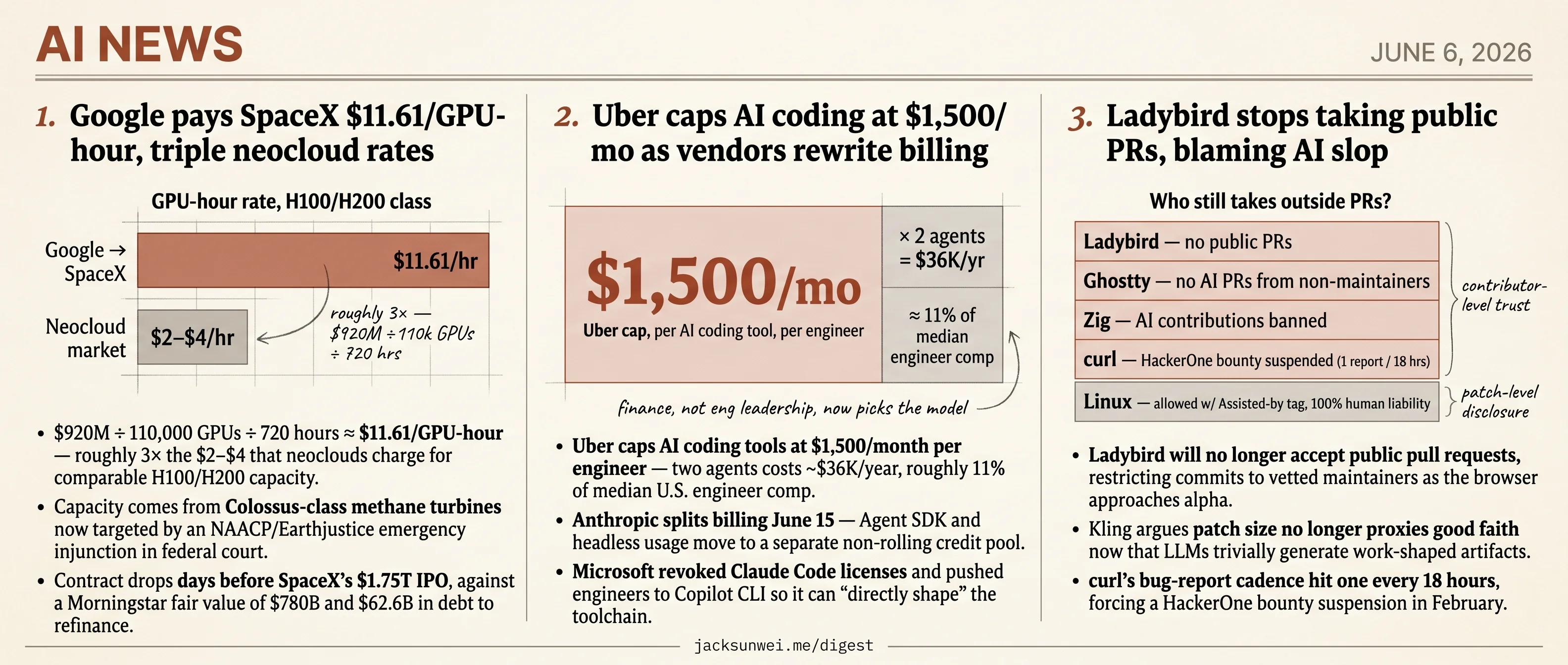
- Google pays SpaceX $11.61/GPU-hour, roughly 3× neocloud H100 rates.
- Ladybird closes public PRs, citing LLM-generated slop overwhelming maintainers.
- Uber caps AI coding at $1,500/month per engineer as productivity claims wobble.
- New York passes a 1-year moratorium on large data center construction.
- S&P 500 locks out OpenAI, Anthropic and SpaceX over its profitability rule.
Today’s AI leads all sit on the supplier side of the table. SpaceX is billing Google $11.61/GPU-hour — roughly 3× what neoclouds charge for comparable H100 capacity — and Google is paying it days before SpaceX’s $1.75T IPO, effectively funding xAI’s buildout in the process. Anthropic is splitting Claude Code billing on June 15 and Microsoft has revoked Claude Code licenses outright, leaving Uber to draw its own line: a $1,500/month per-engineer cap on AI coding tools, against a churn rate 9× baseline and incidents up 23.5%. And Ladybird is shutting public pull requests entirely, on the grounds that LLM output has made patch volume worthless as a signal of good faith.
The briefs round out the squeeze. The S&P 500 committee refused to waive its profit rule for SpaceX, OpenAI or Anthropic, gating them out of passive inflows; New York moved a 1-year data-center moratorium to the governor’s desk and a developer halved a campus after local protests; AirTrunk answered with $30B for 5GW in India; and Google quietly asked 404 Media to drop ‘humans in the loop’ from a quoted statement on AI oversight.
Google pays SpaceX $11.61/GPU-hour, triple neocloud rates
Source: techcrunch-ai · published 2026-06-05
TL;DR
- $920M ÷ 110,000 GPUs ÷ 720 hours ≈ $11.61/GPU-hour — roughly 3× the $2–$4 that neoclouds charge for comparable H100/H200 capacity.
- Capacity comes from Colossus-class methane turbines now targeted by an NAACP/Earthjustice emergency injunction in federal court.
- Contract drops days before SpaceX’s $1.75T IPO, against a Morningstar fair value of $780B and $62.6B in debt to refinance.
- Google is funding xAI’s infrastructure buildout while xAI competes head-on with Gemini.
The scarcity premium hiding inside “bridge capacity”
Google’s framing is that $920M/month buys “bridge capacity” for unexpected Gemini Enterprise demand. The unit economics tell a sharper story. Hacker News did the arithmetic within hours: $920M divided by 110,000 GPUs divided by 720 hours lands at $11.61 per GPU-hour — close to triple the $2–$4/hr that neoclouds quote for equivalent H100/H200 fleets 1. That is not a bulk discount; it is a desperation rate.
The premium reflects who else could deliver a turnkey 110k-GPU cluster on a 2026 timeline: essentially nobody. SpaceX, via its xAI-adjacent Colossus footprint, is the only operator with the power, the racks, and the GPU allocation already in motion. Google owns more custom AI silicon than almost anyone on Earth through TPUs, and it is still paying triple market rate for a 33-month lease — with a 90-day exit option baked in after December 2026, per the contract terms in the TechCrunch filing. Read that exit clause as Google admitting it does not want to be on the hook past the moment its own capacity catches up.
Memphis methane and an active federal injunction
The press release does not mention that the Colossus site is the subject of live litigation. The NAACP, represented by the Southern Environmental Law Center and Earthjustice, has asked a federal court for emergency action against at least 46 unpermitted methane turbines powering xAI’s Southaven, MS data center 2. An EmPower Analytics study commissioned by SELC projects the permanent 41-turbine array would emit roughly 20 tons of PM2.5 and over 1,700 tons of NOx annually, with health damages estimated in the millions of dollars 3.
For the next 33 months, every Gemini Enterprise query routed through this capacity is powered by turbines that a federal court may shortly order offline. The contract’s June 2029 end date sits a clean six months after the earliest 90-day exit window — Google has kept itself one quarterly review away from the door from day one.
The pre-IPO financing pattern
Michael Burry’s “fugazi” critique predates this announcement but maps onto it cleanly. He documented Nvidia booking $5.4B in GPU revenue while routing roughly $1.9B back as an anchor LP into the SPV (Valor Compute Infrastructure) that bought those same chips, then leasing them through to xAI/SpaceX 4. A $30B+ Google contract announced days before SpaceX’s IPO fits the same shape: manufactured revenue that validates the valuation it is timed against.
Morningstar’s independent fair value for SpaceX is $780B — less than half the $1.75T target — and it flags that ~78% of IPO proceeds are earmarked to retire $62.6B in debt rather than fund operations 5. Engadget names the strategic contradiction out loud: Google is now subsidizing the buildout of xAI, a direct Gemini competitor, while Google’s own Project Suncatcher orbital-compute effort trails SpaceX by years 6.
What this actually signals
Strip the vendor language and three things are visible at once. Google cannot ramp TPU and grid-connected capacity fast enough for its own AI roadmap. The cheapest available megawatts in 2026 are unpermitted methane turbines a federal judge may shut down 2. And the counterparty booking the revenue is doing so on a timeline calibrated to a $1.75T IPO that independent analysts cannot justify on fundamentals 5. “Bridge capacity” is the polite version of all three.
Uber caps AI coding at $1,500/mo as vendors rewrite billing
Source: techcrunch-ai · published 2026-06-05
TL;DR
- Uber caps AI coding tools at $1,500/month per engineer — two agents costs ~$36K/year, roughly 11% of median U.S. engineer comp.
- Anthropic splits billing June 15 — Agent SDK and headless usage move to a separate non-rolling credit pool.
- Microsoft revoked Claude Code licenses and pushed engineers to Copilot CLI so it can “directly shape” the toolchain.
- The productivity defense is wobbling — AI-assisted devs churn code at 9× baseline and production incidents are up ~23.5%.
The cap is a comp line item, not austerity
The TechCrunch framing — Uber burned its 2026 coding budget in four months, Priceline’s Cursor renewals went 5×, somebody got a reported $500M Claude bill — reads as a runaway-cost story. The numbers Simon Willison surfaced tell a structural one. Uber’s $1,500/month-per-tool cap, applied to two agents, is roughly $36K/year per engineer, or about 11% of a median U.S. Uber engineer’s total compensation 7. That puts AI tooling in the same budget conversation as salary bands, not the SaaS line. It also explains why finance, not engineering leadership, is now driving the conversation about which models developers are allowed to call.
Vendors are unbundling agentic from interactive
The supply side is moving in lockstep. Anthropic’s June 15 billing change carves all headless and programmatic usage — GitHub Actions, the Agent SDK, anything running without a human in the loop — into a separate non-rolling credit pool: $20/month on Pro, $100–$200 on Max, with overflow billed at standard API rates 8. Anthropic has effectively conceded that flat-rate Claude Code plus an autonomous agent loop is not a sustainable product shape on its own books.
Microsoft’s exit reads similarly, with a strategic twist. Forbes obtained an internal memo from EVP Rajesh Jha framing the six-month Claude Code rollout as a “learning exercise” and explaining that moving to Copilot CLI lets Microsoft “directly shape” the product alongside GitHub 9. The token bill is real, but it’s also cover for platform re-internalization.
The productivity case is shakier than the headline
TechCrunch’s “10× tokens for 2× productivity” line concedes the ROI is murky. The dissent goes further. Forbes’ “valuemaxxing” piece argues that ranking developers by token consumption — which Uber actually did — is the LLM-era version of paying by lines of code, and produces the same bloat 10. ByteIota’s read of recent GitClear/METR-style data is sharper still:
PR cycle times dropped from 9.6 days to 2.4, but production incidents climbed ~23.5%.
In the same dataset, AI-assisted developers churn code at 9× the rate of non-users, and duplicated-code prevalence rose from 8% to 18% 11. If those numbers hold, the “2× productivity” being defended at $36K/seat is partly a measurement artifact of faster PRs that ship more bugs.
A standards body without the standard-setters
The industry’s answer is the Linux Foundation’s new Tokenomics Foundation, pitching “cost-per-intelligence” and “tokens-per-watt” as the FinOps vocabulary for AI spend. The credibility problem is on the masthead: OpenAI and Anthropic — the parties who define what a token costs and what one buys — are absent from the founding membership, and critics argue a vendor-neutral body without the vendors can’t enforce neutrality 12. Customers are capping, suppliers are unbundling, and the layer meant to make the spend legible is launching without the people who price it.
Further reading
- Uber Caps Usage of AI Tools Like Claude Code to Manage Costs — simon-willison
Ladybird stops taking public PRs, blaming AI slop
Source: simon-willison · published 2026-06-05
TL;DR
- Ladybird will no longer accept public pull requests, restricting commits to vetted maintainers as the browser approaches alpha.
- Kling argues patch size no longer proxies good faith now that LLMs trivially generate work-shaped artifacts.
- curl’s bug-report cadence hit one every 18 hours, forcing a HackerOne bounty suspension in February.
- Linux took the opposite route: an
Assisted-bytag allowing AI code while pinning 100% liability on the human submitter.
What changed
Ladybird is closing its inbox. Founder Andreas Kling announced that the project — an independent browser engine built from scratch, now mid-port from C++ to Rust — will stop accepting public pull requests. Code stays open-source under a permissive license; the contribution model does not. Only core maintainers and invited contributors can land changes.
Kling’s reasoning is one sentence worth quoting directly:
A substantial patch used to imply substantial effort, and that effort was a reasonable proxy for good faith. That assumption no longer holds.
The argument is not that AI code is bad. It is that review time is the scarce resource, and LLMs have collapsed the cost of producing things that look like serious work — leaving maintainers to absorb the diff between appearance and reality.
Not an outlier
The pattern is now industry-wide among small, security-sensitive projects. Daniel Stenberg reports curl’s security reports went from roughly weekly to one every 18 hours of AI-generated noise, forcing the project to suspend its HackerOne bounty in February 13. Mitchell Hashimoto closed Ghostty to non-maintainer AI submissions using almost Kling’s exact framing: agentic coding removes the “effort-based backpressure” that historically gated low-quality contributions 14. Zig’s Andrew Kelley went further, calling AI contributions “invariably garbage” and arguing each one displaces a meaningful human submission 15.
| Project | Policy | Framing |
|---|---|---|
| Ladybird | No public PRs | Contributor-level trust |
| Ghostty | No AI PRs from non-maintainers | ”Effort-based backpressure” |
| Zig | AI contributions banned | Displaces human work |
| curl | Bounty suspended | ”Death by a thousand slops” |
| Linux | AI allowed with Assisted-by tag | Patch-level disclosure |
The Linux counter-model
Not everyone is closing the door. The Linux kernel finalized a policy in April 2026 that permits AI-assisted code provided the submitter adds an Assisted-by tag and accepts full legal and technical liability for the result 16. That is the same accountability principle Kling invokes — “who will answer for the consequences” — but operationalized as disclosure plus human ownership rather than gatekeeping.
The fault line isn’t pro- vs. anti-AI. It’s whether you believe provenance can be policed at the patch level (Linux’s subsystem maintainers, with decades of hierarchy) or only at the contributor level (everyone else). Small teams appear to find the second cheaper.
The asymmetry critics noticed
Two caveats are worth holding. First, “drive-by” predates the AI wave in Kling’s vocabulary — he used it in the 2021 SerenityOS pronoun-PR dispute to describe “outsiders doing drive-by [code changes] with ideological motivations” 17. The AI-slop framing extends an existing preference for vetted insiders rather than introducing a new one. Hacker News critics called the move a step toward an effectively “corporate-controlled” project despite the open license 18.
Second, and more awkwardly: Ladybird’s maintainers are themselves shipping AI-accelerated work, reportedly converting 25,000 lines of C++ to Rust in two weeks with Claude Code and Codex. The currency being protected isn’t human-written code. It’s known humans — a distinction the next round of policy fights will have to make explicit.
Round-ups
New York passes 1-year moratorium on new large data centers
Source: the-verge-ai
New York’s legislature approved the first statewide pause on large data center construction, sending the bill to Governor Kathy Hochul. Sponsors want time to study energy-price and environmental impacts before more AI-driven buildout proceeds across the state.
S&P 500 keeps OpenAI, Anthropic and SpaceX locked out over profit rule
Source: ars-technica-ai
The S&P 500 committee declined to waive its profitability requirement for SpaceX, a decision that also blocks fast-track entry for unprofitable AI heavyweights OpenAI and Anthropic. The move cuts them off from billions in passive index-fund inflows.
Developer halves giant data center plan after community backlash
Source: ars-technica-ai
Facing sustained local protests, a data center developer cut its proposed campus by 50%, saying it felt ‘beaten up’ and had ‘no choice.’ The retreat signals how organized opposition is reshaping siting decisions for AI-scale facilities.
AirTrunk pledges $30B for 5GW of AI data centers in India
Source: techcrunch-ai
Australian operator AirTrunk plans to deploy 5 gigawatts of capacity across India, one of the largest single-country commitments by a hyperscale developer. The buildout targets surging demand from AI training and inference workloads in the region.
Google quietly drops ‘humans in the loop’ line from AI statement
Source: simon-willison
After 404 Media published a story on internal Google memes mocking its AI, the company asked the outlet to swap in a revised statement that removed the phrase ‘it’s critical that we maintain humans in the loop’ — a telling edit on AI oversight messaging.
Vergecast unpacks Nvidia and Microsoft’s pitch for the AI laptop
Source: the-verge-ai
Developer conference season has Big Tech reimagining the laptop around AI, with Nvidia’s Jensen Huang sketching a new interaction model and Microsoft pushing Gemini and Spark integrations. The Vergecast weighs whether users actually want the rewrite.
AINews calls it a quiet day across the AI beat
Source: latent-space
Latent Space’s daily AINews digest flags an unusually slow news cycle, with no major model launches, papers or policy moves to recap. A rare breather in a beat that typically churns out multiple headline events per day.
Footnotes
-
Hacker News discussion (news.ycombinator.com) — https://news.ycombinator.com/item?id=48417490
↩$920M / 110,000 GPUs / 720 hours ≈ $11.61 per GPU-hour — nearly triple typical neocloud rates of $2–$4/hr; the premium likely reflects the cost of behind-the-meter methane turbines powering Colossus.
-
Earthjustice / NAACP press release — https://earthjustice.org/press/2026/naacp-asks-court-for-emergency-action-to-stop-illegal-air-pollution-from-xais-data-center-power-plant
↩ ↩2The NAACP, represented by SELC and Earthjustice, asked a federal court for emergency action to stop illegal air pollution from xAI’s data center power plant in Southaven, where at least 46 unpermitted methane turbines now operate.
-
Southern Environmental Law Center (EmPower Analytics study) — https://www.selc.org/press-release/new-study-finds-proposed-xai-gas-plant-could-worsen-regional-air-pollution-cause-millions-of-dollars-in-annual-health-damages/
↩The proposed 41 permanent turbines could emit nearly 20 tons of fine particulate matter and over 1,700 tons of smog-forming nitrogen oxides annually, with health damages estimated in the millions of dollars.
-
24/7 Wall St. on Michael Burry — https://247wallst.com/investing/2026/06/01/michael-burry-just-called-nvidias-spacex-chip-deal-fugazi-heres-why-it-all-seems-wrong/
↩Burry called the Nvidia–SpaceX/xAI GPU arrangement ‘fugazi,’ arguing Nvidia booked $5.4B in revenue while putting ~$1.9B back into the SPV (Valor Compute Infrastructure) that bought the chips — a circular flow that inflates demand signals ahead of SpaceX’s IPO.
-
Forbes — SpaceX IPO analysis (Morningstar) — https://www.forbes.com/sites/investor-hub/article/spacex-ipo-things-to-know/
↩ ↩2Morningstar issued a fair value estimate of $780 billion — less than half the $1.75T IPO target — citing speculative AI revenue forecasts and noting ~78% of IPO proceeds are earmarked to pay down $62.6B in debt.
-
Engadget — https://www.engadget.com/2188862/google-spacex-xai-data-center-deal-gemini/
↩Google is effectively subsidizing the infrastructure build-out of xAI, a direct competitor to its Gemini AI models — a vertical-integration paradox that has raised antitrust red flags around ‘orbital compute.’
-
Clauding.de analysis of Willison’s commentary — https://clauding.de/en/posts/uber-deckelt-ki-coding-budget-1500-dollar
↩If an engineer uses two such tools, the annual cost reaches approximately $36,000, which represents roughly 11% of the median total compensation for a U.S.-based Uber engineer.
-
Pravin Kumar blog — Anthropic June 15 billing change — https://www.pravinkumar.co/blog/claude-june-15-billing-change-explained-2026
↩All headless or programmatic usage—including GitHub Actions and the Agent SDK—will now draw from a separate, non-rolling monthly credit ($20 for Pro; $100–$200 for Max). Once depleted, usage immediately shifts to standard API rates.
-
Forbes (Jon Markman) — Microsoft ends Claude Code licenses — https://www.forbes.com/sites/jonmarkman/2026/06/01/microsoft-ends-claude-code-licenses-as-it-pushes-copilot-cli/
↩Internal memos from EVP Rajesh Jha framed the six-month Claude experiment as a ‘learning exercise,’ but emphasized that moving to Copilot CLI allows Microsoft to ‘directly shape’ the product alongside GitHub.
-
Forbes — ‘Why Tokenmaxxing Is Out and Valuemaxxing Is In’ — https://www.forbes.com/sites/timkeary/2026/06/02/why-tokenmaxxing-is-out-and-valuemaxxing-is-in/
↩Using token volume as a productivity metric is flawed, comparable to rewarding developers for writing the most lines of code, which often leads to bloated and inefficient systems.
-
ByteIota — AI productivity paradox study — https://byteiota.com/ai-code-productivity-paradox-42-ai-generated-23-more-bugs/
↩Code churn is expected to double in 2026, with AI-assisted developers frequently churning code at 9x the rate of those not using the tools… PR cycle times dropped from 9.6 days to 2.4, but production incidents climbed ~23.5%.
-
The Next Web — Tokenomics Foundation launch — https://thenextweb.com/news/token-prices-fell-98-enterprise-ai-bills-tripled-now-the-industry-wants-a-standards-body-to-explain-why
↩A primary point of industry criticism is the notable absence of frontier model providers like OpenAI and Anthropic from the founding group… critics argue a standard-setting body lacking their direct involvement may struggle to enforce vendor-neutrality.
-
The New Stack — Stenberg on AI DDoS — https://thenewstack.io/curls-daniel-stenberg-ai-is-ddosing-open-source-and-fixing-its-bugs/
↩Reports that used to arrive once a week now flood in every 18 hours… Death by a thousand slops
-
Medium — Hashimoto / Ghostty zero-AI policy — https://canartuc.medium.com/59-000-packages-1-400-developers-zero-ai-policy-95a00cfb92b2
↩Mitchell Hashimoto… implemented a zero-tolerance policy that bans all AI-generated pull requests from non-maintainers, citing the rise of ‘agentic programming’ that removes the natural ‘effort-based backpressure’ of manual coding
-
StartupFortune on Andrew Kelley / Zig — https://startupfortune.com/andrew-kelley-banned-ai-code-from-zig-and-the-reasoning-is-harder-to-dismiss-than-most-critics-expect/
↩Kelley has characterized AI-generated contributions as ‘invariably garbage’… every automated submission effectively displaces a meaningful human contribution
-
XDA — Linux kernel AI policy — https://www.xda-developers.com/linux-kernel-now-allows-ai-written-code/
↩The Linux Kernel finalized a policy in April 2026 that permits AI-assisted code provided it includes an
Assisted-bytag… placing 100% of the legal and technical liability for bugs or licensing violations on the human submitter -
kvibber.com — Ladybird inclusivity review — https://kvibber.com/reviews/software/ladybird-inclusivity/
↩He clarified on social media that he does not oppose gender-neutral language itself but objects to ‘outsiders doing drive-by [code changes] with ideological motivations’
-
Neowin — community reaction — https://www.neowin.net/news/ladybird-browser-is-no-longer-accepting-outside-contributions-thanks-to-ai/
↩critics on platforms like Hacker News argued that closing the project to public contributions makes it effectively ‘corporate-controlled’ or less independent