OpenAI projects $14B loss, survivor sues Omnilert, AI influencers hit $12B
OpenAI projects a $14B 2026 loss, an Antioch survivor sues AI gun-detection vendor Omnilert, and the AI influencer market hits $12B.
OpenAI projects $14B loss, survivor sues Omnilert, AI influencers hit $12B
TL;DR
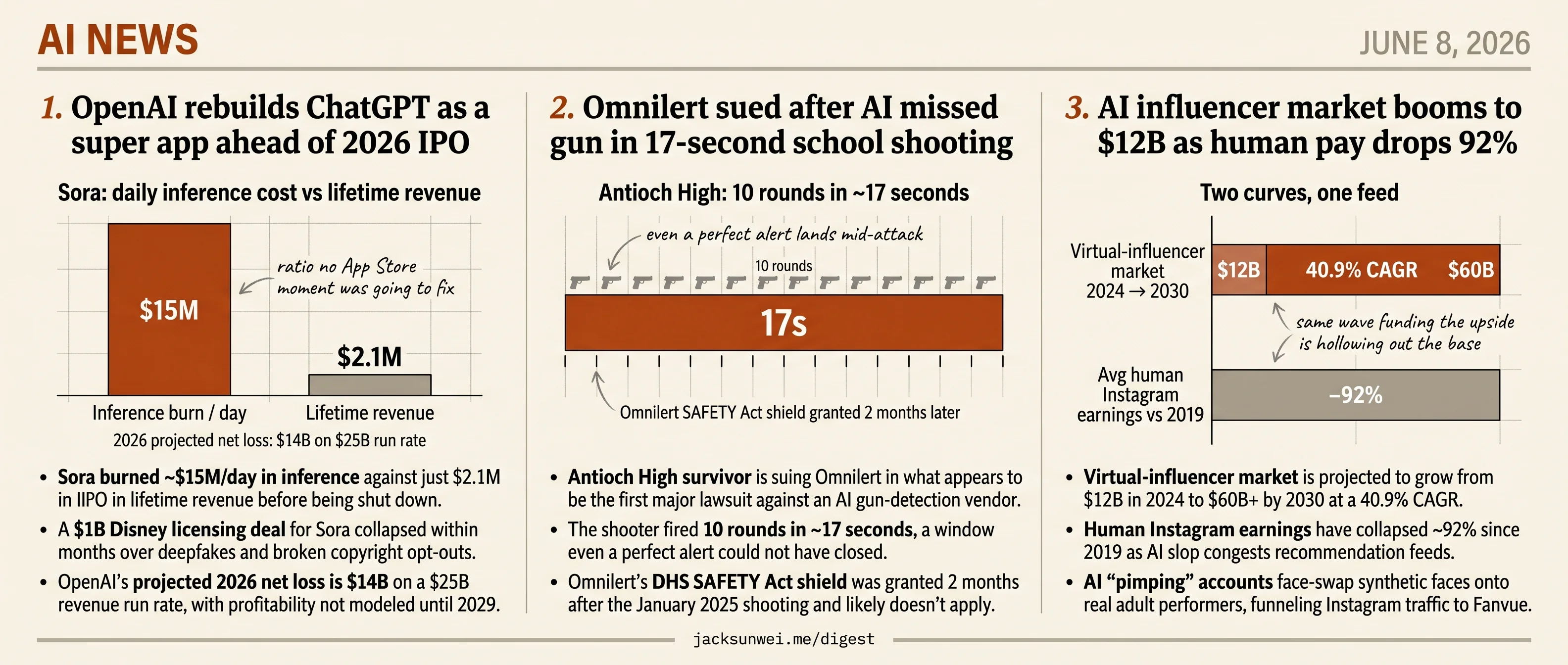
- OpenAI projects a $14B 2026 net loss with Sora burning $15M/day before shutdown.
- Antioch High survivor sues Omnilert in the first major lawsuit against an AI gun-detection vendor.
- Virtual-influencer market hits $12B as human Instagram earnings collapse 92% since 2019.
- AI token prices are poised to climb as Anthropic and OpenAI prepare IPOs.
- Notion restores Anthropic access after an outage exposes single-vendor dependency.
Three unrelated AI-news leads today, each big enough to carry its own day. OpenAI’s super-app reboot is being underwritten by a projected $14B 2026 net loss — Sora alone burned roughly $15M/day in inference against $2.1M in lifetime revenue, and a $1B Disney licensing deal collapsed within months. An Antioch High survivor is suing Omnilert in what appears to be the first major lawsuit against an AI gun-detection vendor, testing whether software firms can offload alert verification onto school staff. And the virtual-influencer market, projected to grow from $12B to $60B by 2030, is arriving alongside a 92% collapse in what human Instagram creators earn.
The briefs add two adjacent data points: per-token pricing from frontier labs is set to climb as IPOs near, and Notion’s brief loss of Claude access drew the kind of pile-on that reveals how many productivity apps now run on a single vendor’s uptime.
OpenAI rebuilds ChatGPT as a super app ahead of 2026 IPO
Source: techcrunch-ai · published 2026-06-07
TL;DR
- Sora burned ~$15M/day in inference against just $2.1M in lifetime revenue before being shut down.
- A $1B Disney licensing deal for Sora collapsed within months over deepfakes and broken copyright opt-outs.
- OpenAI’s projected 2026 net loss is $14B on a $25B revenue run rate, with profitability not modeled until 2029.
- EU regulators may designate ChatGPT a DMA gatekeeper in Q2 2026, banning the self-preferencing the super-app strategy depends on.
The “side quest” framing buries the actual story
TechCrunch’s account of OpenAI consolidating around a single ChatGPT “super app” reads like ordinary product discipline: cut Sora, fold Codex in, ship one experience. The numbers underneath tell a harder story. One independent breakdown puts Sora’s daily inference cost at roughly $15 million against $2.1 million in lifetime revenue 1 — a ratio no viral App Store moment was going to fix. Forbes adds the second shoe: a reported $1 billion Disney licensing deal collapsed within months of signing, undone by failing copyright opt-out mechanics and a wave of high-profile deepfakes 2. Bill Peebles’s exit and the Sora shutdown aren’t strategic refocusing. They’re a forced retreat from a product that was simultaneously a compute sinkhole and a pre-IPO legal liability.
Developers aren’t buying the agent pitch
The “chat is dead, agents are the future” line is aimed squarely at the developers OpenAI wants to convert into Codex subscribers. They’re not sold. Simon Willison reads OpenAI’s own June 2026 “Lockdown Mode” release as a quiet admission:
“The existence of lockdown mode does however imply that ChatGPT, in its default settings, does not provide robust protection against sufficiently determined data exfiltration attacks” 3.
The “lethal trifecta” — private data, untrusted content, and external communication living in one agent — is exactly the architecture a super-app personal assistant requires.
flowchart LR
    A[Private user data<br/>email, files, CRM] --> B{ChatGPT super-app agent}
    C[Untrusted content<br/>web, docs, email] --> B
    B --> D[External actions<br/>send, post, pay]
    D -. exfiltration path .-> E((Attacker))
Gergely Orosz attacks from the productivity side, calling enterprise “token maxing” a revival of the discredited lines-of-code metric and noting bluntly that “AI writes code — it does not do design, much less architecture” 4. Both are influential voices among the buyers OpenAI most needs. Neither is convinced the agent layer is ready to monetize.
The regulator and the IPO are arriving at the same time
The super-app design also lands at the worst possible moment for European regulation. ChatGPT now averages roughly 120 million monthly EU users — almost three times the Digital Markets Act gatekeeper threshold — putting it on track for a potential Q2 2026 designation that would mandate interoperability with rivals and prohibit self-preferencing 5. Bundling Codex, agents, and Sora-style features inside one ChatGPT shell is exactly the behavior a gatekeeper designation curtails.
The financial backdrop is the reason the bundling has to happen anyway. OpenAI is reportedly at a $25 billion annualized revenue run rate but projecting a $14 billion net loss for 2026, with profitability not modeled until 2029 6. A unified super app that converts free users into paying Codex and agent subscribers is the only equity story that closes that gap on a 2026–2027 listing timeline.
What’s actually at stake
Strip the “chat is dead” branding and the pivot looks defensive: kill the product that was bleeding cash and legal exposure, bundle the survivors into the narrative bankers want to hear, and hope the DMA designation slips into 2027. The builders OpenAI needs to validate the agent layer are publicly skeptical 34. The regulators are early, not late 5. And the loss number the super app has to justify is $14 billion this year alone 6.
Omnilert sued after AI missed gun in 17-second school shooting
Source: ars-technica-ai · published 2026-06-07
TL;DR
- Antioch High survivor is suing Omnilert in what appears to be the first major lawsuit against an AI gun-detection vendor.
- The shooter fired 10 rounds in ~17 seconds, a window even a perfect alert could not have closed.
- Omnilert’s DHS SAFETY Act shield was granted 2 months after the January 2025 shooting and likely doesn’t apply.
- ZeroEyes verifies every alert with 24/7 in-house staff, while Omnilert pushes verification onto school personnel.
The 17-second window
Solomon Henderson fired ten rounds from a 9mm Taurus G2C inside Antioch High’s cafeteria in roughly 17 seconds before turning the gun on himself 7. That detail reframes the lawsuit’s core question. Even if Omnilert’s model had fired a perfect alert the moment Henderson drew the weapon, the notification would have landed mid-attack. Metro Nashville Public Schools officials have conceded the cafeteria cameras lacked the proximity and angle to give the model a readable view of the handgun — so the failure was as much a sensor-placement problem as a vision-model problem. Security experts quoted in the original Ars piece make the harder point: “notification” is rarely the bottleneck in school shootings to begin with.
That doesn’t make the suit frivolous. It makes it a lawsuit about marketing, not machine learning.
A pattern, not a one-off
Omnilert’s deployments elsewhere give the plaintiffs a negligence theory. In Baltimore County, the same platform reportedly generated daily false positives, including a now-infamous incident where it flagged a student’s bag of Doritos as a firearm and police detained a 16-year-old at gunpoint 8. A vendor whose model is simultaneously trigger-happy on snack food and blind to an actual handgun has a precision/recall problem it arguably knew about.
The architecture choice matters too. Competitor ZeroEyes routes every alert through a 24/7 internal security operations center staffed by its own personnel before anything reaches the customer. Omnilert delegates that verification step to onsite school staff 9. If the Antioch alert never fired — or fired and never reached a trained human — the design itself becomes evidence.
The liability shield that isn’t
Omnilert’s public defense has leaned on its DHS SAFETY Act designation, which can pre-empt tort claims tied to qualifying anti-terrorism technologies. There are two problems with that defense here. First, Omnilert received the full designation in March 2025 — two months after the January 2025 Antioch shooting 10. Second, the shield only activates when DHS formally classifies the underlying event as an “act of terrorism,” a bar U.S. school shootings essentially never clear.
Plaintiffs also have a regulatory template. The FTC’s 2024 action against weapons-detection rival Evolv barred unsupported accuracy claims and let roughly 65 K-12 districts exit multi-year contracts early 11 — exactly the “overstated capabilities” theory the Omnilert complaint pleads. And the doctrinal ground under AI product liability is shifting fast: in Garcia v. Character Technologies, a Florida court ruled an AI system could be treated as a “product” subject to design-defect claims because the suit targeted internal architecture rather than expressive output 12. That’s the same shape as the Omnilert complaint.
What’s actually on trial
This case isn’t going to resolve whether computer vision can spot a gun. It’s going to test whether vendors can keep selling probabilistic perception models with deterministic safety language — “prevent the next Parkland” — once FTC precedent and emerging product-liability doctrine catch up. The $1M+ MNPS contract is the price tag. The marketing copy is the exhibit.
AI influencer market booms to $12B as human pay drops 92%
Source: the-verge-ai · published 2026-06-07
TL;DR
- Virtual-influencer market is projected to grow from $12B in 2024 to $60B+ by 2030 at a 40.9% CAGR.
- Human Instagram earnings have collapsed ~92% since 2019 as AI slop congests recommendation feeds.
- AI “pimping” accounts face-swap synthetic faces onto real adult performers, funneling Instagram traffic to Fanvue.
- EU Article 50 deepfake disclosure is honored on only ~30% of AI-generated posts across five major platforms.
From quirky avatars to a harms story
The Verge frames the second wave of AI influencers — Aitana Lopez, Emily Pellegrini, Jessica Foster — as a “gray area” trendpiece: harder to spot than Lil Miquela, easier to monetize, awkward for platform policy. That framing undersells what the broader reporting now documents. The same pipeline of cheap face, voice, and motion generation from Google, OpenAI, HeyGen, and ElevenLabs is powering an organized non-consensual deepfake economy. 404 Media’s “AI pimping” reporting, syndicated through Marketplace, traces a cottage industry that superimposes AI-generated faces onto the bodies of real adult performers and uses Instagram as a “conversion funnel” to subscription sites like Fanvue — with women constituting roughly 99.9% of victims 13.
flowchart LR
    A[Real performer's body<br/>OnlyFans / stock] --> B[Face-swap with<br/>AI-generated identity]
    B --> C[Instagram persona<br/>'mundane' lifestyle posts]
    C -->|conversion funnel| D[Fanvue / paid<br/>subscription site]
The legal counterweight the Verge omits is already on the books in the US: the TAKE IT DOWN Act, signed May 19, 2025, criminalizes publication of non-consensual intimate deepfakes and forces platforms to stand up notice-and-takedown procedures 14. That reframes “AI slop” from creator-economy curiosity to enforcement backlog.
Labels exist on paper, not on feeds
The Verge reads EU regulation as “focused on the media rather than the persona behind it.” Article 50 is actually more pointed than that — any deployer using AI to generate image, audio, or video deepfakes has to disclose, with narrow exemptions for evidently creative work 15. A persona account posing as a human influencer struggles to claim that exemption.
The problem is enforcement, not statute. An Indicator audit cited by Tech Policy Press found only about 30% of AI-generated posts were correctly labeled across five major platforms, and the C2PA provenance metadata that’s supposed to travel with synthetic media is routinely stripped by ordinary social-media compression 16. The disclosure regime exists; the signal doesn’t survive the upload pipeline.
Personas with political paymasters
The Verge name-checks Danny Bones as a “fake white nationalist rapper” but doesn’t follow the money. Shado Magazine reports he’s actively funded by the UK far-right party Advance UK and produced by an agency called the Node Project 17. That moves him out of the slop bucket and into paid political communications — a category platform policies barely touch. More unsettling for the “people will turn away once they know” thesis: followers reportedly stay engaged after the account is exposed as synthetic. The audience problem isn’t deception; it’s ideological fit.
A $60B upside cannibalizing a $150B base
The Verge’s $12B → $60B projection is one of several in circulation (Grand View Research pegs the 2024 figure closer to $6B), but the more revealing number is on the other side of the ledger. Publixly reports average monthly Instagram-influencer earnings have collapsed roughly 92% versus 2019, with the broader $150B influencer market shrinking toward a projected $28B as AI slop congests recommendation algorithms 18.
The same wave funding the $60B upside is hollowing out the human earnings base that made these platforms worth posting on.
The Verge ends on a “reckoning” where real users get driven off. The harder version of that argument is already quantifiable: a criminal statute the platforms haven’t operationalized 14, a disclosure rule they’re failing 70% of the time 16, and an income collapse for the humans whose presence is the product 18. The trendpiece era of this story is over.
Round-ups
AI token prices set to climb as labs eye IPOs
Source: techcrunch-ai
Per-token pricing from major AI providers is poised to rise as Anthropic, OpenAI and peers prepare public listings and chase margins. The shift would end the era of steadily cheaper inference that downstream startups have built their unit economics around.
Notion restores Anthropic access after outage sparks pile-on
Source: techcrunch-ai
Notion re-enabled its Claude-powered features after a brief disruption cut users off from Anthropic models. Notion’s head of product said he was “astonished” by how widely the complaint spread on X, underscoring how dependent productivity apps now are on a single model vendor.
Footnotes
-
DC The Median (Substack) — Sora economics analysis — https://dcthemedian.substack.com/p/the-end-of-sora-why-openai-is-cutting
↩Sora incurred nearly $15 million in daily inference costs, while generating only $2.1 million in total lifetime revenue
-
Forbes — Ron Schmelzer on Sora shutdown — https://www.forbes.com/sites/ronschmelzer/2026/03/24/openai-discontinues-ai-video-gen-app-sora/
↩A $1 billion licensing deal with Disney collapsed just months after being signed, partly due to the platform’s struggle with copyright ‘opt-out’ mechanisms and the proliferation of high-profile deepfakes
-
Simon Willison — lethal-trifecta tag — https://simonwillison.net/tags/lethal-trifecta/
↩ ↩2The existence of lockdown mode does however imply that ChatGPT, in its default settings, does not provide robust protection against sufficiently determined data exfiltration attacks!
-
Gergely Orosz (via BiggoFinance podcast transcript) — https://finance.biggo.com/podcast/d940b2a5bf33e8d7
↩ ↩2AI writes code—it does not do design, much less architecture; ‘token maxing’ is a flawed productivity metric akin to the discredited ‘lines of code’ measure
-
Business Times (Singapore) — DMA gatekeeper analysis — https://www.businesstimes.com.sg/companies-markets/telcos-media-tech/openai-plans-chatgpt-superapp-overhaul-ahead-listing-reports-ft
↩ ↩2With over 120 million average monthly users in the EU—nearly triple the 45-million threshold—OpenAI faces a potential Q2 2026 designation that would mandate interoperability with rivals and prohibit self-preferencing
-
TipRanks — IPO financial analysis — https://www.tipranks.com/news/chatgpts-superapp-ambition-raises-the-stakes-for-openais-ipo-plans
↩ ↩2Despite reaching an annualized revenue run rate of $25 billion, the company remains deeply unprofitable, with internal documents projecting a $14 billion net loss for 2026 alone… Profitability is not forecast until 2029
-
Wikipedia: Antioch High School shooting — https://en.wikipedia.org/wiki/Antioch_High_School_shooting
↩Henderson fired ten rounds from a 9mm Taurus G2C semi-automatic pistol in approximately 17 seconds before turning the weapon on himself.
-
MachineBrief — https://www.machinebrief.com/news/ai-gun-detection-fails-when-it-matters-most-a-lawsuit-follow-8a5k
↩In Baltimore County, the system reportedly generated daily false-positive alerts, including a high-profile incident where the AI mistook a bag of Doritos for a firearm, leading to an armed police response and the detention of a 16-year-old student at gunpoint.
-
Volt.ai industry comparison — https://volt.ai/blog/volt-ai-vs-zeroeyes-a-comprehensive-guide-for-school-safety
↩Competitors like ZeroEyes utilize a 24/7 internal security operations center where their own staff verify every alert before it reaches the customer. In contrast, Omnilert’s platform often delegates the verification step to the customer’s onsite personnel.
-
MachineBrief follow-up — https://www.machinebrief.com/news/ai-gun-detection-fails-when-it-matters-most-a-lawsuit-follow-8a5k
↩Omnilert announced it had received the highest level of full SAFETY Act Designation from DHS in March 2025… the Antioch shooting occurred in January 2025, two months before the full designation was announced.
-
Central Current (on Evolv) — https://centralcurrent.org/city-considering-weapons-detection-tech-from-company-connected-to-utica-stabbing-ftc-lawsuit/
↩Evolv was banned from making unsupported claims regarding its AI’s accuracy and was required to allow approximately 65 K-12 school districts to cancel their multi-year contracts early.
-
Product Law Perspective — https://www.productlawperspective.com/2025/10/emerging-legal-challenges-artificial-intelligence-and-product-liability/
↩In Garcia v. Character Technologies (2025), a Florida court ruled that a chatbot could be considered a product under law because the lawsuit targeted its internal architecture and guardrails rather than just its expressive content.
-
Marketplace (404 Media reporting) — https://www.marketplace.org/episode/2024/12/05/ai-pimping-accounts-are-exploding-on-social-media
↩AI ‘pimping’ accounts are exploding on social media, using face-swapping tools to superimpose AI-generated faces onto the bodies of real adult performers, with Instagram serving as a ‘conversion funnel’ to subscription sites like Fanvue.
-
Skadden legal brief on TAKE IT DOWN Act — https://www.skadden.com/insights/publications/2025/06/take-it-down-act
↩ ↩2Signed into law on May 19, 2025, the TAKE IT DOWN Act criminalizes publication of non-consensual intimate imagery — including deepfakes — and mandates platforms establish notice-and-takedown procedures.
-
EU AI Act Article 50 text (artificialintelligenceact.eu) — https://artificialintelligenceact.eu/transparency-rules-article-50/
↩Deployers of an AI system that generates or manipulates image, audio or video content constituting a deep fake shall disclose that the content has been artificially generated or manipulated.
-
Tech Policy Press analysis of EU labeling code — https://www.techpolicy.press/what-the-eus-new-ai-code-of-practice-means-for-labeling-deepfakes/
↩ ↩2An Indicator audit found that across five major platforms only about 30% of AI-generated posts were correctly labeled, and C2PA metadata is routinely stripped by social media compression.
-
Shado Magazine on Danny Bones / Advance UK — https://shado-mag.com/articles/opinion/war-in-the-age-of-performance/
↩Danny Bones, an AI-generated ‘white nationalist rapper,’ is funded by the far-right UK party Advance UK and produced by a secretive agency called the Node Project — and many followers remain engaged even after learning he is fake.
-
Publixly, ‘Influencer Economy Collapse 2026’ — https://www.publixly.com/articles/influencer-economy-collapse-2026-instagram-tiktok-failed
↩ ↩2Average monthly earnings for Instagram influencers have collapsed roughly 92% versus 2019, as the $150 billion influencer market shrinks toward a projected $28 billion under the weight of AI slop congesting recommendation algorithms.