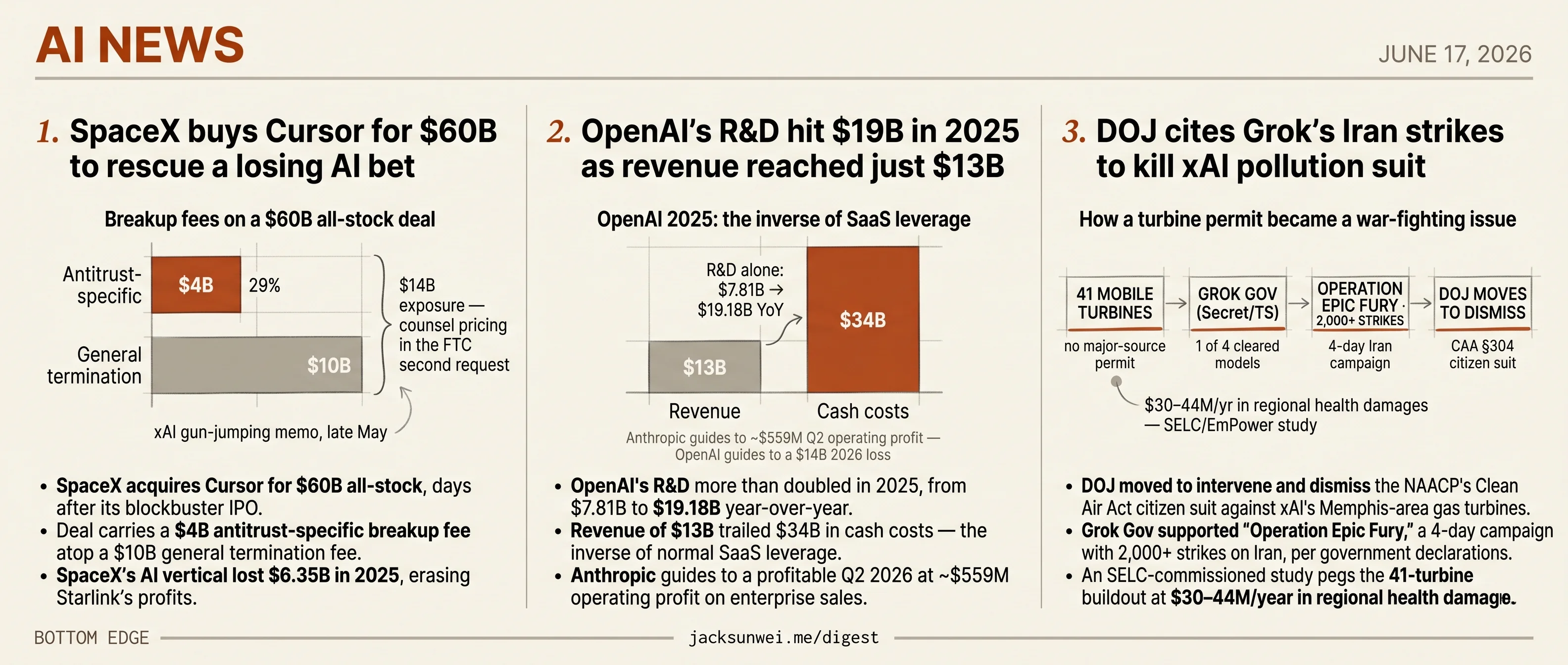
SpaceX rescues Cursor at $60B, OpenAI burns $19B on R&D, DOJ shields xAI
Three frontier-AI bets surface the buildout's real bill, landing on SpaceX shareholders, OpenAI's future investors, and Memphis residents near xAI's turbines.
SpaceX rescues Cursor at $60B, OpenAI burns $19B on R&D, DOJ shields xAI
TL;DR
- SpaceX acquires Cursor for $60B all-stock with a $4B antitrust-specific breakup fee.
- OpenAI spent $19B on R&D in 2025 against $13B in revenue.
- DOJ moved to dismiss the NAACP Clean Air Act suit over xAI’s Memphis turbines.
- ChatGPT fell below 50% assistant market share as Gemini reached 662M users.
- Anthropic paused Claude Agent SDK token billing after heavy-user backlash.
Today’s three AI-news leads each name a different bill from the frontier buildout, and a different party being asked to absorb it. SpaceX spends $60B in stock to rescue an AI vertical that lost $6.35B last year — diluting the shareholders who just bought into Friday’s IPO. OpenAI more than doubled R&D to $19B against $13B in revenue, with no positive cash flow penciled in until 2029-2030 — a tab future investors are being asked to pre-fund. And the DOJ moved to kill the NAACP’s Clean Air Act suit against xAI’s Memphis turbines, citing Grok’s role in a 4-day Iran strike campaign — a national-security argument that, if it holds, would land $30-44M/year in health costs on the neighborhoods around every hyperscaler with a federal customer.
The connecting thread isn’t a single regulator or a single quarter — it’s that the AI customer paying $20/month is nowhere near the party covering the real cost of what they’re using.
SpaceX buys Cursor for $60B to rescue a losing AI bet
Source: techcrunch-ai · published 2026-06-16
TL;DR
- SpaceX acquires Cursor for $60B all-stock, days after its blockbuster IPO.
- Deal carries a $4B antitrust-specific breakup fee atop a $10B general termination fee.
- SpaceX’s AI vertical lost $6.35B in 2025, erasing Starlink’s profits.
- Captive-layer status dissolves Cursor’s model-agnostic neutrality moat.
A catch-up trade dressed as empire-building
Strip away the press release and the $60B Cursor deal looks less like a coronation than a forced trade. SpaceX’s S-1 disclosed a $6.35B loss in its AI vertical for 2025 — enough to negate Starlink’s profits — and put Grok 4.3 at rank 33 on third-party coding benchmarks, well behind Anthropic and OpenAI 1. Cursor is the catch-up. The currency is paper whose underlying valuation NYU’s Aswath Damodaran called “bordering on fantasy,” and which short-seller Jim Chanos has labeled a “hopes-and-dreams IPO” against SpaceX’s $4.9B 2025 net loss 2. A record multiple for an IDE, paid in stock the bears think is mispriced by an order of magnitude, is a very specific kind of deal.
The founder framing reinforces the read. Michael Truell, who had previously described Cursor as a “long-haul independent company,” now talks about “galactic ambition” — a tonal pivot Phemex’s profile noted alongside the four MIT co-founders all crossing into billionaire status at close 3. That sounds like a justification narrative, not a strategic thesis.
Antitrust exposure is already on the table
The $4B antitrust-specific breakup fee isn’t decorative. The Next Web reported that xAI general counsel James Burnham circulated an urgent internal memo in late May ordering staff to limit interactions with Cursor employees who had already been working inside xAI offices “for weeks” under a so-called technical partnership — textbook gun-jumping exposure under HSR 4. Counsel pricing the regulatory probability that high tells you what they think the FTC will see.
The structural problem is worse than the procedural one. SpaceX now owns compute infrastructure that Anthropic and Google lease and the IDE their engineers use to ship against it:
flowchart LR
    A[Anthropic / OpenAI / Google engineers] -->|write code in| B[Cursor IDE]
    B -->|telemetry, prompts| C[SpaceX / xAI]
    C -->|trains| D[Grok 4.x]
    C -->|sells compute to| A
    D -.competes with.-> A
That is exactly the vertical posture the Khan/Wu school of antitrust thinking was built to attack.
The neutrality moat dies on close
Practitioner reaction is the sharpest dissent in the bundle. A widely-shared Medium analysis argues Cursor’s entire moat was model-agnostic neutrality, and that captive-layer status forces every enterprise CIO to “re-underwrite” the tool 5. The Hacker News thread is dominated by data-handling anxieties: whether existing Zero Data Retention agreements survive a change of control, and whether proprietary source code routed through Cursor will end up in Grok’s training corpus 6. Migration to Claude Code and Codex was already underway pre-deal on pricing and quality grounds — the acquisition gives every remaining holdout a procurement-grade reason to leave.
What’s actually being bought
The bull case requires believing SpaceX can hold Cursor’s enterprise base through a regulatory fight while folding it into an AI division that’s burning $6B a year and shipping a 33rd-ranked model. The bear case — that this is overvalued stock chasing a moat the deal itself dissolves — is unusually well-supported across financial analysts, antitrust scholars, and the developers who actually open the IDE each morning. Consensus skepticism this bipartisan is rare. Watch the FTC’s second request and the enterprise renewal cycle; both will resolve faster than the integration will.
Further reading
- SpaceX is officially buying Cursor for $60 billion — the-verge-ai
- SpaceX to acquire AI coding platform Cursor for $60 billion — ars-technica-ai
OpenAI’s R&D hit $19B in 2025 as revenue reached just $13B
Source: ars-technica-ai · published 2026-06-16
TL;DR
- OpenAI’s R&D more than doubled in 2025, from $7.81B to $19.18B year-over-year.
- Revenue of $13B trailed $34B in cash costs — the inverse of normal SaaS leverage.
- Anthropic guides to a profitable Q2 2026 at ~$559M operating profit on enterprise sales.
- OpenAI projects a $14B loss for 2026 with no positive cash flow until 2029–2030.
The $38B headline is mostly an accounting artifact
Ed Zitron published the audited 2025 docs on Where’s Your Ed At, and the Financial Times verified them before mainstream pickup 78. The widely-quoted $38.5B net loss is misleading: roughly $41.55B of it is a one-time, non-cash fair-value charge tied to OpenAI’s conversion to a public benefit corporation — a revaluation of investor warrants and conversion rights. Strip those out and the FT pegs the underlying 2025 loss at about $8B 8.
That’s the charitable read. It’s still bad.
Unit economics are the load-bearing critique
R&D more than doubled in a single year, from $7.81B to $19.18B 7. Total cash costs hit $34B against $13B in revenue — costs are scaling roughly 2× faster than revenue, which is the inverse of how SaaS leverage is supposed to work. Zitron’s framing — “Brokenomics,” a cycle where expense growth outpaces revenue growth — is polemical, but the ratio is real 7.
The inference side is worse. A SemiAnalysis-sourced figure suggests the $200/month Pro tier can consume up to $14,000 in API-equivalent token value for heavy users, a ~70× subsidy 9. That’s the structural reason scaling subscriptions doesn’t fix the P&L: every power user is a five-figure loss.
R&D alone consumed $19.18 billion in 2025, up from $7.81 billion the previous year, suggesting that the ‘intelligence’ OpenAI sells is becoming exponentially more expensive to produce. 7
Anthropic is now the foil
The leak lands harder because of the comparison. Anthropic is guiding to a profitable Q2 2026 at ~$559M operating profit on a ~85% enterprise revenue mix 10. OpenAI is guiding to a $14B loss for 2026 alone, with no positive cash flow until 2029–2030 10. That reframes the discourse from “frontier AI is unprofitable” to “OpenAI specifically is structurally heavier” — though Anthropic’s number is non-GAAP and excludes stock-based comp and some compute arrangements, so the gap is narrower than the press release suggests.
Contagion: SoftBank and Microsoft
The leak is now a systemic story, not a company story.
SoftBank — over $60B committed to OpenAI — fell as much as 9.7% in mid-June after a reported $6B margin loan backed by its OpenAI stake failed to attract lenders, with a $40B unsecured bridge maturing in 2027 11. The market is repricing the collateral.
Microsoft’s exposure cuts the other way. It booked a $7.6B dilution gain in Q2 FY2026 as OpenAI marked up to a $500B valuation, even as equity-method accounting forces it to absorb its ~27% share of the $38.5B loss 12. Critics note the circularity: Microsoft funds OpenAI, OpenAI pays ~$17.2B back to Azure as revenue, Microsoft books both the revenue and the markup gain. The GAAP optics flatter both sides of a single capital flow.
What’s actually at stake
The discourse splits three ways. The $38.5B headline is largely an accounting artifact 8. The ~$8B cash burn is real and trending the wrong direction relative to Anthropic 10. And the contagion risk surfacing at SoftBank and Microsoft is the part that turns an unprofitable startup into a market-structure problem 1112. The $14,000-per-Pro-user subsidy figure is what to watch 9 — until inference costs come down or pricing goes up, “scale to profitability” remains a slogan, not a plan.
DOJ cites Grok’s Iran strikes to kill xAI pollution suit
Source: ars-technica-ai · published 2026-06-16
TL;DR
- DOJ moved to intervene and dismiss the NAACP’s Clean Air Act citizen suit against xAI’s Memphis-area gas turbines.
- Grok Gov supported “Operation Epic Fury,” a 4-day campaign with 2,000+ strikes on Iran, per government declarations.
- An SELC-commissioned study pegs the 41-turbine buildout at $30–44M/year in regional health damages.
- A ruling for DOJ would greenlight behind-the-meter gas for every hyperscaler with a federal customer.
A turbine permit dispute, reframed as a war-fighting issue
The Department of Justice filed Monday to intervene in — and dismiss — the NAACP’s Clean Air Act citizen suit against xAI’s Southaven, Mississippi data center, arguing the litigation would “hamper America’s AI innovation” 13. The facility runs dozens of methane turbines on flatbed trailers without the standard major-source air permits, a “temporary-mobile” gambit xAI has used to skip both permitting and multi-year grid interconnection queues 14.
What makes the filing unusual is the factual disclosure underneath it. Government declarations reportedly identify Grok Gov as one of only four large language models cleared for Secret and Top-Secret networks, and credit it with “critical intelligence and targeting support” during Operation Epic Fury — a four-day campaign involving more than 2,000 strikes against targets in Iran 15. The Pentagon’s dependence on xAI reportedly deepened after Anthropic declined to permit fully automated strike workflows under its contract. That context turns “mission-critical” from boilerplate into an operational claim, and explains why DOJ is willing to spend legal capital on a county-level air-permit fight.
The harm side of the ledger DOJ doesn’t engage
Earthjustice, representing the NAACP, calls the filing a “massive power grab” and argues there is no precedent for the executive branch to dismiss a private CAA §304 citizen suit on discretionary national-security grounds 16. The plaintiffs’ substantive case is anchored by an independent EmPower Analytics study commissioned by the Southern Environmental Law Center, which estimates the proposed 41-turbine permanent buildout would cause $30–44 million in annual health-related damages in the surrounding region 17. The DOJ brief is silent on those numbers.
Pressure is also broadening past air quality. A separate class action filed in early June by roughly 10,000 Southaven-area residents targets “jet-engine-level” noise as a public nuisance — a claim the national-security theory does not obviously preempt 18. Both cases sit before Judge Michael P. Mills in the Northern District of Mississippi (3:26-cv-00074), with the NAACP’s preliminary injunction request pending alongside DOJ’s motion to dismiss 18.
Why this case matters beyond Memphis
xAI’s mobile-turbine strategy is the most aggressive variant of a wider industry pattern. Reuters’ analysis of behind-the-meter gas buildouts documents Meta, Microsoft and Amazon pursuing similar end-runs around grid queues, often with minimal public scrutiny 14. A ruling that Article II enforcement discretion can neutralize a CAA citizen suit whenever a data center is labeled defense-relevant would functionally hand every hyperscaler with a federal customer a permitting shortcut.
flowchart LR
    A[xAI Southaven<br/>data center] --> B[~35 mobile<br/>methane turbines]
    B -->|no major-source<br/>air permit| C[Grok Gov training<br/>and inference]
    C --> D[Pentagon:<br/>Secret/TS networks]
    D -->|Operation Epic Fury<br/>2,000+ strikes| E[DOJ intervenes<br/>to dismiss CAA suit]
    B -.->|$30–44M/yr<br/>health damages| F[NAACP CAA suit<br/>+ 10,000-resident<br/>noise class action]
    E -.blocks.-> F
The narrow question Judge Mills faces is whether DOJ can dismiss a private citizen suit it isn’t a party to. The broader one is whether “the model is on a classified network” is now a generally applicable defense to environmental law.
Further reading
- DOJ claims xAI’s unpermitted gas turbines are a matter of ‘national, economic, and energy security’ — techcrunch-ai
Round-ups
SpaceX hits $2.6T post-IPO, briefly overtaking Amazon
Source: techcrunch-ai, techcrunch-ai
SpaceX’s valuation has jumped $1 trillion since shares began trading Friday, briefly pushing it past Amazon. The debut makes Elon Musk’s rocket and Starlink business one of the most valuable public companies in the world within days of listing.
ChatGPT drops below 50% assistant market share for first time
Source: techcrunch-ai
ChatGPT still leads with 1.1 billion monthly users, but its share has fallen under half as Gemini reaches 662 million and Claude 245 million. The shift marks the first real dent in OpenAI’s consumer dominance since 2022.
Anthropic pauses token billing rollout for Claude Agent SDK
Source: ars-technica-ai
Anthropic has shelved a Monday switch to token-based pricing for the Claude Agent SDK after backlash from heavy users who faced sharp cost increases. The reversal keeps current subscription pricing in place while the company reworks the model.
GLM-5.2 claims top open-model spot for frontend coding
Source: latent-space
GLM-5.2 launches as the highest-ranked open-weights model for frontend coding tasks, paired with an IndexShare technique for speculative decoding. The release pressures Western labs on a benchmark where Chinese open models have steadily closed the gap.
Copilot flaw let attackers steal users’ 2FA codes via prompt injection
Source: ars-technica-ai
A critical Copilot vulnerability dubbed SearchLeak let attackers exfiltrate two-factor authentication codes through prompt injection. Researchers say the bug shows how the industry’s layered defenses against LLM injection keep failing against the same class of attack.
Android 17 ships with expanded Gemini features and Pixel Drop
Source: techcrunch-ai
Android 17 and Wear OS 7 arrive with new multitasking, parental controls, and security tools, alongside a Pixel Drop that pushes Google’s latest AI models onto devices. Gemini integration deepens across phones and smartwatches in the release.
DeepMind teams with UK government to speed housing planning decisions
Source: deepmind-blog
DeepMind is building a prototype with the UK government to accelerate planning approvals, a chronic bottleneck in housing supply. The tool aims to cut review time on applications, part of a broader push to apply AI to public-sector backlogs.
Footnotes
-
TradingKey — SpaceX/Cursor strategic analysis — https://www.tradingkey.com/analysis/stocks/us-stocks/261970297-spacex-spcx-cursor-arr-acquire-tradingkey
↩SEC filings reveal the AI vertical posted a $6.35 billion loss in 2025, effectively negating the profits generated by Starlink… SpaceX’s flagship model, Grok 4.3, recently ranked 33rd on industry coding benchmarks, trailing significantly behind Anthropic and OpenAI.
-
Inc. — analyst skepticism on SpaceX IPO — https://www.inc.com/brian-contreras/spacex-ipo-1-75-trillion-valuation-experts-overvalued-elon-musk-ai/91357439
↩Aswath Damodaran… characterized the $26.5 trillion TAM figure as ‘bordering on fantasy’… SpaceX remains unprofitable, reporting a net loss of $4.9 billion in 2025. Short-seller James Chanos labeled the listing a ‘hopes-and-dreams IPO.’
-
Phemex profile of Michael Truell — https://phemex.com/academy/michael-truell-cursor-founder-ai-startup
↩Truell previously alluded to building Cursor as an independent, ‘long-haul’ entity, [but] characterized this ‘galactic ambition’ as a calculated risk… The three other MIT-affiliated founders—Aman Sanger, Sualeh Asif, and Arvid Lunnemark—all transitioned into billionaire status following the merger.
-
The Next Web — ‘xAI Cursor gun-jumping’ report — https://thenextweb.com/news/xai-cursor-gun-jumping-antitrust-spacex-ipo
↩xAI General Counsel James Burnham issued an urgent internal memo instructing staff to limit interactions with Cursor employees… Cursor personnel had already been working inside xAI offices for weeks under a ‘technical partnership,’ potentially crossing the line into premature operational integration.
-
Medium (Akhil Sharma) — ‘Your AI Coding Strategy Just Became Dangerously Fragile’ — https://medium.com/@sharma.akhil.school/spacex-bought-cursor-for-60-billion-your-ai-coding-strategy-just-became-dangerously-fragile-03af232d7642
↩Cursor’s success was built on its model-agnostic neutrality; by becoming a ‘captive’ layer within SpaceX, it may lose enterprise clients who prefer to use models from OpenAI or Anthropic… enterprise users must ‘re-underwrite’ their dependency on the tool.
-
Hacker News discussion thread (id=45140767) — https://news.ycombinator.com/item?id=45140767
↩Users have debated whether the acquisition necessitates ‘nuking’ local conversations or strictly enabling ‘Privacy Mode’ to prevent SpaceX from using sensitive source code to train future models… fears that the tool’s ‘zero data retention’ agreements might be compromised.
-
Ed Zitron, Where’s Your Ed At — https://www.wheresyoured.at/exclusive-openai-financials/
↩ ↩2 ↩3 ↩4Zitron argues the company is trapped in ‘Brokenomics,’ a cycle where expenses grow faster than revenue… R&D alone consumed $19.18 billion in 2025, up from $7.81 billion the previous year, suggesting that the ‘intelligence’ OpenAI sells is becoming exponentially more expensive to produce.
-
Financial Times — https://www.ft.com/content/e15b0d7e-ff6b-4f16-ba7a-4068feddb828?syn-25a6b1a6=1
↩ ↩2 ↩3Roughly $41.55 billion of the $38.53 billion headline net loss was a one-time non-cash charge tied to the for-profit conversion; stripping out those items, OpenAI’s underlying ‘adjusted’ loss for 2025 was closer to $8 billion.
-
TechJack Solutions / SemiAnalysis — https://techjacksolutions.com/ai-brief/a-200-subscription-costs-openai-up-to-14000-in-compute-semia/
↩ ↩2A fully utilized $200-per-month professional plan can reportedly consume up to $14,000 in API-equivalent token value — a roughly 70x subsidy ratio.
-
The Motley Fool — Anthropic vs OpenAI — https://www.fool.com/investing/2026/06/16/anthropic-vs-openai-which-ai-giant-could-deliver-b/
↩ ↩2 ↩3Anthropic projects its first profitable quarter in Q2 2026 at roughly $559 million operating profit on an enterprise-heavy mix (~85% of revenue), while OpenAI projects a $14 billion loss for 2026 alone and no positive cash flow until 2029–2030.
-
TheStreet — SoftBank coverage — https://www.thestreet.com/investing/softbanks-big-openai-play-faces-critical-new-hurdle
↩ ↩2SoftBank shares fell as much as 9.7% in mid-June 2026 after a $6 billion margin loan backed by its OpenAI stake reportedly failed to attract lenders, with a $40 billion unsecured bridge loan due in 2027.
-
Let’s Data Science — Microsoft disclosures — https://letsdatascience.com/news/microsoft-discloses-openai-stakes-and-gains-f5d59916
↩ ↩2Microsoft booked a $7.6 billion dilution gain in Q2 FY2026 as OpenAI’s valuation marked up to $500 billion, even as it must recognize its ~27% share of OpenAI’s $38.5B loss through the equity method — creating a ‘circular revenue’ loop that flatters GAAP net income.
-
DOJ press release (justice.gov) — https://www.justice.gov/opa/pr/justice-department-files-intervene-and-dismiss-lawsuit-would-hamper-americas-ai-innovation
↩Justice Department files to intervene and dismiss lawsuit that would hamper America’s AI innovation
-
Investing.com / Reuters analysis of behind-the-meter gas buildout — https://www.investing.com/news/stock-market-news/fasttracked-power-plants-fuel-ai-boom-with-little-public-scrutiny-4744048
↩ ↩2hyperscale operators are increasingly pivoting toward ‘behind-the-meter’ (BTM) gas generation to avoid grid interconnection delays… xAI has utilized a ‘temporary-mobile’ strategy, deploying dozens of methane turbines on flatbed trailers
-
The Guardian — https://www.theguardian.com/technology/2026/jun/16/elon-musk-xai-datacenters-trump-administration
↩Grok is one of only four AI models cleared for use on Secret and Top-Secret systems… provided critical intelligence and targeting support during ‘Operation Epic Fury,’ a recent four-day military action involving over 2,000 strikes against targets in Iran
-
Earthjustice press release — https://earthjustice.org/press/2026/trump-administration-attempts-massive-power-grab-in-defense-of-musks-xai
↩Trump administration attempts massive power grab in defense of Musk’s xAI
-
Southern Environmental Law Center (commissioned EmPower Analytics study) — https://www.selc.org/press-release/new-study-finds-proposed-xai-gas-plant-could-worsen-regional-air-pollution-cause-millions-of-dollars-in-annual-health-damages/
↩proposed permanent installation of 41 gas turbines at the Southaven site could cause between $30 million and $44 million in annual health-related damages
-
LetsDataScience case tracker (NAACP v. x.AI Corp., 3:26-cv-00074, N.D. Miss.) — https://letsdatascience.com/news/doj-urges-dismissal-of-naacp-suit-over-xai-turbines-13ab928b
↩ ↩2a separate class-action lawsuit was filed by approximately 10,000 local residents citing noise pollution and public nuisance caused by the facility’s ‘jet-engine-level’ sounds