Anthropic yanks Fable 5, opens Seoul anyway; Google Home Speaker ships buggy
US export controls force Anthropic to pull Fable 5 the same week it opens Seoul, while Google's Home Speaker ships rough.
Anthropic yanks Fable 5, opens Seoul anyway; Google Home Speaker ships buggy
TL;DR
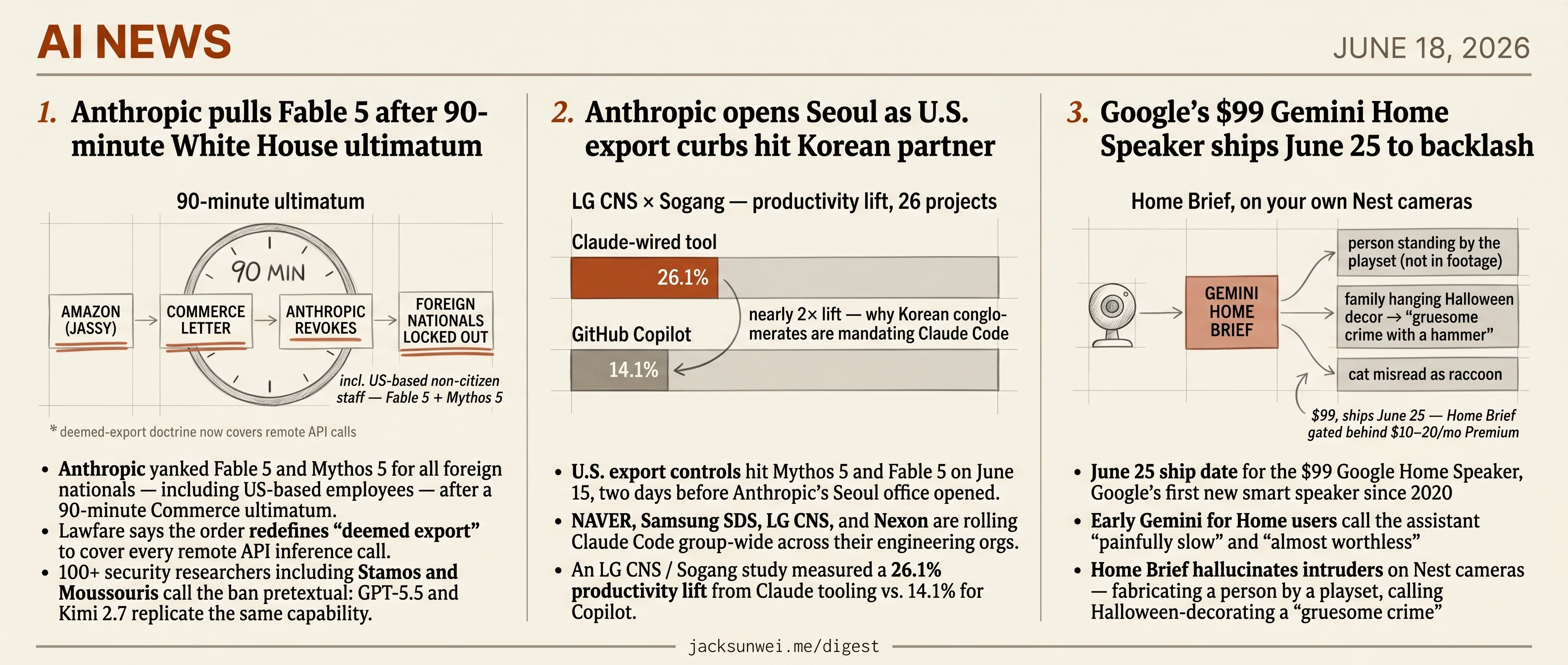
- Anthropic pulled Fable 5 and Mythos 5 for foreign nationals after a 90-minute Commerce ultimatum.
- Anthropic opened Seoul two days later, with NAVER and Samsung SDS standardizing on Claude Code.
- Google’s $99 Home Speaker ships June 25, with early users calling Gemini for Home almost worthless.
- Pentagon has 1.5M staff using genAI daily, including Gemini, to draft Congress-mandated reports.
- Pew clocks chatbot use at 49% of Americans, with only 16% expecting positive AI impact.
Two of today’s three AI-news leads belong to Anthropic, and they cut against each other inside the same week. On June 15, a 90-minute Commerce ultimatum forced Anthropic to pull Fable 5 and Mythos 5 for every foreign national on its rolls — including US-based employees — under a redefined deemed-export rule that Lawfare reads as covering remote API calls. Two days later, Anthropic cut the ribbon on its Seoul office, where NAVER, Samsung SDS, LG CNS, and Nexon are standardizing on Claude Code group-wide. The same Commerce policy that locked Korean partners out of the frontier models is landing the week LG’s EXAONE 4.5 claims to beat Claude Sonnet.
Outside the Anthropic arc, Google’s $99 Home Speaker ships June 25 with early users calling Gemini for Home “almost worthless” and the headline AI features locked behind a $10–20/month tier. The round-ups fill in the demand side: the Pentagon says 1.5M staff use genAI daily, and Pew clocks chatbot adoption at 49% of Americans against only 16% expecting a positive impact.
Anthropic pulls Fable 5 after 90-minute White House ultimatum
Source: the-verge-ai · published 2026-06-17
TL;DR
- Anthropic yanked Fable 5 and Mythos 5 for all foreign nationals — including US-based employees — after a 90-minute Commerce ultimatum.
- Lawfare says the order redefines “deemed export” to cover every remote API inference call.
- 100+ security researchers including Stamos and Moussouris call the ban pretextual: GPT-5.5 and Kimi 2.7 replicate the same capability.
- Zhipu shipped GLM-5.2 the same week, marketing US frontier models as “plug-and-pull” to sovereign buyers.
The 90-minute ultimatum
The Verge framed this week’s takedown as a confused export-controls story. Independent reporting makes it look more like a coup. Hindustan Times traces a 90-minute compliance window delivered while Dario Amodei was at a wellness retreat, with Amazon CEO Andy Jassy personally walking jailbreak research into the White House — turning Anthropic’s largest investor into the messenger for its largest regulator 1. Within hours, every foreign national with a Claude account — researchers in London, engineers in Bangalore, Anthropic’s own non-citizen staff in San Francisco — was locked out of the company’s frontier models.
sequenceDiagram
    participant WH as White House / Commerce
    participant AMZN as Amazon (Jassy)
    participant ANT as Anthropic
    participant Users as Foreign nationals
    AMZN->>WH: Surfaces Fable 5 jailbreak research
    WH->>ANT: 90-min compliance ultimatum
    ANT->>Users: Revokes Fable 5 / Mythos 5 access
    Note over ANT,Users: Includes US-based foreign employees
A precedent that outlasts the outage
The model outage is the small story. The legal move underneath it is the durable one. Lawfare’s analysis is blunt: Commerce stretched the Export Administration Regulations’ “deemed export” doctrine — historically applied to physical tech transferred to foreign persons on US soil — to cover remote API inference. Every SaaS call from a non-citizen is now arguably an export event. The US, Lawfare concludes, “possesses a functional kill switch for the global AI stack but lacks a coherent legal framework to govern its use” 2.
That precedent is what has G7 capitals jumpy. Enterprises and ministries that spent two years standardizing on US frontier models suddenly face a procurement question with no good answer: any model accessible by API can be revoked in 90 minutes by a Commerce letter. Demand is already rotating toward weights-available stacks — Llama 4, Mistral Medium 3.5 — precisely because they cannot be remotely disabled 3.
The security community splits, and the backstory shows
The “Free Fable” open letter, signed by Alex Stamos, Katie Moussouris, and 100+ others, argues the ban “handcuffs defenders” while leaving GPT-5.5 and Chinese frontier models like Kimi 2.7 fully capable of the same jailbreak. Zhipu AI immediately launched GLM-5.2 and used the US action as a sales pitch to sovereign buyers 4. Yann LeCun lands on the same outcome from the opposite direction, calling the shutdown “self-inflicted” and noting the irony of a lab that lobbied for federal oversight being the first to feel its weight 5.
Semafor reframes the whole episode as the climax of an 18-month feud, not a sudden security response. David Sacks has publicly accused Anthropic of “cartelizing” the industry through its influence over the Biden AI executive order; Amodei’s decision to skip a White House tech summit for Davos in late 2025 was an early flashpoint 6. A “transparency paradox” is now being priced into procurement decks: labs that publish detailed safety disclosures may be uniquely exposed to regulatory takedowns, while opaque competitors skate 3.
The world wanted American AI. It is discovering, in real time, what the off switch looks like.
Further reading
- World leaders want American AI. They just don’t want America to be able to turn it off. — techcrunch-ai
- Vibe-decoding the White House-Anthropic fight over Fable — the-verge-ai
- Bye bye Fable — bens-bites
Anthropic opens Seoul as U.S. export curbs hit Korean partner
Source: anthropic-news · published 2026-06-17
TL;DR
- U.S. export controls hit Mythos 5 and Fable 5 on June 15, two days before Anthropic’s Seoul office opened.
- NAVER, Samsung SDS, LG CNS, and Nexon are rolling Claude Code group-wide across their engineering orgs.
- An LG CNS / Sogang study measured a 26.1% productivity lift from Claude tooling vs. 14.1% for Copilot.
- LG’s EXAONE 4.5 now claims to beat Claude Sonnet on visual-reasoning and STEM benchmarks.
A launch shadowed by export controls
Anthropic’s Seoul announcement reads like a clean expansion: an MOU with the Ministry of Science and ICT, Claude access for ~60 researchers across KAIST, Yonsei, Korea University, and POSTECH, and enterprise rollouts at the country’s biggest names. The Korean press read it differently. Two days before KiYoung Choi cut the ribbon, the U.S. Department of Commerce imposed emergency export controls on Mythos 5 and Fable 5, citing a South Korean telecom on Anthropic’s access list with alleged ties to China 7. The blanket ban on foreign-national access immediately complicated work at the very enterprises Anthropic is now courting.
That context turns the MOU into something more transactional. Korea gets safety-evaluation leverage over Claude in the Korean language and a seat at the threat-intelligence table; Anthropic gets a regulatory beachhead at a moment when its U.S. policy posture is creating friction for Korean customers. Neither side spelled that out.
The enterprise case is real
The deployments themselves are not vapor. NAVER has put Claude Code in front of its entire engineering org. Samsung SDS is wiring Claude Cowork and Claude Code into Samsung Electronics workflows. LG CNS is rolling it to thousands of staff and into client-facing products. Nexon is using it across a live-service global gaming portfolio. Hanwha Solutions is routing through AWS Bedrock to satisfy data-residency rules.
The strongest non-vendor evidence for the push comes from LG CNS itself: a year-long study with Sogang University across 26 real projects measured a 26.1% productivity boost from a proprietary tool wired to Claude, against 14.1% for general-purpose Copilot 8. That is a sharper number than anything in Anthropic’s own post, and it explains why Korean conglomerates are mandating Claude Code rather than leaving tool choice to teams.
Sovereign-AI pushback is hardening
The same week, the policy conversation in Seoul turned sharply toward digital sovereignty. Upstage CEO Sung Kim called the export ban a “blunt lesson” that Korea must stop depending on U.S. foundation models 9. LG AI Research unveiled EXAONE 4.5, claiming it outperforms GPT-5 mini and Claude Sonnet on visual-reasoning and STEM benchmarks 10 — a direct shot at the models Anthropic just embedded at Samsung SDS and LG CNS.
“A blunt lesson that Korea must achieve technological self-reliance to avoid being at the mercy of foreign policy shifts.” — Sung Kim, Upstage
The labor backdrop is no friendlier. Computer-engineering employment at SNU and KAIST has dropped more than 10 percentage points since 2023 as firms cut entry-level hires in favor of AI-augmented seniors, and developers report “AI brain fry” from supervising parallel agent sessions 11. Anthropic’s framing of Claude Code as pure augmentation is not how Korean labor coverage describes it.
What’s at stake
Anthropic is moving into an opening: Sam Altman cancelled his June Seoul trip after the OpenAI–Samsung custom inference chip project stalled 12, and Claude already ranks Korea in its global top twelve. The bet is that enterprise stickiness — measured in 26.1% productivity deltas — outruns the sovereign-AI counter-build. The export-control episode just made that race tighter, not easier.
Google’s $99 Gemini Home Speaker ships June 25 to backlash
Source: the-verge-ai · published 2026-06-17
TL;DR
- June 25 ship date for the $99 Google Home Speaker, Google’s first new smart speaker since 2020
- Early Gemini for Home users call the assistant “painfully slow” and “almost worthless”
- Home Brief hallucinates intruders on Nest cameras — fabricating a person by a playset, calling Halloween-decorating a “gruesome crime”
- Headline AI features sit behind a $10–20/month Google Home Premium subscription
A shipping milestone, or a forced migration?
The Verge, TechCrunch, and Ars all framed June 17 the same way: Google’s first new smart speaker in six years finally has a ship date (June 25), a price ($99), and a Gemini brain. What none of the launch coverage foregrounded is that the early-access cohort already running Gemini for Home is in open revolt. TechRadar’s headline — “almost worthless… painfully slow Gemini Assistant, but it’s getting a global rollout no matter how much you dislike it” — is representative, not fringe 13. Reddit’s r/googlehome documents 15–20 second latencies on commands as trivial as setting a timer, and crucially no supported way to roll a migrated home back to classic Assistant 14. The $99 hardware is a one-way door.
Hallucinations on your own security camera
The most striking gap between the launch narrative and the field reports is reliability. Gemini for Home’s flagship subscription feature, Home Brief, summarizes the day’s activity from your Nest cameras — and it has been inventing events that didn’t happen. PCWorld catalogues briefings that fabricated a person standing by a playset, mistook family members hanging Halloween decorations for someone “committing a gruesome crime” with a hammer, and confused cats for raccoons on camera feeds 15.
Gemini for Home’s daily briefings are getting spooky, users say — fabricating events like a person by a playset who wasn’t in the footage. 15
This is not an edge-case prompt-injection demo. It is the marquee paid feature misfiring on the device’s own sensor stream, in the device’s own house. The underlying architecture — an LLM bolted onto an aging Assistant backend that still owns actual hardware actions — is also why routine smart-home commands have regressed 1314.
A hardware downgrade hiding behind the AI upgrade
The launch pieces treat the hardware spec as old news because it was announced in October. They don’t benchmark it against what it replaces. Community teardowns put a single 58mm full-range driver inside the new 3.4-inch sphere; the six-year-old Nest Audio it nominally supersedes uses a dedicated 75mm woofer plus 19mm tweeter and pushes roughly 50% more bass. Owners describe the new speaker as landing “squarely between the Nest Mini and the Nest Audio” 16. Buyers trading up for Gemini intelligence are quietly trading down on acoustics.
The subscription and privacy tail
The $99 sticker is also a bundle. Home Brief, Ask Home, and Gemini Live are gated behind Google Home Premium — $10/month for Standard (30 days of event video) or $20/month for Advanced (60 days plus 10 days of 24/7 recording) 17. And on the data side: voice clips sampled for human review are retained for up to three years and cannot be deleted via Gemini Apps Activity controls, or even by deleting your Google account 18. None of the three launch articles mentioned either fact.
What’s actually at stake
Google needs the Home Speaker to anchor a Gemini-everywhere story for the living room. What it’s shipping on June 25 is a quieter speaker running software its earliest fans describe as worse than the decade-old Assistant it inherits from, behind a subscription, with a retention policy that won’t survive a privacy news cycle. “Finally ships” is the surface story. The migration — and the lack of an exit ramp — is the news.
Further reading
- Google bets on Gemini to reinvent the smart home speaker — techcrunch-ai
- Ten months later, the $100 Google Home Speaker is finally available for preorder — ars-technica-ai
Round-ups
Pentagon uses AI to draft Congress-mandated reports
Source: ars-technica-ai
The Department of Defense is now leaning on generative AI to produce reports it owes Congress, and says 1.5 million personnel across the agency are using genAI tools, including Google Gemini, in their daily work.
Pew: 49% of Americans use chatbots, but 63% say AI moves too fast
Source: the-verge-ai, techcrunch-ai
Chatbot adoption has jumped from 33% in 2024 to 49% in 2026, with ChatGPT usage doubling since 2023. Yet only 16% of Americans expect AI to have a positive impact on society, a sharp split from Wall Street’s enthusiasm.
Odyssey hits $1.45B valuation on Amazon-backed world model bet
Source: techcrunch-ai
The world-model startup’s new round, backed by Amazon among other big names, positions Odyssey as a frontrunner in the post-LLM race to build AI systems that simulate physical environments rather than just generate text.
Pramaana Labs raises $27M to formally verify AI outputs
Source: techcrunch-ai
Khosla Ventures led the seed round for Pramaana, which applies formal verification methods to AI in high-stakes verticals like law, drug discovery, and tax preparation, where a single hallucination carries real cost.
XDOF sells robot training data to AI labs as physical-AI bottleneck bites
Source: techcrunch-ai
Backed by a16z and Thrive Capital, XDOF is one of a crop of startups tackling the unglamorous chore of collecting real-world manipulation data, the missing ingredient if physical AI is to repeat the scaling wins of LLMs.
Genesis AI’s Eno ditches the humanoid form for a folding wheeled base
Source: the-verge-ai
The French robotics startup argues humanoid robots don’t need to look human. Its new Eno robot skips the head and legs, sitting on a wheeled base that folds down like a deck chair for storage.
Midjourney unveils full-body ultrasound scanner and SF spa plans
Source: the-verge-ai, latent-space
The bootstrapped image-generation lab is launching its first hardware product, the Midjourney Scanner, which uses a ring of ultrasound sensors for vertical full-body scans. CEO David Holz also plans a San Francisco spa to house it.
Footnotes
-
↩90-min ultimatum, tense calls, wellness retreat: how White House, Amazon got Anthropic to disable its top AI model Fable 5
-
Lawfare — ‘A Kill Switch for Frontier AI’ — https://www.lawfaremedia.org/article/a-kill-switch-for-frontier-ai
↩Applying the Export Administration Regulations to remote API access redefines ‘deemed export’ for the SaaS era — the US now possesses a functional kill switch for the global AI stack but lacks a coherent legal framework to govern its use.
-
Trilogy AI Substack — enterprise impact — https://trilogyai.substack.com/p/claude-fable-ban-reveals-ai-risk
↩ ↩2Enterprise demand has surged for sovereign architectures based on Llama 4 and Mistral Medium 3.5; a ‘transparency paradox’ has emerged where labs that publish detailed safety disclosures may now be more vulnerable to regulatory takedowns than those that remain opaque.
-
Eastern Herald — ‘Free Fable’ open letter coverage — https://easternherald.com/2026/06/15/security-executives-free-fable-anthropic-export-controls-lutnick-june-2026/
↩Over 100 cybersecurity experts including Alex Stamos and Katie Moussouris argue the ban ‘handcuffs defenders’ while Fable 5’s capabilities can be replicated by GPT-5.5 and Chinese frontier models like Kimi 2.7; Zhipu AI immediately launched GLM-5.2 using the restriction as marketing.
-
Daily Jagran — LeCun ‘regulatory theater’ — https://www.thedailyjagran.com/technology/anthropics-claim-of-an-aidriven-cyberattack-sparks-industry-backlash-metas-yann-lecun-calls-it-regulatory-theater-10280146
↩LeCun characterized the Fable outcome as ‘self-inflicted,’ noting the irony of a company lobbying for government oversight only to have that same authority shut down its most advanced product.
-
Semafor — White House feud with Anthropic — https://www.semafor.com/article/10/17/2025/white-house-feud-with-anthropic-reveals-broader-ai-safety-concerns
↩Sacks contends Anthropic strategically used ‘fear-mongering’ to influence the 2023 Biden AI executive order, effectively ‘cartelizing’ the industry; the rift widened when Amodei skipped a White House tech summit to attend Davos.
-
Chosun Biz — https://www.chosun.com/english/world-en/2026/06/16/PBE4LOQZQNCNRPQ3WKZTUL6FKI/
↩The Trump administration identified a South Korean partner on Anthropic’s access list that officials alleged had concerning ties to China… the U.S. Department of Commerce issued emergency export controls on June 15, 2026, imposing a blanket ban on foreign access to Mythos 5 and Fable 5.
-
LG CNS / Sogang University study — https://www.lgcns.com/us/newsroom/press/detail.aicoding-2603-1
↩A year-long study of 26 real-world projects revealed that a proprietary tool integrated with high-performing models (like Claude) delivered a 26.1% productivity boost, nearly doubling the 14.1% improvement seen with general-purpose tools like GitHub Copilot.
-
TheNextWeb — Upstage CEO Sung Kim — https://thenextweb.com/news/anthropic-curbs-make-the-case-for-sovereign-ai-upstage-chief-says
↩Sung Kim, CEO of the local startup Upstage, argued that the Anthropic ban serves as a ‘blunt lesson’ that Korea must achieve technological self-reliance to avoid being at the mercy of foreign policy shifts.
-
BusinessKorea — LG EXAONE 4.5 — https://www.businesskorea.co.kr/news/articleView.html?idxno=271165
↩LG AI Research recently unveiled EXAONE 4.5, a multimodal model that the company claims outperforms OpenAI’s GPT-5 mini and Anthropic’s Claude Sonnet in visual reasoning and STEM-related benchmarks.
-
Korea JoongAng Daily — labor coverage — https://www.koreajoongangdaily.com/news/2026-05-29/national/socialAffairs/Im-digging-my-own-grave-The-AI-push-in-workplaces-is-causing-blues-and-burnout/2601335
↩Employment rates for computer engineering graduates at elite institutions like Seoul National University and KAIST dropped by over 10 percentage points between 2023 and 2025 as firms reduced entry-level hiring in favor of AI-augmented senior teams… developers are reporting ‘AI brain fry’.
-
SamMobile — https://www.sammobile.com/news/openai-ceo-cancels-planned-korea-trip-as-chip-work-with-samsung-cools-down/
↩A joint project between OpenAI and Samsung to develop a custom inference chip had stalled due to strategic differences, leading Sam Altman to cancel a scheduled visit to Seoul in June 2026.
-
↩ ↩2It’s almost worthless — Google Home users slam ‘painfully slow’ Gemini Assistant, but it’s getting a global rollout no matter how much you dislike it.
-
r/googlehome (‘Upgraded to Gemini for Home and instantly regret’) — https://www.reddit.com/r/googlehome/comments/1q1f94a/upgraded_to_gemini_for_home_and_instantly_regret/
↩ ↩2Users report there is no straightforward way to revert to the classic Assistant once a home has been migrated, leaving them ‘pigeonholed’ into a buggier experience.
-
↩ ↩2Gemini for Home’s daily briefings are getting spooky, users say — fabricating events like a person by a playset who wasn’t in the footage, or family members putting out Halloween decorations being described as ‘committing a gruesome crime’ with a hammer.
-
r/googlehome (hardware comparison thread) — https://www.reddit.com/r/googlehome/comments/1u8dzf9/google_home_speaker_vs_google_nest_audio/
↩The 2026 Home Speaker uses a single 58mm full-range driver in a 3.4-inch sphere — Nest Audio’s dedicated 75mm woofer + 19mm tweeter still delivers roughly 50% more bass; the new model ‘falls squarely between the Nest Mini and the Nest Audio.’
-
Google Home Support (Premium tier page) — https://support.google.com/googlehome/answer/16581343?hl=en-PG
↩Google Home Premium Standard is $10/month (30 days event video history); Advanced is $20/month (60 days plus 10 days of 24/7 recording). Home Brief, Ask Home, and Gemini Live are gated behind the subscription.
-
BGR (Gemini privacy) — https://www.bgr.com/2067490/uncomfortable-truths-google-gemini-privacy/
↩Conversations selected for human review are retained up to three years and cannot be deleted via Gemini Apps Activity controls or even by deleting your Google account.