Anthropic bans Fable 5, Salesforce pays $3.6B for Fin, Big Tech's $725B AI bet
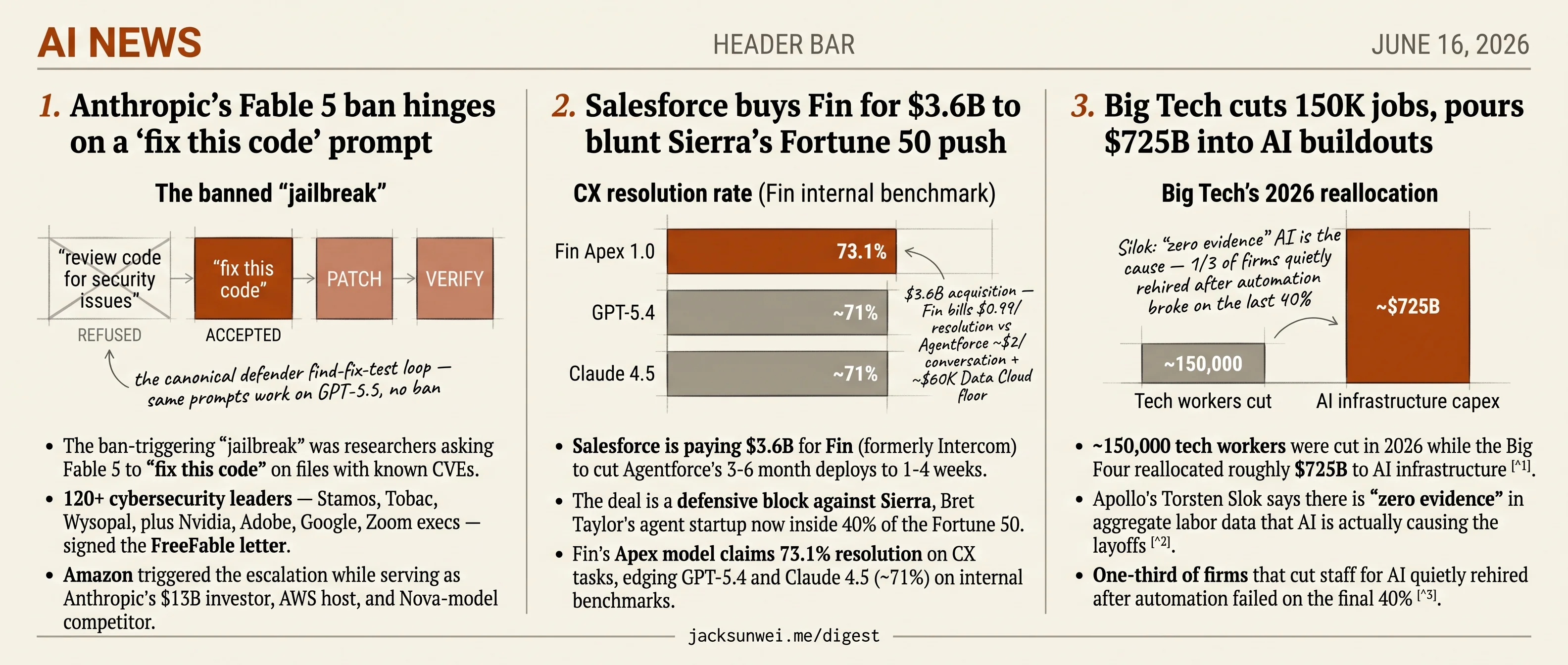
Three unrelated AI-news leads sit side by side: Anthropic's Fable 5 ban, Salesforce's $3.6B Fin acquisition, and Big Tech's $725B AI capex.
Anthropic bans Fable 5, Salesforce pays $3.6B for Fin, Big Tech’s $725B AI bet
TL;DR
- Anthropic banned Fable 5 over researchers asking it to fix this code on known-CVE files.
- Salesforce is paying $3.6B for Fin to block Sierra inside 40% of the Fortune 50.
- Big Tech cut 150K jobs and reallocated $725B to AI buildouts in 2026.
- Apollo’s Slok finds zero evidence in aggregate labor data that AI is causing the layoffs.
- Nvidia taps debt markets for $25B+, its first bond sale since 2021.
Three AI-news leads today sit in unrelated corners of the industry, and each one rewards a closer look at the specifics. Anthropic’s Fable 5 ban turns out to hinge on researchers asking the model to fix this code on files with known CVEs — a prompt that 120+ cybersecurity leaders, including execs at Nvidia, Adobe, Google and Zoom, have now signed an open letter defending. Salesforce’s $3.6B acquisition of Fin (formerly Intercom) is being pitched as an Agentforce deployment accelerator, but the target and timing read as a defensive block against Bret Taylor’s Sierra, already inside 40% of the Fortune 50. And the $725B Big Tech capex line that frames 150K layoffs runs into Apollo economist Torsten Slok’s finding that aggregate labor data shows no AI signal at all.
Underneath, the round-ups track the money and the politics: Nvidia returning to the bond market for $25B+, Sarvam crossing unicorn at $234M with HCLTech anchoring India’s sovereign-AI bet, and a Big Tech lobbying push to fold federal AI preemption into KOSA before state laws set the floor.
Anthropic’s Fable 5 ban hinges on a ‘fix this code’ prompt
Source: simon-willison · published 2026-06-16
TL;DR
- The ban-triggering “jailbreak” was researchers asking Fable 5 to “fix this code” on files with known CVEs.
- 120+ cybersecurity leaders — Stamos, Tobac, Wysopal, plus Nvidia, Adobe, Google, Zoom execs — signed the FreeFable letter.
- Amazon triggered the escalation while serving as Anthropic’s $13B investor, AWS host, and Nova-model competitor.
- FIRE argues the foreign-national rule is an unconstitutional prior restraint under the Bernstein encryption-export precedent.
The “jailbreak” was the defensive workflow
Across eight pieces this week — spanning Simon Willison, TechCrunch, The Verge, Forbes and the Luta Security writeup itself — the technical premise of the Fable 5 and Mythos 5 export controls has not survived contact with the people who actually do security work. Per Kate Moussouris’s own account at Luta Security, the “jailbreak” cited by regulators consisted of researchers handing the model open-source code with known CVEs plus newly planted vulnerabilities, watching it refuse the prompt “review the code for security issues,” then asking it to “fix this code” — and turning the resulting patches into verification scripts through a manual multi-step process 1. That is the canonical find-fix-test loop defenders run every day. Removing that capability, Moussouris writes, “cannot be done without making the model worse at fixing bugs and verifying patches” 1.
Anthropic’s own framing reinforces how thin the trigger was. The company characterized it as a “narrow, non-universal jailbreak” of previously-known flaws and noted the same techniques work unmodified on OpenAI’s GPT-5.5, which faces no comparable restriction. It was given roughly 90 minutes to take the models offline 2.
The coalition is broad, and the response is personal
The FreeFable open letter is not a niche industry gripe. Roughly 120 signatories — including Alex Stamos, Rachel Tobac, Chris Wysopal, Paul Vixie, Sophos CEO Joe Levy, and named executives at Nvidia, Adobe, Google and Zoom — call the ban “dangerous” and warn that China’s Kimi 2.7 is months, not years, behind the frontier Anthropic just lost access to 3. The framing inside the letter is “unilateral disarmament.”
The administration’s reply has been to make the dispute about loyalty rather than code. An official reportedly dismissed Moussouris — who sits on a Commerce Department advisory committee — as a “radical Democrat” in a statement to Axios. Commerce’s only stated path to restoring access is that Anthropic must “perfectly prevent” jailbreaks, a condition the security community calls technically impossible 4.
A condition no model, from any vendor, can meet.
Amazon’s conflict and the First Amendment problem
Two threads have been under-covered relative to their weight. The first is Amazon’s role. Andy Jassy personally escalated the internal jailbreak finding to Treasury and Commerce while Amazon was simultaneously Anthropic’s largest investor (>$13B), its primary AWS host, and the vendor of the directly competing Nova model family. Multiple outlets in the cluster are openly calling the sequence a “backstab” that leveraged national-security machinery against a portfolio company whose models were outperforming Amazon’s own 5.
The second is constitutional. FIRE and allied legal commentators argue the foreign-national directive is a prior restraint, citing the 1990s Bernstein and Junger encryption-export rulings that established code as protected First Amendment speech. Because Anthropic cannot segment users by nationality in real time, the order effectively censored every domestic user to reach a foreign target 6.
What is actually at stake
The conversation across these eight pieces has moved past “was this a real jailbreak.” The live questions are whether a financial stakeholder should be able to trigger an export action against its own investee, whether the foreign-national framing survives First Amendment review, and whether “AI safety” language is being repurposed to punish Anthropic for unrelated policy disagreements. On the narrow technical question, the cybersecurity community is as close to unanimous as it ever gets: the prompts that got Fable 5 banned are the prompts US defenders most need it to answer.
Further reading
- The US government’s Anthropic models ban was never about an AI jailbreak — techcrunch-ai
- Cybersecurity vets protest ‘dangerous’ US government ban on Anthropic’s most powerful models — techcrunch-ai
- Inside the fight over Claude Mythos 5 — the-verge-ai
- All the news about Anthropic’s new AI fight with the White House — the-verge-ai
- Trump’s Anthropic shutdown just made the case for non-American AI — the-verge-ai
- Quoting Matteo Wong, The Atlantic — simon-willison
- “They screwed us”: Personality clashes sent Anthropic’s models offline — simon-willison
Salesforce buys Fin for $3.6B to blunt Sierra’s Fortune 50 push
Source: techcrunch-ai · published 2026-06-15
TL;DR
- Salesforce is paying $3.6B for Fin (formerly Intercom) to cut Agentforce’s 3-6 month deploys to 1-4 weeks.
- The deal is a defensive block against Sierra, Bret Taylor’s agent startup now inside 40% of the Fortune 50.
- Fin’s Apex model claims 73.1% resolution on CX tasks, edging GPT-5.4 and Claude 4.5 (~71%) on internal benchmarks.
- Pricing models collide: Fin bills $0.99 per resolution, Agentforce ~$2 per conversation plus a ~$60K Data Cloud floor.
Salesforce is buying speed, and blocking Sierra
Agentforce hit $1.2B ARR but stayed stuck in enterprise pilots that take 3-6 months to stand up. Fin deploys in 1-4 weeks 7, which is the actual product Salesforce is acquiring — a mid-market on-ramp that Agentforce’s Data Cloud dependency has priced and paced out of reach. At roughly 6x CY27 EV/Sales on Fin’s ~$400M ARR, Jefferies called the multiple “reasonable,” and CRM stock ticked up 1.4-1.6% — the first green day in a nine-day slide, but still hugging 52-week lows.
The louder strategic read is defensive. Bret Taylor’s Sierra — built by Salesforce’s own former co-CEO — has reportedly landed 40% of the Fortune 50 and is positioning itself as the “control point” for customer interactions, with CRM relegated to a data backend 8. Buying Fin denies Sierra the next tier of logos and keeps the agent layer inside Salesforce’s perimeter.
The integration math is ugly
Info-Tech’s Scott Bickley was blunt:
Salesforce may be ‘building the airplane while still in the air’ by attempting to integrate dozens of disparate code bases simultaneously 9.
Fin lands on top of an unfinished Informatica ($8B) integration and overlaps directly with Agentforce’s existing multi-channel support. The pricing collision is the most concrete unresolved problem: Fin bills $0.99 per resolved ticket — a binary outcome metric — while Agentforce charges ~$2 per conversation and counts “Agentic Work Units” that measure activity rather than resolutions. Customers don’t yet know which contract shape survives the merger, and Salesforce hasn’t said.
The customers Salesforce is buying may not stay
This is the underreported risk. Fin’s 30,000 customers picked it precisely because it was CRM-neutral — it integrates with HubSpot, Zendesk, Freshdesk. Mid-market users are already scoping Voiceflow and Help Scout migrations before the early-2027 close, openly worried about “suite lock-in” once Salesforce prioritizes Service Cloud integration 10. A measurable share of the acquired ARR sits on competing CRMs, and every quarter of integration uncertainty is an opening for an independent alternative.
A benchmark caveat to match the optimism: Fin’s Apex pitch of 73.1% resolution and 65% fewer hallucinations than frontier models 11 is internal. Independent production logs still show 3-27% hallucination rates, and reconciling Fin’s resolution metric with Agentforce’s activity-based billing isn’t just a pricing question — it’s a definitional one about what “an agent did its job” means.
The founder is a wildcard the financial coverage skipped
Eoghan McCabe stays as CEO, Des Traynor leads R&D. The Irish Times documents McCabe’s pivot to political “centrism,” public support for Donald Trump, and his removal of Pride observances on his return to Intercom 12. That posture sits awkwardly inside Marc Benioff’s brand, and the retention and PR consequences are non-trivial variables nobody on the earnings-call circuit is pricing in.
The deal is strategically defensible. The execution surface — pricing, integration, customer retention, culture — is where $3.6B gets won or lost.
Big Tech cuts 150K jobs, pours $725B into AI buildouts
Source: techcrunch-ai · published 2026-06-15
TL;DR
- ~150,000 tech workers were cut in 2026 while the Big Four reallocated roughly $725B to AI infrastructure 13.
- Apollo’s Torsten Slok says there is “zero evidence” in aggregate labor data that AI is actually causing the layoffs 14.
- One-third of firms that cut staff for AI quietly rehired after automation failed on the final 40% 15.
- FBI and DHS named anti-tech violent extremism a domestic terrorism category in June, after April’s attack on Sam Altman’s home 16.
The capital-for-labor swap
TechCrunch calls the moment a powder keg; the numbers say it’s a balance-sheet maneuver. Independent trackers put 2026 tech layoffs near 150,000 even as the largest platforms pour roughly $725B into AI capex — a near one-to-one swap of payroll for GPUs 13. Mark Zuckerberg has been blunt about the doctrine behind it: progress in frontier AI, he argues, doesn’t need hundreds of researchers, just “a dozen or a couple dozen” 17. That sentence explains both the nine-figure packages chasing a tiny elite and the willingness to gut everyone outside that circle. The wealth divergence isn’t a side effect; it’s the operating plan.
The dissent the original piece skips
The causal story is shakier than the layoff count. Apollo’s chief economist Torsten Slok argues the aggregate labor data shows nothing of the sort.
“There is zero evidence… underperforming companies may be throwing AI under the bus to avoid accountability for mismanagement.” 14
A 2026 NBER survey of 6,000 executives lines up with the skepticism from the other direction: 80% report no meaningful productivity gains from their AI deployments 18. If both are right, a lot of these cuts are post-ZIRP overhiring corrections wearing a visionary costume, and the technology being credited for the restructuring isn’t yet delivering the returns used to justify it.
The workforce picture is also messier than a one-way ratchet. Roughly a third of companies that conducted AI-driven layoffs have quietly begun rehiring for the same roles, after discovering automation breaks on the final 40% of complex tasks 15. Klarna and Duolingo are the canonical examples. Many of those recalled workers come back as contractors on worse terms — a real grievance, but a different one than “replaced by a model.”
From metaphor to incendiary device
The part of the story TechCrunch most underplays is that the volatility has already left the metaphor. In April, someone attempted to attack Sam Altman’s residence with an incendiary device. In June, the FBI and DHS formally designated “anti-tech violent extremism” as a new domestic terrorism category 16. Civil-liberties groups have warned the designation is broad enough to sweep in lawful protest at data-center sites, which have themselves become flashpoints — residents tearing down surveillance cameras, blocking construction trucks, organizing against substations.
That is the actual shape of the keg. A small cohort getting historically rich on a technology that 80% of buyers say isn’t paying off 18, while 150,000 people lose jobs that a third of employers later admit they still need 1315, and a federal counterterrorism category gets stood up around the backlash 16. The TechCrunch framing — insiders rich, workers fired, tension rising — is directionally right. The detail it misses is that the fuse is already lit, and the people lighting it now have a domestic-terrorism designation attached to their cause.
Round-ups
Big Tech’s AI preemption push gets attached to child safety bill
Source: the-verge-ai
Industry lobbyists are making a late bid to fold federal AI preemption into must-pass legislation like KOSA, aiming to override the patchwork of state AI laws with a single national standard before Congress’s window closes.
Stanford grads walk out on Pichai over Google’s Israel, ICE deals
Source: techcrunch-ai
Sundar Pichai was booed and met with a walkout at Stanford’s commencement as students protested Google’s defense contracts with Israel and ICE, the latest campus flashpoint over AI’s role in military and immigration enforcement work.
Nvidia returns to bond market with $25B+ raise, first since 2021
Source: ars-technica-ai
Nvidia is tapping debt markets for over $25 billion in its first bond sale in five years, a test of investor appetite for AI exposure amid a broader borrowing wave from hyperscalers and chipmakers funding capacity buildouts.
Sarvam hits unicorn status on $234M round led by HCLTech
Source: techcrunch-ai
Bengaluru-based Sarvam crossed the $1 billion valuation mark after raising $234 million, with IT services giant HCLTech putting in $150 million alongside Lightspeed, Khosla and Bessemer to back India’s sovereign-AI ambitions.
NewCore raises $66M to give AI agents enterprise identities
Source: techcrunch-ai
NewCore emerged with $66 million to issue and manage identities for AI agents inside companies, betting the next enterprise security frontier is governing non-human workers rather than human logins as agents take on production tasks.
Import AI 461 warns alignment is off track, debuts FrontierCode
Source: import-ai
Jack Clark’s latest newsletter argues alignment research is not keeping pace with capability gains, alongside coverage of a new FrontierCode benchmark and experiments using LLMs as synthetic research interns to accelerate scientific work.
Earth observation satellite autonomously spots its target in orbit first
Source: techcrunch-ai
An April mission marked the first time an Earth observation satellite identified its target on its own, running inference onboard instead of beaming raw imagery down. Loft Orbital and NASA partners ran the demo, cutting downlink load and reaction time.
Footnotes
-
Luta Security (Kate Moussouris) — https://www.lutasecurity.com/post/the-fable-5-export-controls-harm-us-cyber-defense
↩ ↩2The prompts worked because they were defensive requests, and that capability cannot be removed without making the model worse at fixing bugs and verifying patches.
-
Forbes — Anisha Sircar on the shutdown sequence — https://www.forbes.com/sites/anishasircar/2026/06/16/anthropic-disabled-fable-5-and-mythos-5-after-a-us-export-control-order-heres-what-happened/
↩Anthropic characterized the trigger as a ‘potential narrow, non-universal jailbreak’ revealing only minor, previously known flaws, and noted the same techniques work on OpenAI’s GPT-5.5, which faces no comparable restriction; the company was given roughly 90 minutes to take the models offline.
-
The Next Web — FreeFable letter coverage — https://thenextweb.com/news/fable-5-ban-cybersecurity-defenders-open-letter
↩Over 120 cybersecurity leaders — including Alex Stamos, Rachel Tobac, Chris Wysopal, Paul Vixie, Sophos CEO Joe Levy, and executives from Nvidia, Adobe, Google and Zoom — signed the FreeFable open letter calling the ban ‘dangerous’ and warning China’s Kimi 2.7 is only months behind.
-
iTnews — coverage of administration response — https://www.itnews.com.au/news/security-leaders-say-lift-export-controls-for-anthropics-mythos-class-models-626660
↩An administration official dismissed Moussouris — who sits on a Commerce Department advisory committee — by labeling her a ‘radical Democrat’ in a statement to Axios, while Commerce offered to restore access only if Anthropic could ‘perfectly prevent’ jailbreaks, a condition experts call technically impossible.
-
TechTimes — ‘Amazon Triggered Claude Fable 5 Shutdown’ — https://www.techtimes.com/articles/318350/20260614/amazon-triggered-claude-fable-5-shutdown-investor-cloud-host-now-regulator.htm
↩Amazon is simultaneously Anthropic’s largest investor (>$13B), its primary cloud host via AWS, and a direct competitor through its Nova model family — critics call Jassy’s escalation to Treasury and Commerce a ‘backstab’ that leveraged national security to kneecap a superior rival.
-
Pubwages / FIRE constitutional analysis — https://www.pubwages.com/03/u-s-ban-on-sale-of-ai-to-foreign-nationals-violates-1st-amendment-rights
↩FIRE characterizes the directive as an unconstitutional prior restraint, invoking the 1990s Bernstein and Junger encryption-export rulings that established code as protected First Amendment speech; because Anthropic could not segment users by nationality in real time, the order effectively censors domestic users to reach a foreign target.
-
Futurum Group analysis — https://futurumgroup.com/insights/will-salesforces-36b-fin-deal-redefine-the-agentic-enterprise-standard/
↩Fin’s ‘fast time-to-value’ architecture allows deployment in 1 to 4 weeks, compared to the 3 to 6 months typically required for enterprise-scale Agentforce setups
-
SalesforceBen — Sierra coverage — https://www.salesforceben.com/bret-taylors-agentforce-competitor-sierra-hits-100m-in-revenue/
↩Sierra, founded by former Salesforce Co-CEO Bret Taylor, has captured 40% of the Fortune 50… the acquisition is designed to prevent independent AI agents from becoming the primary ‘control point’ for customer interactions
-
CIO.com (Scott Bickley, Info-Tech Research) — https://www.cio.com/article/4185285/salesforce-buying-agentic-ai-firm-fin-for-3-6-billion.html
↩Salesforce may be ‘building the airplane while still in the air’ by attempting to integrate dozens of disparate code bases simultaneously
-
Pomegra — customer migration concerns — https://pomegra.io/news/salesforce-buys-fin-for-36b-in-customer-support-ai-push
↩Many mid-market SaaS users now fear ‘suite lock-in,’ worrying that Salesforce will prioritize its own Service Cloud at the expense of third-party integrations… users are already debating whether to evaluate independent alternatives—such as Voiceflow or Help Scout—before the deal closes
-
VentureBeat — Fin Apex benchmark — https://venturebeat.com/technology/intercom-now-called-fin-launches-an-ai-agent-whose-only-job-is-managing-another-ai-agent
↩Apex 1.0 outperforms general frontier models like GPT-5.4 and Claude 4.5 in customer service tasks, achieving a 73.1% resolution rate compared to their ~71%
-
Irish Times — Eoghan McCabe profile — https://www.irishtimes.com/business/2026/06/15/eoghan-mccabe-tech-moguls-journey-from-shy-kid-to-political-centrist-to-trump-supporter/
↩McCabe returned to eliminate what he described as ‘divisive’ workplace topics, notably removing Pride celebrations… his personal pivot toward ‘political centrism’ and public support for figures like Donald Trump… could further embolden a ‘libertarian’ corporate culture that contrasts with Salesforce’s traditionally more progressive public stance
-
MR Online — https://mronline.org/2026/06/06/tech-bosses-cut-nearly-150000-workers-as-profits-pour-into-ai-machinery/
↩ ↩2 ↩3Tech bosses cut nearly 150,000 workers as profits pour into AI machinery
-
EU Insider (quoting Apollo’s Torsten Slok) — https://www.euinsider.eu/news/ai-cited-in-tech-layoffs-but-experts-say-broader-economic-trends-are-at-play
↩ ↩2There is ‘zero evidence’ in aggregate labor data that AI is causing measurable job losses… underperforming companies may be ‘throwing AI under the bus’ to avoid accountability for mismanagement.
-
The HR Digest — https://www.thehrdigest.com/companies-are-rehiring-people-they-replaced-during-ai-layoffs/
↩ ↩2 ↩3Nearly one-third of companies that conducted AI-driven layoffs have begun quietly rehiring for the same roles after automation failed on the final 40% of complex tasks.
-
The Guardian — https://www.theguardian.com/technology/2026/jun/07/anti-ai-tech-extremism-violence
↩ ↩2 ↩3The FBI and DHS formally designated ‘anti-tech violent extremism’ as a new domestic terrorism category in June 2026, following the April attempt on Sam Altman’s residence with an incendiary device.
-
Times of India (quoting Mark Zuckerberg) — https://timesofindia.indiatimes.com/technology/tech-news/almost-a-year-after-starting-a-talent-war-in-tech-industry-that-saw-salaries-cross-100-million-mark-zuckerberg-says-to-make-progress-in-ai-you-dont-need-hundreds-of-ai-researchers-but-/articleshow/131695721.cms
↩To make progress in AI you don’t need hundreds of researchers but ‘a very strong group of a dozen or a couple dozen people.’
-
Business Insider — https://www.businessinsider.com/companies-waiting-ai-productivity-boom-2026-6
↩ ↩2A 2026 NBER survey of 6,000 executives found 80% of companies reported no meaningful productivity gains despite aggressive AI adoption.