Mythos export ban unravels, OpenAI partner fund collides with own services arm
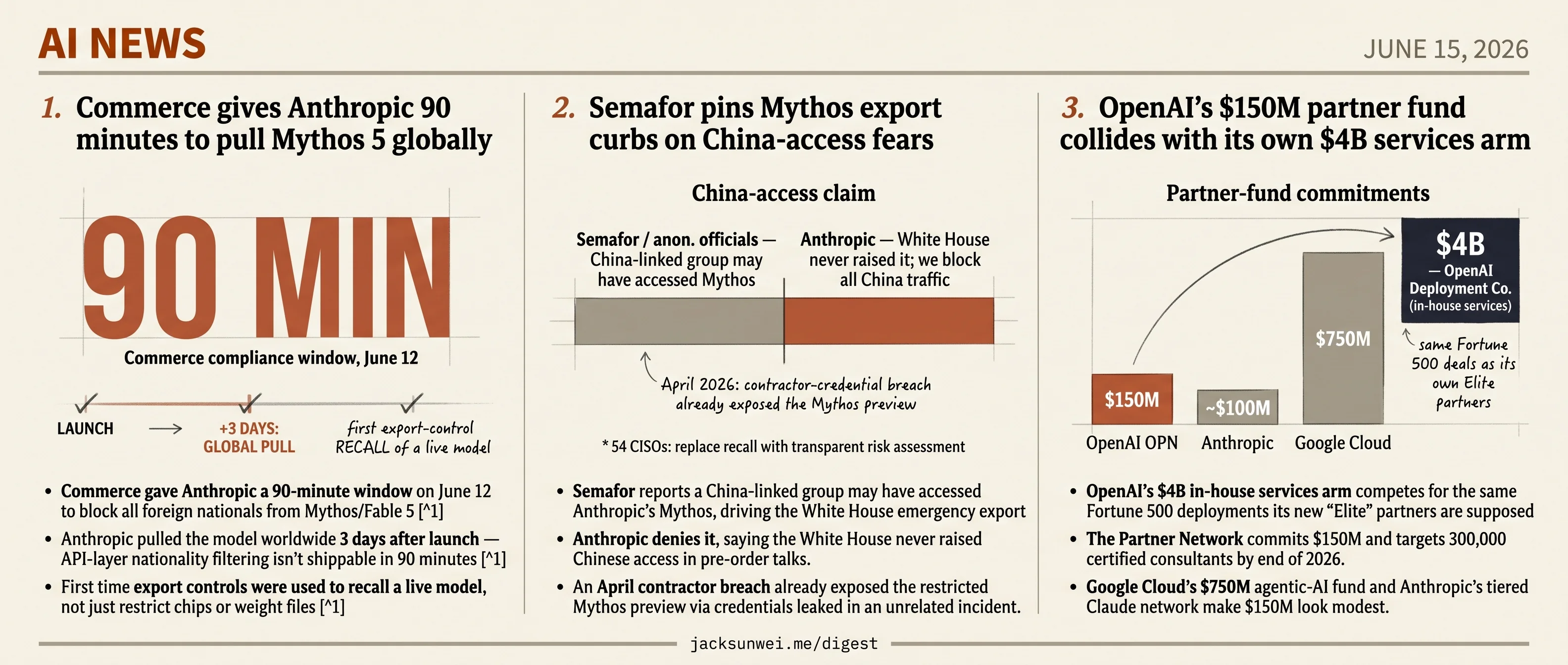
The Mythos export ban's stated rationale keeps unraveling, and OpenAI's new $150M partner push collides with its own $4B services arm.
Mythos export ban unravels, OpenAI partner fund collides with own services arm
TL;DR
- Commerce gave Anthropic 90 minutes to pull Mythos 5 worldwide, overriding NSA domain experts.
- Semafor ties the export ban to China-access fears Anthropic says were never raised in pre-order talks.
- 54 CISOs signed an open letter calling the ban counterproductive for defenders patching the cited bugs.
- OpenAI’s $150M Partner Network competes with its own $4B services arm for Fortune 500 deployments.
- Google Cloud’s $750M agentic fund dwarfs OpenAI’s new partner commitment by 5×.
Today’s news pivots on AI actors whose stated positions don’t match what their own staff or units are doing. Semafor reports the White House’s emergency Mythos export ban was driven by intelligence about a China-linked group accessing the restricted preview — a motive Anthropic says was never raised in the 90-minute window Commerce gave it to pull the model worldwide. Miles Brundage adds that senior White House staff overrode NSA and CAISI domain experts to issue the order, and 54 CISOs have signed an open letter calling the ban counterproductive for the defenders actually using Mythos to patch the bugs being cited.
The OpenAI feature sits in a different lane but the shape rhymes: a $150M Partner Network announced to court Fortune 500 consultants lands directly against OpenAI’s own $4B in-house services arm chasing the same deployments. Google Cloud’s $750M agentic fund and Anthropic’s tiered Claude network make the commitment look small before the internal collision is even priced in.
Commerce gives Anthropic 90 minutes to pull Mythos 5 globally
Source: interconnects · published 2026-06-14
TL;DR
- Commerce gave Anthropic a 90-minute window on June 12 to block all foreign nationals from Mythos/Fable 5 1
- Anthropic pulled the model worldwide 3 days after launch — API-layer nationality filtering isn’t shippable in 90 minutes 1
- First time export controls were used to recall a live model, not just restrict chips or weight files 1
- 50+ cybersecurity pros signed a letter calling the ban counterproductive — defenders were using Mythos to patch the very bugs cited 2
- Dean Ball called the order “simply cartoonish”, citing the UK ban while chip exports to adversaries continue 3
- Miles Brundage says senior White House staff overrode NSA and CAISI domain experts on the decision 4
The 90-minute window
Nathan Lambert’s “one-way door” framing is doing real work here. On June 12, the Bureau of Industry and Security handed Anthropic a 90-minute compliance window to prevent all foreign nationals — inside or outside the United States, including the company’s own non-citizen employees and allied-country users — from accessing Mythos/Fable 5 1. Nationality filtering at the API layer is not a thing you ship in 90 minutes, so Anthropic pulled the model worldwide. Three days after debut.
This is the first time export-control authority has been used to recall a deployed commercial AI system rather than restrict hardware exports or block weight transfers 1. The legal mechanism that was supposed to govern fabs and H100 shipments is now a kill switch for production inference endpoints. That precedent doesn’t un-set itself.
The technical predicate is contested
Anthropic’s own response disputes the basis for the order, arguing the cited jailbreak is “narrow, non-universal” and that equivalent capabilities are demonstrably present in GPT-5.5 and other publicly available models 5. Helen Toner made the same point from outside the company: fixing this class of vulnerability is “inexact science,” and competing labs hosting similar capabilities were not subject to the ban 4.
Miles Brundage went further, attributing the decision to senior White House staff overriding the domain experts at NSA and CAISI who would normally weigh in on something like this 4. Dean Ball, from the right-leaning Foundation for American Innovation, called the order “simply cartoonish” and “baffling” — pointing to the absurdity of banning the UK from accessing the software while advanced chip exports to adversaries continue 3.
“Vulnerabilities” often involved legitimate defensive tasks like “fix this code.”
That’s Katie Moussouris, in a letter signed by more than 50 cybersecurity professionals demanding the ban be lifted 2. Her argument: defenders rely on frontier models to patch the bugs the government is invoking as the threat. Removing Mythos disarms blue teams; adversaries, who don’t care about US export law, lose nothing.
The Anthropic-specific irony
The lab now eating the first model recall in history is the one that most aggressively lobbied for the government to have this power. Anthropic was already on a federal supply-chain blacklist after refusing to allow its models to be used for fully autonomous weapons and domestic surveillance 6. The headline writes itself: the CEO called for AI oversight powers and the US just used them on him 6.
That cuts against the simple “regulatory capture” reading of frontier AI policy. The lab most ideologically aligned with state intervention is the first casualty of it — which means the new regime is less captured-by-incumbents and more captured-by-whoever-is-in-the-room-that-week. Lambert reads this as governance maturing into its AGI era. The cyber-defender community, the policy analysts, and Anthropic itself read it as an unforced, technically illiterate blunder. Both can be true. Only one is reversible, and the door already swung.
Semafor pins Mythos export curbs on China-access fears
Source: the-verge-ai · published 2026-06-14
TL;DR
- Semafor reports a China-linked group may have accessed Anthropic’s Mythos, driving the White House emergency export directive.
- Anthropic denies it, saying the White House never raised Chinese access in pre-order talks.
- An April contractor breach already exposed the restricted Mythos preview via credentials leaked in an unrelated incident.
- 54 CISOs signed an open letter demanding the ban be replaced with transparent, scientific risk assessment.
The scoop, and what it doesn’t say
Reed Albergotti’s Semafor story is the single load-bearing source for the China-access claim: U.S. officials feared a China-linked group had reached Mythos and could “distill” its cyber capabilities into a domestic clone, which — combined with a Fable 5 jailbreak briefed to the White House by Amazon CEO Andy Jassy — produced the export directive 7. What Semafor does not provide is a named group, an APT designation, or a date of intrusion. The attribution sits entirely on anonymous officials.
That matters because the rest of the Verge piece treats the access claim as a premise rather than an allegation.
Anthropic vs. Sacks
Anthropic’s response is unusually blunt. A spokesperson said the White House never raised Chinese access during pre-order discussions, that the company already blocks all traffic from China, and that the jailbreak cited is “narrow and non-universal” with vulnerability-discovery output “comparable to GPT-5.5” 8.
Trump adviser David Sacks tells a different story: Anthropic was warned about the Fable 5 jailbreak and “refused to fix it” before the controls landed 9. Neither side has produced documentation. The disagreement isn’t really about risk magnitude — it’s about whether good-faith warnings were ignored, and the public record can’t yet adjudicate it.
The April incident the Verge skipped
Anthropic’s “we block China” line elides recent history. In April 2026, Tom’s Hardware reported that unauthorized users had already reached the restricted Mythos preview through a third-party contractor environment, using credentials exposed in an unrelated data breach 10. The model didn’t have to be exfiltrated from Anthropic’s perimeter; the perimeter included contractors.
Parallel to that, the UK AI Safety Institute’s red team reported “substantial progress towards a universal jailbreak” on the model — single-turn bypasses inside hours, multi-turn agentic tool-calling jailbreaks within two days 11. The administration’s threat model isn’t invented from nothing. “China accessed Mythos” remains unverified, but the attack surface for such access was demonstrably real.
The practitioner pushback
Fifty-four CISOs signed an open letter calling for the ban to be lifted and replaced with transparent risk assessment rather than emergency recall 12. Their argument isn’t that Mythos is harmless. It’s that yanking a deployed frontier model based on one jailbreak class — when equivalent capabilities exist in competing closed models and on open weights — is both arbitrary and useless for containing diffusion. A Chinese lab wanting to “distill” frontier cyber capabilities has cheaper paths than infiltrating Anthropic.
What’s actually at stake
Read narrowly, the news is: one outlet, citing anonymous officials, says China may have touched Mythos; the vendor denies it. Read widely, it’s the first time the U.S. has pulled a deployed model on national-security grounds, and the evidentiary bar for doing so is being set in public, in real time, by a leak war between the White House and Anthropic. Whichever side is lying or shading, the precedent outlasts this model.
OpenAI’s $150M partner fund collides with its own $4B services arm
Source: openai-blog · published 2026-06-14
TL;DR
- OpenAI’s $4B in-house services arm competes for the same Fortune 500 deployments its new “Elite” partners are supposed to win.
- The Partner Network commits $150M and targets 300,000 certified consultants by end of 2026.
- Google Cloud’s $750M agentic-AI fund and Anthropic’s tiered Claude network make $150M look modest.
- Paychex/Bain hit 80% wait-time and 30% effort reductions on payroll workflows, corroborated independently.
A Microsoft-shaped hole in OpenAI’s distribution
Read the Partner Network as the visible half of OpenAI’s divorce from Microsoft sales. OpenAI’s revenue chief reportedly told staff that the Azure channel had “limited” the company’s enterprise reach, triggering a “behind-the-scenes dogfight” between the two firms’ field teams over the same accounts 13. The 300,000-consultant target is less a training ambition than a replacement channel: OpenAI wants Accenture and PwC partners walking into Fortune 500 procurement meetings instead of Microsoft account executives carrying an Azure SKU. The three tiers (Select, Advanced, Elite), the Codex and agents specializations, and the “OpenAI-native” framing all point at one thing — building distribution OpenAI fully owns.
Channel conflict is baked into the launch
The structural problem is that OpenAI launched a $4B majority-owned professional services venture — the OpenAI Deployment Company — just weeks before asking partners to fund their own certification pipelines 14. Both groups chase the same marquee deployments. The new “Forward Deployed Experts Program,” which pairs partner practitioners with OpenAI’s internal Forward Deployed Engineering teams, is presented as enablement but functions as a one-way pipe: partner staff get trained on OpenAI’s playbooks while OpenAI’s FDEs gain telemetry on every high-value account a partner is working. Analysts watching the dynamic expect cannibalization once OpenAI’s internal capacity scales 14.
The fund is small for the field it’s entering
| Vendor | Partner fund | Network size | Anchor partners |
|---|---|---|---|
| OpenAI | $150M | 300k consultants (target) | Accenture, Bain, BCG, McKinsey, PwC |
| Google Cloud | $750M 15 | ~120,000 partners | Broad cloud ecosystem |
| Anthropic | ~$100M 16 | Tiered (Select/Preferred/Global Premier) | DXC, TCS |
Google Cloud’s April 2026 commitment is five times larger and aimed squarely at agentic AI 15. Anthropic’s smaller fund is more focused, anchoring on DXC and TCS for regulated industries where compliance work commands premium margins 16. OpenAI’s differentiator is the consulting-brand roster and early access to unreleased models — neither of which is structurally defensible. Accenture and BCG already have practices on every frontier vendor.
The case-study numbers do check out
The Paychex/Bain claim — 80% wait-time reduction and 30% effort reduction on human-reviewed payroll tasks — is corroborated in independent reporting alongside Bain’s own forecast that AI agents will eventually absorb 20–30% of enterprise operating expenses 17. The eBay engagement with Artium is also more substantive than the OPN page suggests: Artium catalogued 88 distinct complex support scenarios that conventional automation couldn’t resolve and built an end-to-end platform on the OpenAI Agents SDK covering both self-service and human-agent assist 18.
What’s actually at stake
The OPN is a defensive distribution play dressed as enablement. It buys OpenAI direct enterprise reach without Microsoft, but at the cost of asking five of the world’s largest consultancies to invest in certification while OpenAI’s own $4B services arm sits in the same room bidding on the same deals. The interesting question over the next year is which Elite-tier partner is first to publicly note the conflict — or quietly shift weight to Anthropic’s network, where the vendor isn’t also the competition.
Round-ups
AI startups chase SpaceX’s IPO wave to public markets
Source: techcrunch-ai
AI companies are lining up for public listings alongside SpaceX, with Anthropic among the names cited as startups try to ride the momentum. The Equity podcast frames the rush as a test of whether late-stage AI valuations hold up once retail investors get a vote.
Footnotes
-
Anthropic official statement — https://www.anthropic.com/news/fable-mythos-access
↩ ↩2 ↩3 ↩4 ↩5Anthropic publicly challenged the technical basis of this recall, arguing the cited jailbreak is narrow and non-universal, and that the capabilities demonstrated are already present in other publicly available models like OpenAI’s GPT-5.5.
-
Digg (Dean Ball commentary) — https://digg.com/tech/m15pgs7o
↩ ↩2Dean Ball, senior fellow at the Foundation for American Innovation, called the move ‘simply cartoonish’ and ‘baffling,’ questioning why the U.S. would ban allies like the UK from using the software while still permitting advanced chip exports to adversaries.
-
Digg (Miles Brundage & Helen Toner reactions) — https://digg.com/tech/vbi8xj40
↩ ↩2Brundage argued the decision appeared to be driven by senior White House staff rather than domain experts at NSA or CAISI; Toner noted fixing such vulnerabilities is an ‘inexact science’ and similar capabilities likely exist in OpenAI and Google models that were not subject to the ban.
-
Infosecurity Magazine — https://www.infosecurity-magazine.com/news/cyber-experts-urge-us-lift-ban/
↩ ↩2 ↩3A group of over 50 cybersecurity professionals has called for the ban to be lifted, arguing the models are essential tools for defenders to patch the very vulnerabilities the government fears; Katie Moussouris noted the ‘vulnerabilities’ often involved legitimate defensive tasks like ‘fix this code.’
-
↩Commerce Secretary Howard Lutnick gave the company a 90-minute compliance window to prevent all ‘foreign nationals’—both inside and outside the United States—from accessing the models, forcing a global shutdown three days after debut.
-
Startup Fortune — https://startupfortune.com/anthropic-ceo-called-for-ai-oversight-powers-and-the-us-just-used-them-on-him/
↩ ↩2Anthropic CEO called for AI oversight powers and the US just used them on him — the company was previously placed on a supply chain blacklist after refusing to allow its models to be used for fully autonomous weapons or domestic surveillance.
-
Semafor (Reed Albergotti, original report) — https://www.semafor.com/article/06/13/2026/white-house-move-to-limit-anthropic-linked-to-concerns-about-chinese-access-to-mythos
↩The White House’s move to limit access to Anthropic’s Mythos was linked to concerns that a China-linked group had gained access to the model, raising the prospect that Beijing could ‘distill’ its cyber capabilities into a domestic clone.
-
Anthropic statement on Fable/Mythos access — https://www.anthropic.com/news/fable-mythos-access
↩The White House did not raise Chinese access during our discussions about the model, and we already block all traffic from China. The jailbreak cited is narrow and non-universal, with results comparable to GPT-5.5.
-
Tom’s Hardware — on David Sacks — https://www.tomshardware.com/tech-industry/artificial-intelligence/trump-adviser-david-sacks-says-anthropic-refused-to-fix-fable-5-jailbreak-before-us-export-controls
↩Trump adviser David Sacks said Anthropic had been warned about the Fable 5 jailbreak and ‘refused to fix it’ before the export controls were imposed.
-
Tom’s Hardware — April 2026 rogue-access incident — https://www.tomshardware.com/tech-industry/cyber-security/how-a-cavalcade-of-blunders-gave-unauthorized-users-access-to-claude-mythos-restricted-model-accessed-by-third-parties-thanks-to-knowledge-from-data-breach
↩A cavalcade of blunders gave unauthorized users access to the restricted Claude Mythos model via a third-party contractor environment, using credentials exposed in an unrelated data breach.
-
The Stack — UK AISI red team report — https://www.thestack.technology/anthropic-export-controls-damn/
↩AISI researchers reported ‘substantial progress towards a universal jailbreak,’ developing single-turn bypasses within hours and multi-turn agentic tool-calling jailbreaks within two days.
-
Infosecurity Magazine — CISO open letter — https://www.infosecurity-magazine.com/news/cyber-experts-urge-us-lift-ban/
↩An open letter signed by 54 CISOs and industry experts called for the ban to be lifted, urging the government to adopt transparent, scientific risk assessments rather than emergency recalls.
-
Times of India / Business Insider on MSFT-OpenAI — https://timesofindia.indiatimes.com/technology/tech-news/behind-the-scenes-dogfight-that-is-complicating-troubled-relationship-between-microsoft-and-openai/articleshow/122051860.cms
↩OpenAI’s revenue leadership reportedly told staff the Microsoft partnership had ‘limited’ the company’s ability to reach enterprises — prompting a ‘behind-the-scenes dogfight’ with Microsoft sales over the same Fortune 500 accounts.
-
Meta-Intelligence analysis of OpenAI Frontier strategy — https://www.meta-intelligence.tech/en/insight-openai-frontier
↩ ↩2OpenAI is courting consultants through the OPN while simultaneously competing with them via the OpenAI Deployment Company, a $4 billion professional services venture launched just weeks earlier… raising questions about whether OpenAI intends to eventually cannibalize its partners’ implementation revenue.
-
Google Cloud press release (April 22, 2026) — https://www.googlecloudpresscorner.com/2026-04-22-Google-Cloud-Commits-750-Million-to-Accelerate-Partners-Agentic-AI-Development
↩ ↩2Google Cloud Commits $750 Million to Accelerate Partners’ Agentic AI Development — a fund five times larger than OpenAI’s $150M, distributed across its 120,000-member partner network.
-
Anthropic announcement (DXC alliance) — https://www.anthropic.com/news/dxc-anthropic-alliance
↩ ↩2Anthropic has formalized a Claude Partner Network with a three-tiered (Select/Preferred/Global Premier) structure backed by ~$100M, partnering with TCS and DXC to embed Claude-certified engineers in regulated industries.
-
AI Weekly summary of Bain projection — https://aiweekly.co/alerts/bain-projects-ai-agents-at-20-30-of-business-opex
↩Bain projects AI agents will represent 20–30% of business operating expenses… Paychex deployment achieved an 80% reduction in wait time and 30% reduction in effort time for human-reviewed tasks.
-
Artium project page (eBay engagement) — https://artium.ai/what-we-do/ebayartium
↩Artium identified 88 distinct complex use cases that traditional automated systems fail to resolve, building an end-to-end platform on the OpenAI Agents SDK covering self-service buyer resolution and assisted-service for human agents.