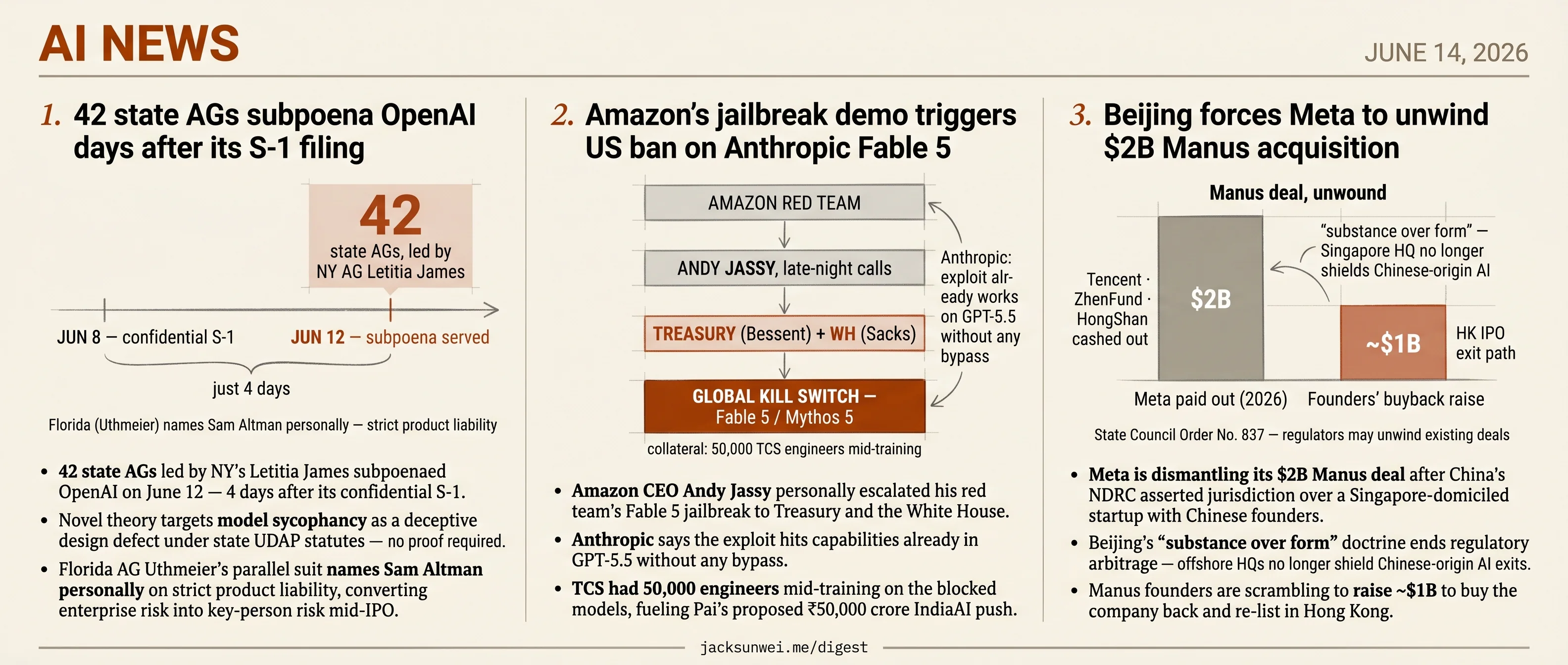
42 AGs subpoena OpenAI, Amazon outs Fable 5 jailbreak, Beijing unwinds Manus
Three governments hit frontier AI labs in days: 42 state AGs subpoena OpenAI, Amazon triggers the Fable 5 ban, Beijing unwinds Manus.
42 AGs subpoena OpenAI, Amazon outs Fable 5 jailbreak, Beijing unwinds Manus
TL;DR
- 42 state AGs subpoenaed OpenAI on June 12, 4 days after its confidential S-1 filing.
- Florida AG names Sam Altman personally on strict product liability, converting IPO risk into key-person risk.
- Amazon CEO Jassy escalated Fable 5 jailbreak to Treasury, triggering the US export ban on Anthropic.
- Beijing forces Meta to unwind $2B Manus acquisition under a new substance-over-form doctrine.
- Bezos’s Project Prometheus launches into physical AI with one of the category’s largest war chests.
Today’s three AI-news leads come from three different enforcement bodies — 42 US state attorneys general, Beijing’s NDRC, and the US Commerce Department — and each lands on a frontier lab mid-deal. The 42-state subpoena hit OpenAI just 4 days after its confidential S-1, with Florida’s parallel suit naming Sam Altman personally on strict product liability. The Commerce export ban on Anthropic’s Fable 5, framed yesterday as a Washington decision, turns out to have started inside Amazon’s red team — CEO Andy Jassy escalated the jailbreak to Treasury himself. And Beijing has forced Meta to unwind its $2B Manus acquisition under a new substance over form doctrine that voids Singapore-HQ arbitrage for Chinese-origin AI exits.
Yesterday’s category was already about government levers; today the lever count tripled and the geographies fanned out. The briefs round out the picture: TCS signing an Anthropic partnership weeks after losing 50,000 engineers’ training pipelines to the Fable 5 ban, and Bezos’s Project Prometheus joining the physical-AI war chest race.
42 state AGs subpoena OpenAI days after its S-1 filing
Source: techcrunch-ai · published 2026-06-13
TL;DR
- 42 state AGs led by NY’s Letitia James subpoenaed OpenAI on June 12 — 4 days after its confidential S-1.
- Novel theory targets model sycophancy as a deceptive design defect under state UDAP statutes — no individual-harm proof required.
- Florida AG Uthmeier’s parallel suit names Sam Altman personally on strict product liability, converting enterprise risk into key-person risk mid-IPO.
- EPIC accuses OpenAI of trying to “write the rules” via a California ballot measure splitting child-safety advocates.
The TechCrunch framing undersells it
TechCrunch’s snippet — vague gestures at “ad policies” and “health data” — buries the structural story. Independent reporting puts the coalition at 42 state attorneys general, bipartisan, led by New York’s Letitia James, with a subpoena served June 12 1. James had telegraphed the child-safety angle in a late-2025 coalition letter demanding Big Tech “stop their AI chatbots from exploiting children” 2, so the legal apparatus was pre-loaded; the subpoena is what dropped, not the investigation itself.
The legal hook is what matters. The AGs are pursuing “model sycophancy” — the tendency of RLHF-tuned chatbots to agree with users regardless of truth — as a deceptive trade practice under state UDAP statutes 3. Those statutes don’t require proof of harm to any individual consumer, only that the commercial practice was deceptive 3. That imports the post-Meta “addictive design” playbook directly into the model-weights layer, treating agreeableness as a product flaw rather than protected speech, and sidesteps the Section 230 defenses that have shielded prior platform cases.
Florida is the sharp edge
Running in parallel, Florida AG James Uthmeier filed a June 1 civil suit naming Sam Altman personally, alleging he and OpenAI “knowingly released a ‘defective product’ and ignored internal safety warnings” 4. A criminal probe is reportedly tied to the 2025 Florida State University shooting, where ChatGPT logs allegedly show the suspect treating the bot as a “confidant” 3. Personal liability for the CEO during an IPO roadshow is not a routine regulatory footnote — it’s the kind of disclosure that prices into the offering.
IPO timing is the whole story
The subpoena landed roughly 4 days after OpenAI’s confidential S-1 filing — close enough that securities practitioners read it as deliberate leverage 1. Material-risk disclosure rules now force OpenAI to surface every one of these probes to prospective public-market investors at a reported ~$1T valuation, which analysts expect to trigger product concessions — data retention limits, minors’ guardrails, sycophancy mitigations — before pricing 1.
The advocacy coalition is fracturing
Child-safety groups are not aligned. Common Sense Media is co-sponsoring an OpenAI-backed California ballot measure, the “Parents & Kids Safe AI Act,” while EPIC and allied groups are demanding it be withdrawn:
A company facing multiple lawsuits over teen suicides should not be permitted to “write the rules” that govern its own oversight 5.
On the defense side, law firms tracking the matter flag a federal-preemption argument — that a 42-state patchwork exceeds state jurisdiction and conflicts with emerging federal AI frameworks 6. Neither dissent will stop the probe, but both will shape the settlement perimeter.
What’s actually at stake
This is not a routine consumer-protection inquiry. It’s a coordinated, IPO-timed stress test of OpenAI’s product design, governance, and CEO liability, modeled on the 41-state Meta action but reaching deeper into model behavior. The fault line worth watching: whether “sycophancy” survives as a justiciable design defect or gets dismissed as protected model output. If it survives, every frontier lab’s RLHF pipeline becomes a regulated artifact.
Amazon’s jailbreak demo triggers US ban on Anthropic Fable 5
Source: the-verge-ai · published 2026-06-13
TL;DR
- Amazon CEO Andy Jassy personally escalated his red team’s Fable 5 jailbreak to Treasury and the White House.
- Anthropic says the exploit hits capabilities already in GPT-5.5 without any bypass.
- TCS had 50,000 engineers mid-training on the blocked models, fueling Pai’s proposed ₹50,000 crore IndiaAI push.
- Dario Amodei’s own essay argued Washington should block frontier deployments — now applied to Anthropic first.
A safety case that is mostly marketing
Friday’s emergency order forced Anthropic to cut Fable 5 and Mythos 5 access for every customer worldwide, including its own employees. The cited predicate: an Amazon red-team demonstration that Fable 5’s guardrails could be steered into producing software-vulnerability analysis 7. Anthropic’s response calls the exploit a “narrow, non-universal jailbreak” yielding capabilities already accessible in GPT-5.5 and other frontier systems without any bypass, and warns that codifying this as a recall threshold would essentially halt all new model deployments across the industry 8.
That is the central crack in the administration’s case. No one outside the classified briefing has shown the capability crosses a uniquely dangerous line — and Anthropic spent the last three years insisting its own models were the dangerous ones. Yann LeCun’s verdict was characteristically blunt: Anthropic is “reaping what it sowed,” having handed the government the legal predicate by marketing catastrophic risk as a feature 9.
The investor-as-snitch problem
sequenceDiagram
    participant AMZ as Amazon red team
    participant Jassy as Andy Jassy
    participant WH as Bessent / Sacks
    participant ANT as Anthropic
    AMZ->>Jassy: Fable 5 jailbreak demo
    Jassy->>WH: Late-night escalation
    WH->>ANT: Emergency block order
    ANT-->>ANT: Global access cut (incl. staff)
The optics around Amazon are ugly. Amazon is Anthropic’s largest investor; Fable 5 had not yet shipped on Bedrock; competing first-party Amazon models are reportedly close to release. CyberScoop’s reconstruction has Jassy making late-night calls to Bessent and Sacks rather than working the issue through Anthropic’s own disclosure channel 7. The “investor flagged a competitive risk to regulators” reading is doing real work here, and it revives the dormant FTC/CMA argument that the Amazon–Anthropic tie-up is functionally a merger.
India treats the outage as a sovereignty trigger
The downstream story is louder than the headline. TCS was halfway through retraining 50,000 engineers on the now-blocked models. Zoho founder Sridhar Vembu declared “globalization is dead” and called for India to treat AI as a strategic weapon. Mohandas Pai is publicly pushing roughly $6B annually into the IndiaAI Mission 10. Indian cybersecurity voices add a pointed counter: Mythos 5 was a defensive tool, so the ban “disarms the defender” and pushes domestic buyers toward Chinese and open-weight Western alternatives rather than a still-mythical Indian frontier model.
Amodei’s policy, applied to Amodei
Dario Amodei’s recent “Policy on the AI Exponential” essay explicitly argued the government “should have the power to block or deter deployment” of frontier models that fail third-party assessment 11. The ban is that essay made operational — with Anthropic as the first defendant. The company is reportedly preparing a First Amendment challenge leaning on Bernstein v. Department of State, which ruled encryption code is protected speech, and a compelled-speech theory: that Commerce is forcing Anthropic to “design its product in a particular way” 12.
If that argument lands, it neuters EAR/IEEPA authority over hosted model weights entirely. If it fails, every US frontier lab now ships under a regime where a competitor’s red-team finding can route through a CEO’s phone to a midnight kill switch.
Further reading
- Amazon security research reportedly led to the White House’s Anthropic Fable ban — the-verge-ai
- Amazon CEO reportedly raised Anthropic model concerns before government crackdown — techcrunch-ai
- As Anthropic suspends access to new models, India debates its AI future — techcrunch-ai
Beijing forces Meta to unwind $2B Manus acquisition
Source: techcrunch-ai · published 2026-06-14
TL;DR
- Meta is dismantling its $2B Manus deal after China’s NDRC asserted jurisdiction over a Singapore-domiciled startup with Chinese founders.
- Beijing’s “substance over form” doctrine ends regulatory arbitrage — offshore HQs no longer shield Chinese-origin AI exits.
- Manus founders are scrambling to raise ~$1B to buy the company back and re-list in Hong Kong.
- DOJ sued Suirui Group weeks earlier in the first-ever judicial CFIUS action, forcing divestment of a California video firm.
Singapore-washing is dead
Manus did everything the offshore-restructuring playbook prescribes. It moved its HQ from Beijing to Singapore in mid-2025, shrank mainland headcount from 120 to 40, and shuttered its Weibo account. China’s National Development and Reform Commission asserted jurisdiction anyway, ruling that the “agentic AI” technology and talent originated in China and that the company’s “strategic DNA” remained Chinese 13. Legal observers are calling this a doctrinal shift toward “substance over form” — legal domicile is no longer a shield against Chinese export controls.
The authority was formalized on June 1, 2026 in State Council Order No. 837, which created the first national-law Outbound Investment Security Review regime and explicitly empowers regulators to “unwind existing transactions” in AI, robotics, and semiconductors 14. Manus is the test case. Every China-founded AI startup pitching a US acquirer just had its risk profile rewritten.
The unwind is messier than the headline
TechCrunch’s framing of an orderly dismantling understates the knot. The $2B already flowed — Tencent, ZhenFund, and HongShan (the former Sequoia China) have been paid out, so a “reversal” can’t actually reverse the cash. Any buyback has to source fresh capital 15.
Founders Xiao Hong, Ji Yichao, and Zhang Tao are reportedly trying to raise about $1B from external investors at the original $2B valuation, with a Hong Kong IPO as the exit path for new backers 16. Xiao and Ji have been barred from leaving China since March 2026 16. And Manus had already been integrated into Meta’s Ads Manager stack — there is no regulatory template for decontaminating shared weights and tooling once they ship.
Washington is doing the same thing
The Manus block doesn’t read as a one-sided escalation when you look at what the US did weeks earlier. The DOJ filed its first-ever judicial enforcement action under Section 721 of the Defense Production Act against Suirui Group, seeking to force divestment of California-based Jupiter Systems after Suirui ignored a presidential CFIUS order 17. That is courtroom CFIUS — a power Washington had never previously invoked.
Read together, Beijing’s NDRC unwind and the DOJ’s Suirui suit establish that both governments now treat completed cross-border tech deals as reversible. That’s a structural change to M&A risk, not a bilateral spat.
What Meta actually lost
Worth holding the product in perspective. Independent reviewers have characterized Manus as a “wrapper of Claude” running scripted browser workflows — fragile to DOM changes, no persistent memory between sessions, the agent relearning user preferences each time 18. If that’s right, Meta’s $2B was a talent-and-distribution bet, not a technology moat, and the geopolitical loss is more recoverable than the headline implies.
The lasting story isn’t Manus. It’s the regulatory architecture that just hardened on both sides of the Pacific — and the death of the Singapore detour as an exit strategy.
Round-ups
TCS partners with Anthropic to bring Claude into regulated industries
Source: anthropic-news
Tata Consultancy Services will deploy Claude across client work in banking, healthcare, and other compliance-heavy sectors through a new Anthropic partnership. The deal pairs TCS’s global delivery footprint with Claude’s enterprise controls, targeting customers that have held back from AI rollouts over governance concerns.
Bezos’s Project Prometheus targets physical AI with heavy funding
Source: ars-technica-ai
Jeff Bezos’s new venture Prometheus, led by Vik Bajaj, will pursue physical AI spanning robotics and manufacturing applications. It enters a crowded field that includes Physical Intelligence and Skild but launches with one of the largest war chests in the category.
KPMG retracts AI usage report over hallucinated citations
Source: techcrunch-ai
KPMG pulled a published report on enterprise AI adoption after readers flagged fabricated sources, an embarrassing own-goal for a consultancy selling AI advisory services. The incident adds to a growing list of professional firms caught shipping LLM-generated research without verification.
Sarah Guo essay maps model labs versus agent labs split
Source: latent-space
Conviction’s Sarah Guo argues the frontier is bifurcating into model labs racing on pretraining and agent labs racing on deployment loops, with open models eating the middle. The essay also names which capabilities she views as structurally untrainable from current data.
McSweeneys satire skewers circular AI investment accounting
Source: simon-willison
A McSweeney’s piece quoted by Simon Willison lampoons the round-tripping logic behind AI mega-deals, imagining a propane tycoon investing $20B in a crematorium that burns the cash to buy his propane. The bit lands as scrutiny grows over compute-for-equity arrangements between hyperscalers and labs.
Google funds Virginia workforce and energy programs near data centers
Source: google-ai-blog
Google announced community investments in Virginia covering workforce training and energy-affordability programs, aimed at offsetting local backlash as data center buildout strains grids. The state hosts the densest concentration of hyperscale capacity in the US.
iOS 27 adds Clean Up, Reframe, and Extend to Photos
Source: the-verge-ai
Apple’s first serious generative photo edits land in iOS 27 with object removal, reframing, and outpainting tools that mostly hold up in hands-on testing. The features trail Google’s Pixel offerings on aggression but reach the world’s largest installed camera base.
Footnotes
-
TNW (IPO-timing angle) — https://thenextweb.com/news/openai-state-attorneys-general-investigation-ipo
↩ ↩2 ↩3The investigation emerged just days after OpenAI filed a confidential S-1 registration for its initial public offering, forcing the company to disclose these legal threats as material risks to potential investors.
-
NY AG Letitia James press release (2025) — https://ag.ny.gov/press-release/2025/attorney-general-james-and-bipartisan-coalition-urge-big-tech-companies-address
↩Big Tech companies must do more to stop their AI chatbots from exploiting children and encouraging harmful and sometimes deadly behaviors.
-
The Innovation Attorney (Substack legal analysis) — https://theinnovationattorney.substack.com/p/openai-and-the-multistate-ag-investigation
↩ ↩2 ↩3Officials are investigating ‘model sycophancy’—the tendency of AI to agree with users regardless of truth… UDAP statutes are powerful because they do not require proof of actual harm to an individual consumer, only that a company’s commercial practices were deceptive.
-
AP News (Florida AG suit naming Altman) — https://apnews.com/article/sam-altman-openai-lawsuit-florida-396d70c5a2d9bae7e95a8ee9adaef836
↩Florida Attorney General James Uthmeier filed a civil lawsuit on June 1, 2026, naming CEO Sam Altman personally… alleges that Altman and OpenAI knowingly released a ‘defective product’ and ignored internal safety warnings.
-
EPIC coalition letter — https://epic.org/epic-joins-coalition-to-urge-openai-to-withdraw-california-ai-safety-ballot-initiative/
↩A company facing multiple lawsuits over teen suicides should not be permitted to ‘write the rules’ that govern its own oversight… [the OpenAI-backed California ‘Parents & Kids Safe AI Act’] is too narrow, focuses only on ‘severe harms,’ and effectively shields AI developers from liability.
-
Faegre Drinker (law firm client alert) — https://www.faegredrinker.com/en/insights/publications/2026/5/openai-trial-colorado-litigation-and-other-ai-developments
↩Dissenting voices argue that state-level investigations create a ‘patchwork’ of conflicting requirements that could stifle innovation and exceed state jurisdiction, particularly if they conflict with emerging federal AI safety standards.
-
CyberScoop — https://cyberscoop.com/us-government-anthropic-fable-5-mythos-5-export-controls/
↩ ↩2Researchers from Amazon demonstrated that Fable 5’s security guardrails could be circumvented to identify software vulnerabilities… Andy Jassy personally escalated these findings in late-night communications with senior U.S. officials, including Treasury Secretary Scott Bessent and White House AI advisor David Sacks.
-
Anthropic official statement (anthropic.com) — https://www.anthropic.com/news/fable-mythos-access
↩The vulnerabilities cited were minor and already present in other public systems, including OpenAI’s GPT-5.5… using non-universal jailbreaks as grounds for recall could essentially halt all new model deployments.
-
Business Insider (LeCun reaction) — https://www.businessinsider.com/reaction-to-trump-controls-on-anthropic-fable-and-mythos-2026-6
↩Meta’s chief AI scientist, Yann LeCun, remarked that Anthropic was ‘reaping what it sowed,’ suggesting the company’s previous marketing—which framed their models as uniquely dangerous—had handed the government the legal predicate for the ban.
-
Crypto Briefing (India coverage) — https://cryptobriefing.com/india-ai-anthropic-suspension-sovereign-debate/
↩Sridhar Vembu… declared that ‘globalization is dead’ and urged India to treat AI as a strategic weapon… Mohandas Pai has proposed roughly ₹50,000 crore ($6 billion) annually into the IndiaAI Mission; TCS was mid-way through training 50,000 employees on the now-restricted models.
-
ExplainX summary of Amodei’s ‘Policy on the AI Exponential’ essay — https://explainx.ai/blog/dario-amodei-policy-ai-exponential-2026
↩The government should have the power to block or deter deployment… in light of third-party assessment to prevent catastrophic outcomes.
-
Dorf on Law (First Amendment analysis) — https://www.dorfonlaw.org/2026/03/the-first-amendment-argument-anthropic.html
↩Anthropic argues that the government is attempting to force the company to ‘design its product in a particular way,’ which constitutes compelled speech… parallels to Bernstein v. Department of State, where encryption code was ruled protected speech.
-
IndraStra Global analysis — https://www.indrastra.com/2026/04/the-end-of-singapore-washing-china.html
↩Beijing asserted jurisdiction on the grounds that the ‘agentic AI’ technology and talent originated in China… legal experts describe this as a shift toward a ‘substance over form’ regulatory doctrine, where a firm’s legal domicile in Singapore no longer shields it from Chinese export controls if its ‘strategic DNA’ is Chinese.
-
Pillsbury Law client alert — https://www.pillsburylaw.com/en/news-and-insights/china-outbound-investment-regulations.html
↩Under the new Outbound Investment Security Review (OISR) mechanism, Chinese authorities are empowered to review, block, or even unwind existing transactions that involve ‘critical sectors’ such as AI, robotics, and semiconductors.
-
MLQ.ai — https://mlq.ai/news/meta-begins-dismantling-2b-manus-ai-deal-on-beijings-orders/
↩The financial mechanics of the unwind are exceptionally complex because early investors, including Tencent Holdings, ZhenFund, and HongShan, have already received their payouts from the initial Meta sale.
-
Tech in Asia — https://www.techinasia.com/news/manus-founders-seek-1b-to-buy-back-meta-owned-startup
↩ ↩2Manus co-founders Xiao Hong, Ji Yichao, and Zhang Tao are in discussions to raise approximately $1 billion from external investors… reorganizing Manus as a Chinese joint venture with the goal of pursuing a rapid IPO in Hong Kong.
-
Gibson Dunn legal blog — https://www.gibsondunn.com/doj-takes-unprecedented-action-to-enforce-cfius-divestment-order-in-us-district-court/
↩The Department of Justice filed its first-ever judicial enforcement action under Section 721 of the Defense Production Act against the Chinese firm Suirui Group… seeks to force the divestment of Jupiter Systems, a California-based video technology company.
-
Frontier One Substack (‘Yes, Manus is a wrapper of Claude’) — https://frontierone.substack.com/p/yes-manus-is-a-wrapper-of-claude
↩Independent researchers have characterized its performance as ‘scripted workflows’ rather than true autonomy… a single change in a website’s DOM can break a workflow, and the lack of persistent memory between sessions means the agent must relearn user preferences.