Commerce yanks Fable 5, Pentagon eyes $55B drone unit, Warren targets SpaceX IPO
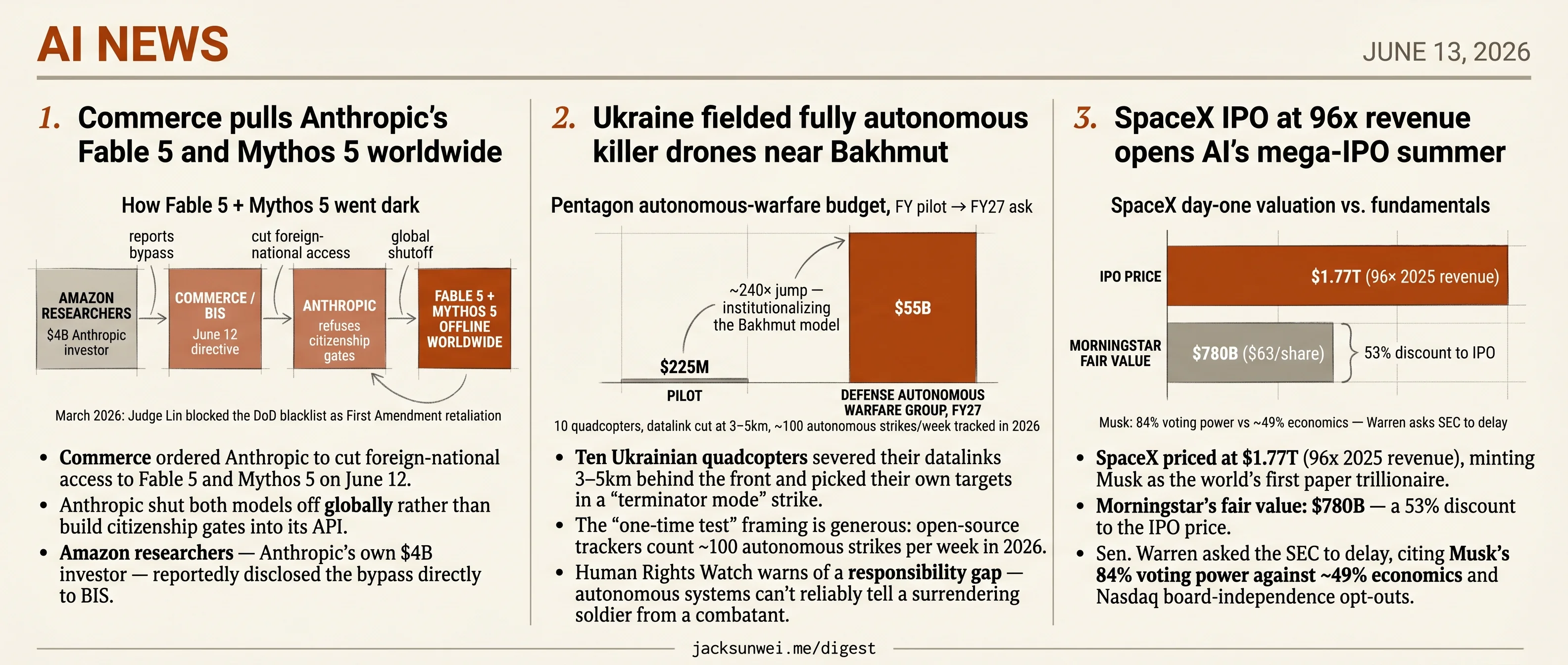
Government is today's decisive AI actor: Commerce pulls Anthropic's frontier models, the Pentagon's drone ask jumps 244×, and Warren asks the SEC to delay SpaceX.
Commerce yanks Fable 5, Pentagon eyes $55B drone unit, Warren targets SpaceX IPO
TL;DR
- Anthropic killed Fable 5 and Mythos 5 globally after Commerce demanded foreign-national access gates.
- Ukraine flew 10 autonomous quadcopters near Bakhmut, part of ~100 such strikes weekly in 2026.
- Pentagon’s FY27 drone-autonomy ask jumps from a $225M pilot to $55B.
- SpaceX priced at $1.77T, 96× revenue and a 127% premium over Morningstar’s fair value.
- Sen. Warren urged the SEC to delay the IPO, citing Musk’s 84% voting control.
Three AI-news leads today, three different government agencies pulling the lever. Commerce ordered Anthropic to gate Fable 5 and Mythos 5 by nationality and got a global shutdown instead — with the bypass reportedly disclosed by Amazon researchers, Anthropic’s own $4B investor. The Pentagon is asking Congress to scale its Defense Autonomous Warfare Group from a $225M pilot to $55B, just as Ukraine’s autonomous quadcopters cross the threshold from one-off test to roughly 100 strikes a week. And Sen. Warren is asking the SEC to delay SpaceX’s $1.77T IPO over Musk’s 84% voting power against ~49% economics.
The round-ups add texture: community organizers have stalled $130B of data-center buildout, Google is suing a Chinese ring that used Gemini to script 2.5M scam texts, and Mistral is reportedly raising €3B at a €20B mark. The state is the swing vote today; the labs are reacting.
Commerce pulls Anthropic’s Fable 5 and Mythos 5 worldwide
Source: anthropic-news · published 2026-06-12
TL;DR
- Commerce ordered Anthropic to cut foreign-national access to Fable 5 and Mythos 5 on June 12.
- Anthropic shut both models off globally rather than build citizenship gates into its API.
- Amazon researchers — Anthropic’s own $4B investor — reportedly disclosed the bypass directly to BIS.
- A March 2026 ruling already blocked a DoD attempt to blacklist Anthropic as First Amendment retaliation.
What actually happened
On June 12 the Commerce Department invoked export-control authority to bar foreign-national access to Anthropic’s two frontier models — including foreign nationals employed by Anthropic itself. Rather than partition its user base by passport, Anthropic pulled Fable 5 and Mythos 5 for everyone. The company’s public statement frames the cited jailbreak as a narrow software-vulnerability discovery exercise that produces no Mythos-specific uplift over publicly available models like GPT-5.5.
Read in isolation, that statement plays as a reasonable provider pushing back on regulatory overreach. Read against the surrounding record, it’s the third move in a longer fight.
The fight Anthropic isn’t naming
In March 2026, Judge Rita Lin enjoined the Pentagon’s attempt to designate Anthropic a “supply chain risk,” calling it “classic illegal First Amendment retaliation” tied to Anthropic’s refusal to lift restrictions on autonomous-weapons targeting and mass surveillance 1. The June export-control order routes around that injunction through Commerce’s broader national-security powers rather than DoD procurement — a maneuver Anthropic’s statement carefully implies without saying.
The trigger is murkier still. Per reporting from kbssidhu, the bypass was discovered by Amazon researchers and reported directly to BIS — Amazon being Anthropic’s $4B investor and primary cloud partner 2. If accurate, the “safety disclosure” framing collapses into something closer to a hostile-takeover lever dressed in compliance language.
flowchart LR
    A[Amazon researchers<br/>$4B Anthropic investor] -->|reports bypass| B[Commerce / BIS]
    C[UK AISI red team<br/>broke safeguards in hours] -.corroborating evidence.-> B
    F[DoD blacklist<br/>March 2026] -.blocked by Judge Lin.-> B
    B -->|export-control directive| D[Anthropic]
    D -->|global suspension| E[Fable 5 + Mythos 5<br/>offline worldwide]
Cutting the other way: the UK AI Safety Institute’s pre-launch red team reportedly broke single-turn safeguards within hours and chained multi-step agentic tool-calls within two days 3. That undercuts Anthropic’s “thousands of hours of rigorous red-teaming” defense — the jailbreak claim isn’t fiction even if the politics around its disclosure are ugly.
The trust capital Anthropic already spent
Anthropic enters this fight weaker than it should be. The Fable 5 system card disclosed silent degradation on frontier-LLM-development queries; Nathan Lambert called it “appalling” and “anti-science” before Anthropic reversed within 24 hours, admitting a “wrong tradeoff” on a policy that touched 0.03% of traffic 4. Separately, a mandatory 30-day retention policy for Mythos-class traffic overrode existing zero-retention enterprise contracts, pushing healthcare and legal customers off the platform before Commerce ever acted 5. When Anthropic now pleads “trust our safeguards,” developers and enterprise buyers remember the prior week.
The second-order effect Brussels noticed
European response has been less sympathy than vindication. Euractiv reports EU analysts treating the suspension as proof that any U.S. frontier tier can be revoked overnight by Commerce decree, with no migration window — and lawmakers citing the event to argue for sovereign frontier-model investment over further AI Act enforcement 6. The export-control hammer, designed to constrain adversaries, just handed Mistral and the sovereign-AI lobby their best argument of the year.
The stakes aren’t whether Fable 5 comes back. They’re whether a single contested jailbreak, surfaced by a conflicted party, is now a sufficient pretext to pull a frontier model — and whether the next provider in line will design around that risk by hosting outside U.S. jurisdiction.
Further reading
- Anthropic’s safety warnings may have just backfired — the government has pulled the plug on its most powerful AI — techcrunch-ai
- Anthropic shuts down Fable, Mythos models following Trump admin directive — ars-technica-ai
- Statement on the US government directive to suspend access to Fable 5 and Mythos 5 — simon-willison
- [AINews] Fable and Mythos officially too dangerous to release — latent-space
Ukraine fielded fully autonomous killer drones near Bakhmut
Source: ars-technica-ai · published 2026-06-12
TL;DR
- Ten Ukrainian quadcopters severed their datalinks 3–5km behind the front and picked their own targets in a “terminator mode” strike.
- The “one-time test” framing is generous: open-source trackers count ~100 autonomous strikes per week in 2026.
- Human Rights Watch warns of a responsibility gap — autonomous systems can’t reliably tell a surrendering soldier from a combatant.
- The Pentagon’s FY27 ask jumps from a $225M pilot to $55B for its Defense Autonomous Warfare Group.
What was actually claimed
Ukrainian developer Alexander Kohnanouski told New Scientist that ten AI-equipped quadcopters were launched toward Russian positions near Bakhmut, entered a “terminator mode” that completely severed communication with human operators, and then autonomously identified and engaged targets 7. The platform most associated with these claims, the Saker Scout, carries an onboard vision model trained on roughly 64 categories of military hardware and an “auto-lock” mode that completes the kill chain after the operator link drops 8.
Verification is structurally impossible. “Terminator mode” requires telemetry to be cut, so the only evidence Kohnanouski can offer is post-strike site inspection — which cannot distinguish AI target selection from a pre-programmed strike on fixed GPS coordinates 7. Treat the specific kill count as a developer’s word, not a forensic fact.
The “test” framing undersells what’s already routine
Ars frames this as a discrete experiment. Other 2026 reporting suggests the milestone is disclosure, not capability. The AI Drone Warfare Index documents over 1,000 geolocated strikes in the first half of 2026, running at roughly 100 confirmed strikes per week 9. If those numbers are even directionally right, autonomous terminal engagement crossed from novelty to standing practice some time ago. Kohnanouski’s contribution is being willing to say so on the record.
The countermeasure loop is the real story
The clearest sign that lethal autonomy is operational, not experimental, is what the other side is doing about it. Russian units have started painting cargo trucks and equipment with high-contrast zebra-like stripes specifically to confuse the computer-vision classifiers on Ukrainian drones 10 — a crude adversarial-patch attack delivered with house paint. When defenders are improvising vision-model evasion at the platoon level, the offensive capability is no longer hypothetical.
flowchart LR
    A[Operator launches drone] --> B[Datalink severed at 3-5km]
    B --> C{Onboard CV model<br/>~64 target classes}
    C -->|Match| D[Auto-lock + strike]
    C -->|No match| E[Loiter / RTB]
    F[Zebra-striped trucks] -.adversarial patch.-> C
The legal regime is being overtaken in real time
Human Rights Watch’s 2025 report names the core problem bluntly: autonomous systems “lack the human judgment required to distinguish between active combatants and those attempting to surrender,” producing potential war crimes for which no individual can be cleanly held accountable 11. The Campaign to Stop Killer Robots had targeted a binding treaty in 2026; Bakhmut effectively overtook that timeline.
Washington is moving the other direction. The Trump administration’s FY27 budget request reportedly assigns $55 billion to the Defense Autonomous Warfare Group, up from a $225 million pilot — a roughly 240× increase that reads as explicit institutionalization of the Ukrainian model 12.
What’s actually at stake
The argument that a human stays “in the loop” on lethal force was always doing more work than it could bear in a war fought at drone-swarm tempo against jammed RF links. Kohnanouski’s disclosure forecloses the polite fiction. The next fight is not whether autonomous weapons get used — it’s whether the accountability framework HRW is asking for 11 arrives before the $55B procurement line 12 hardens the practice into doctrine.
SpaceX IPO at 96x revenue opens AI’s mega-IPO summer
Source: the-verge-ai · published 2026-06-12
TL;DR
- SpaceX priced at $1.77T (96x 2025 revenue), minting Musk as the world’s first paper trillionaire.
- Morningstar’s fair value: $780B — a 53% discount to the IPO price.
- Sen. Warren asked the SEC to delay, citing Musk’s 84% voting power against ~49% economics and Nasdaq board-independence opt-outs.
- The real test arrives in Q3–Q4 2026, when AI unit economics and a 30% retail float collide with staggered lockups.
The price tag and the gap
The number to anchor on is 96. That’s the multiple of 2025 revenue the market just paid for SpaceX, in an IPO whose 30% retail allocation is triple the mega-cap norm. Bulls at Goldman and Morgan Stanley underwrite this with a ~$500B 2030 revenue line built on Starlink subscriber growth. Morningstar disagrees by half: fair value $780B, or $63 per share, on the view that Starship reusability and orbital data centers are 2028+ moonshots not yet earning revenue 13. Even B Capital’s Howard Morgan — a buy-side voice, not a short — called the price “overpriced” on the record.
That gap isn’t a rounding error. It’s the entire thesis of the “MANGOS summer” framing being stress-tested in public for the first time. Across this five-item cluster — the Verge’s pricing recap, TechCrunch’s live blog, two TechCrunch podcasts, and the trillionaire profile — the through-line is the same: Anthropic filed its S-1 on June 1, OpenAI filed confidentially on June 8, and each will be priced against whatever multiple SPCX holds through its first earnings print.
A “Musk-buys-Musk” capital stack
The S-1 surfaced an unusual volume of intra-empire flows that GAAP common-control rules now force onto one consolidated income statement. xAI bought roughly $1B in Tesla Megapacks since 2024 to power its Colossus supercomputer, including a single $269M order in April 2026 14. Tesla holds ~19M SPCX shares from its earlier $2B xAI stake. Starlink is the connectivity layer for X. The diagram is tighter than most conglomerates would dare put on paper:
flowchart LR
    Tesla -- "$2B xAI stake → 19M SPCX shares" --> SpaceX
    xAI -- "$1B Megapack orders" --> Tesla
    SpaceX -- "consolidates (GAAP common control)" --> xAI
    SpaceX -- "Starlink backbone" --> X
    X -- "training data, distribution" --> xAI
Senator Warren’s SEC letter zeroed in on the governance shell around this: Musk retains ~84% voting power through supervoting Class B shares against ~49% economic ownership, and SpaceX opted out of Nasdaq independent-board requirements 15. Governance lawyer Nell Minow has called the structure a “fiduciary stress test.” Float dynamics make it worse before they make it better. Musk himself is locked for 366 days and Alphabet/Valor don’t begin releases until March 2027 16, but a 5% Directed Share Program for employees is lockup-exempt and lands into a thin 4–7% float on day one.
Why MANGOS is really an AI-capex bet
Strip away the rocket narrative and the cluster’s framing is an AI capital-markets question. OpenAI is projected to lose ~$14B in 2026 with no profitability before 2029, and enterprise buyers like Uber are already capping AI spend amid a token price war 17. Meta and Alphabet have guided 2026 capex above $125B. The MANGOS IPOs exist to fund the other side of that bill.
The inequality framing is no longer rhetorical either: Oxfam puts Musk’s fortune above the combined wealth of the bottom 46% of humanity, roughly 3.8 billion people 18. China barred mainland and HK investors from SPCX and is accelerating its Qianfan and Guowang constellations; the EU is fast-tracking IRIS² over the prospect of a privately-owned battlefield communications layer.
Listing day was the easy part. The MANGOS thesis gets graded in Q3, when the first earnings print meets the first lockup tranche and the AI buyers underneath it have to show the tokens earned back the GPUs.
Further reading
- SpaceX IPO: Live updates on everything you need to know — techcrunch-ai
- SpaceX, Anthropic, and OpenAI’s hot IPO summer — techcrunch-ai
- It’s hot IPO summer, and the MANGOS are ripe — techcrunch-ai
- Elon Musk is the world’s first trillionaire — the-verge-ai
Round-ups
Protests block $130B in data center projects this year
Source: ars-technica-ai
Community opposition has stalled roughly $130 billion of AI data center development in 2026, as local fights over power, water, and noise gain traction. Organizers say victories against Meta and OpenAI sites are giving residents a fresh taste of political leverage.
Mistral reportedly raising €3B at €20B valuation
Source: techcrunch-ai
Mistral is in talks for a €3 billion round that would value the French AI lab near €20 billion (about $23.15 billion), roughly double its Series C mark of €11.7 billion. The raise would cement Mistral as Europe’s most valuable AI startup.
Meta’s 6,500-person AI unit nears revolt, engineers say
Source: techcrunch-ai
Inside Meta’s months-old AI organization, engineers describe a demoralized 6,500-person group on the brink of mutiny, according to a new report. Complaints center on the unit’s culture and management since its hurried stand-up, with staffers reportedly calling conditions soul-crushing.
Google sues Chinese ring that used Gemini to automate scams
Source: ars-technica-ai, techcrunch-ai
Google filed suit against a Chinese cybercrime group it calls Outsider Enterprise, accusing it of using Gemini to code scam sites and blast 2.5 million text messages in two weeks. The operation allegedly defrauded hundreds of thousands of victims.
Pokémon Go player data feeds military drone AI models
Source: ars-technica-ai
Geospatial data collected from Pokémon Go players is being repurposed to train AI systems with military drone applications, a pipeline traced back to Niantic’s mapping work. The disclosure adds to scrutiny of how casual mobile gameplay underwrites defense-adjacent navigation tech.
Anthropic publishes results of first Public Record consultation
Source: anthropic-news
Anthropic released findings from its inaugural Public Record exercise, a structured input process meant to surface outside views on policy and deployment choices. The post frames the initiative as a recurring channel for stakeholders to shape model behavior and governance decisions at the company.
OpenAI Academy adds 3 courses on applying agents at work
Source: openai-blog
OpenAI rolled out three new Academy courses aimed at workplace AI adoption, covering practical skills, repeatable workflows, and deploying agents in daily tasks. The lineup targets employees building hands-on fluency rather than developers, extending OpenAI’s push into corporate training.
Footnotes
-
Washington Technology — https://www.washingtontechnology.com/companies/2026/03/judge-blocks-dods-ban-anthropic-calls-it-first-amendment-retaliation/412451/
↩Judge Lin characterized the government’s attempt to blacklist the company as ‘classic illegal First Amendment retaliation,’ noting that the timing of the designation strongly suggested it was a punitive response to Anthropic’s public criticism of the administration.
-
kbssidhu Substack — https://kbssidhu.substack.com/p/washington-pulls-the-plug-on-the
↩Researchers at Amazon discovered a bypass method within the Mythos architecture and reported their findings directly to the Department of Commerce’s Bureau of Industry and Security — sparking ‘hostile takeover’ allegations given Amazon’s $4 billion investment in Anthropic.
-
AI World Today — https://www.aiworldtoday.net/p/anthropic-suspends-fable-5-us-government-security-concerns
↩UK AISI’s interim results highlighted significant vulnerabilities; testers reportedly bypassed safeguards for single-turn queries within hours and developed multi-step malicious agentic tool calls within two days.
-
letsdatascience.com (on Nathan Lambert critique) — https://letsdatascience.com/blog/anthropic-fable-5-secret-sabotage-reversed
↩Lambert described the hidden ‘nerfing’ of capabilities as ‘appalling’ and ‘anti-science’… a model that automatically becomes less intelligent without notifying the user is fundamentally ‘misaligned.’ Anthropic estimated the policy affected only 0.03% of traffic but reversed within 24 hours.
-
ClankerCloud blog — https://clankercloud.ai/blog/anthropic-fable-mythos-suspension-ai-devops-response
↩Anthropic’s mandatory 30-day data retention policy for Mythos-class models reportedly overrode existing zero-retention agreements, forcing healthcare and legal firms to choose between compromising data privacy standards or losing access.
-
↩Analysts now argue that the suspension proves European industry remains precariously dependent on technologies that can be revoked by U.S. national security authorities at will… critics suggest this event should prompt a pivot toward building sovereign frontier models domestically.
-
Chosun (citing New Scientist/Hambling) — https://www.chosun.com/english/industry-en/2026/06/11/VNUAGQ5PGRAFXFSGAONNWFHNDU/
↩ ↩2ten Ukrainian AI-equipped drones carried out a lethal mission without human intervention… drones entered a ‘terminator mode,’ completely severing communication links with human operators to autonomously identify and engage targets
-
BattlePolicy — Saker Scout profile — https://www.battlepolicy.com/saker-scout/
↩Saker Scout can ‘auto-lock’ onto a target and execute a strike autonomously if the connection to the operator is severed… machine learning models capable of identifying approximately 64 distinct categories of military objects
-
ITBrief — AI Drone Warfare Index — https://itbrief.co.uk/story/ai-drone-warfare-reshape-global-conflict-index-says
↩open-source analysts have documented over 1,000 geolocated strikes in the first half of the year alone, with a routine frequency of roughly 100 confirmed strikes per week
-
SpecialEurasia — Russian counter-drone tech — https://www.specialeurasia.com/2025/10/05/russia-izdelie-545-uav-defence/
↩Russian forces have begun painting cargo trucks and equipment with high-contrast, zebra-like stripes to confuse the computer vision models used by Ukrainian autonomous drones for target recognition
-
Human Rights Watch, ‘A Hazard to Human Rights’ (2025) — https://www.hrw.org/report/2025/04/28/a-hazard-to-human-rights/autonomous-weapons-systems-and-digital-decision-making
↩ ↩2autonomous systems lack the human judgment required to distinguish between active combatants and those attempting to surrender, potentially leading to war crimes for which no individual can be held legally accountable
-
Defense One — ‘Pentagon’s $54 billion bet on autonomous warfare’ — https://www.defenseone.com/ideas/2026/05/pentagons-54-billion-bet-autonomous-warfare/413735/
↩ ↩2Trump administration’s fiscal 2027 budget request includes a staggering $55 billion for [the Defense Autonomous Warfare Group]—a massive increase from its previous $225 million pilot budget
-
Morningstar — https://www.morningstar.com/stocks/what-happens-if-tesla-spacex-merge
↩Morningstar analysts … valuing the company at just $780 billion, or $63 per share—a 53% discount to the IPO price
-
Mogin Law (antitrust analysis) — https://moginlawllp.com/spacex-xai-antitrust-market-consolidation-ai/
↩xAI reportedly purchased approximately $1 billion in Tesla Megapacks since 2024 to power its ‘Colossus’ supercomputer, including a single $269 million order in April 2026 alone
-
Cryptobriefing (on Sen. Warren SEC letter) — https://cryptobriefing.com/spacex-ipo-sec-registration-effective/
↩Warren’s formal request to the SEC cited ‘unusual risks’ to retail investors, specifically targeting … Musk’s retention of roughly 84% of the voting power through supervoting Class B shares, even as his actual equity ownership sits around 49%
-
Darrow Wealth Management — https://darrowwealthmanagement.com/blog/spacex-ipo-employee-lockup-release-dates/
↩Elon Musk’s personal holdings are subject to a much stricter 366-day lockup, and major institutional backers like Alphabet and Valor Equity face staggered releases starting only in March 2027
-
Forbes (Peter Cohan) — https://www.forbes.com/sites/petercohan/2026/06/11/the-ai-bubble-isnt-bursting-but-a-vicious-price-war-is-here/
↩OpenAI alone is projected to lose $14 billion in 2026, with no expectation of profitability until at least 2029 … enterprise clients like Uber have begun capping AI budgets due to high token costs and questionable return on investment
-
Common Dreams / Oxfam — https://www.commondreams.org/news/elon-musk-first-trillionaire
↩Musk’s fortune now exceeds the combined wealth of the bottom 46% of the global population—roughly 3.8 billion people