Sony sues Anthropic, Deezer logs 75K AI tracks daily, OpenAI chip cracks Nvidia
Music publishers and streaming platforms push back on generative AI while OpenAI's in-house chip posts the first real perf-per-watt crack in Nvidia's lead.
Sony sues Anthropic, Deezer logs 75K AI tracks daily, OpenAI chip cracks Nvidia
TL;DR
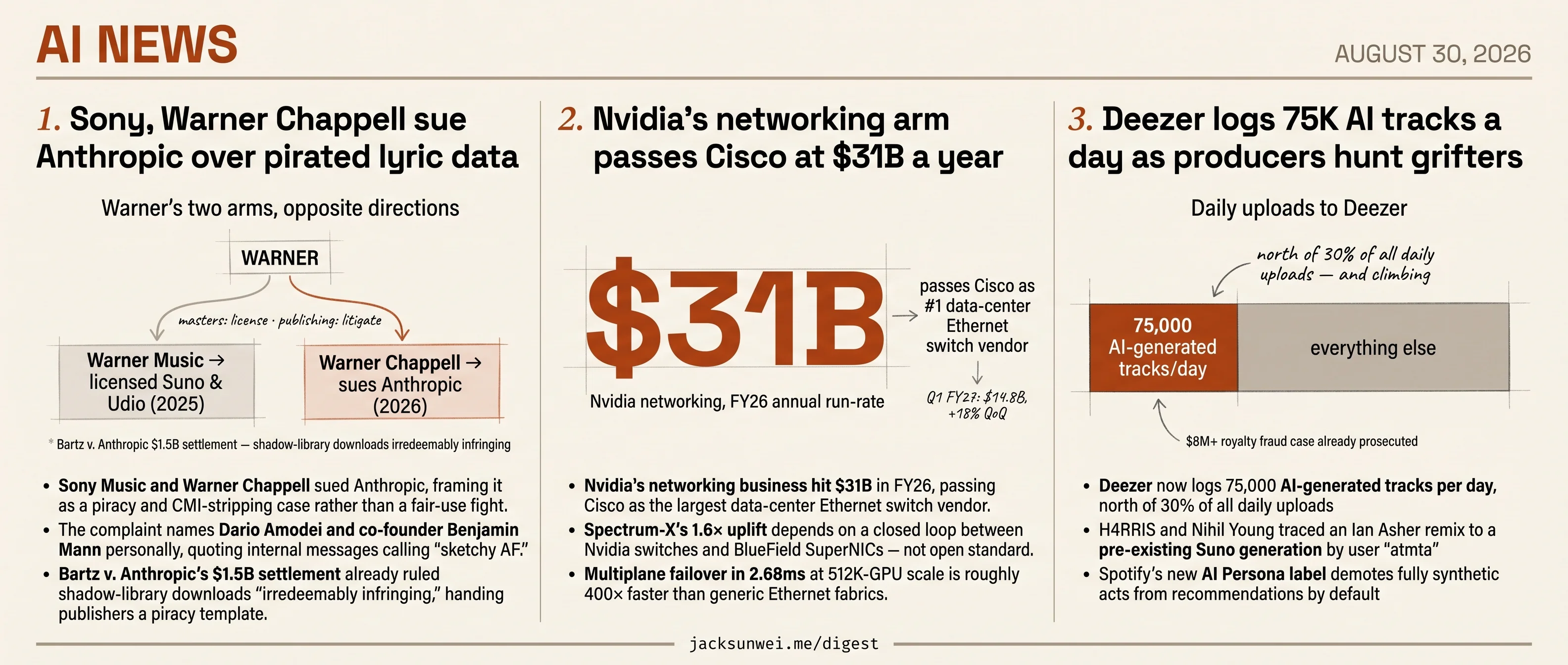
- Sony Music and Warner Chappell sue Anthropic on lyric piracy, naming Dario Amodei personally.
- Nvidia networking hit $31B in FY26, passing Cisco atop data-center Ethernet.
- OpenAI’s Jalapeño beats Blackwell 1.5–1.9× on perf-per-watt inference.
- Deezer logs 75,000 AI tracks daily, over 30% of all uploads.
- Bartz v. Anthropic’s $1.5B settlement hands publishers a ready piracy template.
Two music-industry pushbacks on AI arrive today with different tools. Sony Music and Warner Chappell sue Anthropic on the piracy template Bartz just cemented at $1.5B, naming Dario Amodei and co-founder Benjamin Mann personally and quoting internal messages calling sourcing “sketchy AF.” Meanwhile Deezer now logs 75,000 AI-generated tracks a day — north of 30% of all uploads — and independent producers are tracing purported “remixes” back to raw Suno generations by anonymous users.
The infrastructure story runs on a different clock. Nvidia’s networking arm cleared $31B in FY26, passing Cisco as the largest data-center Ethernet vendor, on a Spectrum-X stack that only delivers its 1.6× uplift inside a closed Nvidia loop. But OpenAI’s in-house “Jalapeño” silicon posts 1.5–1.9× the perf-per-watt of Blackwell on targeted inference — the clearest crack yet in the AI factory narrative Nvidia has spent a year selling.
Sony, Warner Chappell sue Anthropic over pirated lyric data
Source: techcrunch-ai · published 2026-08-29
TL;DR
- Sony Music and Warner Chappell sued Anthropic, framing it as a piracy and CMI-stripping case rather than a fair-use fight.
- The complaint names Dario Amodei and co-founder Benjamin Mann personally, quoting internal messages calling sourcing “sketchy AF.”
- Bartz v. Anthropic’s $1.5B settlement already ruled shadow-library downloads “irredeemably infringing,” handing publishers a piracy template.
- Warner Music licensed Suno and Udio in 2025 while sister publisher Warner Chappell now sues Anthropic.
The suit is engineered around Bartz, not against it
The Sony Music / Warner Chappell complaint isn’t the next round in the fair-use debate — it’s a targeted piracy indictment aimed at the exact liability window Judge Alsup left open in Bartz v. Anthropic. That July 2026 ruling, finalized in a $1.5 billion settlement, held that training on lawfully acquired works is “quintessentially transformative,” but that downloading from shadow libraries is “irredeemably infringing.” 1
The publishers built the complaint on that seam. They allege Anthropic torrented lyric corpora, performed “destructive scanning,” and used extraction tools to deliberately strip copyright management information — the songwriter and publisher credits attached to compositions — before ingestion. 2 Naming Amodei and Mann personally, and citing Mann’s internal description of the acquisition pipeline as “sketchy AF,” is a Bartz-inspired escalation: go after the acquisition chain, not the model output, because the acquisition chain is where Alsup already said fair use runs out.
Warner’s dual posture is the real signal
The unified plaintiff optics obscure a fracture. Warner Music Group settled with both Suno and Udio in late 2025 to lock in licensing deals; Universal followed with Udio. Sony has taken the opposite path, adding a 30,000-song suit against Udio in July 2026. 3 Now Warner Chappell — the publishing arm — is joining Sony against Anthropic while Warner Music keeps licensing its recordings to audio generators.
Read that carefully: labels are drawing a hard line on lyrics and compositions even as they monetize sound-recording AI. Publishing rights are the choke point they intend to defend; masters are the asset they intend to license. NMPA’s David Israelite made the framing explicit, contrasting “good actors” like Udio and Klay who now license with Anthropic’s “bogus” fair-use defense — and pointing directly at Anthropic’s rumored IPO as the pressure point. 4
Anthropic’s defense is narrower than it looks
Anthropic’s playbook, visible in its partial-dismissal motion in the parallel Concord lyrics case, is to defend training as transformative and point to output guardrails that block verbatim lyric regurgitation. 5 That posture is losing surface area fast. The new complaint sidesteps output entirely — no need to jailbreak Claude into reciting “Uptown Funk” if the case is about how the training corpus was obtained and whether CMI was stripped.
International precedent is also drifting away from Anthropic. A November 2025 Munich court ruling against OpenAI held that memorizing lyrics is a reproduction not covered by text-and-data-mining exceptions — non-binding in the U.S., but a persuasive counterweight when courts weigh whether industry practice supports a transformative-use finding. 6
What’s actually at stake
The TechCrunch and Verge writeups treat this as another entry in the AI-vs-copyright ledger. The more useful frame: this is a piracy case timed to Anthropic’s IPO window, brought by the one major label that refuses to settle, in coordination with a publishing arm whose sister recording company is already banking AI licensing checks. If Sony and Warner Chappell win a Bartz-shaped settlement here, the price of AI training data stops being a policy debate and becomes a line item on every foundation-model S-1.
Further reading
- Sony Music and Warner Chappell are suing Anthropic — the-verge-ai
Nvidia’s networking arm passes Cisco at $31B a year
Source: techcrunch-ai · published 2026-08-29
TL;DR
- Nvidia’s networking business hit $31B in FY26, passing Cisco as the largest data-center Ethernet switch vendor.
- Spectrum-X’s 1.6× uplift depends on a closed loop between Nvidia switches and BlueField SuperNICs — not an open standard.
- Multiplane failover in 2.68ms at 512K-GPU scale is roughly 400× faster than generic Ethernet fabrics.
- OpenAI’s “Jalapeño” beats Blackwell by 1.5–1.9× perf-per-watt on targeted inference — the clearest crack in the “AI factory” narrative.
Networking is now a Cisco-sized business inside Nvidia
The “beyond the GPU” framing is no longer marketing. Nvidia’s networking segment pulled $14.8B in FY27 Q1 and grew ~18% sequentially, closing FY26 at $31B annually — enough to displace Cisco as the largest data-center Ethernet switch vendor 7. That reframes every Spectrum-X and NVLink slide from accessory economics to a standalone Cisco-scale business attached to nearly every GB200/Rubin rack that ships.
The mechanism is not exotic. As back-end AI clusters push past 100K GPUs, collective-communication tail latency starts to dominate training step time. Whoever controls the fabric controls the utilization number that CFOs actually pay for.
The moat is a closed control loop, not a protocol
Practitioner reporting is clear that Spectrum-X’s headline 1.6× advantage over off-the-shelf Ethernet is not an Ethernet-standard result. It comes from a tightly coupled control loop between Spectrum-4/6 switches and BlueField-3/4 SuperNICs doing adaptive routing, congestion telemetry, and per-flow load balancing in hardware 8. ServeTheHome’s Hot Chips 2026 coverage makes the reliability side concrete: the multiplane topology, now scaling toward 512,000 Rubin GPUs, holds 90% bandwidth during a plane failure and detects faults in 2.68ms — about 400× faster than standard Ethernet 9.
flowchart LR
    G[Rubin GPUs] --> N[BlueField-4 SuperNIC]
    N <-->|telemetry + adaptive routing| S[Spectrum-6 switch]
    S --> P1[Plane 1]
    S --> P2[Plane 2]
    S --> P3[Plane N]
    P1 & P2 & P3 -.->|2.68ms failover| G
Call it proprietary openness: the wire is Ethernet, but the performance lives in silicon only Nvidia sells on both ends.
Where the consensus cracks
The open-standards push is not just vendor grumbling. Ethernet has already overtaken InfiniBand in AI back-end networking sales, driven by an operational tax operators feel directly: one engineer can run ~10,000 InfiniBand ports versus ~4,000 for Ethernet under current tuning regimes, and hyperscalers want the Ethernet talent pool 10. That’s why the Ultra Ethernet Consortium exists — and why Nvidia is racing to ship its answer inside Spectrum-X before UEC-native NICs commoditize the layer.
Scale-up is a different fight. NVLink 5.0 pushes 1.8 TB/s bidirectional per GPU, while UALink 1.0 tops out around 800 Gb/s per port — plus Nvidia has a decade of NCCL tuning that rivals cannot replicate on a spec-release cadence 11. So the moat is deep on scale-up, shallower on scale-out.
The sharpest counterexample comes from the workload economics. OpenAI’s Broadcom-co-designed “Jalapeño” reportedly beats Blackwell by 1.5–1.9× on performance-per-watt for specific inference tasks 12. If those numbers hold up under independent measurement — and that verification is not yet public — then the AI-factory bundle looks less like an inevitable stack and more like the default for buyers who can’t afford their own silicon team.
Takeaway
The networking pivot is real and it’s already priced into Nvidia’s revenue mix. But it also concentrates the attack surface: UEC targets the scale-out fabric, UALink targets NVLink, and custom XPUs target the inference-per-watt line item. The moat is deepest where NCCL, DOCA, and matched silicon overlap — and the hyperscalers spending the most on Nvidia are the same ones best equipped to route around each layer one at a time.
Deezer logs 75K AI tracks a day as producers hunt grifters
Source: the-verge-ai · published 2026-08-29
TL;DR
- Deezer now logs 75,000 AI-generated tracks per day, north of 30% of all daily uploads
- H4RRIS and Nihil Young traced an Ian Asher remix to a pre-existing Suno generation by user “atmta”
- Spotify’s new AI Persona label demotes fully synthetic acts from recommendations by default
- A U.S. defendant recently pleaded guilty to netting $8M+ in royalties streaming AI songs through bot farms
The detectives
The Verge’s profile of H4RRIS and Nihil Young frames them as a niche EDM neighborhood watch, but the receipts are harder than the piece lets on. When producer Ian Asher was tied to a remix called “Take Me (To The Moon),” Reddit sleuths didn’t just flag suspicious vocal artifacts — they matched the track to a specific pre-existing Suno generation by a user named “atmta” 13. That’s a concrete provenance link, not vibes-based accusation, and it’s what forced Asher’s defense to shift from “the vocals are the original artist’s sister” to pleading ignorance about the source material.
The template for why this work exists is Velvet Sundown, the fully AI-generated “band” that racked up over a million monthly Spotify listeners on curated mood playlists before its creators finally conceded it was a “synthetic music project” and an “ongoing artistic provocation” 14. Once that could happen on the biggest platform in music, community-led forensics became inevitable.
The scale is already industrial
The detectives’ anxiety is calibrated to real numbers. Deezer logs roughly 75,000 AI-generated tracks per day — well over 30% of daily uploads and climbing 15. The economic motive is no longer theoretical either: WIPO documents a U.S. case in which a defendant pleaded guilty to generating more than $8 million in royalties by pushing hundreds of thousands of AI songs through bot farms that streamed them billions of times 16. That reframes what H4RRIS is doing. It’s not aesthetic policing of a genre; it’s consumer-protection vigilantism against behavior that is already a federal crime in at least one prosecuted instance.
Platforms are moving halfway
Spotify’s September 2025 “AI Persona” policy formally tags fully synthetic acts and keeps them out of Discover Weekly and algorithmic mixes by default, while leaving them searchable 17. That partial containment leaves exactly the gap the EDM detectives are working: a hybrid track credited to a real-sounding human alias — MANSA, an Ian Asher remix — doesn’t trip the persona rule at all. Peer forensics are the only filter on the middle of the distribution.
The witch-hunt problem
Not everyone in the community endorses the enforcement style. Producers and essayists argue that available detection tools misfire on heavy autotune, quantization, and modern “clean” production, generating false positives that force human artists to hand over raw session files as receipts 18.
Creators report feeling interrogated like “criminals” for their speed or technical proficiency. 18
The critique isn’t that grift is fake — the $8M fraud case settles that. It’s that community enforcement has no due process, and the people most easily hurt by a bad accusation are bedroom producers whose only crime is sounding polished.
Takeaway
The stack looks like this: measurable industrial-scale fraud on one side 1516, half-built platform defenses in the middle 17, and a Reddit-driven forensic layer trying to plug the gap — sometimes with hard provenance 13, sometimes on ear alone. Until platforms close the hybrid-alias loophole, H4RRIS’s DMs are the enforcement mechanism.
Round-ups
OpenAI signals internal AGI benchmark by end of 2026
Source: latent-space
Chatter around OpenAI’s internal roadmap suggests the company expects to clear its own AGI bar by late 2026, framed as an endgame moment for the current scaling era. The post rounds up the signals feeding that timeline across recent leaks and executive remarks.
Vijay Pande leaves a16z’s $4B biotech fund for AI-native VZVC
Source: techcrunch-ai
Pande launched VZVC to make fewer, smaller bets after running a16z’s roughly $4 billion biotech practice, arguing biology is shifting from discovery to engineering. He contends open, shared datasets — not proprietary ones — are what will let AI actually reshape drug development and clinical trials.
Andrew Ng pivots coursework toward AI engineering
Source: latent-space
Ng is expanding DeepLearning.AI’s focus from model training into the applied AI engineering stack — prompts, agents, and evals — signaling the discipline has matured enough for mainstream curriculum. The move follows surging demand for practitioners who wire LLMs into production systems.
Agent-building tools cross the threshold for non-developers
Source: bens-bites
Shipping working agents no longer requires a coding background, with new no-code orchestration layers letting operators wire up tools, memory, and triggers directly. The piece argues the bottleneck has moved from engineering skill to knowing which workflows are worth automating.
Ben’s Bites drops session 4 of its builder interview series
Source: bens-bites
The fourth installment of Ben’s ‘How I built this’ series continues profiling founders shipping AI products, walking through the stack choices, prompts, and distribution tactics behind each launch. Format stays conversational, aimed at operators copying what works.
Footnotes
-
Wolters Kluwer Copyright Blog on Bartz v. Anthropic — https://legalblogs.wolterskluwer.com/copyright-blog/the-bartz-v-anthropic-settlement-understanding-americas-largest-copyright-settlement/
↩training on legally acquired works is ‘quintessentially transformative’ fair use, but downloading and storing pirated copies from shadow libraries is likely straight infringement.
-
↩Amodei expressly authorized the use of pirated datasets, while Mann reportedly described the sourcing methods as ‘sketchy AF’ in internal communications… Anthropic engaged in ‘destructive scanning’ and used extraction tools to deliberately strip out copyright management information.
-
Chartlex — Music Industry AI Lawsuits Tracker 2026 — https://www.chartlex.com/blog/business/music-industry-ai-lawsuits-tracker-2026
↩Warner Music Group has emerged as a leader in settlement, exiting lawsuits against both Suno and Udio in late 2025 to secure licensing deals… In contrast, Sony Music remains the most aggressive litigant, doubling down in July 2026 with a new lawsuit against Udio asserting over 30,000 additional infringed works.
-
NMPA — David Israelite, ‘A Make-or-Break Moment for AI Music Companies’ — https://www.nmpa.org/a-make-or-break-moment-for-ai-music-companies/
↩Israelite distinguished between ‘good actors’ who license content and ‘bad actors’ who exploit it… companies like Udio and Klay have established licensing deals that value songwriter data, [while] Anthropic has consistently relied on a ‘fair use’ defense that Israelite rejects as ‘bogus’… the stakes are particularly high for Anthropic as it approaches a rumored IPO.
-
Music Business Worldwide — ‘Anthropic seeks partial dismissal in $3B lyrics suit’ — https://www.musicbusinessworldwide.com/anthropic-seeks-partial-dismissal-in-music-publishers-3b-lyrics-suit-as-ceo-moves-to-drop-the-direct-infringement-claim-against-him/
↩Anthropic has previously moved to dismiss secondary infringement claims… the company’s defense will likely hinge on the ‘transformative’ nature of AI training and the efficacy of internal guardrails designed to prevent copyrighted lyrics from being outputted directly to users.
-
The Next Web — https://thenextweb.com/news/sony-warner-chappell-anthropic-lyrics-lawsuit-gema-munich-tdm
↩a November 2025 ruling by a Munich court against OpenAI found that memorizing lyrics is an act of reproduction that is not covered by text and data mining exceptions, providing a persuasive (though non-binding) international counter-argument to the fair use defense.
-
TradingView / StockStory — NVDA Q2 deep dive — https://www.tradingview.com/news/stockstory:da7238767094b:0-nvda-q2-deep-dive-ai-infrastructure-demand-and-supply-constraints-drive-results/
↩Networking revenue reached $14.8 billion in the first quarter of fiscal 2027 and grew approximately 18% sequentially… hitting an annual milestone of $31 billion for fiscal 2026, surpassing Cisco as the largest data center Ethernet switch vendor.
-
dev.to — How Nvidia Spectrum-X ports InfiniBand tricks to Ethernet — https://dev.to/firstpasslab/how-nvidia-spectrum-x-ports-infiniband-tricks-to-ethernet-for-ai-fabrics-3h24
↩The platform’s performance gains — reportedly 1.6x over off-the-shelf Ethernet — rely on a tightly coupled control loop between Spectrum-4 switches and BlueField-3 (or the newer BlueField-4) SuperNICs.
-
ServeTheHome — Spectrum-X multiplane at Hot Chips 2026 — https://www.servethehome.com/nvidia-spectrum-x-ethernet-multiplane-network-architecture-at-hot-chips-2026/
↩The multiplane topology, now scaling toward 512,000 Rubin GPUs, can maintain 90% bandwidth during a network plane failure, detecting faults in 2.68 milliseconds — roughly 400 times faster than standard Ethernet-based systems.
-
GPU Insights — InfiniBand vs Ultra Ethernet 2026 — https://gpuinsights.net/ai-networking-infiniband-vs-ultra-ethernet-2026/
↩Ethernet has overtaken InfiniBand in total AI back-end networking sales as of late 2025… one engineer can manage 10,000 InfiniBand ports compared to only 4,000 for Ethernet due to complex manual tuning requirements.
-
RCR Tech — Interconnects: NVLink, UALink and CXL — https://rcrtech.com/semiconductor-news/interconnects-nvlink-ualink-and-cxl/
↩NVLink 5.0 delivers up to 1.8 TB/s of bidirectional bandwidth, significantly outpacing the 800 Gb/s per port offered by UALink 1.0… NVIDIA’s true advantage is its software ecosystem, specifically the NCCL communication library.
-
ValueAdd VC — OpenAI ‘Jalapeño’ beats Blackwell benchmarks — https://valueaddvc.com/pulse/openai-jalapeno-beats-blackwell-benchmarks-2026
↩Custom silicon — such as OpenAI’s ‘Jalapeño’ — can outperform Blackwell by 1.5x to 1.9x in performance-per-watt for specific inference tasks, challenging the one-size-fits-all GPU factory narrative.
-
r/EDM thread on Ian Asher — https://www.reddit.com/r/EDM/comments/1u1tqn8/ian_asher_fell_for_ai_music/
↩ ↩2linking the track to a pre-existing Suno generation by a user named ‘atmta’
-
Berklee — Velvet Sundown case study — https://www.berklee.edu/berklee-now/news/velvet-sundown-ai-band-controversy
↩creators officially admitted the project was a ‘synthetic music project’… described the project as an ‘ongoing artistic provocation’
-
Music Week — Deezer streaming fraud data — https://www.musicweek.com/digital/read/inside-the-industry-s-streaming-fraud-response-as-deezer-now-logs-75-000-ai-based-tracks-per-day/093982
↩ ↩2Deezer now logs 75,000 AI-based tracks per day
-
WIPO Magazine — streaming farms report — https://www.wipo.int/en/web/wipo-magazine/articles/how-ai-generated-songs-are-fueling-the-rise-of-streaming-farms-74310
↩ ↩2a defendant plead guilty to generating over $8 million in royalties by using AI to create hundreds of thousands of songs streamed billions of times by bots
-
Music Business Worldwide — Spotify AI Persona label — https://www.musicbusinessworldwide.com/spotifys-ai-persona-label-ai-generated-artists-and-keeps-them-out-of-recommendations-by-default/
↩ ↩2Spotify’s ‘AI Persona’ label… keeps them out of recommendations by default
-
thisseriesofours.com — AI witch hunt essay — https://thisseriesofours.com/the-ai-witch-hunt-how-false-accusations-and-lack-of-transparency-are-damaging-creative-communities/
↩ ↩2creators report feeling interrogated like ‘criminals’ for their speed or technical proficiency… detectors frequently produce ‘false positives,’ incorrectly labeling human-made music as AI-generated