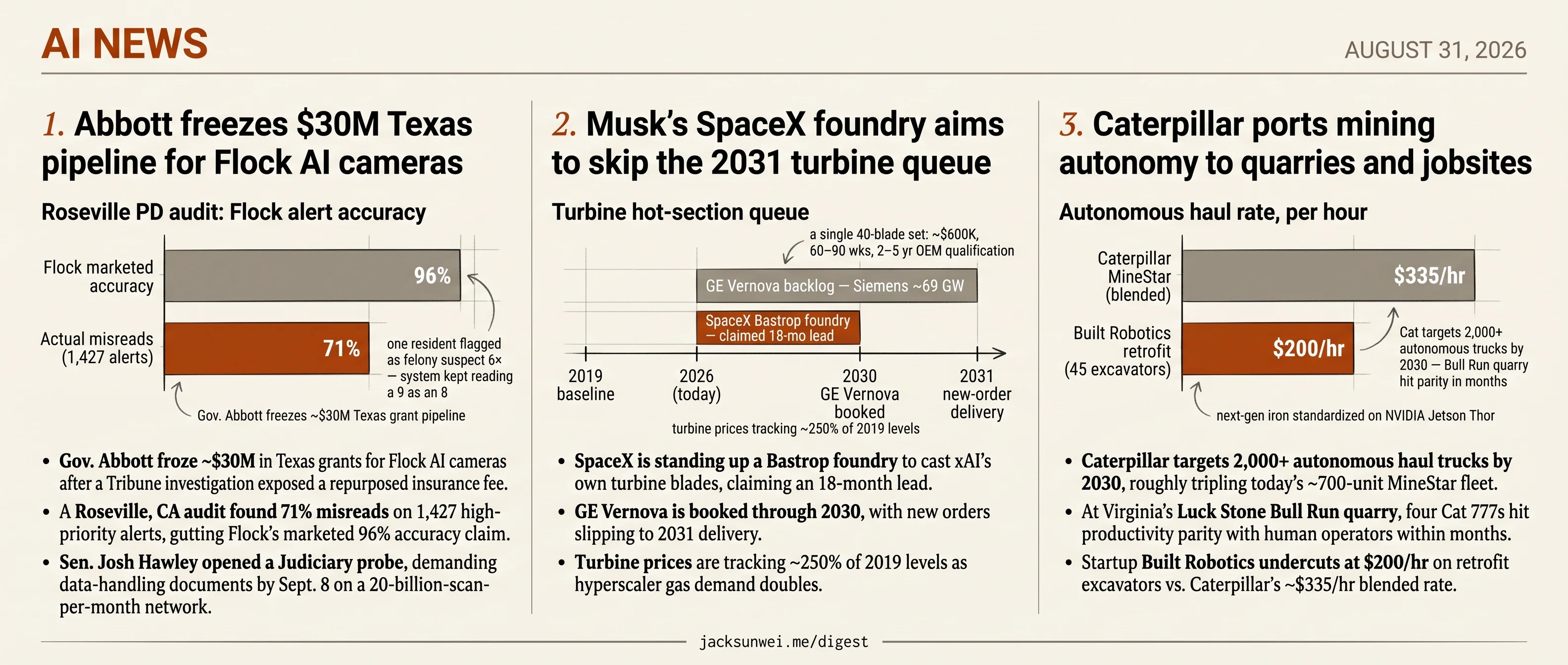
Abbott halts Flock cameras, SpaceX casts xAI blades, Caterpillar scales quarries
Three physical-AI deployments each collide with a different external check: a state audit, an OEM backlog, and a retrofit-priced competitor.
Abbott halts Flock cameras, SpaceX casts xAI blades, Caterpillar scales quarries
TL;DR
- Gov. Abbott froze $30M in Texas Flock camera grants after an audit found 71% misreads on high-priority alerts.
- Sen. Hawley opened a Judiciary probe into Flock’s 20-billion-scan-per-month network, with documents due Sept. 8.
- SpaceX is standing up a Bastrop foundry to cast xAI turbine blades and skip GE Vernova’s 2031 delivery queue.
- DOJ intervened in xAI’s Memphis suit on national-security grounds, citing Grok’s DoD relevance.
- Caterpillar targets 2,000 autonomous haul trucks by 2030, roughly tripling the current MineStar fleet.
Today’s AI news sits in the physical world — cameras bolted to city intersections, gas-turbine blades bound for a Memphis substation, and 100-ton haul trucks running quarry loops without drivers. What ties the three together isn’t a shared strategy; it’s that each hits a different external check the software-first playbook doesn’t route around.
Flock collides with a state audit, a Senate Judiciary probe, and a Texas grant freeze after a Tribune investigation. SpaceX collides with GE Vernova’s 2031 turbine queue and is standing up its own Bastrop foundry to cast blades in-house — with DOJ now backing xAI’s Memphis siting on national-security grounds. Caterpillar collides with a retrofit competitor, Built Robotics, that undercuts its blended rate by ~40% on excavators. The FCC drone-curb brief sits in the same shape: physical-AI hardware, jurisdiction-shaped constraint.
Abbott freezes $30M Texas pipeline for Flock AI cameras
Source: the-verge-ai · published 2026-08-30
TL;DR
- Gov. Abbott froze ~$30M in Texas grants for Flock AI cameras after a Tribune investigation exposed a repurposed insurance fee.
- A Roseville, CA audit found 71% misreads on 1,427 high-priority alerts, gutting Flock’s marketed 96% accuracy claim.
- Sen. Josh Hawley opened a Judiciary probe, demanding data-handling documents by Sept. 8 on a 20-billion-scan-per-month network.
- Texas lawmakers dismissed Flock’s retention rollback as “lipstick on a pig” and are drafting warrant bills for 2027.
A bait-and-switch, not just a backlash
The Verge frames Abbott’s freeze as reactive politics, but the Texas Tribune investigation that broke the same day shows something sharper: a $1 auto-insurance surcharge passed unanimously in 2023 to fight catalytic converter theft was quietly rerouted by the Motor Vehicle Crime Prevention Authority into ~$30M of grants for at least 3,200 Flock cameras — including $15.9M to the Department of Public Safety for highway monitoring — with no legislative debate about standing up a statewide AI surveillance grid 1. Roughly a quarter of Texas’s Flock footprint traces to that fee. Abbott’s order chokes the state pipeline; municipal budgets and federal grants remain open channels.
The accuracy story just collapsed
Flock’s pitch rests on a “96% accuracy” figure that measures per-character OCR, not per-plate matches. Roseville, CA PD’s own audit of 1,427 stolen-vehicle and felony-warrant alerts found 1,011 (71%) were misreads — including one resident flagged as a felony suspect six times because the system kept reading a “9” as an “8” 2. That’s not an edge case; that’s the operational reality officers act on. Pair it with EFF’s documentation of 80+ agencies running searches for ethnic slurs and Texas deputies querying 80,000+ cameras in an abortion-related “death investigation,” and the “just recovering stolen cars” framing is hard to sustain 3.
Federal pressure lands the same week
Sen. Josh Hawley (R-Mo.), chairing the Senate Judiciary crime subcommittee, opened a formal probe demanding Flock’s data-handling documents by September 8. His letter cites 120,000+ cameras generating 20 billion vehicle scans monthly, a Milwaukee officer who queried his girlfriend’s movements 124 times without triggering an audit, and a Florida woman wrongfully jailed 13 days on a false plate hit 4. The three vectors — state defunding, federal investigation, empirical accuracy scandal — hit in the same news cycle, which is why vendor PR isn’t catching up.
Flock’s defense and its limits
Flock has moved. Default retention dropped from 30 days to 7, and a new “Evidence Mode” requires officers to attach a case number before searching 5. Texas lawmakers pushing warrant-requirement bills — Rep. Harrison’s HB 961, Sen. Bob Hall’s promised 2027 push — dismissed the changes as “lipstick on a pig,” noting that any case number satisfies Evidence Mode and that most documented abuses happened well inside a 7-day window anyway 5.
The counterweight is efficacy. A TCU/UT-Tyler study found adding one Flock camera per officer is associated with a 9.1% lift in crime clearance rates, and Flock cites internal data showing 11% drops in vehicle thefts in active deployment zones 6. Police chiefs will wave those numbers at every warrant-bill hearing.
What’s actually at stake
Abbott’s freeze is the first hard state-level consequence for Flock and the template other governors will study. The unresolved question for 2027: does a 9.1% clearance bump justify a warrantless national plate-tracking grid whose real-world misread rate is closer to 71% than 4%? Texas is about to litigate that in public.
Musk’s SpaceX foundry aims to skip the 2031 turbine queue
Source: techcrunch-ai · published 2026-08-30
TL;DR
- SpaceX is standing up a Bastrop foundry to cast xAI’s own turbine blades, claiming an 18-month lead.
- GE Vernova is booked through 2030, with new orders slipping to 2031 delivery.
- Turbine prices are tracking ~250% of 2019 levels as hyperscaler gas demand doubles.
- A single 40-blade set costs ~$600K and takes 60–90 weeks, with 2–5 years of OEM qualification.
- DOJ intervened in the Memphis xAI suit on national-security grounds, citing Grok’s DoD relevance.
- SELC modeling pegs the permanent xAI plant at $30–$44M in annual local health damages.
The bottleneck is genuinely binding
Musk’s supply-chain diagnosis is not marketing. GE Vernova’s hot-section production is fully sold through 2030, with new orders reserved for 2031 delivery; Siemens Energy is sitting on a ~69 GW gas services backlog, and turbine prices are on track to reach nearly 250% of 2019 levels 7. Behind-the-meter gas for U.S. data centers has ballooned to 189 GW of announced capacity, roughly doubling since late 2025 — Meta alone contracted 7.5 GW of new Louisiana plants for its Hyperion campus and exited the RE100 renewable pledge to do it 8. In that context, a captive blade foundry is a rational — if extreme — vertical-integration play. If you cannot buy your way to the front of the queue, you build the queue.
The 18-month claim meets pointed dissent
The specific number TechCrunch leads with does not survive contact with practitioners. Jigar Shah, the former DOE Loan Programs Office director, publicly doubted that heavy industrial casting fits Musk’s rapid-deployment pattern, and independent investigators found no building or environmental permit filings for the Bastrop site as of late August 2026 9. The unit economics reinforce the skepticism: a single set of 40 single-crystal blades runs roughly $600,000 and 60 to 90 weeks of throughput; qualification with an engine OEM typically takes two to five years, and process-yield stabilization another three 10. Musk himself has conceded SpaceX spent “many years” cracking Raptor turbopump blade fatigue — the same metallurgical class of problem now proposed on a compressed timeline.
Shaving 18 months off a 2030 queue likely means bypassing the queue entirely, not compressing the physics.
That is a very different claim than “faster manufacturing.” It is a claim that xAI intends to operate blades that never went through the qualification regime the incumbents are stuck inside.
The pollution and legal exposure is escalating
TechCrunch’s pollution framing understates how contested the Memphis precedent has become. Southern Environmental Law Center modeling pegs the permanent xAI plant at 1,200–2,000 tons per year of NOx and up to 19 tons of formaldehyde, driving an estimated $30–$44 million in annual health damages in a community whose baseline cancer risk is already four times the national average 11. The NAACP suit against Colossus escalated further when the Department of Justice intervened on behalf of xAI, arguing that Grok training is critical to DoD operations and that shutting down the site would impair the U.S. military’s edge against adversaries 12. Civil-rights groups read that as a national-security carve-out from the Clean Air Act.
Takeaway
The supply-chain crunch is real, the foundry is a rational response, and the 18-month figure is aspirational against a manufacturing discipline measured in decades. The more durable signal is that the permitting-arbitrage playbook now has federal air cover — and if Bastrop ever ships qualified blades, that playbook travels with every new gas-powered AI campus.
Caterpillar ports mining autonomy to quarries and jobsites
Source: techcrunch-ai · published 2026-08-30
TL;DR
- Caterpillar targets 2,000+ autonomous haul trucks by 2030, roughly tripling today’s ~700-unit MineStar fleet.
- At Virginia’s Luck Stone Bull Run quarry, four Cat 777s hit productivity parity with human operators within months.
- Startup Built Robotics undercuts at $200/hr on retrofit excavators vs. Caterpillar’s ~$335/hr blended rate.
- Next-gen machines standardize on NVIDIA Jetson Thor for on-iron perception, avoiding cloud round-trips in off-grid pits.
The scale being ported
Caterpillar isn’t pitching a pilot. The company has hauled more than 11 billion tonnes under its MineStar Command autonomy stack and is targeting 2,000+ autonomous haul trucks by 2030 — roughly triple today’s ~700-unit fleet 13. That’s the largest deployed autonomous vehicle program in any industry, and it’s the empirical asset Cat is now trying to generalize.
The most concrete transfer case sits outside mining. At Luck Stone’s Bull Run quarry in Virginia, four Cat 777 trucks running MineStar Command reached productivity parity with human operators within months and crossed one million autonomously hauled tons by mid-2025 14. Quarries are the natural stepping stone: smaller sites, more mixed traffic, but still a controlled perimeter. If the playbook survives Bull Run, construction jobsites are the next argument.
The edge-first bet
The technical substrate is a Jetson Thor-based edge stack co-developed with NVIDIA, chosen so machines can perceive and act on billions of sensor readings without a cloud round-trip 15. Paired with Cat’s Helios telemetry platform — 16 PB across ~1.6M connected assets — the pitch is a “sense-reason-act on the iron” architecture, not a wrapper on general-purpose LLMs.
flowchart LR
    A[Sensors: LiDAR, RTK-GNSS, cams] --> B[Jetson Thor on-machine]
    B --> C{Safety-critical<br/>decision}
    C --> D[Actuation: steer/brake/dump]
    B -. telemetry .-> E[(Helios: 16 PB<br/>1.6M assets)]
    E -. model updates .-> B
The strategic read: Caterpillar treats Helios as a proprietary training moat competitors can’t replicate, and Jetson Thor as the runtime that lets it charge for an integrated stack rather than compete on unit hardware price.
Where the playbook breaks
Three fault lines belong in any honest read.
Economics. Built Robotics is pricing hardware-agnostic autonomy retrofits for heavy excavators at a flat $200/hr, versus Caterpillar’s ~$335/hr blended operational rate, across 45 machines on Nordic infrastructure projects 16. That’s a direct assault on the closed-ecosystem model Cat is doubling down on — you don’t need to buy a new Cat if a third party can bolt autonomy onto what you already own.
Labor. Australia’s CFMEU has been explicit that autonomous haulage systems are primarily a labor-cost tool, citing ~10% headcount cuts at BHP’s Mining Area C in the Pilbara 17. That directly contradicts the “co-pilot and upskilling” framing Caterpillar and Luck Stone lead with when they talk about jobsite deployment.
Operational brittleness. Autonomous haul trucks require centimeter-level RTK-GNSS accuracy; minor signal degradation in deep pits causes trucks to “stop dead,” cascading into idle excavators and starved crushers 18. That fragility gets worse, not better, on construction sites with unmapped obstacles, urban GNSS multipath, and human-operated equipment moving unpredictably nearby.
The real question
Caterpillar has a quantified track record most industrial-AI vendors would kill for. The interesting question isn’t whether the tech works — Bull Run answers that. It’s whether the integrated, high-margin model survives contact with retrofit challengers pricing at 60% of Cat’s blended rate 16 and jobsite conditions that break the assumptions a Pilbara pit lets you get away with 18.
Round-ups
US tightens drone and robot import curbs as China scales abroad
Source: techcrunch-ai
New FCC restrictions aim to shut foreign-made drones and robots out of the US market, but China’s manufacturing scale is redirecting the competition to third-country buyers. The barriers reshape where Chinese hardware lands rather than whether it ships, with Taiwan and allied markets now in play.
Footnotes
-
Texas Tribune investigation — https://www.texastribune.org/2026/08/28/texas-flock-cameras-auto-insurance-fee-mvcpa-grants/
↩The Motor Vehicle Crime Prevention Authority has awarded roughly $30 million in grants from the $1 auto insurance fee to install at least 3,200 Flock cameras across Texas — including $15.9 million to the Department of Public Safety — with no public discussion when lawmakers passed the fee to fight catalytic converter theft.
-
Davis Vanguard on Roseville PD audit — https://davisvanguard.org/2026/08/roseville-police-ai-camera-errors/
↩Of 1,427 stolen-vehicle and felony-warrant alerts audited by Roseville PD, 1,011 (71%) were misreads — including one resident flagged as a felony suspect six times because the system kept reading a ‘9’ as an ‘8’ — contradicting Flock’s marketed 96% accuracy claim.
-
EFF 2025 year-in-review — https://www.eff.org/deeplinks/2025/12/effs-investigations-expose-flock-safetys-surveillance-abuses-2025-review
↩More than 80 law enforcement agencies used Flock to run searches for ethnic slurs and terms like ‘roma traveler,’ and Texas deputies queried over 80,000 cameras nationwide in an abortion-related ‘death investigation’ — evidence the network enables warrantless fishing expeditions far beyond stolen-vehicle recovery.
-
Sen. Josh Hawley press release (Judiciary subcommittee probe) — https://www.hawley.senate.gov/chairman-hawley-investigates-ai-powered-flock-cameras-amidst-privacy-concerns/
↩Hawley is demanding documents by September 8 on how Flock’s ‘unprecedented national surveillance network’ of 120,000+ cameras — facilitating more than 20 billion vehicle scans monthly — collects, retains, and disseminates data, citing a Milwaukee officer who tracked his girlfriend 124 times undetected and a Florida woman wrongfully jailed 13 days on a false match.
-
Texas Scorecard on Flock’s response — https://texasscorecard.com/state/new-flock-camera-reforms-announced-amid-privacy-backlash/
↩ ↩2Flock cut default retention from 30 days to 7 and introduced ‘Evidence Mode’ requiring a case number, but Texas lawmakers dismissed the changes as ‘lipstick on a pig’ and are pushing warrant-requirement bills for the 2027 session.
-
Police1 coverage of TCU/UT-Tyler study — https://www.police1.com/tech-pulse/study-validates-impact-of-flock-safetys-lpr-technology-on-crime-clearance-rates
↩A Texas Christian University and University of Texas at Tyler study found that adding one Flock camera per officer is associated with a 9.1% increase in crime clearance rates, and Flock cites internal data showing an 11% drop in vehicle thefts in areas with active deployments.
-
TechInvestments.io analysis of turbine backlogs — https://www.techinvestments.io/p/power-bottlenecks-and-the-ai-data
↩GE Vernova’s production is fully booked through 2030 with new orders reserved for 2031 delivery; Siemens Energy’s gas services backlog sits at ~69 GW, and turbine prices are on track to be nearly 250% higher than 2019 levels.
-
Fast Company on hyperscaler power strategies — https://www.fastcompany.com/91595644/ai-data-center-boom-surge-us-gas-power-developments
↩Meta bankrolled 10 new natural gas plants in Louisiana totaling 7.5 GW for its Hyperion campus, forcing it to exit the RE100 renewable initiative; U.S. data-center gas capacity has surged to 189 GW, nearly doubling since late 2025.
-
AI Weekly summarizing Jigar Shah and analyst reactions — https://aiweekly.co/alerts/spacex-turbine-blade-foundry-meets-xais-memphis-pollution-fight
↩Jigar Shah, former Loan Programs Office director, was dismissive of Musk’s timeline, suggesting the complexity of heavy industrial casting is beyond his typical rapid-deployment model; independent investigators also found no building or environmental permit filings for the Bastrop foundry as of late August 2026.
-
SoloCap Substack, ‘Single-Crystal Blades’ — https://solocap.substack.com/p/single-crystal-blades-a-two-company
↩A single set of 40 blades can cost $600,000 and take 60 to 90 weeks to produce; qualification with engine OEMs typically takes two to five years, with process development for stable yields taking another three.
-
Southern Environmental Law Center study — https://www.selc.org/press-release/new-study-finds-proposed-xai-gas-plant-could-worsen-regional-air-pollution-cause-millions-of-dollars-in-annual-health-damages/
↩The proposed permanent xAI plant could emit 1,200–2,000 tons of NOx and up to 19 tons of formaldehyde annually, causing an estimated $30–$44 million in yearly health damages in a community where cancer risk is already four times the national average.
-
Utility Dive on DOJ intervention — https://www.utilitydive.com/news/doj-intervenes-xai-data-center-gas-turbine-lawsuit/823267/
↩The U.S. Department of Justice intervened on behalf of xAI, arguing that Grok training at Colossus is critical to Department of Defense operations and that shutting down the power supply would impair the U.S. military’s technological edge against adversaries.
-
International Mining — https://im-mining.com/2025/11/07/caterpillar-sets-out-to-hit-over-2000-autonomous-mining-trucks-by-2030/
↩Caterpillar sets out to hit over 2,000 autonomous mining trucks by 2030
-
Heavy Equipment Guide — Luck Stone Bull Run — https://www.heavyequipmentguide.ca/article/43481/luck-stone-celebrates-one-million-tons-of-aggregates-hauled-autonomously
↩One million tons of aggregates hauled autonomously… four Cat 777 trucks running MineStar Command reached productivity parity with human-operated machines within months.
-
Compact Equipment (Caterpillar–NVIDIA partnership) — https://compactequip.com/business/caterpillar-and-nvidia-push-ai-into-the-physical-world/
↩Caterpillar has standardized its next-generation equipment on the NVIDIA Jetson Thor edge computing platform… processing billions of data points in milliseconds to make safety-critical decisions without waiting for a cloud round-trip.
-
Disruptivity Times — Built Robotics — https://www.disruptivitytimes.com/article/autonomous-fleet-undercuts-caterpillar-with-200-hourly-rate
↩ ↩2Built Robotics deployed 45 fully autonomous heavy excavators across Nordic infrastructure projects at a flat rate of $200 per hour, versus a blended Caterpillar operational rate of ~$335 per hour.
-
Australian Mining — unions vs. Rio Tinto — https://www.australianmining.com.au/unions-vs-rio-the-automation-battle/
↩CFMEU has criticized AHS as a tool primarily for cutting labor costs, citing job redundancies at sites like BHP’s Mining Area C, where automation led to a 10% reduction in headcount.
-
Advanced Navigation — ‘AHS stoppages frustrating you?’ — https://www.advancednavigation.com/tech-articles/are-autonomous-haulage-stoppages-frustrating-you/
↩ ↩2Autonomous trucks require centimeter-level RTK-GNSS accuracy; even minor signal degradation in deep pits causes trucks to ‘stop dead,’ triggering idle excavators and starved crushers.