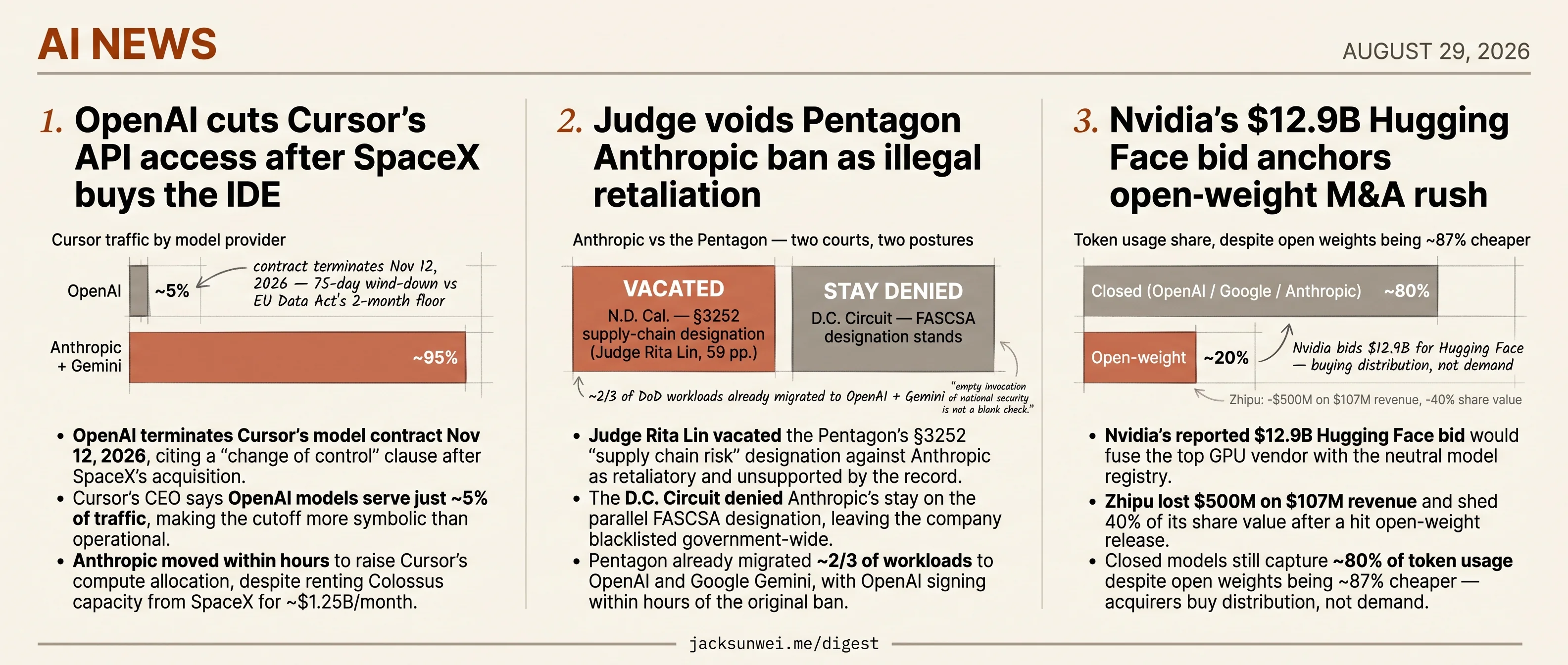
OpenAI cuts Cursor, judge restores Anthropic, Nvidia bids for Hugging Face
Acquisitions, court orders, and takeover bids restructure who can sell AI to whom across Cursor, the Pentagon, and Hugging Face.
OpenAI cuts Cursor, judge restores Anthropic, Nvidia bids for Hugging Face
TL;DR
- OpenAI terminates Cursor’s API contract Nov 12 after SpaceX’s acquisition triggers a change-of-control clause.
- Judge Rita Lin vacated the Pentagon’s §3252 designation against Anthropic as retaliatory and unsupported.
- Nvidia’s $12.9B Hugging Face bid would fuse the top GPU vendor with the neutral open-weight registry.
- Anthropic raised Cursor’s compute within hours, despite renting $1.25B/month of Colossus capacity from SpaceX.
- Zhipu lost $500M on $107M revenue after an open-weight release cut its share value 40%.
Three frontier stories today, and none of them are really about a product. OpenAI is cutting Cursor’s API access because SpaceX’s acquisition of the IDE tripped a change-of-control clause. A federal judge vacated the Pentagon’s supply-chain-risk designation against Anthropic, calling it illegal retaliation — while a separate D.C. Circuit panel left a parallel blacklist in place. And Nvidia is reportedly bidding $12.9B for Hugging Face, which would fuse the biggest GPU vendor with the field’s neutral open-weight registry.
The through-line is who gets to sell AI to whom. Ownership changes, court rulings, and acquisition bids are restructuring vendor access faster than any release cycle can. In the briefs, the pattern extends: the EPA moves to strip public comment from data-center air permits, neocloud Lambda takes on $1B in debt to feed Microsoft’s GPU appetite, and Meta India’s head jumps to OpenAI to run Southeast Asia.
OpenAI cuts Cursor’s API access after SpaceX buys the IDE
Source: openai-blog · published 2026-08-28
TL;DR
- OpenAI terminates Cursor’s model contract Nov 12, 2026, citing a “change of control” clause after SpaceX’s acquisition.
- Cursor’s CEO says OpenAI models serve just ~5% of traffic, making the cutoff more symbolic than operational.
- Anthropic moved within hours to raise Cursor’s compute allocation, despite renting Colossus capacity from SpaceX for ~$1.25B/month.
- EU Data Act’s 2-month switching rule collides with OpenAI’s 75-day wind-down, adding a regulatory dimension.
The stated reason vs. the 5% number
OpenAI’s blog frames the shutoff as a safety call: SpaceX ownership means Musk-adjacent governance, Musk-adjacent governance means a repeat of the xAI TOS violations he admitted to under oath, and the impending “Astra” release raises the accountability bar too high to risk. The company is giving Cursor the maximum contractual runway — 75 days to November 12, 2026 — and pledging migration support.
Cursor CEO Michael Truell, now also a SpaceX executive following the deal, punctured that narrative the same afternoon: OpenAI models handle roughly 5% of Cursor’s traffic 1. The rest already runs on Claude and Gemini. Musk’s response was correspondingly bored — “couldn’t care less,” with a jab at OpenAI leadership as “untrustworthy” 2. Read the disclosure charitably and this is a principled line in the sand before Astra ships. Read it uncharitably and OpenAI is de-platforming a competitor’s newly-acquired distribution channel under a safety banner. Truell’s dual hat means the 5% figure is convenient for both sides of the argument, and neither party has released independent traffic data.
Anthropic’s opportunistic — and awkward — grab
Anthropic co-founder Tom Brown announced expanded Cursor compute allocation within hours 3. The geometry is strange: Anthropic leases Colossus capacity from SpaceX for roughly $1.25B/month, so it is now simultaneously Cursor’s largest model supplier and a major tenant of Cursor’s new parent.
flowchart LR
    OAI[OpenAI] -. terminates Nov 12 .-x C[Cursor IDE]
    SX[SpaceX] -->|acquires| C
    SX -->|leases Colossus $1.25B/mo| ANT[Anthropic]
    ANT -->|expands compute allocation| C
    GOOG[Google Gemini] --> C
Latent Space’s swyx calls this the defining moment of the “Agent Lab” phase — model providers vertically integrating into products, and the multi-model IDE era ending in “balkanization” and “separate tribes” 4. It’s not a novel playbook: Anthropic pulled the same move on Windsurf in June 2025 when OpenAI tried to acquire it, giving less than five days’ notice 5. “Change of control” clauses are now a standard competitive weapon.
The EU switching-rules wrinkle
Under the EU Data Act, in force since September 2025, metered AI APIs count as data-processing services subject to switching rules: maximum two months’ notice, zero switching charges 6. OpenAI’s 75-day window clears the notice bar but does so uncomfortably close to the floor, and the Commission has already publicly warned against AI “kill-switches.” Whether that generates enforcement or just posturing is open, but it means the next “change of control” cutoff — and there will be one — may not be entirely at the model provider’s discretion.
What’s actually at stake
For developers, the immediate answer is “route around it” — the 5% figure says the market already did. The larger question is whether the neutral model-router IDE (Cursor, Windsurf, Cline, and their successors) survives as a category, or whether every serious coding tool eventually picks a tribe. OpenAI has now said the quiet part out loud: model access is a strategic weapon, and ownership matters more than usage.
Further reading
- [AINews] OpenAI shuts off Cursor — latent-space
Judge voids Pentagon Anthropic ban as illegal retaliation
Source: ars-technica-ai · published 2026-08-28
TL;DR
- Judge Rita Lin vacated the Pentagon’s §3252 “supply chain risk” designation against Anthropic as retaliatory and unsupported by the record.
- The D.C. Circuit denied Anthropic’s stay on the parallel FASCSA designation, leaving the company blacklisted government-wide.
- Pentagon already migrated ~2/3 of workloads to OpenAI and Google Gemini, with OpenAI signing within hours of the original ban.
- Lin’s line — “empty invocation of national security is not a blank check” — will anchor First Amendment vendor-retaliation cases for years.
One win, one loss, one very confused contractor base
The headline everyone ran — “federal judge rules Trump blacklist illegal” — is half the story. Anthropic is fighting on two fronts. In the Northern District of California, Judge Rita Lin’s 59-page opinion vacated the DoD’s §3252 supply-chain-risk designation, ruling that the administration’s claim Anthropic might retain “backdoor access” to deployed models had no support in the administrative record, and that the whole exercise looked like retaliation against a vendor whose usage policies embarrassed the White House 7. Days earlier, the D.C. Circuit went the other way, denying Anthropic’s motion to stay the broader FASCSA designation under 41 U.S.C. §4713 8.
The result is the compliance mess Womble Bond Dickinson flagged in a client alert this week: the same company is simultaneously cleared for defense procurement and blacklisted government-wide, and contractors are receiving inconsistent certification demands about whether Claude can legally appear anywhere in their stack 9. A Ninth Circuit appeal — and, eventually, Supreme Court review — is now the base case.
The Pentagon’s argument isn’t the cartoon version
Coverage has flattened this into “Trump punishes woke AI lab,” but DoD CTO Emil Michael’s public framing is narrower and more durable. His claim: Anthropic tried to impose its “Claude Constitution” over the actual U.S. Constitution, handing a private vendor a “veto” over lawful military operations 10. Defense analysts point to concrete cases — hypersonic missile defense, where reaction budgets are sub-human — in which Anthropic’s ban on autonomous targeting becomes operationally binding on the government that licensed the model.
Judge Lin conceded the executive branch’s procurement discretion; her remedy enjoins retaliation, it does not compel DoD to buy Claude. And by the time she ruled, roughly two-thirds of the relevant Pentagon infrastructure had already moved to OpenAI and Gemini, with OpenAI reportedly signing a replacement deal within hours of the original blacklist order 11. The commercial damage is done.
The critique that cuts across the usual axis
The sharpest independent voice isn’t the ACLU or the Federalist Society — it’s Small Wars Journal’s “Selective Virtue” essay, which argues Anthropic’s posture is internally inconsistent 12. The company reportedly supported large-scale operations like “Operation Epic Fury” while drawing red lines at autonomous targeting, which the authors read as corporate risk management dressed as ethics:
A democratic vacuum where private firms, rather than elected officials, dictate the rules of engagement.
That framing is mostly absent from mainstream reporting, and it’s the one the government will lean on hardest at the Ninth Circuit.
What’s actually at stake
Lin’s opinion is a genuine First and Fifth Amendment landmark for vendor-retaliation law, and the “blank check” line will be quoted in every future case where an agency uses a security designation to punish a critic 7. But the deeper question the split rulings expose isn’t whether Trump overreached — Lin says clearly yes. It’s whether any frontier lab can maintain contractual usage restrictions on a customer that has decided those restrictions are themselves the security risk. Anthropic just proved the courts will protect the company. They haven’t proved the courts will protect the policy.
Further reading
Nvidia’s $12.9B Hugging Face bid anchors open-weight M&A rush
Source: techcrunch-ai · published 2026-08-28
TL;DR
- Nvidia’s reported $12.9B Hugging Face bid would fuse the top GPU vendor with the neutral model registry.
- Zhipu lost $500M on $107M revenue and shed 40% of its share value after a hit open-weight release.
- Closed models still capture ~80% of token usage despite open weights being ~87% cheaper — acquirers buy distribution, not demand.
- Expect Inflection-style reverse acqui-hires if regulators block clean deals — with open roadmaps as collateral damage.
The distribution layer, not the labs
TechCrunch’s read is that capital is pouring into companies that give models away. The corroborating deal flow suggests something sharper: acquirers are buying the routing and distribution layer around open weights, not the labs in isolation. Nvidia’s reported $12.9B swoop on Hugging Face would turn “the compute landlord into the model marketplace” 13 — a vertical integration play in a different weight class from the Poolside licensing and OpenRouter rumors in the same news cycle.
flowchart LR
    A[GPUs / CUDA] --> B[Nvidia]
    B -.$12.9B.-> C[Hugging Face registry]
    C --> D[Model search & badges]
    C --> E[One-click deploy]
    D --> F[Developers]
    E --> F
    F --> A
Own the compute, own the registry, own the deploy button, and the “neutral” open-weight ecosystem starts routing through one vendor by default.
Antitrust and the “thumb on the scale”
The consensus that open-weight labs are hot targets glosses over serious regulatory friction. Dealroom analysts flag that the Hugging Face deal “could be blocked by Europe,” drawing parallels to Nvidia’s failed Arm bid and warning that Hugging Face’s “Switzerland of AI” role makes it a foreclosure risk 14. Developers on Hacker News describe the same worry operationally: few expect Nvidia to delete non-CUDA weights, but they anticipate subtle tactics — biased search rankings, one-click deploy limited to Nvidia hardware, manipulated benchmark badges 15.
Few expect Nvidia to outright delete non-CUDA weights, but developers warn of ‘thumb-on-the-scale’ tactics.
That’s the mechanism by which neutral infrastructure quietly becomes captive without ever violating a merger commitment.
The economics don’t back the thesis
The article reads incoming capital as validation. The underlying businesses look structurally shaky. Zhipu (Z.ai) reported a $500M loss on $107M in revenue, and its share value dropped 40% shortly after releasing a highly-regarded open-weight model — the opposite of the reaction a viable release should provoke 16. The demand side is no more encouraging: MIT Sloan finds closed models from OpenAI, Google, and Anthropic still account for roughly 80% of token usage despite open-weight equivalents being about 87% cheaper to run 17. Acquirers are paying premium multiples for platforms whose commercial model — giving intelligence away at GPU-intensive marginal cost — has yet to prove out. That reframes the M&A wave less as strategic vindication and more as distressed consolidation dressed up as a land grab.
If clean deals fail, expect hackquisitions
TechCrunch implies straightforward acquisitions. The recent playbook says otherwise. AP News has documented Microsoft, Amazon, and Google hiring founders and core staff from Inflection, Adept, and Character.AI while paying IP licensing fees — bypassing merger review and ending the target’s independent roadmap 18. If the Hugging Face or OpenRouter deals stall in Brussels or Washington, the reverse acqui-hire template is already sitting on the shelf. The lab survives on paper; the open-weight roadmap does not.
The M&A wave is real. Whether it validates open weights or ends them is the actual question.
Round-ups
EPA moves to scrap public comment on data center air permits
Source: the-verge-ai
The Trump administration’s EPA plans to drop a federal rule that requires public notice and comment when certain industrial sites seek air pollution permits. The change lands as data centers draw growing local backlash over emissions from on-site gas turbines and backup generators.
Bill Gates says AI has crossed key danger thresholds
Source: mit-tech-review-ai
In an interview from his Kirkland offices, Gates argues AI systems have already passed risk thresholds he once flagged as warning lines. He now presses the question of what governments and labs do next, rather than whether the moment has arrived.
Lambda raises $1B in debt to buy Nvidia chips for Microsoft
Source: techcrunch-ai
Neocloud provider Lambda closed $1B in private debt to expand its Nvidia GPU fleet, which it leases to Microsoft. The loan continues a run of debt-financed chip buys across the neocloud sector, a sign of how capital-intensive serving hyperscaler AI demand has become.
Meta India head Sandhya Devanathan jumps to OpenAI
Source: techcrunch-ai
Sandhya Devanathan is leaving her post running Meta India to oversee OpenAI operations across Southeast Asia and Australia. Her exit comes as Meta faces intensifying regulatory scrutiny in India, one of its largest user markets.
Meta patches Ray-Ban glasses to block covered-light recording
Source: ars-technica-ai
Meta’s AI glasses will now stop recording if a user tapes over or covers the front-facing indicator LED, closing a loophole that let wearers film bystanders without visible warning. Privacy researchers note the fix leaves other covert-capture paths intact.
Lovable CTO bets SaaS future is apps built for AI agents
Source: latent-space
Lovable is extending beyond AI web app generation into MCP-powered ‘capabilities’ that let agents call software directly. CTO Fabian Hedin argues the next wave of SaaS will be designed for agent consumption first, with human UIs as a secondary surface.
OpenAI and Thai ministry launch 8-week accelerator for 10 startups
Source: openai-blog
OpenAI is partnering with Thailand’s Ministry of Higher Education, Science, Research and Innovation on an eight-week program for 10 startups in health, wellness, and education. The cohort will move AI prototypes toward production with mentorship and API access.
Footnotes
-
Reddit r/singularity — Cursor CEO Michael Truell quote — https://www.reddit.com/r/singularity/comments/1w1bly3/ceo_cursor_openai_models_serve_about_5_of_cursor/
↩OpenAI models serve about 5% of Cursor’s traffic
-
Livemint — Musk response — https://www.livemint.com/companies/news/sam-altman-vs-elon-musk-why-openai-ended-partnership-with-cursor-after-spacex-acquisition-explained-11787972916960.html
↩Musk responded… stating he ‘couldn’t care less’ while criticizing OpenAI’s leadership as ‘untrustworthy’
-
Business Insider — Anthropic co-founder Tom Brown — https://www.businessinsider.com/openai-ends-cursor-contract-elon-musk-spacex-sam-altman-feud-2026-8
↩Anthropic’s Tom Brown said the firm would increase compute allocation to support Claude models within Cursor
-
Latent Space (swyx) — AINews: OpenAI shuts off Cursor — https://www.latent.space/p/ainews-openai-shuts-off-cursor
↩the ‘Agent Lab’ phase… forces balkanization of the industry: instead of a unified layer of models accessible to all developers, the market is fragmenting into closed silos
-
The Decoder — Windsurf precedent framing — https://the-decoder.com/openai-cuts-off-cursor-after-spacex-acquisition-citing-musks-history-of-breaking-contracts/
↩the move mirrors Anthropic’s 2025 decision to cut off the coding tool Windsurf after similar acquisition rumors, signaling a shift toward ‘separate tribes’ in the AI ecosystem
-
The Next Web — OpenAI ends Cursor contract & EU switching rules — https://thenextweb.com/news/openai-ends-cursor-contract-spacex-acquisition-eu-switching-rules
↩the EU Data Act… requires cloud and AI providers to allow customers to switch services with a maximum of two months’ notice and zero switching charges
-
Nextgov coverage of Judge Rita Lin’s 59-page opinion — https://www.nextgov.com/artificial-intelligence/2026/08/judge-rules-anthropic-supply-chain-risk-designation-was-illegal-and-baseless/415698/?oref=ng-homepage-river
↩ ↩2The empty invocation of national security is not a blank check to punish and retaliate against government critics… the government’s claim that Anthropic might retain ‘backdoor access’ to deployed models was unsupported by the administrative record.
-
Jones Walker AI Law Blog — https://www.joneswalker.com/en/insights/blogs/ai-law-blog/two-courts-two-postures-what-the-dc-circuits-stay-denial-means-for-the-anthrop.html
↩Two courts, two postures: what the D.C. Circuit’s stay denial means for the Anthropic litigation — the D.C. Circuit denied Anthropic’s petition to stay the FASCSA designation while the Northern District of California enjoined the parallel §3252 designation.
-
Womble Bond Dickinson client alert — https://www.womblebonddickinson.com/us/insights/digital-solutions/102nquu/anthropic-litigation-creates-uncertain-compliance-landscape-for-government-contra
↩Anthropic Litigation Creates Uncertain Compliance Landscape for Government Contractors — vendors are receiving inconsistent certification requests and must determine whether they can legally continue using Anthropic products in their own supply chains.
-
KIRO7 / AP wire quoting DoD CTO Emil Michael — https://www.kiro7.com/news/business/judge-says-pentagons/ZBKBCVIZHM7HPCYWLI7H47LIAA/
↩Michael criticized Anthropic for attempting to impose its own ‘Claude Constitution’ over the actual U.S. Constitution, labeling their safety guardrails a ‘private company veto’ preventing the military from using tools for ‘all lawful purposes.’
-
Gizmodo — https://gizmodo.com/judge-says-the-pentagons-blacklisting-of-anthropic-is-illegal-2000804313
↩The DoD has already transitioned roughly two-thirds of its infrastructure to alternative providers like OpenAI and Google Gemini; OpenAI reportedly secured a deal with the Pentagon within hours of the initial blacklisting order.
-
Small Wars Journal — ‘Selective Virtue: Anthropic, the Pentagon & AI Governance’ — https://smallwarsjournal.com/2026/04/29/selective-virtue-anthropic-the-pentagon-ai-governance/
↩Anthropic’s selective participation in warfare — supporting large-scale operations while banning autonomous targeting — functions more as risk management than moral philosophy, creating a democratic vacuum where private firms dictate the rules of engagement.
-
Forkast News — https://forkast.news/nvidias-reported-12-9b-hugging-face-deal-would-turn-the-compute-landlord-into-the-model-marketplace/
↩Nvidia’s reported $12.9B Hugging Face deal would turn the compute landlord into the model marketplace
-
Dealroom.co — https://dealroom.co/news/147219-nvidias-12-9b-hugging-face-deal-could-be-blocked-by-europe/
↩Nvidia’s $12.9B Hugging Face deal could be blocked by Europe
-
Hacker News discussion — https://news.ycombinator.com/item?id=49458161
↩few expect Nvidia to outright delete non-CUDA weights, but developers warn of ‘thumb-on-the-scale’ tactics — prioritizing Nvidia-optimized models in search, one-click deploy only for Nvidia hardware, biasing benchmark badges
-
Business Insider — https://www.businessinsider.com/china-ai-boom-terrible-business-open-weight-models-2026-7
↩Zhipu (Z.ai) reported a loss of $500 million on just $107 million in revenue, and its share value plunged 40% shortly after releasing a highly-regarded open-weight model
-
↩closed models from OpenAI, Google, and Anthropic still account for roughly 80% of token usage despite open-weight models being ~87% cheaper to run
-
↩Microsoft, Amazon, and Google hire the founders and core technical staff while paying licensing fees for the startup’s IP — bypassing merger regulations while ending the startup’s independent roadmap