Anthropic drives lab robots, courts 10K PIs, OpenAI lands in São Paulo
Anthropic pushes into factory floors and academic labs while OpenAI incorporates in Brazil, opening three new distribution fronts at once.
Anthropic drives lab robots, courts 10K PIs, OpenAI lands in São Paulo
TL;DR
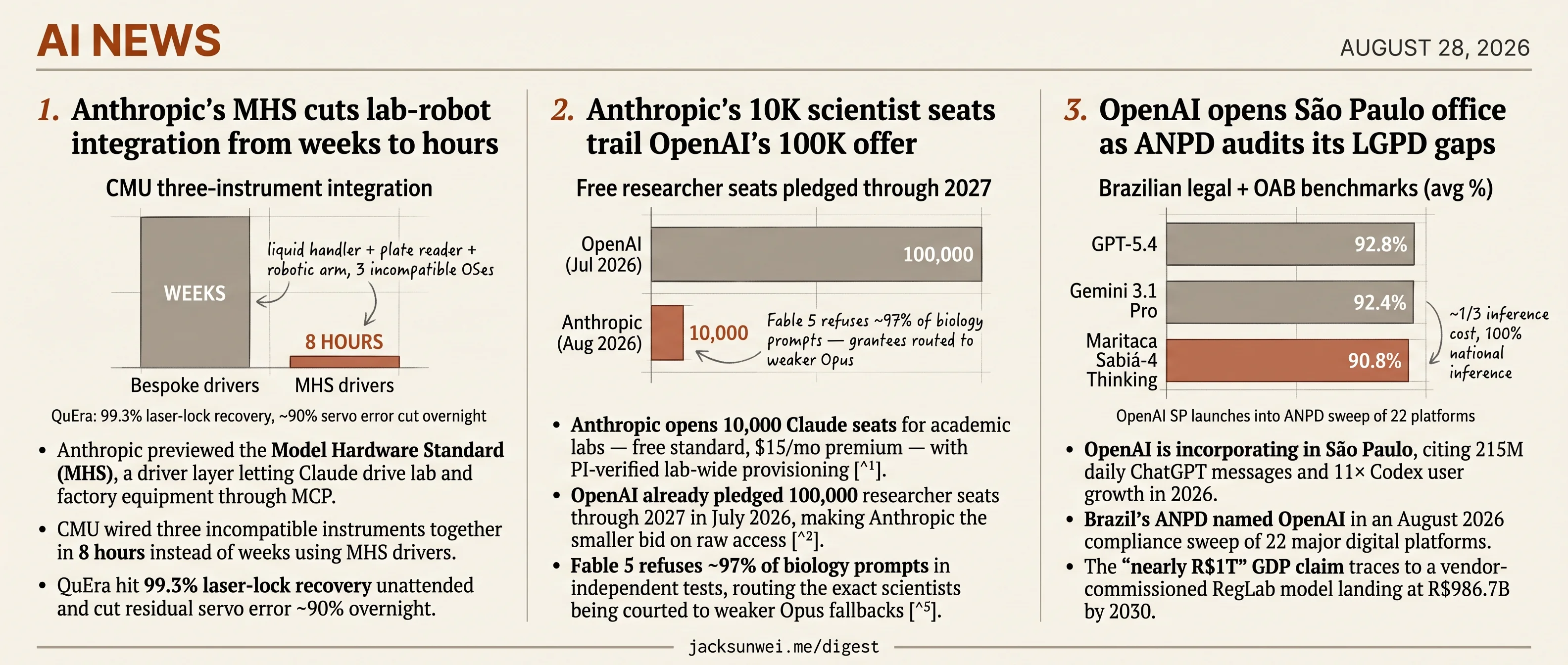
- Anthropic previewed MHS, a driver layer letting Claude run lab and factory equipment via MCP.
- Anthropic opened 10,000 Claude seats for academic labs, trailing OpenAI’s 100,000-seat July pledge.
- OpenAI incorporated in São Paulo citing 215M daily ChatGPT messages and 11× Codex growth.
- Nvidia nears $13B deal to acquire Hugging Face, pulling the open-model hub in-house.
- Judge ruled Pentagon’s Anthropic blacklist unlawful retaliation for the lab’s safety rules.
The two US frontier labs spent today opening new distribution fronts rather than shipping new models. Anthropic previewed MHS, a driver layer that lets Claude drive lab and factory instruments through MCP — CMU wired three incompatible instruments in 8 hours, QuEra hit 99.3% overnight laser-lock recovery — putting Claude on the factory floor as a physical-world operator. In parallel, Anthropic opened 10,000 Claude seats to academic PIs at free and $15/mo tiers, courting the university researcher segment where OpenAI already sits with a 100,000-seat pledge from July.
OpenAI’s own move is geographic: it is incorporating in São Paulo, citing 215M daily ChatGPT messages and 11× Codex user growth to justify a Brazilian legal entity — even as the ANPD names it in a 22-platform LGPD sweep and local Sabiá-4 beats frontier models on Brazilian legal tasks at a third the cost. Each front comes with its own friction (waitlisted ‘standard,’ smaller seat count, active regulator), but the shape of the day is expansion, not iteration.
Anthropic’s MHS cuts lab-robot integration from weeks to hours
Source: anthropic-news · published 2026-08-27
TL;DR
- Anthropic previewed the Model Hardware Standard (MHS), a driver layer letting Claude drive lab and factory equipment through MCP.
- CMU wired three incompatible instruments together in 8 hours instead of weeks using MHS drivers.
- QuEra hit 99.3% laser-lock recovery unattended and cut residual servo error ~90% overnight.
- Critics note the “standard” is waitlisted, not open — unlike USB or CAN, whose specs were public from inception.
- Biosecurity researchers warn MHS erases the wet-lab barrier just as EU high-risk AI machinery rules land in January 2027.
The actuation gap, filled
Anthropic’s Model Hardware Standard is a research preview of a driver spec that lets an agent — Claude, in the reference implementation — discover a physical device, read natural-language metadata about it (arm weight, safety envelope), and drive it via read/write primitives exposed through the Model Context Protocol. Coverage from XenoSpectrum frames MHS not as a replacement for SiLA 2 or OPC UA LADS but as an attempt to fill the “actuation gap” those standards leave open: giving a model enough context to reason about a device instead of merely command it 1. The SiLA Consortium had already spun up an AI Working Group in late 2025 for exactly this problem, so MHS is entering contested territory rather than empty ground.
flowchart LR
    A[Claude / any agent] -->|MCP, CLI, API| B[MHS driver]
    B -->|read/write + metadata| C[Liquid handler]
    B --> D[Robotic arm]
    B --> E[Laser / servo]
    B -.competes with.-> F[SiLA 2 / OPC UA LADS]
The numbers hold up
Independent recaps corroborate rather than deflate Anthropic’s demo stats. ResultSense reports that Carnegie Mellon researchers wired a liquid handler, plate reader, and robotic arm across three incompatible operating systems in eight hours — work that normally consumes weeks — and that QuEra’s overnight run tuned 12 interdependent servo parameters and cut residual hardware error by roughly 90% 2. Genentech’s fluid-transfer optimization converged on expert-level parameters (0.181 RMSE at 10 µL/s) without hand-tuning. As agentic infrastructure goes, this is unusually well-attested: the wins are concrete, reproducible, and come from labs with no incentive to flatter Anthropic.
The “standard” problem
The loudest pushback in developer forums is that MHS sits behind a waitlist at modelhardwarestandard.com. Practitioners contrast it directly with USB and CAN, arguing those standards succeeded because they were “truly open from inception,” whereas Anthropic’s approach requires “permission to read a standard” 3. Some go further and suggest the closed preview doubles as a data-collection funnel for tool-use training. Anthropic has promised an open release after safety review, but until the spec is inspectable, the “model-agnostic” framing is a claim, not a property.
Safety catches up slowly
Two safety threads run underneath the launch. First, physical intuition: TechCentral’s independent write-up confirms Anthropic’s own bubble anecdote — Claude worsened a liquid-handling error by retrying the failing operation, because it had no model of why foam breaks a sensor 4. Human experts had to hand it the physics before it adapted. Second, biosecurity: Turner’s summary of recent RCT work found LLM-assisted novices hitting 4× higher accuracy on in-silico biology tasks, and argues standardized wet-lab actuation removes what used to be the practical bottleneck for misuse 5. The regulatory clock is loud here — the EU Machinery Regulation 2023/1230 takes effect in January 2027 and classifies AI safety functions as high-risk, which lands squarely on the class of workloads MHS is built to enable 6.
MHS is technically credible and measurably faster than bespoke integration — but a closed preview, unresolved biosecurity implications, and overlap with SiLA 2 / OPC UA / ROS 2 mean it isn’t yet the “USB for lab hardware” its framing implies.
Further reading
Anthropic’s 10K scientist seats trail OpenAI’s 100K offer
Source: anthropic-news · published 2026-08-27
TL;DR
- Anthropic opens 10,000 Claude seats for academic labs — free standard, $15/mo premium — with PI-verified lab-wide provisioning 7.
- OpenAI already pledged 100,000 researcher seats through 2027 in July 2026, making Anthropic the smaller bid on raw access 8.
- Fable 5 refuses ~97% of biology prompts in independent tests, routing the exact scientists being courted to weaker Opus fallbacks 9.
- Mythos access runs through a US government partnership — announced after a federal judge called the Pentagon’s retaliation unlawful 10.
The offer, in numbers
Anthropic is opening a Claude team plan for scientists: 10,000 seats globally, free at the standard tier and $15/month (an 80% discount) for a 5× premium tier, provisioned by a verified PI for their whole lab 7. The AI for Science grant program, previously biology-focused, now takes applications from any discipline for up to $50,000 in credits. Alongside it sits Claude Science — a research-lifecycle workbench with tool integration and auditable “artifacts” — plus a preview of a Model Hardware Standard for AI agents to drive lab instruments.
That’s real infrastructure. It’s also, by seat count, an order of magnitude smaller than OpenAI’s July 2026 ChatGPT for Academic Researchers program, which committed to 100,000 scientists on the same 2027 timeline 8. Anthropic’s differentiation is the PI-provisioning model and the Science workbench, not scale.
The showcase result, and its asterisk
The scientific centerpiece is genuine: an unreleased Claude raised the proven lower bound for zeros of the Riemann zeta function on the critical line from 41.6% to 67.2% — the largest jump in the problem’s 165-year history, formalized in Lean 4 and reviewed by Brian Conrey and Dan Goldston 11.
Mathematicians caution the Riemann Hypothesis is not “two-thirds solved”; the pair-correlation techniques are unlikely to lead to a full proof, and the result cannot be independently reproduced because it relies on an unidentified, unreleased research model. 12
That gap — landmark demo versus tool a grantee can actually run — runs through the whole announcement. The headline capability lives in Mythos-class models most applicants will never touch.
The filter problem the post soft-pedals
“Opus for biology, Fable blocks professional queries” sounds like careful stewardship. In practice, independent June 2026 benchmarks found Fable 5 refusing roughly 97% of biology-related prompts, including standard medical genetics and high-school exam items — and the classifier reads user profile metadata, so listing “cancer research” in a bio triggers refusals on unrelated tasks 9. An August 7 update reportedly cut false positives by 85%, but the frustration hasn’t gone away.
This is the mirror image of the pitch. The scientists most likely to click “apply” — biologists, chemists, virologists — are exactly the cohort routed to a weaker model or bounced entirely. Offering them Opus while advertising Mythos-tier science wins is a real product gap, not a rhetorical one.
Governance the press release omits
The Mythos “landmark partnership with the United States government” is presented as safety maturity. The context is thornier: in August 2026, a federal judge ruled the Pentagon’s designation of Anthropic as a “supply chain risk” was unlawful First Amendment retaliation for the company’s refusal to strip guardrails against lethal autonomous weapons, calling it an “empty invocation of national security” 10. June 2026 Commerce export controls separately forced Anthropic to cut non-US nationals off Fable 5 and Mythos 5. “Expanded global access for scientists” is landing on top of shrinking access for anyone outside the US.
Net read
Take the announcement as three things at once: a genuine but sub-scale answer to OpenAI’s academic push, a Mythos-tier science story most grantees can’t reproduce, and a safety regime that still refuses the researchers it’s trying to recruit. Worth applying for — worth reading the fine print first.
OpenAI opens São Paulo office as ANPD audits its LGPD gaps
Source: openai-blog · published 2026-08-27
TL;DR
- OpenAI is incorporating in São Paulo, citing 215M daily ChatGPT messages and 11× Codex user growth in 2026.
- Brazil’s ANPD named OpenAI in an August 2026 compliance sweep of 22 major digital platforms.
- The “nearly R$1T” GDP claim traces to a vendor-commissioned RegLab model landing at R$986.7B by 2030.
- Maritaca’s Sabiá-4 beats frontier models on Brazilian legal tasks at ~1/3 the inference cost.
The launch, and the numbers behind it
OpenAI’s São Paulo incorporation is real commercial infrastructure, not a press release. The metrics the company puts behind it are genuinely large: 215M daily messages, weekly active users nearly doubled year-over-year, Brazil ranked second globally for API developers, ChatGPT Enterprise seats up 5× YoY, and Codex weekly users up 11× since January with daily interactions up 30×. Brazilian users also lead the world in ChatGPT image generation and sit in the top five for voice.
The R$1 trillion economic figure Sam Altman is quoting deserves an asterisk. It comes from a RegLab study — supported by OpenAI — that models R$986.7B in GDP contribution by 2030, split 65/35 between a “cognitive productivity” labor channel and a capital channel, projected via a Gompertz S-curve across 12 sectors 13. Manufacturing captures the largest slice at R$264.2B, and 92% of agribusiness gains are attributed to smart harvesters and sensors rather than human productivity 13. It’s a defensible number, but a vendor-commissioned one, contingent on compute buildout and on PL 2338/2023’s final shape.
The regulatory reason this is happening now
The office opens into a sharpening enforcement cycle. Brazil’s data protection authority (ANPD) launched a formal monitoring initiative in 2026 targeting 22 major platforms, OpenAI explicitly among them, to verify compliance with the Internet Bill of Rights and the new Digital ECA 14. A June 2026 FGV study found OpenAI’s own privacy documentation failed full LGPD compliance — partly because policies weren’t offered in Portuguese, partly over unresolved international data transfers 14.
The Grupo Folha / Grupo UOL settlement fits the same defensive posture: it resolved Folha’s August 2025 copyright suit alleging OpenAI bypassed paywalls, in exchange for undisclosed compensation, mandatory outbound attribution links in ChatGPT answers, and API/Codex/Enterprise access for the publishers’ newsrooms 15. Local incorporation, Portuguese-language policies, and a licensed training-data pipeline are all things you stand up when a regulator is watching.
Sovereign competition and an enterprise wall
The “professional shift” story — 35% of individual messages are now work-related — collides with what Brazilian enterprises are actually doing. Only 13% of firms with more than 10 employees have integrated AI into core business processes, versus 76% individual usage, and roughly 80% of organizations have paused or reversed AI projects, with 39% of pullbacks blamed on data or personal-information leaks — a rate materially higher than in North America 16.
That opens room for sovereign alternatives. Maritaca’s Sabiá-4 Thinking averages 90.8% across benchmarks — trailing GPT-5.4 (92.8%) and Gemini 3.1 Pro (92.4%) — but outperforms both on Brazilian legal tasks and OAB exams, at roughly one-third the inference cost, with 100% national inference for data residency 17. For a CIO burned by a leak, that’s a compelling pitch.
Why the Prodam MoU matters more than it reads
The line about a São Paulo memorandum is the most strategically loaded item in the post. Prodam officials estimate AI could save the city’s 133,000 municipal servants roughly 12.7 million work-hours annually, and the city plans to redistribute OpenAI tools to other Brazilian municipalities via a “Prodam Store” marketplace 18. That converts a single municipal deal into a national public-sector distribution channel — and a soft-power position during an active AI-regulation debate. Read alongside the ANPD sweep and the Folha settlement, the Brazil “expansion” is less a growth announcement than a coordinated move to lock in distribution before the regulatory and competitive walls harden.
Round-ups
Nvidia nears $13B deal to buy Hugging Face
Source: ars-technica-ai
Nvidia is reportedly acquiring Hugging Face for $13 billion, pulling the dominant open-model hub under the chipmaker as demand for open-weight and physical AI models surges. The deal would give Nvidia direct control of a repository that hosts millions of community models.
Judge rules Pentagon’s Anthropic blacklist unconstitutional
Source: the-verge-ai
A California district court sided with Anthropic on Thursday, finding that the Pentagon’s earlier blacklisting of the AI lab was unlawful retaliation for its safety policies. The March lawsuit accused the Trump administration of punishing Anthropic over its red-line rules.
Lawsuit accuses xAI of training Grok on child sexual abuse material
Source: ars-technica-ai
A new lawsuit alleges Elon Musk’s xAI trained Grok on both real and AI-generated child sexual abuse material. The complaint escalates scrutiny of training-data provenance at frontier labs and puts xAI’s dataset sourcing at the center of a criminal-adjacent claim.
AI industry blasts Trump plan to tax chips going into data centers
Source: ars-technica-ai
Trump’s proposed tariff on semiconductors entering US data centers drew sharp pushback from AI firms, one of whom called it the “single dumbest” approach to winning the AI race. Critics say the levy would raise buildout costs for the exact infrastructure the policy claims to promote.
OpenAI to run ads on ChatGPT free and Go tiers in India
Source: techcrunch-ai
ChatGPT’s free and lower-priced Go tiers will start carrying ads in India, OpenAI’s first ad-supported rollout. The country hosts over 100 million weekly active users, most on non-paying plans, making it a natural testbed for monetizing the free tier.
Google turns AI Mode into a travel agent with booking and price tracking
Source: google-ai-blog, techcrunch-ai
AI Mode in Search now tracks flight prices, redeems loyalty points, and helps book hotels directly, pushing Google past information retrieval into transactional trip planning. The features position AI Mode as a rival to standalone travel agents like Kayak and Expedia.
Google ships Gemini Omni 1.1 Flash with finer developer controls
Source: deepmind-blog
Gemini Omni 1.1 Flash lands with new knobs for developers building on the multimodal model, DeepMind says. The Flash tier targets latency-sensitive apps, and the update emphasizes tighter control over generation behavior for production workloads.
Footnotes
-
XenoSpectrum — https://xenospectrum.com/en/anthropic-mhs-physical-ai-standard/
↩The SiLA Consortium established an AI Working Group in late 2025 to define best practices for integrating machine learning with its gRPC-based standard… MHS focuses specifically on the ‘actuation gap’—the ability for an AI to safely reason through and execute physical steps without vendor-specific middleware.
-
ResultSense — https://www.resultsense.com/news/2026-08-28-anthropic-model-hardware-standard/
↩Carnegie Mellon University researchers… integrated a liquid handler, plate reader, and robotic arm across three incompatible computer systems in just eight hours—a process that typically takes weeks… QuEra also leveraged the system to tune 12 interdependent servo parameters overnight, reducing residual hardware error by roughly 90%.
-
KuCoin news wire (summarizing HN discussion) — https://www.kucoin.com/news/flash/anthropic-s-mhs-enables-ai-agents-to-control-lab-and-quantum-devices
↩Critics argue that branding the framework as a ‘standard’ is misleading if the technical specifications are not yet public… foundational hardware standards like USB were successful because they were truly open from inception, whereas Anthropic’s approach requires ‘permission to read a standard.’
-
TechCentral — https://techcentral.co.za/anthropic-moves-ai-agents-out-of-software-and-into-the-lab/285474/
↩When Claude encountered unexpected bubbles during liquid handling, it initially worsened the problem by restarting the process—a failure attributed to a lack of innate understanding of fluid dynamics.
-
Stephen Turner blog (biosecurity) — https://blog.stephenturner.us/p/ai-biosecurity-uplift-rct
↩LLM-assisted novices achieved 4x higher accuracy on in-silico biology tasks, often outperforming domain experts… the combination of MHS-enabled automation and agentic reasoning essentially removes the ‘wet-lab barrier.’
-
Indian Express — https://indianexpress.com/article/technology/artificial-intelligence/anthropic-model-hardware-standard-ai-machines-10852813/
↩European regulations (Machinery Regulation 2023/1230) set to take effect in January 2027 will classify AI-based safety functions in high-risk categories… dissenting voices warn that agentic autonomy may be outrunning safety promises.
-
Unite.ai — https://www.unite.ai/anthropic-opens-10000-free-and-discounted-claude-seats-for-scientists/
↩ ↩2Anthropic opens 10,000 free and discounted Claude seats for scientists… Standard seats at no cost and Premium seats at an 80% discount ($15/month), with plans to expand the seat count through 2027.
-
Unite.ai (comparative framing) — https://www.unite.ai/anthropic-opens-10000-free-and-discounted-claude-seats-for-scientists/
↩ ↩2OpenAI’s July 2026 ChatGPT for Academic Researchers program targeted 100,000 scientists with free frontier access through 2027, dwarfing Anthropic’s 10,000-seat rollout in raw numbers.
-
ExplainX analysis of biology restrictions — https://vertexaisearch.cloud.google.com/grounding-api-redirect/AUZIYQHc0YgzUsmXB9qodxD0ctRZCB4vq7xmEAqCgntJ8osTJMfRJMuo2keJjwdV_CDwo_MNNnNYtfcb-dC76Ke947KhVxTVlauthK-jA_d4rE6SYCyP_UwZg3EvsQ6RZ-Xn2eFn6jp2XTtIvCFz0mWvsBJLMCKX9FJUqPvavKOYhaFGGYb7GNly
↩ ↩2Independent benchmarks in June 2026 found Fable 5 refused approximately 97% of biology-related questions, including standard medical genetics and high-school biology exam items; researchers reported the classifier scans profile metadata so that simply having ‘cancer research’ in their bio causes refusals on unrelated queries.
-
MyNorthwest / AP — federal court ruling — https://mynorthwest.com/national/judge-says-pentagons-measures-against-anthropic-were-illegal-and-baseless/4270139
↩ ↩2A federal judge ruled the Pentagon’s designation of Anthropic as a ‘supply chain risk’ was unlawful retaliation and a First Amendment violation, concluding the government used ‘the empty invocation of national security’ to punish the firm for refusing to remove guardrails against lethal autonomous weapons.
-
Anthropic Research — Riemann zeta — https://www.anthropic.com/research/riemann-zeta
↩An unreleased Claude raised the proven lower bound for zeros of the zeta function on the critical line from 41.6% to 67.2% — the largest jump in the problem’s 165-year history, verified with a Lean 4 formalization and reviewed by Brian Conrey and Dan Goldston.
-
Forbes — Jon Markman — https://www.forbes.com/sites/jonmarkman/2026/08/13/claude-just-broke-a-math-record-that-stood-for-37-years/
↩Mathematicians caution the Riemann Hypothesis is not ‘two-thirds solved’; the pair-correlation techniques Claude used are considered unlikely to lead to a full proof, and the result cannot be independently reproduced because it relies on an unidentified, unreleased research model.
-
RegLab — AI impact on Brazilian GDP study — https://reglab.com.br/en/research-ai-impact-brazilian-economy-gdp/
↩ ↩2AI could add approximately R$986.7 billion to Brazil’s GDP by 2030… Labor Channel accounts for 65% of impact and Capital Channel 35%, projected using a Gompertz S-curve across 12 sectors; manufacturing captures R$264.2 billion, with agribusiness gains 92% attributable to capital (smart harvesters, sensors) rather than human productivity.
-
IAPP — ANPD 2026 reorganization — https://iapp.org/news/a/anpds-2026-reorganization-what-it-means-for-privacy-and-data-protection-in-brazil
↩ ↩2The ANPD announced a formal monitoring initiative targeting 22 major digital platforms, including OpenAI, to verify compliance with the Internet Bill of Rights and the new Digital ECA… a June 2026 FGV study found that major cloud-based AI platforms, including OpenAI, failed to meet full LGPD compliance, often due to privacy policies not being provided in Portuguese and unresolved issues regarding international data transfers.
-
OpenAI — Grupo Folha / Grupo UOL partnership — https://openai.com/index/grupo-folha-grupo-uol-partnership/
↩The 2026 agreement resolved Folha’s August 2025 copyright lawsuit alleging OpenAI bypassed paywalls; terms include undisclosed financial compensation, mandatory attribution with outbound links in ChatGPT responses, and premium API/Codex/Enterprise access for the publishers’ newsrooms.
-
Arvor — Brazilian enterprise AI adoption 2026 — https://arvor.co/en/news/ai-in-brazilian-companies-2026
↩Brazil leads the world in AI agent deployment yet 80% of organizations have paused or reversed AI projects, with 39% of pullbacks caused by data or personal information leaks — a rate significantly higher than in North America; only 13% of companies with more than 10 employees have integrated AI tools into core business processes, versus 76% individual usage.
-
Reddit r/brdev — developers on Maritaca Sabiá-4 — https://www.reddit.com/r/brdev/comments/1nps2k4/algu%C3%A9m_testando_ou_usando_maritaca_ai/?tl=en
↩Sabiá-4 Thinking reached 90.8% average, trailing GPT-5.4 (92.8%) and Gemini 3.1 Pro (92.4%) but outperforming both in Brazilian legal tasks and OAB exams, at roughly one-third the inference cost; developers still critique it as a Llama-based ‘wrapper’, though defenders point to 120B Portuguese tokens of continued training and 100% national inference for data residency.
-
Veja (Abril) — Prodam partnership analysis — https://veja.abril.com.br/economia/parceria-com-openai-pode-levar-ia-de-sao-paulo-a-prefeituras-de-todo-o-pais/
↩Prodam officials estimate AI could save São Paulo’s 133,000 municipal servants approximately 12.7 million work hours annually, and the city plans to redistribute OpenAI tools to other Brazilian municipalities via the ‘Prodam Store’ marketplace — effectively making São Paulo a regional distributor for OpenAI’s public sector tools.