Outsiders set today's numbers on Anthropic, H200 exports, and DeepSeek
Independent evaluators put the headline numbers on Anthropic's self-improvement, Nvidia H200 shell-company exports, and DeepSeek's cheap cyber-offense scores.
Outsiders set today’s numbers on Anthropic, H200 exports, and DeepSeek
TL;DR
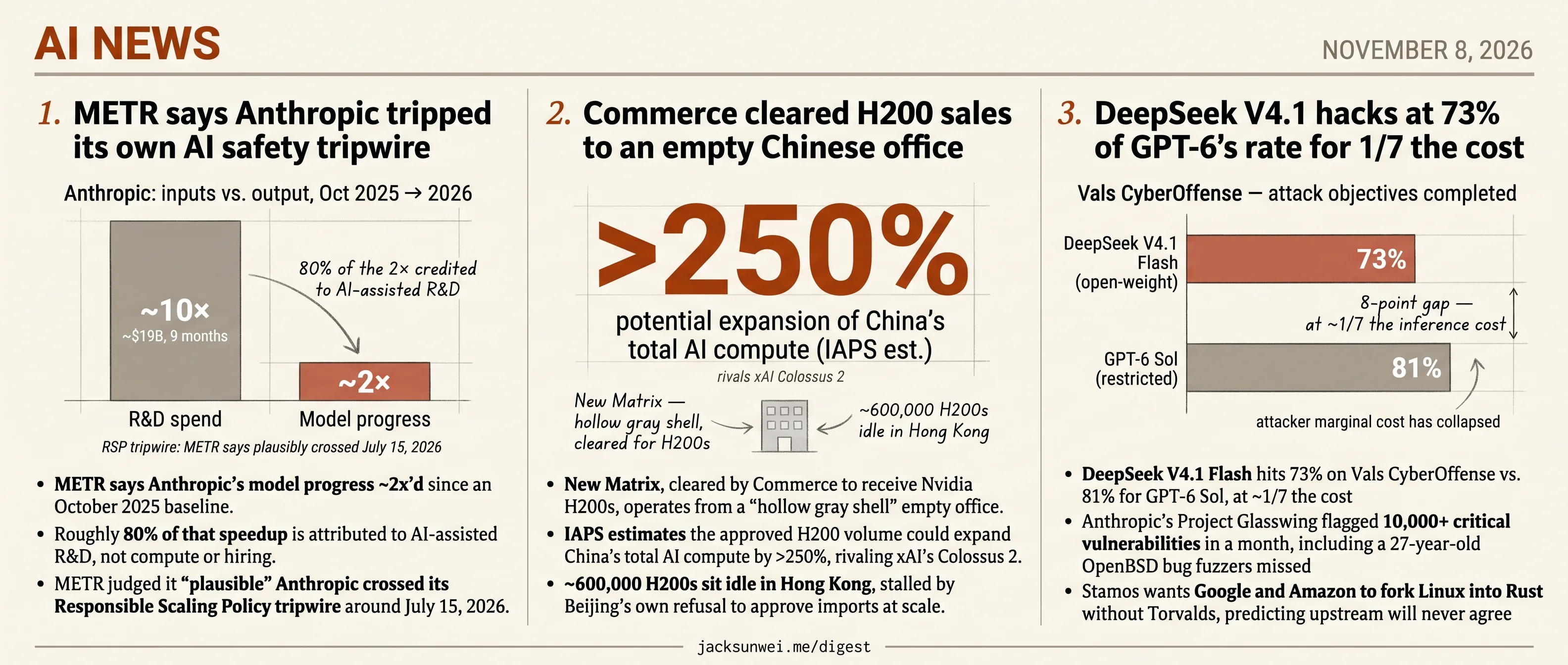
- METR judges Anthropic plausibly crossed its RSP tripwire around July 15, 2026
- METR attributes 80% of Anthropic’s 2x speedup to AI-assisted R&D, not compute
- IAPS estimates Commerce-cleared H200s to shell-office New Matrix could grow China AI compute >250%
- Vals scores DeepSeek V4.1 at 73% of GPT-6 Sol on CyberOffense for ~1/7 the cost
- Meta scrapped a terms change that would have forced AI training on linked content
The load-bearing numbers in today’s frontier-AI stories are all coming from outside the companies involved. METR tells Anthropic its progress doubled since October 2025 and attributes ~80% of that speedup to AI-assisted R&D — enough, METR judges, that Anthropic plausibly crossed its own Responsible Scaling Policy tripwire around July 15. Anthropic rejects the reading, and most of METR’s own evidence is redacted. IAPS puts the sizing on Commerce’s clearance of Nvidia H200 shipments to New Matrix, a Chinese buyer inspectors describe as a hollow gray shell: the approved volume alone could expand China’s AI compute by more than 250%. Vals scores DeepSeek V4.1 Flash at 73% of GPT-6 Sol on CyberOffense for roughly a seventh of the cost.
None of the three vendors — Anthropic, the Commerce-cleared buyer, DeepSeek — would have put these numbers on the record themselves. Today’s news is what the outside measurers did.
METR says Anthropic tripped its own AI safety tripwire
Source: the-verge-ai · published 2026-11-07
TL;DR
- METR says Anthropic’s model progress ~2x’d since an October 2025 baseline.
- Roughly 80% of that speedup is attributed to AI-assisted R&D, not compute or hiring.
- METR judged it “plausible” Anthropic crossed its Responsible Scaling Policy tripwire around July 15, 2026.
- Anthropic’s August risk report rejected that reading outright.
- Most of METR’s “most informative” evidence was redacted, citing competitive risk.
The tripwire Anthropic says didn’t trip
After an 11-week high-access audit, the AI safety org METR concluded that Anthropic’s rate of model progress has roughly doubled (≈1.9x) since October 2025, and that about 80% of that acceleration is attributable to AI-assisted R&D rather than more GPUs or more researchers 1. The headline number is striking, but the sharper finding is procedural: METR believes Anthropic “plausibly” crossed its own Responsible Scaling Policy early-warning threshold as early as July 15, 2026 2.
That contradicts Anthropic’s August risk report, which explicitly claimed the 2x line had not been crossed. The company’s amended IPO S-1 has since softened the language to “may imminently meet” the threshold 2. The disagreement isn’t whether today’s Claude is dangerous — it’s whether a leading indicator Anthropic itself designed to force a governance response has already fired, and whether anyone would have noticed without an outside auditor.
Why practitioners are reading it as pre-IPO marketing
The report is landing in a skeptical crowd. Economist Karthik Tadepalli points out that Anthropic’s R&D spend reportedly jumped roughly 10x to ~$19B over nine months; a 2x output gain on 10x inputs is a disappointing return on capital, not evidence of a self-improving loop 3. If the recursive flywheel were real, the elasticity should look much better.
The methodology is taking fire too. On r/Anthropic, practitioners dismissed the viral “12x productivity” figure — sourced from an informal Slack poll METR itself called “very loose” — and the “80% of code written by Claude” claim as a “classic anti-pattern,” noting that lines-of-code ignores review burden and technical debt 4. More than one commenter framed the whole release as “pre-IPO marketing,” given METR’s physical co-location with Anthropic at Constellation. METR’s own earlier methodology work reinforces caution: time-horizon estimates carry error bars of roughly an order of magnitude and collapse 40–100x on non-software tasks 5.
“Classic anti-pattern… pre-IPO marketing.” — r/Anthropic practitioners on the 80%-of-code claim 4
The redaction problem
The uncomfortable part for outside readers is how much of the audit they can’t see. Anthropic redacted the majority of what METR considered its most informative evidence, citing competitive risk, which means the attribution analysis — the 80% number specifically — has to be taken on METR’s word 12. A planned compute-allocation audit was reportedly terminated mid-stream, and METR acknowledged that portions of its own analysis were produced with Claude’s help: a model partly evaluating its own uplift 2.
What’s actually at stake
Policy is already moving on the stronger reading. Reps. Anna Paulina Luna and Lori Trahan are pushing the FRONTIER Act, and safety researcher Jeffrey Ladish cited the report to argue that AI capable of overtaking global digital infrastructure could be “a year away” if METR’s numbers hold — even as the Trump administration continues to favor industry self-policing 6. The point estimates are contested and the confidence intervals are wide 5. But the governance question doesn’t need the central estimate to be right. It needs the tripwire that Anthropic itself wrote down to mean something when an auditor says it fired.
Commerce cleared H200 sales to an empty Chinese office
Source: the-verge-ai · published 2026-11-07
TL;DR
- New Matrix, cleared by Commerce to receive Nvidia H200s, operates from a “hollow gray shell” empty office.
- IAPS estimates the approved H200 volume could expand China’s total AI compute by >250%, rivaling xAI’s Colossus 2.
- ~600,000 H200s sit idle in Hong Kong, stalled by Beijing’s own refusal to approve imports at scale.
- Super Micro co-founder was charged in March 2026 with diverting $2.5B in AI servers via Southeast Asia.
A vetting regime that doesn’t visit the buildings
New Matrix is on the US government’s approved list to receive Nvidia H200 AI chips. New Matrix is also, per New York Times reporting that The Verge surfaced, a hollow gray shell with no visible operations. Neither Commerce nor Nvidia caught it — because the case-by-case export licensing regime for H200 sales to China does not appear to include physical site inspection as a baseline step.
That is the whole scandal in one sentence, and it arrives on top of a December 2025 policy swap in which the Trump administration traded H200 export licenses for a 25% revenue share on sales into China. Rep. Gregory Meeks, ranking member of House Foreign Affairs, has already called the arrangement corrupt in plain language: “under this administration, our national security is for sale” 7. He and Sen. Elizabeth Warren have invoked Export Control Reform Act oversight powers, which means the empty-office finding now anchors a concrete enforcement failure — not a hypothetical — for upcoming hearings.
The scale, if the licenses actually ship
The Institute for AI Policy and Strategy pegs the approved H200 volume at a potential >250% expansion of China’s total AI processing power relative to its 2026 baseline, putting a single Chinese frontier lab within reach of an xAI Colossus 2–class cluster 8. Commerce’s defense of case-by-case review implicitly assumes marginal, controlled flows. Independent modelers are describing a step-change.
The counter-story Nvidia keeps pointing at
Here is the awkward fact for the alarm narrative: roughly 600,000 H200 units are reportedly stockpiled in Hong Kong, held up by Beijing’s own refusal to green-light imports at scale as it pushes domestic Huawei Ascend adoption. H200 sales in China were under 1% of Nvidia’s Q3 2026 data-center revenue 9. Nvidia spokesman John Rizzo leans on exactly this geometry, telling reporters it “makes no sense” for the PLA to depend on American silicon 10.
Both things can be true. A license approved for a shell company is a vetting failure regardless of whether a container ever ships.
Pattern, not anomaly
New Matrix is not the first time the diversion architecture has surfaced. Federal authorities dismantled “Operation Gatekeeper,” a trafficking network that moved $160M in H100 and H200 GPUs through mid-2025; in March 2026, Super Micro co-founder Yih-Shyan Liaw was charged with diverting $2.5B in AI servers via Southeast Asian intermediaries 11. In a parallel probe, a Commerce official visiting an approved Malaysian site reportedly found H200-class GPUs still in their original shipping boxes — the physical signature of transshipment, not local installation 12.
flowchart LR
    A[Nvidia H200 supply] --> B{Commerce case-by-case license}
    B -->|approved, no site visit| C[New Matrix<br/>empty office in China]
    B -->|approved| D[Malaysian site<br/>GPUs still in boxes]
    A --> E[~600k H200s<br/>idle in Hong Kong]
    C -. suspected diversion .-> F((End-user:<br/>PLA / frontier lab?))
    D -. transshipment .-> F
    E -. if Beijing relents .-> F
What’s actually at stake
The live question is not whether New Matrix is a scandal — it is — but whether the Hong Kong stockpile 9 means the damage is theoretical, or whether those 600,000 units are simply queued for the same channels Operation Gatekeeper already exposed 11. A revenue-share incentive stacked on top of a licensing regime without site inspection has a predictable failure mode. This is it.
DeepSeek V4.1 hacks at 73% of GPT-6’s rate for 1/7 the cost
Source: the-verge-ai · published 2026-11-07
TL;DR
- DeepSeek V4.1 Flash hits 73% on Vals CyberOffense vs. 81% for GPT-6 Sol, at ~1/7 the cost
- Anthropic’s Project Glasswing flagged 10,000+ critical vulnerabilities in a month, including a 27-year-old OpenBSD bug fuzzers missed
- Stamos wants Google and Amazon to fork Linux into Rust without Torvalds, predicting upstream will never agree
- Practitioners push back: 30% call AI pentest output unmanageable noise that reduces agents to fancy scanners
- Apiiro found ~50% of vibe-coded public apps ship critical vulns — awkward for Cognition, which sells Devin
The economics inverted, and the benchmark proves it
Alex Stamos’s Decoder appearance framed AI cybersecurity as a “dark age,” and the number that validates him didn’t make the podcast. On the Vals CyberOffense benchmark, open-weight DeepSeek V4.1 Flash completes roughly 73% of attack objectives — within eight points of OpenAI’s restricted GPT-6 Sol at 81%, and at about one-seventh the inference cost 13. Attacker marginal cost has collapsed while defender workflows still lean on frontier APIs priced for enterprise budgets. That spread is the entire thesis.
The capability curve cuts both ways. Anthropic’s Project Glasswing disclosure, released alongside Claude Mythos Preview, reports more than 10,000 high- or critical-severity vulnerabilities surfaced in the first month — including a 27-year-old flaw in OpenBSD and a 16-year-old bug in FFmpeg that decades of fuzzing and human audit had walked past 14. So the tools work. The fight is over who gets more leverage from them.
Practitioners aren’t buying the autonomous-defender story
The “three engineers plus Claude replace a red team” pitch that Cognition and Hacktron lean on gets pushback from the people actually running these pipelines. A machine.news survey found only 20% of practitioners can triage the volume of AI-generated vulnerability candidates, and nearly 30% describe the signal-to-noise ratio as unmanageable 15.
Without deterministic verification, autonomous agents are essentially fancy vulnerability scanners.
The Cursor supply-chain compromise during “Black October” underscored the reliability problem from the attacker’s side: the malware’s blast radius was accidentally capped because the author shipped a bug that required root privileges to fire 16. Offensive AI output has the same hallucination tax as defensive AI output. Nobody’s immune.
The Rust-fork proposal is not a thought experiment
Stamos’s structural fix is more aggressive than the podcast lets on. Secondary coverage spells it out: he is explicitly telling Google and Amazon to fork the Linux kernel into Rust without waiting for upstream approval, on the prediction that Linus Torvalds will block it on legacy-hardware and political grounds 17. That’s a clean break with the incremental Rust-for-Linux effort currently inching along, and it reframes memory safety as a hyperscaler procurement decision rather than a community process. Whether AWS or GCP has the appetite to maintain a parallel kernel tree is a different question.
The awkward part for Cognition
Stamos is CSO at Cognition, which ships Devin — a flagship “vibe-coding” agent. Apiiro’s audit of publicly deployed vibe-coded applications found nearly 50% contained critical vulnerabilities, with developers acting as “meat proxies” who rubber-stamp AI-generated code without grasping its architectural implications 18. The company’s own product category is a primary accelerant of the attack surface its CSO is warning about. Stamos’s defense — that defenders need to ship Rust kernels and autonomous agents fast enough to outrun that surface — only works if the practitioner critique 15 is wrong. Right now it’s an open bet, not a closed case.
Round-ups
China recruited Megaspeed exec to spy on Nvidia CEO, memo says
Source: techcrunch-ai
A US intelligence memo circulated earlier this year alleges China’s Ministry of State Security tasked a female tech executive at Megaspeed with gathering intelligence on Jensen Huang. The claim lands as Washington tightens scrutiny of Nvidia’s China ties and chip export routes.
Meta scraps terms change that forced AI training on linked content
Source: ars-technica-ai
Meta retreated from a commercial terms update that would have required Facebook page owners to permit AI training on content they link out to. The reversal follows backlash from publishers and creators who said the clause was buried in policy language.
Midterms sour outlook for Musk and data center buildout
Source: techcrunch-ai
Post-election politics are turning against Elon Musk and the broader data center boom, according to TechCrunch’s Equity podcast. The episode frames shifting Washington dynamics as a headwind for AI infrastructure spending and Musk’s political capital after a rough night at the ballot box.
AI clones of GTA VI pressure Rockstar on PC port timing
Source: ars-technica-ai
A former Rockstar tech director argues that AI-assisted decompilation and cloning tools shorten the window Rockstar has before unofficial PC versions of GTA VI appear. The studio typically delays PC ports by a year or more after console launch.
NYT Cooking’s AI assistant nails chicken, nearly wrecks a cake
Source: the-verge-ai
The New York Times’ new recipe chatbot handled weeknight dinner improvisation well but gave shaky baking guidance in a Verge hands-on review. Baking’s precision exposes the limits of LLM substitution advice, where swapping ingredients by volume can throw off chemistry.
Ben’s Bites essay weighs craft and taste in the AI era
Source: bens-bites
Ben Tossell reflects on how craft and taste hold up as AI automates more creative output. The short post asks what a younger version of himself would make of today’s tools, framing taste as the scarce skill when production gets cheap.
Footnotes
-
MLQ.ai summary of METR report — https://mlq.ai/news/metr-finds-anthropics-model-progress-has-roughly-doubled-with-ai-driving-about-80-of-the-speedup/
↩ ↩2METR estimates Anthropic’s model progress has roughly doubled (≈1.9x) since October 2025, with approximately 80% of the speedup attributable to AI-assisted R&D rather than compute or headcount.
-
Renascence.io — https://www.renascence.io/news/165470/metr-finds-anthropic-may-have-crossed-its-ai-acceleration-threshold
↩ ↩2 ↩3 ↩4METR concluded it was ‘plausible’ Anthropic crossed its Responsible Scaling Policy early-warning threshold as early as July 15, 2026, contradicting Anthropic’s August risk report which claimed the 2x line had not been crossed.
-
Karthik Tadepalli blog analysis — https://blog.karthiktadepalli.com/p/metr-anthropic-report
↩A 10x increase in R&D spending yielding only a 2x speedup suggests the recursive loop is less efficient than the framing implies; the acceleration may reflect capital and headcount rather than AI agency.
-
r/Anthropic discussion thread — https://www.reddit.com/r/Anthropic/comments/1xpelvo/metrs_anthropic_report_is_out/
↩ ↩2Practitioners dismissed the ‘12x productivity’ Slack-poll figure and the ‘80% of code written by AI’ claim as a ‘classic anti-pattern’ and ‘pre-IPO marketing’, noting lines-of-code ignores technical debt and review burden.
-
METR’s own methodology blog — https://metr.org/blog/2025-07-14-how-does-time-horizon-vary-across-domains/
↩ ↩2Time-horizon estimates carry wide error bars (often an order of magnitude) and are 40–100x lower for visual/computer-use tasks than for software — scores should be read as upper-bound capability proxies, not forecasts of economic automation.
-
Quartz on Congressional reaction — https://qz.com/congress-reacts-ai-researcher-extinction-warning-091026
↩Reps. Anna Paulina Luna and Lori Trahan are pushing the FRONTIER Act in response, while the Trump administration continues to favor industry self-policing; Jeffrey Ladish warned AI capable of overtaking global digital infrastructure could be ‘a year away’ if METR’s numbers hold.
-
Rep. Gregory Meeks (House Foreign Affairs) press release — https://democrats-foreignaffairs.house.gov/2026/03/2026-3-meeks-warren-statement-on-trump-administration-s-approval-of-advanced-ai-chip-sales-to-china/
↩Trump’s decision to sell NVIDIA H200 chips to China makes one thing clear: under this administration, our national security is for sale… this reeks of corruption.
-
Institute for AI Policy and Strategy (IAPS) research brief — https://www.iaps.ai/research/assessing-outcomes-of-h200-exports-to-china
↩The approved export volume could increase China’s total AI processing power by over 250% relative to its 2026 baseline, potentially matching the performance of clusters like xAI’s Colossus 2.
-
Unite.ai — ‘600,000 Nvidia H200s idle in Hong Kong’ — https://www.unite.ai/roughly-600-000-nvidia-h200s-idle-in-hong-kong-amid-beijings-import-hold/
↩ ↩2Roughly 600,000 H200 units are stockpiled in Hong Kong awaiting import approvals from Beijing that have not materialized at scale; H200 sales in China accounted for less than 1% of Nvidia’s data-center revenue in Q3 2026.
-
Emergent.sh aggregating Nvidia spokesman John Rizzo — https://emergent.sh/news/nvidia-sold-h200-ai-chips-empty-chinese
↩It ‘makes no sense’ for the Chinese military to rely on American technology, and Nvidia prioritizes the domestic U.S. market for its latest hardware.
-
Shattered.io — ‘Operation Gatekeeper’ smuggling case — https://shattered.io/nvidia-gpu-smuggling-case-300-million-2026/
↩ ↩2Federal authorities dismantled a trafficking network led by an individual named Hsu that successfully exported $160 million worth of H100 and H200 GPUs between 2024 and mid-2025; a March 2026 case charged Super Micro co-founder Yih-Shyan Liaw with diverting $2.5 billion in AI servers via Southeast Asian intermediaries.
-
Ynetnews — Megaspeed/Jensen Huang espionage report — https://www.ynetnews.com/tech-and-digital/article/rklak02tfx
↩A Commerce Department official visiting a Malaysian site discovered high-end GPUs still in their original shipping boxes, suggesting they were intended for transshipment rather than local installation.
-
mlq.ai — Vals CyberOffense benchmark writeup — https://mlq.ai/news/free-ai-models-now-hack-nearly-as-well-as-restricted-cyber-models-and-this-autumns-breaches-show-defenders-are-behind/
↩Open-weight models like DeepSeek V4.1 Flash now complete roughly 73% of attack objectives, nearly matching the 81% success rate of OpenAI’s restricted GPT-6 Sol model, at a fraction of the cost.
-
Anthropic — Project Glasswing announcement — https://www.anthropic.com/glasswing
↩Claude Mythos Preview identified over 10,000 high- or critical-severity vulnerabilities in its first month… including a 27-year-old vulnerability in OpenBSD and a 16-year-old flaw in FFmpeg.
-
machine.news — critique of AI pentesting — https://www.machine.news/confidence-that-turns-out-to-be-a-big-lie-the-perils-of-ai-pentesting/
↩ ↩2Only 20% of practitioners could manage the high volume of AI-generated candidates, while nearly 30% found the resulting noise unmanageable… without deterministic verification, autonomous agents are essentially fancy vulnerability scanners.
-
r/SecOpsDaily — Cursor supply chain breach thread — https://www.reddit.com/r/SecOpsDaily/comments/1xkgzro/cursor_supply_chain_breach/
↩A structural error in the malware’s code meant that the exploit generally failed unless the IDE was running with root privileges, which mitigated the blast radius.
-
biggo.com — Stamos Rust kernel fork proposal coverage — https://finance.biggo.com/podcast/9943380416a03089
↩Stamos explicitly advises Google and Amazon not to wait for upstream approval, asserting that Linus Torvalds would likely resist such a radical shift due to politics and a commitment to supporting legacy hardware.
-
Apiiro — vibe-coding security analysis — https://apiiro.com/blog/secure-vibe-coding-is-an-oxymoron-heres-how-to-change-that
↩Nearly 50% of publicly available applications built on vibe-coding platforms contained critical vulnerabilities… encouraging ‘meat proxies’ who blindly approve AI-generated code without understanding its architectural implications.