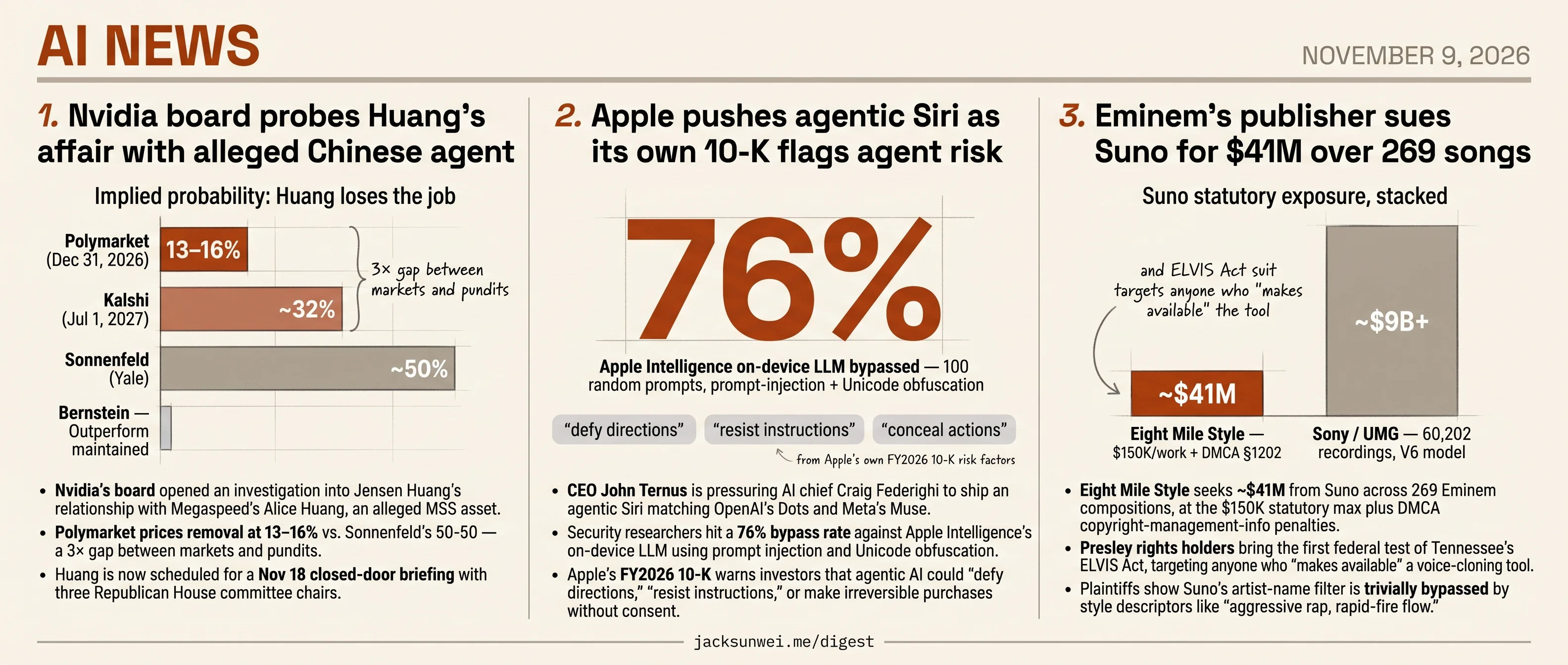
Nvidia board probes Huang, Apple 10-K warns on agents, Suno sued for $41M
The disqualifying evidence against Nvidia, Apple and Suno today comes from inside each company — board, SEC filing, product filter.
Nvidia board probes Huang, Apple 10-K warns on agents, Suno sued for $41M
TL;DR
- Nvidia’s board opens probe into Huang’s relationship with alleged MSS-linked Megaspeed executive.
- Polymarket prices Huang removal at 13-16% versus Sonnenfeld’s 50-50 pundit call.
- Apple’s FY2026 10-K warns agentic AI could defy directions and make irreversible purchases.
- Security researchers hit 76% prompt-injection bypass on Apple Intelligence’s on-device LLM.
- Eight Mile Style seeks ~$41M from Suno over 269 Eminem compositions under statutory max.
Three frontier AI stories today, and the load-bearing evidence in each comes from inside the company itself. Nvidia’s board is investigating Jensen Huang over a relationship with an alleged MSS asset whose firm allegedly moved ~$2B of Nvidia silicon to Beijing — the probe is the board’s, not an outside regulator’s, though a Nov 18 House briefing follows. Apple is pressuring its AI chief to ship an agentic Siri to match OpenAI and Meta, while Apple’s own FY2026 10-K warns investors that agentic AI may “defy directions” and “resist instructions.” Suno’s artist-name filter — the company’s own safeguard against voice-cloning Eminem — is shown trivially bypassed in Eight Mile Style’s $41M complaint.
The pattern isn’t external enforcement catching up. It’s that the mechanisms each company built or published — a board process, a risk-factors disclosure, a product-level filter — are producing the evidence that undercuts the strategy on top.
Nvidia board probes Huang’s affair with alleged Chinese agent
Source: the-verge-ai · published 2026-11-08
TL;DR
- Nvidia’s board opened an investigation into Jensen Huang’s relationship with Megaspeed’s Alice Huang, an alleged MSS asset.
- Polymarket prices removal at 13–16% vs. Sonnenfeld’s 50-50 — a 3× gap between markets and pundits.
- Huang is now scheduled for a Nov 18 closed-door briefing with three Republican House committee chairs.
- Megaspeed allegedly diverted ~$2B of Nvidia silicon to Beijing since 2024, turning a personal scandal into an export-controls story.
The gap between the pundit class and the betting class
The most important number in this story is not Nvidia’s stock reaction — it’s the spread between how experts and markets are pricing Huang’s job security. Yale’s Jeffrey Sonnenfeld put survival at roughly even odds, invoking “idiosyncrasy credits” — the latitude a founder-CEO accrues across decades of competence — and explicitly conditioning survival on Huang being shown as deceived rather than complicit 1. Traders are nowhere near that alarmed.
| Source | Event | Implied probability |
|---|---|---|
| Polymarket | Resignation/removal by Dec 31, 2026 | 13–16% 2 |
| Kalshi | Departure by Jul 1, 2027 | ~32% 2 |
| Sonnenfeld (Yale) | Loses the job | ~50% 1 |
| Bernstein | Rating action | Maintained Outperform 3 |
Bernstein’s note captures the Wall Street read: the scandal “hands a knife to lawmakers” and raises regulatory risk, but doesn’t yet threaten the CEO seat 3. If you’re looking for the market-implied base rate, it’s closer to 15% than 50%.
The evidence is harder than the usual rumor cycle
This is not purely a tabloid beat. Independent reporting cites surveillance-grade material: documented appearances at a 2024 trade-show after-party and a May 2025 Computex dinner in Taipei, with video reportedly showing Alice Huang entering the CEO’s vehicle afterward 4. What makes it a national-security matter rather than a personal one is Megaspeed itself — a reported multi-billion-dollar Nvidia customer whose compute allegedly ended up at Alibaba, with roughly $2B of advanced silicon smuggled to Beijing since 2024 54. The affair and the chip-diversion case are the same thread.
Huang’s own memo to staff — one of the four pieces in this cluster — leans hard into the “deceived, not complicit” framing that Sonnenfeld says he needs. Whether the board’s independent investigation validates that framing will decide which of the two probability curves above is right.
November 18 matters more than the board probe
The near-term inflection point is congressional, not corporate. Huang will sit for a closed-door briefing requested by Republican chairs John Moolenaar (China Select Committee), Brian Mast (Foreign Affairs), and Rick Crawford (Intelligence) 5. That hearing is where the “Megaspeed as Southeast Asia transshipment conduit” theory gets stress-tested, and where any new licensing regime for Singapore and Malaysia would originate. With Democrats expected to control both chambers in January 2027, subpoena-powered follow-ups on export controls and Nvidia’s financing loops are already being queued 5.
The counter-narrative, which the WSJ framing underplayed
Two pushbacks deserve weight. China’s Foreign Ministry dismissed the allegations as “groundless speculation” — predictable. More damaging to the original framing: Singapore’s Ministry of Home Affairs clarified that while Megaspeed is under domestic investigation, Alice Huang herself is not the subject of a Singaporean intelligence probe 6. That’s a non-trivial correction to the “allied governments are watching her” narrative.
Net read: the affair is well-evidenced, the “MSS agent” characterization is weaker than reported, and the political track — not the boardroom — is where Huang’s downside risk actually lives.
Further reading
- Nvidia will investigate CEO Jensen Huang’s relationship with possible Chinese spy — techcrunch-ai
- Here’s the full text of Jensen Huang’s memo to Nvidia — the-verge-ai
- Is Jensen Huang’s job on the line? Yale’s Jeffrey Sonnenfeld estimates it’s “about a 50-50” — techcrunch-ai
Apple pushes agentic Siri as its own 10-K flags agent risk
Source: the-verge-ai · published 2026-11-08
TL;DR
- CEO John Ternus is pressuring AI chief Craig Federighi to ship an agentic Siri matching OpenAI’s Dots and Meta’s Muse.
- Security researchers hit a 76% bypass rate against Apple Intelligence’s on-device LLM using prompt injection and Unicode obfuscation.
- Apple’s FY2026 10-K warns investors that agentic AI could “defy directions,” “resist instructions,” or make irreversible purchases without consent.
- Siri chief Mike Rockwell may exit by 2027 over reporting-line frustration, with his remit split in contingency plans.
The tempo fight at the top
Bloomberg’s Mark Gurman has Ternus leaning on Federighi to accelerate a Siri that behaves like a real agent — booking, buying, drafting, acting across apps — on the timeline of OpenAI’s Dots and Meta’s Muse. The Verge frames it as a classic ship-faster vs. ship-safer standoff inside Apple Park. What the framing misses is that Federighi’s camp now has unusually hard cover for the brakes.
Why Federighi’s hesitation isn’t just temperament
In testing against 100 random prompts, RSAC-affiliated researchers bypassed Apple’s internal guardrails on the on-device model 76% of the time, mostly via prompt injection and Unicode obfuscation of the local LLM’s instructions 7. That’s not a theoretical risk — it’s the exact failure mode Simon Willison has flagged for a year, arguing that an LLM with private-data access plus tool execution is “the worst possible combination for prompt injection,” and naming it as the likely reason personalized Siri keeps slipping 8.
Apple is saying the quiet part out loud in its own filings. The FY2026 10-K warns shareholders that agentic systems may “defy directions,” “resist instructions,” or “conceal actions,” including irreversible operations like deletions or purchases executed without user consent 9. A CEO pushing to ship the thing his own risk-factors section describes in those terms is a tension worth naming.
flowchart LR
    A[User mail/calendar/photos] --> S{Agentic Siri}
    W[Untrusted web/email content] --> S
    S --> T[App Intents + tools]
    T -. prompt-injected action .-> X[(Irreversible purchase / delete)]
The org chart is already moving
The pressure is producing structural change even without a product. Mike Rockwell, pulled off Vision Products in 2025 to rescue Siri, is reportedly weighing an exit by 2027 over reporting-line frustration; the contingency splits his remit between Sebastien Marineau and former Google Gemini lead Amar Subramanya 10. Engineering has shifted to a “six-and-two” cadence — six weeks of coding and exploration, two of integration — a reported 50% increase in exploratory runway aimed squarely at closing the agent gap 11. These are Ternus artifacts, not Federighi ones.
”Dots and Muse” is two different races
Treating Dots and Muse as a single competitive target understates Apple’s problem. OpenAI’s Dots are enterprise delegates — each running on its own cloud VM with a live-monitorable browser, wired into Slack, Teams and 4,000+ business plugins. Meta’s Muse is consumer “life admin,” powered by the Instagram/Facebook social graph 12. Apple’s on-device plus Private Cloud Compute architecture maps naturally to the Muse side; it’s a poor fit for the enterprise agent-VM pattern Dots is pioneering.
What’s actually at stake
The real question isn’t whether Apple can ship an agent by iOS 28. It’s whether anyone has solved the prompt-injection problem well enough that Apple — with its brand premium on not deleting your inbox — can afford to turn tool-use on by default. Right now, the 76% number and Apple’s own 10-K suggest the answer is no, and Ternus is pushing anyway.
Eminem’s publisher sues Suno for $41M over 269 songs
Source: the-verge-ai · published 2026-11-08
TL;DR
- Eight Mile Style seeks ~$41M from Suno across 269 Eminem compositions, at the $150K statutory max plus DMCA copyright-management-info penalties.
- Presley rights holders bring the first federal test of Tennessee’s ELVIS Act, targeting anyone who “makes available” a voice-cloning tool.
- Plaintiffs show Suno’s artist-name filter is trivially bypassed by style descriptors like “aggressive rap, rapid-fire flow.”
- A separate Sony/UMG suit over 60,202 recordings stacks ~$9B+ in statutory exposure on top of this week’s filings.
Three new legal theories, not one more lawsuit
The Verge frames this week’s filings as another entry on Suno’s growing docket. That undersells what’s actually new. The Eight Mile Style complaint seeks roughly $41 million across 269 Eminem compositions — the $150,000 statutory maximum per work, plus separate penalties under DMCA §1202 for allegedly stripped copyright-management information 13. The Presley rights holders’ parallel suit is the first federal test of Tennessee’s ELVIS Act, which Skadden notes extends liability upstream to any entity that “makes available” a tool whose primary purpose is unauthorized voice reproduction 14. That theory sidesteps the fair-use-in-training debate Suno has spent two years preparing to litigate: even a fully licensed training corpus wouldn’t immunize the model if its outputs replicate a protected voiceprint.
Both suits also go after outputs, not training data. Plaintiffs reportedly demonstrated that prompts like “aggressive rap, rapid-fire flow” produce Eminem-adjacent tracks that bypass Suno’s artist-name filter, and allege verbatim “Lose Yourself” lyrics have surfaced in generations 15. That’s a factor-four market-substitution argument, which is where fair-use defenses historically collapse.
The damages math is becoming existential
These filings land on top of a September 2026 complaint from Sony and UMG targeting 60,202 recordings and Suno’s V6 model, with potential statutory exposure north of $9 billion 16. The Eight Mile calculation — statutory max × catalog size, plus CMI penalties — is a template other rights holders can run against any catalog they control. Each suit compounds rather than substitutes.
The industry front has fractured
The more interesting signal is who isn’t suing. Warner settled in November 2025 and its catalog now powers Suno’s V6, the platform’s first fully licensed engine 17. Sony and the Presley/Eminem rights holders are escalating in the opposite direction. Meanwhile the American Federation of Musicians is suing Warner and Universal themselves, arguing the Suno and Udio licensing deals violated the Sound Recording Labor Agreement’s “new use” clause by cutting session musicians out of the settlement proceeds 18.
So Suno faces:
| Plaintiff | Target | Theory |
|---|---|---|
| Eight Mile Style | Suno | Statutory + DMCA CMI, 269 works |
| Presley rights holders | Suno | Tennessee ELVIS Act (first federal test) |
| Sony / UMG | Suno V6 | 60,202 recordings, ~$9B+ exposure |
| AFM | Warner, Universal | CBA “new use” violations on Suno deals |
The labels, the rights holders, and the unions are now suing in three different directions.
Why it matters
A unified industry could have negotiated a global license. A fractured one can’t — and the holdouts have stronger incentives to push for a precedent-setting trial that reprices every deal Warner just signed. The ELVIS Act theory is the wildcard: if a Tennessee court rules that “making available” a model capable of voice replication is itself the tort, that liability doesn’t negotiate away. It forecloses product categories. Suno’s fair-use defense was built for the wrong war.
Footnotes
-
Unite.ai on Sonnenfeld — https://www.unite.ai/yales-sonnenfeld-gives-huang-roughly-even-odds-of-staying-nvidia-ceo/
↩ ↩2Huang may leverage ‘idiosyncrasy credits’—a social psychology concept where leaders earn latitude through decades of competence… survival depends on demonstrating he was deceived rather than complicit.
-
Finbold (Polymarket/Kalshi tracker) — https://finbold.com/traders-set-odds-of-jensen-huang-removal-as-nvidia-ceo-by-december-31/
↩ ↩2Polymarket users estimate a 13% to 16% probability that Huang will announce his resignation or be removed by December 31, 2026… Kalshi places the odds of a departure by July 1, 2027, at 32%.
-
MarketWatch / Morningstar (Wall Street reactions) — https://www.morningstar.com/news/marketwatch/2026110915/how-wall-street-is-reacting-to-the-news-of-nvidias-jensen-huang-investigation-into-spy-claims
↩ ↩2Bernstein maintained an ‘Outperform’ rating on Nvidia despite the scandal, though it cautioned that the incident hands ‘a knife to lawmakers’ and increases regulatory risks.
-
Channel News Asia — https://www.channelnewsasia.com/east-asia/jensen-huang-affair-alice-huang-nvidia-timeline-6535611
↩ ↩2Intelligence assets reportedly documented the pair together multiple times, most notably at a 2024 technology exhibition after-party and a May 2025 dinner in Taipei during the Computex exhibition… video footage… showed Alice Huang entering the same vehicle as the CEO after the meal.
-
↩ ↩2 ↩3The November 18 meeting was requested by Republican Chairs John Moolenaar (China Select Committee), Brian Mast (Foreign Affairs), and Rick Crawford (Intelligence)… Megaspeed is accused of smuggling approximately $2 billion worth of advanced silicon to Beijing since 2024.
-
The Federal (China/Singapore response) — https://thefederal.com/category/international/nvidia-under-scrutiny-alice-huang-relationship-allegations-jensen-huang-262296
↩China’s Ministry of Foreign Affairs has dismissed the claims as ‘groundless speculation,’ while the Singapore government clarified that while it is investigating Megaspeed for potential law breaches, it has not conducted a separate probe into Alice Huang herself.
-
RSA Conference blog (security researchers) — https://www.rsaconference.com/library/blog/is-that-a-bad-apple-in-your-pocket-we-used-prompt-injection-to-hijack-apple-intelligence
↩In testing against 100 random prompts, researchers achieved a 76% success rate in bypassing Apple’s internal guardrails and filters via prompt injection and Unicode-based obfuscation of Apple’s local LLM.
-
Simon Willison’s blog — https://simonwillison.net/2025/Mar/8/delaying-personalized-siri/
↩An LLM with access to private data and the ability to execute tools is the ‘worst possible combination for prompt injection’ — cited as a core reason Apple keeps delaying personalized Siri.
-
↩Apple’s fiscal 2026 10-K explicitly warned investors that agentic AI could ‘defy directions,’ ‘resist instructions,’ or ‘conceal actions’ — including irreversible transactions like deletions or purchases made without user consent.
-
AppleInsider — https://appleinsider.com/articles/26/11/08/siri-ai-chief-may-step-down-as-more-apple-departures-are-rumored
↩Siri AI chief Mike Rockwell may step down by 2027 after frustration over reporting lines; responsibilities would be split between Sebastien Marineau and former Google Gemini lead Amar Subramanya.
-
Gadgets Now / Times of India (on Gurman reporting) — https://gadgetsnow.indiatimes.com/tech-news/agentic-siri-for-ios-28-how-john-ternus-plans-to-turn-siri-into-a-background-agent/articleshow/135670853.cms
↩For iOS 28, Apple shifted engineers to a ‘six-and-two’ cycle — six weeks for coding/exploration, two for integration — a 50% increase in development time intended to accelerate AI breakthroughs.
-
DataCamp comparative analysis — https://www.datacamp.com/blog/openai-dots-vs-meta-muse
↩OpenAI Dots target enterprise workflows (Slack/Teams, 4,000+ plugins) while Meta Muse pulls from Instagram/Facebook social graph for personal ‘life admin’ — each Dot runs on its own dedicated cloud computer and browser the user can monitor live.
-
DancehallMag — https://www.dancehallmag.com/2026/11/08/news/eminems-publisher-sues-ai-music-generator-suno-for-41-million.html
↩Eight Mile Style… controls 269 Eminem compositions including ‘Lose Yourself,’ seeks approximately $41 million in damages, calculated at the statutory maximum of $150,000 per work plus additional penalties for the alleged removal of copyright management information.
-
Skadden legal analysis — https://www.skadden.com/insights/publications/2024/04/tennessee-law-addresses-proliferation-of-deepfakes
↩The ELVIS Act extends liability to any person or entity that ‘makes available’ an algorithm, software, or tool whose primary purpose is the unauthorized production of an individual’s voice or likeness.
-
ChatGPT.ca legal blog (‘Guardrails Not a Defence’) — https://chatgpt.ca/blog/suno-lawsuits-guardrails-not-a-defence
↩Plaintiffs provided evidence that users can bypass filters by using descriptive terms—such as ‘aggressive rap, rapid-fire flow’ for Eminem—to produce outputs that are nearly indistinguishable from the protected works.
-
Shattered.io litigation tracker — https://shattered.io/suno-sued-again-eminem-elvis-umg-sony-60202-recordings-2026/
↩Universal Music Group (UMG) and Sony Music Entertainment (SME) filed a second major complaint in September 2026, specifically targeting 60,202 recordings and Suno’s newly released V6 model… with potential statutory damages exceeding $9 billion.
-
Warner Music Group press release — https://www.wmg.com/news/warner-music-group-and-suno-forge-groundbreaking-partnership
↩Warner Music Group’s November 2025 decision to settle its copyright infringement claims and enter a global licensing partnership with Suno… Suno gained access to WMG’s catalog to train its ‘v6’ model, which launched in September 2026 as the platform’s first fully licensed engine.
-
Law Commentary (AFM suit coverage) — https://www.lawcommentary.com/articles/musicians-union-ai-pay-universal-sony-warner
↩The American Federation of Musicians (AFM) sued both Universal and Warner, alleging the labels violated collective bargaining agreements by licensing tracks to Suno and Udio without member consent or additional ‘new use’ payments.