Anthropic floats $1T IPO, OpenAI closes $11B, voters block 40 of 41 data centers
Anthropic and OpenAI price trillion-dollar valuations against mounting compute bills, while voters block 40 of 41 local data-center ballots.
Anthropic floats $1T IPO, OpenAI closes $11B, voters block 40 of 41 data centers
TL;DR
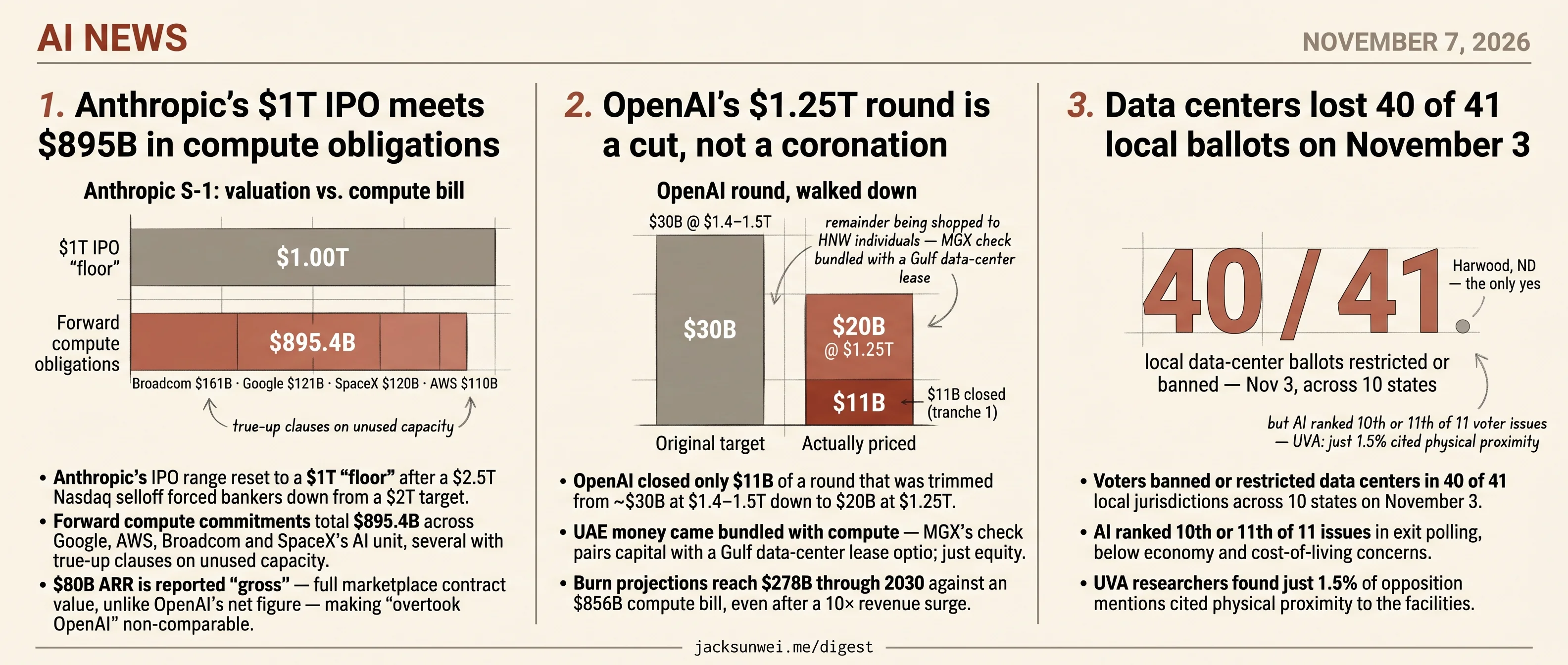
- Anthropic sets a $1T IPO floor against $895B in forward compute commitments.
- OpenAI closed $11B of a round trimmed from $20B at a $1.25T valuation.
- Voters rejected data centers in 40 of 41 local jurisdictions on November 3.
- Google absorbs Crusoe’s stalled Wyoming AI data-center build-out.
- Protesters breached Microsoft’s Amsterdam data-center construction site.
Today’s frontier-lab news comes in pairs that don’t flatter each other. Anthropic sets a $1T IPO floor — down from a $2T target — while its S-1 books $895B in forward compute commitments and reports an $80B ARR figure that isn’t comparable to OpenAI’s. OpenAI, meanwhile, closed just $11B of a round originally sized at $30B, now capped at $20B and a $1.25T valuation, with UAE money tied to a Gulf data-center lease rather than clean equity. Both stories are priced above their own counter-numbers.
The third feature is the ground those numbers stand on. On November 3, voters banned or restricted data centers in 40 of 41 jurisdictions across 10 states, even as AI ranked dead last among exit-poll issues. The round-ups extend the thread: Google is absorbing a stalled Crusoe site in Wyoming, and Dutch activists breached a Microsoft construction site outside Amsterdam. The capital stack keeps growing; the physical and political substrate under it keeps pushing back.
Anthropic’s $1T IPO meets $895B in compute obligations
Source: latent-space · published 2026-11-07
TL;DR
- Anthropic’s IPO range reset to a $1T “floor” after a $2.5T Nasdaq selloff forced bankers down from a $2T target.
- Forward compute commitments total $895.4B across Google, AWS, Broadcom and SpaceX’s AI unit, several with true-up clauses on unused capacity.
- $80B ARR is reported “gross” — full marketplace contract value, unlike OpenAI’s net figure — making “overtook OpenAI” non-comparable.
- Enterprise AI token spend grew just 1.5% in Aug–Sep, after 42% MoM in July, right as the S-1 lands.
The valuation walk-down
The $1–1.5T range Latent Space cites is already the compressed number. Independent reporting has Anthropic entering Q4 targeting as much as $2T before an early-November tech rout wiped $2.5T off the Nasdaq and institutional investors pushed bankers toward a $1T “floor” 1. That reset is the backdrop for every other number in the S-1: a 1,127% YoY revenue curve priced against a market that just decided AI exposure needs a haircut.
The timing is awkward in another way. Ramp’s card-and-invoice data — the cleanest real-time read on enterprise AI spend — shows token purchases grew just 1.5% month-over-month in August and September after a 42% July. Pair that with Gartner’s forecast that 40% of agent projects get abandoned by 2027, and the 94% of CIOs who say their data isn’t clean enough for agents in the first place, and the demand curve underwriting a trillion-dollar valuation looks softer than the ARR headline 2.
The $895B asterisk
The number independent analysts keep circling isn’t revenue — it’s Anthropic’s $895.4B in non-cancelable compute obligations: $121B to Google through 2033, $110B to AWS through 2036, $161B to Broadcom, ~$120B to SpaceX’s AI unit. Several contracts carry true-up clauses requiring Anthropic to pay the difference if actual usage falls below committed levels 3.
Michael Burry: Anthropic “is betting its entire existence on optimism.” Jeffrey Gundlach called the company’s investment-grade credit aspiration “simply absurd.” 4
Against that liability stack, Anthropic holds roughly $96–132B in cash. The H1 2026 net loss of $80.7B is mostly non-cash convertible-note revaluation, but the underlying operating line swung from a $974M Q2 profit back to a $567M Q3 loss as compute spend re-accelerated 45. The “profitable at the model layer” story is doing a lot of work.
Gross vs. net, and the circular money
The detail the Latent Space framing skips is the accounting posture. Anthropic books gross revenue — the full value of contracts sold through AWS and GCP marketplaces — while OpenAI reports net, counting only the portion it retains 6. The “Anthropic overtook OpenAI” storyline falls apart once you normalize.
It also matters because Ed Zitron and Gary Marcus estimate ~44–48% of Anthropic’s revenue flows through the cloud marketplaces of the same hyperscalers funding it and selling it compute — Amazon and Google are simultaneously investor, supplier, and distribution channel 5. Zitron separately alleges “brutal” pre-IPO tactics: temporary discounts offered to startups, then withdrawn unless customers signed larger long-term commitments, specifically to lift the run-rate number ahead of the filing 5.
What’s actually being priced
The IPO will almost certainly clear. The question is whether the market prices the $80B gross ARR and the Model 4 capability jump, or the $895B obligation stack, the gross-vs-net asterisk, and a Ramp curve that just went flat. The dissent isn’t fringe — it’s Burry, Gundlach, Marcus, and the company’s own auditors sitting between the roadshow deck and the clearing price.
Further reading
OpenAI’s $1.25T round is a cut, not a coronation
Source: techcrunch-ai · published 2026-11-06
TL;DR
- OpenAI closed only $11B of a round that was trimmed from ~$30B at $1.4–1.5T down to $20B at $1.25T.
- UAE money came bundled with compute — MGX’s check pairs capital with a Gulf data-center lease option, not just equity.
- Burn projections reach $278B through 2030 against an $856B compute bill, even after a 10× revenue surge.
- Anthropic’s imminent IPO — $33.2B revenue in 9 months, ~80% enterprise — is about to reset frontier-lab multiples.
The headline hides a downshift
The $1.25T sticker is doing a lot of work. OpenAI originally shopped this round at roughly $30B on a $1.4–1.5T valuation; what actually priced is a $20B target at $1.25T, with only the first $11B tranche closed and anchors MGX, SoftBank, Coatue and T. Rowe Price carrying it 7. Bankers are reportedly opening a later tranche to high-net-worth individuals to fill the remainder — a tell that institutional appetite for more OpenAI paper at this mark has thinned 7.
The MGX piece is the most interesting structural wrinkle. The UAE commitment comes paired with a “compute option” that lets OpenAI lease Gulf-region data-center capacity against the investment 8. That’s not a pure equity round — it’s capital and capacity bundled, which makes the headline valuation harder to compare against earlier marks and quietly moves some of OpenAI’s infrastructure spend off its own balance sheet.
The burn math the deck doesn’t show
Michael Burry used the raise to argue markets should “tank hard” before OpenAI and Anthropic reach public investors, calling the frontier labs “destined to suck up and then destroy TRILLIONS of dollars of capital” 9. That’s rhetoric, but it sits on top of real numbers. Leaked projections put OpenAI’s cumulative free-cash-flow burn at roughly $278B through 2030 against an $856B compute bill — a tenfold revenue surge that still doesn’t close the gap 10.
“Destined to suck up and then destroy TRILLIONS of dollars of capital.” — Michael Burry 9
The political layer is unpriced in the valuation. CFO Sarah Friar’s late-2025 suggestion that Washington could “backstop” AI financing drew a sharp response from Senator Warren, who accused OpenAI of trying to “socialize losses while privatizing profits”; Altman publicly disavowed any federal guarantees shortly after 11. The round also closes after a Democratic midterm sweep in which 40 of 41 local ballot measures restricted data-center build-outs, forcing OpenAI’s “National Community Compact” pledge to cover grid and electricity costs itself — a new capex layer that isn’t in the $1.25T math 11.
Anthropic is about to mark the comp
The tell on why now is Anthropic. Its S-1 shows $33.2B of revenue in the first nine months of 2026, roughly 80% from enterprise, and a brief quarterly operating profit — a materially different financial shape from OpenAI’s consumer-heavy, loss-making base 12. Bankers have already walked Anthropic’s IPO target down from ~$2T toward $1.0–1.3T, which is the band OpenAI just priced into 712. Closing before Anthropic trades means OpenAI gets to set its own mark instead of inheriting one.
What this round actually says
Read against the burn curve, the trimmed target, the tranching, the UAE compute swap, and the Anthropic clock, this is a raise closed under time pressure — not a breakout. The $1.25T number will be quoted for months; the fact that institutions wouldn’t fund the full $30B at $1.5T is the part that matters for the next round.
Further reading
Data centers lost 40 of 41 local ballots on November 3
Source: the-verge-ai · published 2026-11-06
TL;DR
- Voters banned or restricted data centers in 40 of 41 local jurisdictions across 10 states on November 3.
- AI ranked 10th or 11th of 11 issues in exit polling, below economy and cost-of-living concerns.
- UVA researchers found just 1.5% of opposition mentions cited physical proximity to the facilities.
- A federal AI Litigation Task Force, stood up December 2025, is built to sue state moratoriums back into line.
The ballot math is more lopsided than the takes
The Vergecast’s “Big Tech lost big” headline understates the raw numbers. Of 41 data-center measures on local ballots across 10 states, voters restricted or blocked facilities in 40 — Edgewater, FL passed a ban with 77%, Ashville, OH killed an existing EdgeConneX deal with 81%, and only Harwood, ND went the industry’s way 13. Statewide, Democratic gubernatorial winners in Texas, Georgia and Ohio campaigned on explicit moratoriums, and Goldman Sachs analysis cited post-election puts the newly-hostile states at roughly 45% of planned U.S. capacity.
Virginia’s Spanberger didn’t wait for the results. Executive Order 22, signed pre-election, kills the NDAs that used to shield site deals from residents and caps state economic assistance for any facility drawing more than 25 MW 14. Expect the template to travel.
But was it actually a vote on AI?
Two independent threads puncture the clean “referendum” narrative. TIME’s post-election analysis has AI and data centers dead last among voter priorities — 10th or 11th of 11 — while 84% cited economy and cost of living as “very important” 15. The Blue Wave fits ordinary midterm-curse math without invoking AI at all.
The UVA National Security Institute’s survey, released the same day as the Vergecast episode, goes further:
Only 1.5% of survey responses mentioned physical distance; opposition functions as a proxy for a broader crisis of trust in AI and the federal government. 16
Randomized tests found environmental pledges performed no better than generic school-investment pitches at softening opposition. Direct cash to households was the only lever that moved numbers, and even that failed to flip majorities. If voters are mad about anything concrete, it’s utility bills — not latency zones.
The loss isn’t evenly distributed
Bisnow’s reporting on the post-election industry call notes the asymmetry Patel’s framing flattens: Google, Amazon and Equinix can absorb a 50-state patchwork by site-shopping, and most signed the March 2026 Ratepayer Protection Pledge. Leveraged neocloud providers like CoreWeave don’t have the balance sheet to relocate a rejected project 17. When a Virginia county says no, a hyperscaler moves to Mississippi; a neocloud takes a writedown.
Federally, the counter-move is already built. The Trump administration stood up an AI Litigation Task Force in December 2025 to challenge state laws deemed not “minimally burdensome,” Commerce has floated withholding BEAD broadband funds from states with “onerous” AI rules, and BLM land in AZ/NV/UT/OR offers a zoning workaround that routes around county boards entirely 18.
What’s actually at stake
The electoral facts are real and the 40-of-41 margin is genuinely striking. But the next two years look less like Big Tech’s Waterloo and more like a jurisdictional trench war: local bans vs. federal preemption, hyperscaler site-shopping vs. stranded neocloud capex, and a voter mood that’s about affordability, with AI as the nearest available target.
Further reading
- How a Blue Wave midterm might reshape the AI industry — techcrunch-ai
- After the midterms, is the AI industry in for a rough two years? — techcrunch-ai
- All the latest updates on AI data centers — the-verge-ai
- Quoting Nilay Patel — simon-willison
Round-ups
Google buys Crusoe’s troubled Wyoming AI data center project
Source: techcrunch-ai
Google is acquiring a stalled Crusoe-developed data center site in Wyoming, taking over a build-out that ran into execution challenges. The deal underscores how difficult siting and powering gigawatt-scale AI campuses has become, even for well-capitalized developers.
Protesters storm Microsoft data center construction site in Amsterdam
Source: the-verge-ai
Around 100 members of Dutch activist group Geef Tegengas breached a Microsoft construction site on Amsterdam’s outskirts, Reuters reports. The protest targets plans for three 85-meter data center towers, part of growing European backlash against the land, power, and water demands of AI infrastructure.
China’s MSS recruited Megaspeed exec to spy on Jensen Huang
Source: the-verge-ai
Chinese intelligence enlisted Megaspeed executive Alice Huang to gather information on Nvidia’s advanced AI chips and pressure the company to sell its top silicon in China, The New York Times reports. The Ministry of State Security operation targeted CEO Jensen Huang directly.
Agility Robotics lists on Nasdaq, testing humanoid robot hype
Source: ars-technica-ai
Agility Robotics, the US leader in commercial humanoid deployments through its Digit warehouse robot, has gone public on the Nasdaq. The listing gives investors their first clean read on humanoid-robot economics after years of private valuations built largely on demos.
OpenAI taps Hacktron to hunt vulnerabilities with frontier AI
Source: openai-blog
OpenAI is partnering with security startup Hacktron to probe its own systems for flaws, stress-test third-party integrations, and harden defenses. The collaboration applies frontier models to offensive security work, extending OpenAI’s push to use its own technology for internal red-teaming.
Hundreds of Artex pen-testing servers sit exposed on the open web
Source: techcrunch-ai
Security researchers found hundreds of internet-facing servers running Artex, an AI-assisted penetration testing tool, with no access controls. Anyone who stumbles onto them can wield offensive hacking capabilities meant for authorized red teams, turning the misconfiguration into a ready-made attacker toolkit.
Underdog squeezes speech and music generation into a 32MB model
Source: techcrunch-ai
Underdog demoed a 32MB model that generates both speech and music, a footprint small enough to run comfortably on-device. The size pitch targets local AI deployments where latency, cost, and privacy rule out cloud-scale audio models.
Footnotes
-
Unite.AI — ‘Anthropic IPO Valuation Expectations Fall After Technology Selloff’ — https://www.unite.ai/anthropic-ipo-valuation-expectations-fall-after-technology-selloff/
↩Anthropic now faces intense pressure from major institutional investors to reset its expectations toward a $1 trillion ‘floor’ following a brutal $2.5 trillion market-wide technology sell-off in early November 2026.
-
Medium / mygom.tech — ‘Why Companies Delay AI Adoption 2026’ — https://medium.com/@mygom.tech/why-companies-delay-ai-adoption-2026-8-doubts-7d9acd4cbb2b
↩Roughly 94% of CIOs believe their internal data requires significant ‘cleanup’ before it can support advanced AI agents… Gartner warns that up to 40% of current AI agent projects may be abandoned by 2027 if organizations cannot demonstrate clear ROI.
-
Agentic AI Hype Substack — ‘Anthropic’s $895B Compute Bill’ — https://agenticaihype.substack.com/p/anthropics-895b-compute-bill-fals
↩Total future compute and infrastructure commitments reach $895.4 billion… including $121.3 billion to Google through 2033, $110 billion to AWS through 2036, $161.2 billion to Broadcom, and roughly $120.5 billion to SpaceX’s AI unit — with ‘true-up’ provisions requiring Anthropic to pay the difference if actual usage falls below committed levels.
-
TradingView / Stocktwits — Michael Burry on amended S-1 — https://www.tradingview.com/news/stocktwits:7b7e2d00b094b:0-anthropic-is-betting-its-entire-existence-on-optimism-michael-burry-flags-risks-after-ai-firm-s-updated-s-1-says-won-t-pursue-ipo-shares/
↩ ↩2Michael Burry flagged that Anthropic ‘is betting its entire existence on optimism,’ while DoubleLine’s Jeffrey Gundlach called Anthropic’s hope for an investment-grade credit rating ‘simply absurd’ given its massive liabilities.
-
Business Insider — Ed Zitron / Gary Marcus critique — https://www.businessinsider.com/anthropic-revenue-ipo-ai-doomer-tech-investing-2026-10
↩ ↩2 ↩3Nearly half of Anthropic’s revenue is effectively routed through the cloud marketplaces of the same companies that provide its funding and compute infrastructure… Zitron also alleged Anthropic employed ‘brutal’ tactics to pump revenue ahead of the IPO, offering temporary discounts to startups that were later withdrawn unless they committed to higher long-term spending.
-
r/BetterOffline — Anthropic vs OpenAI revenue accounting — https://www.reddit.com/r/BetterOffline/comments/1wv0axn/anthropic_vs_openai_difference_in_reported_revenue/
↩Auditors noted that Anthropic records ‘gross’ revenue — including the full value of contracts sold via cloud partners like Amazon — while OpenAI reports ‘net’ revenue, counting only the portion it retains.
-
NAI500 — tranche mechanics — https://nai500.com/blog/2026/11/openai-completes-first-tranche-of-new-funding-round-as-ai-market-investment-sentiment-turns-cautious/
↩ ↩2 ↩3OpenAI completes first tranche of new funding round as AI market investment sentiment turns cautious
-
Forbes — Yildiz on UAE compute-for-capital — https://www.forbes.com/sites/guneyyildiz/2026/11/02/openai-cuts-round-to-20-billion-as-uae-investors-pair-capital-with-compute-capacity/
↩OpenAI cuts round to $20 billion as UAE investors pair capital with compute capacity
-
Benzinga — Michael Burry on AI IPOs — https://www.benzinga.com/markets/tech/26/09/62096939/michael-burry-openai-anthropic-ipos-markets-humanity
↩ ↩2markets should ‘tank hard’ to prevent OpenAI and Anthropic from reaching public markets… destined to suck up and then destroy TRILLIONS of dollars of capital
-
Tom’s Hardware — burn-rate projection — https://www.tomshardware.com/tech-industry/artificial-intelligence/openai-projections-point-to-a-massive-usd278-billion-cash-burn-through-2030-that-exceeds-the-national-budgets-of-indonesia-and-norway-usd856-billion-compute-tab-outpaces-tenfold-revenue-surge
↩OpenAI projections point to a massive $278 billion cash burn through 2030… $856 billion compute tab outpaces tenfold revenue surge
-
Unite.ai — CFO Friar and the federal-backstop backlash — https://www.unite.ai/openai-cfo-says-data-center-buildout-will-continue-after-midterms/
↩ ↩2Senator Elizabeth Warren accused the company of attempting to ‘socialize losses’ while ‘privatizing profits’… Altman stated that OpenAI ‘does not have or want’ government guarantees
-
NewMarketPitch — Anthropic IPO benchmark — https://newmarketpitch.com/blogs/news/frontier-ai-labs-anthropic-ahead-openai
↩ ↩2Anthropic reported $33.2 billion in revenue for the first nine months of 2026, a 12-fold increase… roughly 80% of its revenue from business customers
-
↩Voters opted to restrict or ban data centers in 40 of 41 jurisdictions where measures appeared on local ballots across 10 states on November 3, 2026.
-
Williams Mullen legal brief on Virginia EO 22 — https://www.williamsmullen.com/insights/news/legal-news/new-rules-virginia-data-centers-what-developers-need-know-about-eo-22-and
↩Executive Order 22 establishes a Data Center Accountability Framework that bans new NDAs shielding project details and limits state economic assistance for any facility requiring more than 25 megawatts.
-
TIME — https://time.com/article/2026/11/04/midterm-elections-results-ai-industry-data-centers/
↩AI and data centers consistently ranked near the bottom of voter priorities — 10th or 11th of 11 issues — while ~84% of voters cited the economy and cost of living as ‘very important.’
-
UVA National Security Institute (Maura Austin, Substack) — https://aiatuva.substack.com/p/the-data-center-backlash-isnt-about
↩The Data Center Backlash Isn’t About Data Centers — only 1.5% of survey responses mentioned physical distance; opposition functions as a proxy for a broader crisis of trust in AI and the federal government.
-
↩After the electoral wipeout, hyperscalers can absorb a ‘patchwork’ of state rules by site-shopping, but smaller neocloud providers like CoreWeave lack the capital flexibility to relocate rejected projects.
-
Bipartisan Policy Center — https://bipartisanpolicy.org/explainer/strategic-federal-actions-aim-to-strengthen-ai-and-energy-infrastructure/
↩The administration established an AI Litigation Task Force in December 2025 to challenge state laws deemed not ‘minimally burdensome,’ and has explored withholding BEAD broadband funds from states with ‘onerous’ AI rules.