OpenAI floats 5%, Microsoft embeds 6,000, AI Engineer backs constrained loops
OpenAI offers Washington 5% equity, Microsoft commits 6,000 deployment engineers, and AI Engineer backs constrained loops over autonomous agents.
OpenAI floats 5%, Microsoft embeds 6,000, AI Engineer backs constrained loops
TL;DR
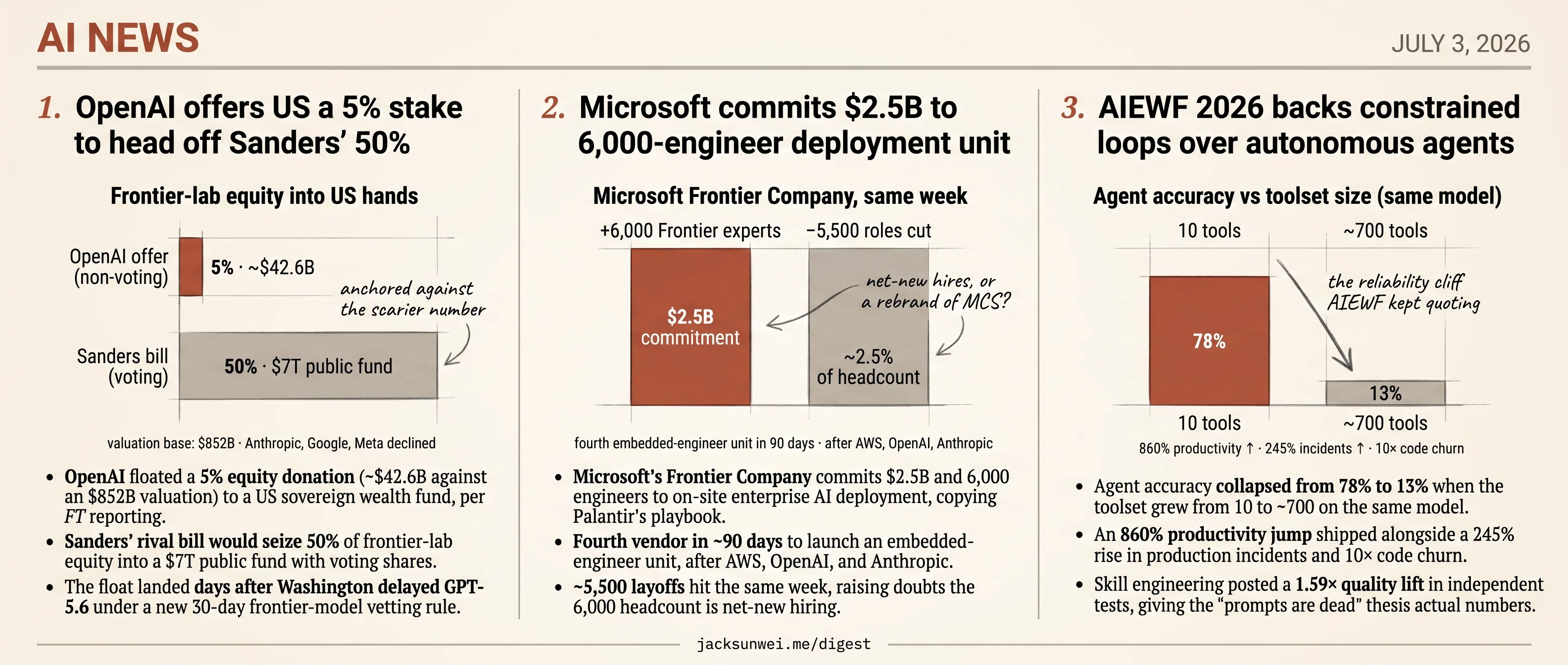
- OpenAI floated 5% equity (~$42.6B) to a US sovereign wealth fund to head off Sanders’ 50% bill.
- Microsoft committed $2.5B and 6,000 engineers to on-site enterprise AI deployment, copying Palantir.
- AI Engineer 2026 backed constrained loops as agent accuracy fell from 78% to 13% at 700 tools.
- Anthropic opened Samsung chip talks, extending the frontier-lab push to diversify off Nvidia.
- Google’s electricity use jumped 37% in 2025 on AI buildout, straining its net-zero pledges.
Today’s AI news is unusually light on model launches and unusually heavy on the structures around them. OpenAI is floating a 5% equity donation to a US sovereign wealth fund — an attempt to defuse Bernie Sanders’ rival bill that would seize half of frontier-lab equity outright, and one Anthropic, Google and Meta declined to cosign. Microsoft is copying Palantir’s playbook with a $2.5B, 6,000-engineer embedded deployment unit — the fourth vendor in 90 days to concede that enterprise AI needs bodies on-site, not just API keys. And at the AI Engineer World’s Fair, the consensus swung hard toward constrained loops after benchmarks showed agent accuracy collapsing from 78% to 13% as toolsets grew past 700. Three different bets, one shared premise: the model itself is no longer where the interesting moves are being made.
OpenAI offers US a 5% stake to head off Sanders’ 50%
Source: ars-technica-ai · published 2026-07-02
TL;DR
- OpenAI floated a 5% equity donation (~$42.6B against an $852B valuation) to a US sovereign wealth fund, per FT reporting.
- Sanders’ rival bill would seize 50% of frontier-lab equity into a $7T public fund with voting shares.
- The float landed days after Washington delayed GPT-5.6 under a new 30-day frontier-model vetting rule.
- Anthropic, Google and Meta declined to follow, leaving Altman’s “all-labs” pitch as a solo act.
An anchor, and a counter-offer
Sam Altman’s proposal to hand the US government a 5% non-voting stake in OpenAI reads less like generosity than a hedge priced against a much scarier alternative. Bernie Sanders’ American AI Sovereign Wealth Fund Act would impose a one-time 50% stock tax on OpenAI, Anthropic and xAI, transferring half their equity into a $7 trillion public fund with voting shares, board representation, and an “Independent Commission for Democratic AI” attached 1. Against that anchor, 5% of an $852B valuation — roughly $42.6B, non-voting, donated — is the low ball you make to keep the high ball off the table.
The convergence is what should catch attention: Trump and Sanders now agree on the principle of public ownership of frontier AI. They differ by an order of magnitude on price and by everything on control.
The Intel template, minus the outlay
The maneuver isn’t invented from scratch. CSIS has documented an “equity-for-grants” pattern the administration built at Intel, where $8.9B in CHIPS Act and Secure Enclave grants were converted into ~433 million non-voting shares — a 9.9% federal stake — with the same template now being extended to IBM in quantum and MP Materials in rare earths 2.
The asymmetry matters. Intel’s deal converted existing federal outlays into equity. OpenAI’s proposal costs Washington nothing upfront, which is precisely what critics call the tell. Bradley Tusk of Tusk Ventures told CNBC the proposal “makes zero sense” from a regulatory perspective, arguing the government cannot impartially oversee a company in which it holds a multi-billion-dollar interest 3. Regulator-as-shareholder is the fault line every serious critique returns to.
The silence around the table
Equally revealing is who isn’t negotiating. Anthropic has reportedly held no equivalent talks, and Google and Meta have declined to comment, with analysts noting their public shareholders would resist the dilution 4. Altman’s framing of an industry-wide “AI sovereign wealth fund” is, at the moment, a solo act. If it stays that way, the practical outcome is a two-tier market in which state-aligned OpenAI enjoys procurement and export-license tailwinds while peers absorb regulatory friction.
The cap-table math also complicates the vendor-friendly spin. Microsoft’s recently finalized 27% stake in the new OpenAI Group PBC is valued at ~$135 billion with IP rights through 2032 5 — and any fresh 5% issuance to the Treasury dilutes it. Redmond’s silence on the proposal is its own data point.
Why now
The timing is the loudest signal. The float landed days after the administration invoked its June 2026 executive-order authority to delay GPT-5.6’s launch under a new 30-day frontier-model vetting regime, and briefly slapped an export-control embargo on Anthropic’s Mythos model in the same window 6. Read in that sequence, 5% isn’t a public-wealth policy — it’s political insurance ahead of an IPO, priced by a regulator that just proved it can freeze shipments.
What OpenAI is buying, if the deal clears, is a shareholder who is also its licensor. What everyone else is buying is a competitor whose regulator has skin in the game.
Further reading
- OpenAI proposed donating 5% of its equity to a US sovereign wealth fund — techcrunch-ai
- OpenAI floats giving Trump administration 5 percent cut of AI boom — the-verge-ai
Microsoft commits $2.5B to 6,000-engineer deployment unit
Source: techcrunch-ai · published 2026-07-02
TL;DR
- Microsoft’s Frontier Company commits $2.5B and 6,000 engineers to on-site enterprise AI deployment, copying Palantir’s playbook.
- Fourth vendor in ~90 days to launch an embedded-engineer unit, after AWS, OpenAI, and Anthropic.
- ~5,500 layoffs hit the same week, raising doubts the 6,000 headcount is net-new hiring.
- Subsidized deployment sells Azure consumption and the new $99/user Frontier Suite tier.
An embedded-engineer arms race, and Microsoft is late
Microsoft’s newly-announced Frontier Company — $2.5B, 6,000 “Frontier experts” deployed into enterprise accounts — is the fourth major forward-deployed engineering launch from a frontier vendor in roughly 90 days. AWS committed $1B to its own unit two days earlier, dispatching engineers in “5-6 person pods for intensive 45-day engagements.” OpenAI runs a ~50-person bench under Colin Jarvis; Anthropic embeds “Applied AI Engineers” at strategic accounts 7.
The shared thesis is now explicit: model API access alone doesn’t monetize, and the enterprise “last mile” needs bodies on-site. The pitch rests on a statistic doing enormous work across every one of these announcements — MIT’s finding that ~95% of generative AI pilots never reach production, alongside HCL’s 43% large-project failure rate 8.
| Vendor | Commitment | Headcount | Model |
|---|---|---|---|
| Microsoft | $2.5B | 6,000 | Frontier Company |
| AWS | $1B | thousands | 5-6 person, 45-day pods |
| OpenAI | undisclosed | ~50 | Central deployment bench |
| Anthropic | undisclosed | small | Embedded “Applied AI” |
The Palantir shadow
The template Microsoft is copying belongs to Palantir, whose CEO Alex Karp spent the quarter preemptively torching it. Karp called frontier-lab business practices “effing insane” and accused competitors of “irresponsibly overselling” raw tokens while risking customer IP exposure 9. Microsoft’s counter is an explicit “trust platform” pledge not to train foundation models on customer data — a firewall aimed squarely at Karp’s critique. Whether a deployment unit sitting inside the model vendor can credibly enforce that separation is the question analysts keep circling back to.
Where did 6,000 experts come from?
The launch landed the same week Microsoft cut ~5,500 roles — roughly 2.5% of headcount, concentrated in traditional sales and consulting 10. Directions on Microsoft characterizes Frontier Company as a “make-over” of the old Microsoft Consulting Services and Industry Solution Engineering org, not net-new capacity, and argues the economic logic is deployment-as-customer-acquisition-cost: subsidized services that pull customers deeper onto metered Azure AI consumption 11.
That reframes the $2.5B. It’s not primarily a services investment — it’s a demand-generation subsidy for the consumption business, financed partly by cannibalizing legacy consulting.
The pricing side no one is watching
Underneath the services announcement, the meter is being rewired. The Frontier Suite ships as a $99/user/month M365 E7 tier, and — more consequentially — Microsoft is rolling out “Copilot Credits” at roughly $0.01 per credit, billing autonomous agent work by consumption rather than seat 12. Futurum and procurement advisors are already flagging “agent sprawl” and budget blowouts as the emerging enterprise risk. Embedded engineers on the ground accelerate both vectors at once: higher-tier seats and metered agent execution.
What to watch
Two threads decide whether this holds. First, the origin of the 6,000 headcount — if independent reporting confirms most are transfers from the laid-off consulting org, the “$2.5B commitment” framing collapses into a rebrand. Second, the “we won’t train on your data” pledge, which is easy to promise and hard to audit when the same vendor sells the model, the cloud, the agents, and the engineers deploying them.
AIEWF 2026 backs constrained loops over autonomous agents
Source: latent-space · published 2026-07-03
TL;DR
- Agent accuracy collapsed from 78% to 13% when the toolset grew from 10 to ~700 on the same model.
- An 860% productivity jump shipped alongside a 245% rise in production incidents and 10× code churn.
- Skill engineering posted a 1.59× quality lift in independent tests, giving the “prompts are dead” thesis actual numbers.
- 70% of orgs now run 3+ LLMs in production, making multi-model orchestration the new default.
The loops debate got its numbers
The AI Engineer World’s Fair ended not on a keynote flourish but on an argument about how much rope to give an agent. Across the four closing dispatches Latent Space filed, the through-line was scaffolding vs. autonomy — and independent recaps supplied the receipts the stage talk mostly gestured at. The demo everyone kept citing: agent accuracy cratered from 78% to 13% when the available toolset expanded from 10 to roughly 700, on the same underlying model 13. That’s not a subtle degradation — it’s the reliability cliff that makes “just add more tools” a losing strategy and hands the mic to people arguing for tighter loops, narrower scopes, and deterministic rails.
The macro picture is worse than the demo. DB Services’ “Acceleration Whiplash” report puts a number on Dex Horthy’s on-stage anxiety: an 860% raw productivity jump across surveyed teams, paired with a ~245% rise in production incidents and a tenfold spike in code churn 14. Ship faster, break more, rewrite constantly. Attendee Dave Thackeray summarized the room’s converging position bluntly — “hype is outrunning the discipline,” with humans as ultimate authority, agents supplying judgment, and code supplying determinism 15. That’s the compromise the fair actually landed on, and it reads less like a philosophy and more like an incident-response plan.
Skill engineering picks up where prompts died
The second thread across the dispatches — skill engineering and the case against one-shot AI design — got unusually concrete external validation. An independent benchmark of Paul Bakaus’s Impeccable skill measured a 1.59× improvement over baseline generations across revenue dashboards and landing pages, with an aggregate quality score of 0.82/1.00; features like OKLCH color usage and fluid typography went from near-zero to full adoption when the skill was loaded 16. That’s a rare reproducible lift in a discourse dominated by taste claims.
The ideological tailwind is loud. Bernard Marr’s Forbes column from earlier this year argues prompt engineering is “a transient skill akin to memorizing search engine operators in the 1990s” 17. Read alongside the AIEWF pivot to portable, file-based skills, the field’s answer to prompt-brittleness is starting to look coordinated: stop crafting incantations, start shipping reusable capability files that survive model upgrades.
Agentic sites meet the multi-model reality
Vercel’s Andrew Qu pitched agents as “a new kind of software” and previewed websites that assemble themselves per visitor. The AI Engineer Q1 2026 report suggests the substrate is already there: LangGraph and Pydantic AI adoption nearly doubled year-over-year, and over 70% of organizations now run three or more LLMs in production 18. If every site is composing itself across a portfolio of models per request, generative UI isn’t the hard part — the context supply chain and eval coverage are. Which loops back to the opening argument: more capability, more surface area, more ways to fail at 13%.
What the fair actually decided
Nothing, formally. But the through-line across the closing sessions is a field that has stopped selling autonomy as the endpoint and started pricing its costs. Constrain the loop, engineer the skill, keep the human on the escalation path. The 78%→13% number will be quoted for the rest of the year.
Further reading
- Vercel’s Andrew Qu on why agents are a new kind of software — latent-space
- The website of the future may assemble itself for every visitor — latent-space
- Skill engineering and the case against one-shot AI design — latent-space
Round-ups
Anthropic talks custom AI chip with Samsung
Source: techcrunch-ai
Anthropic is in talks with Samsung to co-develop a custom AI accelerator, following a similar path to rivals reducing Nvidia dependence. The move lands about a week after OpenAI unveiled its own in-house chip designed with Broadcom.
Google’s electricity use jumps 37% on AI buildout in 2025
Source: ars-technica-ai
Google’s 2025 electricity consumption rose 37% year over year, driven by AI data center expansion. The surge complicates the company’s net-zero pledges even as it signs record clean-energy deals to offset ballooning data center emissions.
Zuckerberg tells Meta staff AI agents lag his expectations
Source: techcrunch-ai
Meta CEO Mark Zuckerberg told employees at an internal meeting that AI agent development has moved slower than he anticipated. The candid admission comes as Meta pours billions into superintelligence hiring and infrastructure aimed at catching OpenAI and Google.
Advocates urge FTC to keep monitoring X over AI privacy risks
Source: ars-technica-ai
Privacy groups are pressing the FTC to reject Elon Musk’s bid to end the consent-decree monitoring of X, arguing user data feeding Grok training poses serious risks to Americans. The 2011 order has governed Twitter’s privacy practices since the Musk takeover.
Meta quietly ships Pocket, a prompt-to-game mini app
Source: techcrunch-ai
Meta has quietly released Pocket, an experimental app that turns text prompts into shareable interactive mini games. The launch marks Meta’s push into vibe-coded gaming, letting users generate and remix titles without writing code.
Google convenes 150 NYC leaders on AI in classrooms
Source: google-ai-blog
Google, the New York Jobs CEO Council and Urban Assembly hosted 150 educators and industry executives at a Manhattan summit to shape AI classroom policy. The gathering focused on teacher training and workforce alignment as districts weigh generative AI adoption.
Jersey Mike’s IPO filing name-drops AI, showing hype spread
Source: techcrunch-ai
Jersey Mike’s S-1 filing references artificial intelligence despite the chain being a sandwich franchise, a sign of how far AI mentions have crept into public offerings. Investors increasingly expect the buzzword even from businesses with no clear AI application.
Footnotes
-
LA Times — ‘Public ownership in AI: Trump and Sanders find common ground’ — https://www.latimes.com/world-nation/story/2026-06-06/public-ownership-in-ai-trump-sanders-find-common-ground
↩Sanders’ American AI Sovereign Wealth Fund Act would impose a one-time 50% tax on the stock of the nation’s largest AI firms — including OpenAI, Anthropic and xAI — transferring half their equity into a $7 trillion public fund with voting shares and board representation.
-
CSIS — ‘Understanding Federal Equity Investments in Strategic Companies’ — https://www.csis.org/analysis/understanding-federal-equity-investments-strategic-companies
↩The government’s 9.9% stake in Intel was brokered by converting roughly $8.9 billion in previously awarded CHIPS Act and Secure Enclave grants into ~433 million non-voting shares — an ‘equity-for-grants’ framework being extended to quantum (IBM) and rare earths (MP Materials).
-
Reddit r/BetterOffline discussion of CNBC segment — https://www.reddit.com/r/BetterOffline/comments/1txt8b5/cnbc_us_government_reportedly_weighing_financial/
↩Bradley Tusk of Tusk Ventures told CNBC the proposal ‘makes zero sense’ from a regulatory perspective, questioning how the government could impartially oversee a company in which it holds a multi-billion-dollar interest.
-
The Guardian — ‘OpenAI stake US government’ — https://www.theguardian.com/technology/2026/jul/02/openai-stake-us-government-ai-sam-altman
↩Sources familiar with the matter report that Anthropic has not engaged in any discussions with the Trump administration regarding government equity stakes, and Google and Meta have refrained from official comment; analysts suggest their shareholders would likely oppose the dilution.
-
Microsoft blog — ‘The next chapter of the Microsoft–OpenAI partnership’ — https://blogs.microsoft.com/blog/2025/10/28/the-next-chapter-of-the-microsoft-openai-partnership/
↩Microsoft secured a 27% ownership stake in the new OpenAI Group PBC valued at ~$135 billion, with IP rights extended through 2032 — a stake that would be directly diluted by any new 5% government issuance.
-
Tom’s Hardware — ‘OpenAI floats 5% government stake days after Washington delayed GPT-5.6’ — https://www.tomshardware.com/tech-industry/artificial-intelligence/openai-floats-5-percent-government-stake-days-after-washington-delayed-gpt-5-6
↩The equity float came days after the administration delayed the launch of GPT-5.6 under a June 2026 executive order mandating a 30-day frontier-model vetting period; Anthropic’s Mythos model was briefly hit with an export-control embargo the same month.
-
↩Microsoft and Amazon devote billions of dollars to thousands of FDEs… AWS recently launched a $1 billion FDE organization, deploying engineers in 5-6 person pods for intensive 45-day engagements.
-
EdTech Innovation Hub — https://www.edtechinnovationhub.com/news/microsoft-puts-25b-and-6000-experts-behind-frontier-company
↩Data from HCL Tech suggests 43% of large-scale AI projects end in failure, while an MIT study found that a staggering 95% of generative AI pilots never reach actual deployment.
-
Cybernews (Palantir’s Karp) — https://cybernews.com/ai-news/palantir-karp-slams-ai-business-models/
↩Palantir CEO Alex Karp described the business models of frontier AI labs as ‘effing insane,’ arguing competitors have ‘irresponsibly oversold’ raw models that charge high fees for tokens while potentially exposing proprietary customer IP.
-
People Matters — https://www.peoplematters.in/news/business/microsoft-unveils-dollar25-billion-ai-business-after-latest-round-of-layoffs-50665
↩The launch arrived alongside reports of approximately 5,500 layoffs… reports are mixed on whether the 6,000 Frontier experts consist of net-new hires or internal transfers from the impacted consulting and sales divisions.
-
Directions on Microsoft — https://www.directionsonmicrosoft.com/microsoft-launches-its-own-forward-deployed-engineering-unit-the-frontier-company/
↩The Frontier Company represents a fundamental ‘make-over’ of Microsoft Consulting Services… using free or subsidized deployment as a customer acquisition cost to drive long-term consumption on Azure’s metered AI services.
-
Futurum Group — https://futurumgroup.com/insights/can-microsofts-frontier-suite-deliver-ai-excellence-at-scale/
↩The Frontier Suite (M365 E7) launched at $99 per user/month… increasingly supplemented by consumption-based billing via ‘Copilot Credits’ (~$0.01/credit) rather than a flat monthly fee.
-
AI GoPubby review of AIEWF 2026 — https://ai.gopubby.com/the-model-stopped-being-the-hard-part-ai-engineer-worlds-fair-2026-review-b3c35506b43a
↩increasing an agent’s toolset from 10 to over 700 tools caused accuracy to plummet from 78% to a mere 13%, even with the same underlying model
-
DB Services — ‘The AI Engineering Report 2026: The Acceleration Whiplash’ — https://dbservices.pt/the-ai-engineering-report-2026-the-acceleration-whiplash/
↩a staggering 860% increase in raw productivity … production incidents have risen by approximately 245% … code churn rate has spiked tenfold
-
Dave Thackeray — ‘15 things I learned at AI Engineer World’s Fair 2026’ (Medium) — https://medium.com/@DaveThackeray/15-things-i-learned-at-ai-engineer-worlds-fair-2026-48b66456ebc1
↩hype is outrunning the discipline … humans should remain the ultimate authority, while agents handle judgment and code provides determinism
-
Emelia review of Paul Bakaus’s Impeccable — https://emelia.io/hub/impeccable-ai-design-skill
↩In tests across revenue dashboards and landing pages, the tool achieved a 1.59x improvement over baseline generations, with an aggregate quality score of 0.82/1.00
-
Bernard Marr, Forbes — ‘Why Prompt Engineering Isn’t the Most Valuable AI Skill in 2026’ — https://www.forbes.com/sites/bernardmarr/2026/01/20/why-prompt-engineering-isnt-the-most-valuable-ai-skill-in-2026/
↩prompt engineering is a transient skill akin to memorizing search engine operators in the 1990s … the competitive advantage of knowing ‘magic’ phrasing is fading
-
AI Engineer — Q1 2026 State of AI Engineering report (PDF) — https://www.ai.engineer/AIE_2026_Q1_report.pdf
↩adoption of agent frameworks like LangGraph and Pydantic AI has nearly doubled year-over-year … 70% of organizations now utilize three or more LLMs in production