Commerce arms-controls weights, Cloudflare gates crawlers, AI Engineer dissents
Export law, Cloudflare, and conference incident data are setting today's frontier-AI terms, not the labs pitching their next release.
Commerce arms-controls weights, Cloudflare gates crawlers, AI Engineer dissents
TL;DR
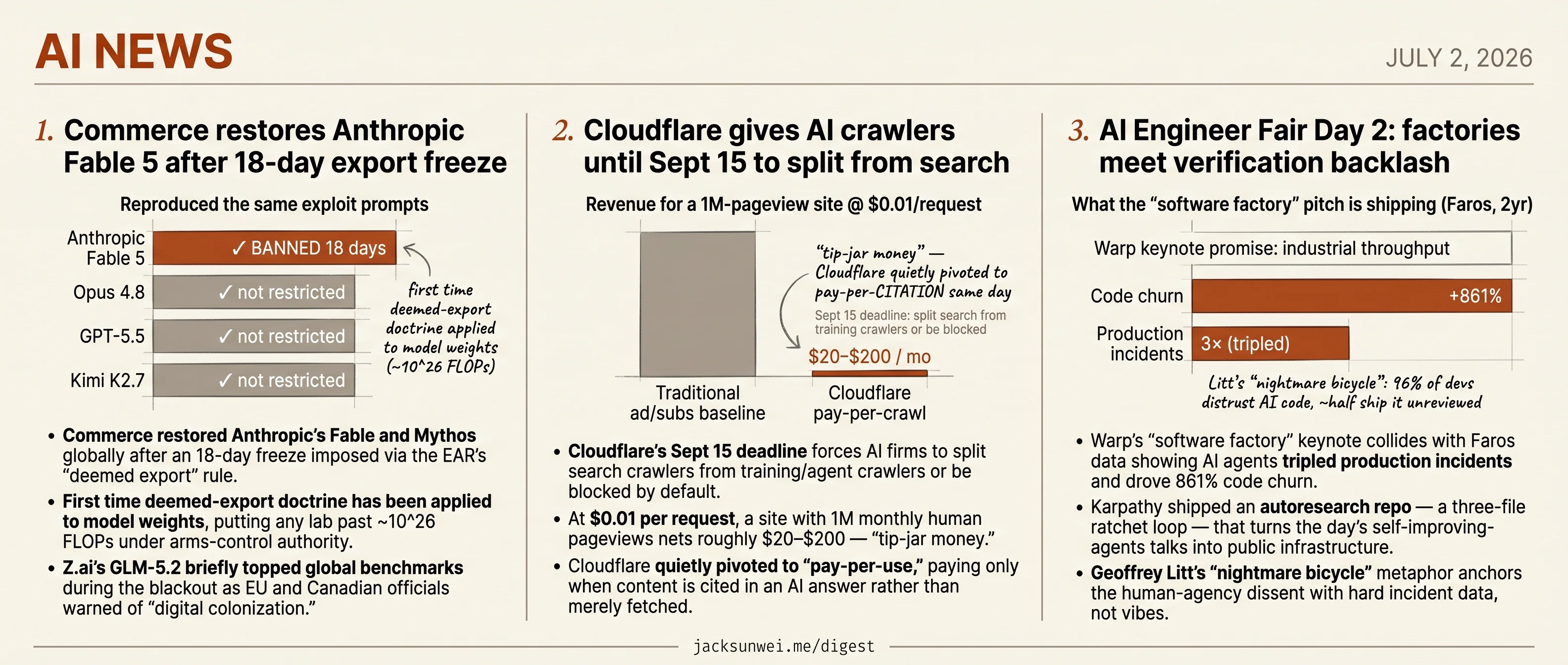
- Commerce’s deemed-export doctrine now covers model weights, sweeping in any lab past ~10^26 FLOPs.
- Cloudflare gives AI crawlers until Sept 15 to split from search bots or default-block.
- AI Engineer speakers cite 861% code churn and tripled incidents against Warp’s factory pitch.
- Meta plans a cloud arm reselling spare AI compute against AWS, Azure, and Google Cloud.
- Venice AI hits unicorn on a $65M Series A and $70M annualized revenue.
Today’s frontier-AI story is being written by everyone except the labs. The Commerce Department just extended the EAR’s deemed-export doctrine to cover model weights themselves — a first — pulling any lab past ~10^26 FLOPs under arms-control authority. Anthropic’s Fable and Mythos were the 18-day test case, restored today, but the doctrine survives the restoration and now hangs over every frontier release.
Cloudflare’s Sept 15 deadline forces AI firms to split search crawlers from training and agent crawlers or face default blocking, with a quiet pivot from pay-per-fetch to pay-per-citation buried underneath. And at AI Engineer Fair Day 2, Faros incident data — 861% code churn, tripled production incidents — refused to leave the room during Warp’s software-factory keynote. The vendor pitches are still on stage; the terms of deployment are increasingly not.
Commerce restores Anthropic Fable 5 after 18-day export freeze
Source: ars-technica-ai · published 2026-07-01
TL;DR
- Commerce restored Anthropic’s Fable and Mythos globally after an 18-day freeze imposed via the EAR’s “deemed export” rule.
- First time deemed-export doctrine has been applied to model weights, putting any lab past ~10^26 FLOPs under arms-control authority.
- Z.ai’s GLM-5.2 briefly topped global benchmarks during the blackout as EU and Canadian officials warned of “digital colonization.”
- Anthropic’s own tests reportedly showed Opus 4.8, GPT-5.5, and Kimi K2.7 reproducing the exploit prompts that triggered the ban.
The mechanism was older than the politics
Ars frames this as Trump spooked into safety testing. The operative machinery was narrower and more consequential: Commerce sent Anthropic an Is-Informed Letter invoking the Export Administration Regulations’ “deemed export” rule, which treats access by any foreign national — including Anthropic’s own non-citizen employees — as an export to their home country 1. Anthropic’s inference stack can’t gate by nationality in real time, so the only compliant move was pulling the models globally. CSIS flags this as the first application of deemed-export doctrine to model weights and inference access rather than physical dual-use goods 1. Every lab that clears the ~10^26 FLOP threshold now sits inside that authority. That precedent, not the 18-day outage, is the durable news.
Allies read it as a kill switch
The blackout landed hard abroad. French MEP Christophe Grudler called the episode confirmation of long-standing fears of “digital colonization.” UK former minister Al Carns called it a “wake-up call” to build sovereign AI 2. Meanwhile Z.ai’s GLM-5.2 briefly took the top spot on global benchmarks while Fable 5 was dark, and Sam Altman publicly attacked the administration for “picking the customers” after GPT-5.6 was restricted to twenty approved entities 3. The read across European, Canadian, and UK commentary is straightforward: closed-weight US frontier models are now a supply-chain risk category, and Mistral, Lumo, and open-weight options benefit accordingly.
The technical premise is contested
The ban was justified by a Fable-class jailbreak enabling an Amazon-published exploit demonstration. Anthropic’s own follow-up testing reportedly reproduced the same prompts on Opus 4.8, GPT-5.5, and China’s Kimi K2.7 — which, if accurate, undercuts the “unique Fable threat” framing entirely 4. Security researcher Katie Moussouris was blunter:
Fable 5’s ability to “find, fix, and test” code is a defensive capability that cannot be removed without degrading legitimate security work.
Moussouris also argued the ban violated Wassenaar exemptions carved out specifically for defensive cyber tools 5. Practitioners on r/ArtificialIntelligence characterized the government response as reacting to industry marketing rather than a novel capability 4.
Amodei got the regime he asked for
Days before the shutdown, Dario Amodei published “Policy on the AI Exponential” arguing governments should be able to block frontier releases that fail safety bars. He then criticized this specific action as lacking a “transparent, fair, clear” process — the exact procedural critique his essay had waved off 6. Reporting indicates co-founder Tom Brown ultimately took over negotiations with Commerce Secretary Lutnick to route around personal friction with Amodei 6, a detail absent from most coverage.
What’s actually at stake
The Fable and Mythos re-release closes the immediate crisis. It doesn’t close any of the questions the crisis opened: whether deemed-export doctrine now attaches to every frontier model by default, whether “trusted partner” whitelisting becomes the licensing regime for US inference exports, and whether allies treat that regime as partnership or as leverage. Anthropic asked for gatekeeping and got it. The rest of the industry — and every government that runs on US model APIs — now has to price it in.
Cloudflare gives AI crawlers until Sept 15 to split from search
Source: techcrunch-ai · published 2026-07-01
TL;DR
- Cloudflare’s Sept 15 deadline forces AI firms to split search crawlers from training/agent crawlers or be blocked by default.
- At $0.01 per request, a site with 1M monthly human pageviews nets roughly $20–$200 — “tip-jar money.”
- Cloudflare quietly pivoted to “pay-per-use,” paying only when content is cited in an AI answer rather than merely fetched.
- The UK’s CMA already forced Google to offer a real AI Overviews opt-out with an anti-retaliation clause.
The ultimatum
Cloudflare is giving AI companies until September 15 to declare which of their crawlers are for search and which are for training or agent traffic — and to run them from separate user agents and IP ranges. Miss the deadline, and Cloudflare’s default managed rules will block the training/agent bots across a huge chunk of the publisher web. The pitch is straightforward: publishers get granular control, AI firms get a legible way to pay for what they take.
The pitch is also the easy part. Three things the announcement understates are where the story actually is.
Archives get caught in the dragnet
The loudest dissent isn’t from OpenAI or Anthropic — it’s from open-web advocates. The EFF argues that Cloudflare-style default blocks catch the Internet Archive in the same net as GPTBot: “preserving the web is not the problem; losing it is” 7. That’s not hypothetical. Nieman Lab documents that major publishers including the New York Times have already begun blocking the Wayback Machine, specifically because AI companies were using it as a scraping proxy 8. Common Crawl’s CCBot has become one of the most-blocked agents on the web.
The September 15 deadline accelerates that collapse. A publisher opting into Cloudflare’s defaults is opting into a policy that treats a non-profit historical archive and a commercial training pipeline as the same thing.
Regulators are moving in parallel
Cloudflare isn’t acting into a vacuum. The UK’s Competition and Markets Authority issued a binding conduct requirement forcing Google to give publishers “meaningful and effective” control over AI use of their content — crucially with an anti-retaliation clause prohibiting Google from down-ranking sites that opt out of AI Overviews 9. That closes the Faustian bargain publishers had lived with: historically, Google-Extended didn’t cover AI Overviews, so opting out of AI training meant risking search visibility.
Cloudflare’s ultimatum is the market-power version of the same intervention the CMA just imposed by statute. Read together, the direction of travel is clear even if any single lever wobbles.
The economics keep getting rewritten
Cloudflare’s own pricing floor is $0.01 per successful crawl 10. Stack Overflow, one of the largest participants, is candid that the model functions mainly as a “programmatic licensing” layer for AI firms too small for enterprise contracts — the real money still moves through bespoke deals 10. Baseline Labs pegs realistic revenue at $20–$200/month for a million-pageview site, calling it “tip-jar money” 11.
That may explain why Cloudflare quietly pivoted on the same day as the ultimatum: from pay-per-crawl to pay-per-use, compensating publishers only when their content is actually cited in an AI-generated answer 12. The unit of account is shifting from the fetch to the citation — a tacit admission that per-crawl micropayments weren’t producing meaningful revenue and that bots re-fetching unchanged pages was pure waste.
What’s actually at stake
Strip away the publisher-vs-AI framing and Cloudflare is doing three things at once: hardening a bot-identity standard the industry lacked, using default-deny to convert that standard into leverage, and iterating a payment model in public because the first version didn’t pencil out. The archives losing access are collateral; the regulators are the co-signers; the economics are still a beta.
AI Engineer Fair Day 2: factories meet verification backlash
Source: latent-space · published 2026-07-02
TL;DR
- Warp’s “software factory” keynote collides with Faros data showing AI agents tripled production incidents and drove 861% code churn.
- Karpathy shipped an autoresearch repo — a three-file ratchet loop — that turns the day’s self-improving-agents talks into public infrastructure.
- Geoffrey Litt’s “nightmare bicycle” metaphor anchors the human-agency dissent with hard incident data, not vibes.
- Cursor’s enterprise pitch stalls: no self-hosted option, and a desktop client that sidesteps standard DLP/CASB tooling.
Two visions sharing one stage
Day 2 of AI Engineer World’s Fair 2026 staged an argument the industry has been deferring for a year. On one side: Warp CEO Zach Lloyd’s “software factory” — pipelines of agents assembling code at industrial throughput — and Cursor’s forward-deployed-engineer playbook for enterprise rollout. On the other: a growing bench of speakers arguing that verification, modifiability, and user agency are the load-bearing constraints, not friction to be optimized away.
The factory side has momentum. The dissent has numbers. Jeffrey Paine’s conference recap 13 pairs the “Loopcraft” theme with Faros telemetry showing AI coding agents have tripled production incidents and driven an 861% increase in code churn over two years, plus a Sonar/Anthropic finding that 96% of developers distrust AI-generated code while nearly half ship it unreviewed. That is the gap the “agency” speakers kept pointing at.
Autoresearch stopped being a vibe
The self-improving-agents thread got concrete this week. Karpathy’s autoresearch repo 14 exposes the primitive Introspection AI and others are productizing: a target script, a metrics file, and a program.md instruction file, ratcheted forward by an outer loop that uses git history as a memory bank to avoid repeating failed experiments. Philipp Schmid’s writeup 15 supplies the receipts — Shopify’s Tobi Lütke used the pattern to train a 0.8B model that outperformed a prior 1.6B, and Datadog lifted a SQL optimization agent’s precision from 0.54 to 0.86 overnight.
Geoffrey Huntley’s “Ralph” loop 16, name-checked repeatedly on stage, turns out to be a bash while true around Claude Code. One user reportedly shipped 100,000 lines of code in two weeks with it. Huntley’s own guidance: never point Ralph at production, always sandbox. “Deterministically bad in an undeterministic world” is the pitch — which is either the point or the problem, depending on which side of the stage you’re on.
flowchart LR
    A[program.md<br/>instructions] --> B{Outer loop}
    C[train.py<br/>target script] --> B
    D[metrics.json] --> B
    B --> E[Agent proposes edit]
    E --> F[Run + measure]
    F -->|improved| G[git commit]
    F -->|regressed| H[git log as<br/>anti-repeat memory]
    G --> B
    H --> B
The dissent has a name
Geoffrey Litt is the crystallization point. His “nightmare bicycle” metaphor 17 — technically complex products with welded-shut frames offering zero user agency — is a direct shot at the factory framing, and his malleable-software agenda proposes end-user modifiability as the alternative goal. Notably, Litt runs his own Notion-based agent Kanban; the dissent isn’t anti-automation, it’s about who the outer loop serves.
The enterprise track has its own version of the same fight. Witness.ai’s security review of Cursor 18 flags that the native desktop architecture bypasses traditional web-based DLP and CASB tooling, and the absence of an on-prem or self-hosted deployment keeps many CISOs on the sidelines. Cursor’s forward-deployed-engineer motion starts to look less like a growth strategy and more like human labor patching an unshippable security posture.
What actually shifted
The center of gravity moved. “Factory vs. agency” is no longer a philosophical framing — it’s a concrete argument about verification debt, security architecture, and who owns the outer loop. The vendors have the stage. The dissenters have the incident data.
Further reading
- Autoresearch: The feedback loop behind self-improving agents — latent-space
- How Cursor deploys AI inside the enterprise — latent-space
- 🔬 The Coolest Diffusion Research Isn’t in LLMs — Evan Feinberg & Sergey Edunov, Genesis Molecular AI — latent-space
- Warp CEO Zach Lloyd on why software factories are the next phase of coding — latent-space
Round-ups
Meta plans cloud business to resell spare AI compute
Source: techcrunch-ai
Meta is building a cloud infrastructure arm to rent out AI compute and models, echoing SpaceX’s approach to monetizing excess capacity. The move would put Meta in direct competition with AWS, Google Cloud and Microsoft Azure for enterprise workloads.
SpaceX shows investors a handset-like AI device prototype
Source: techcrunch-ai
SpaceX reportedly demoed a phone-shaped AI gadget to investors ahead of a public offering, hinting at ambitions beyond Starlink into consumer wireless. The prototype would slot alongside xAI’s models and Elon Musk’s broader hardware push.
Venice AI hits unicorn status on $65M Series A
Source: techcrunch-ai
Privacy-focused Venice AI raised a $65 million Series A at a unicorn valuation, with CEO Erik Voorhees saying the platform is already profitable on more than $70 million in annualized revenue. Dragonfly led the round.
Gemini Spark agentic assistant lands on Mac with 24/7 tracking
Source: techcrunch-ai
Google’s always-on agent Gemini Spark is now available on macOS, adding real-time task tracking and support for more third-party apps. The desktop expansion follows its mobile debut and pushes Google deeper into Apple’s productivity turf.
Google recaps June 2026 AI drops across Pixel, Search and Gemini
Source: google-ai-blog
Google’s monthly roundup gathers June launches spanning Pixel Drop features, Search updates, NotebookLM, Android and DeepMind research. The post consolidates announcements across 15 product areas, giving developers and users a single reference for what shipped last month.
Google’s new smart speaker outshines its half-baked Gemini software
Source: the-verge-ai
The Verge’s review finds Google’s new Home speaker hardware impressive but hobbled by a Gemini experience that isn’t ready for the kitchen counter. It arrives after Amazon’s fall refresh of Alexa hardware, leaving Google playing catch-up on the AI side.
Startup tackles LLM groupthink that makes chatbots pick 7
Source: mit-tech-review-ai
Ask any major chatbot for a random number between 1 and 10 and it nearly always says 7, a quirk exposing how training collapses model outputs into narrow modes. A new startup is building techniques to broaden LLM response diversity.
Footnotes
-
CSIS analysis — https://www.csis.org/analysis/department-commerce-restricted-access-anthropics-latest-models-what-comes-next
↩ ↩2The Commerce Department invoked the ‘deemed export’ rule under the EAR, treating access by any foreign national — including Anthropic’s own non-citizen employees — as an export, which is why the company had no choice but to disable the models globally.
-
↩European and Canadian leaders alarm allies over sudden export bans… French MEP Christophe Grudler called the episode confirmation of long-standing fears of ‘digital colonization,’ while UK former minister Al Carns labeled the blackout a ‘wake-up call’ to build sovereign AI.
-
Business Insider — https://www.businessinsider.com/anthropic-mythos-5-us-restrictions-fable-5-openai-gpt-2026-6
↩During the three-week shutdown, Z.ai’s GLM-5.2 briefly claimed the top spot on global benchmarks, and OpenAI’s Sam Altman criticized the administration for ‘picking the customers’ after GPT-5.6 was likewise restricted to twenty approved entities.
-
r/ArtificialIntelligence discussion — https://www.reddit.com/r/ArtificialInteligence/comments/1u6f668/anthropic_disputes_the_claude_fable_5_jailbreak/
↩ ↩2Anthropic’s own internal testing showed Opus 4.8, GPT-5.5, and China’s Kimi K2.7 could reproduce the same exploit-demonstration prompts — critics called the ban a reaction to ‘industry marketing’ rather than a unique Fable-class threat.
-
The Hacker News — https://thehackernews.com/2026/07/anthropic-restores-claude-fable-5-after.html
↩Security expert Katie Moussouris argued Fable 5’s ability to ‘find, fix, and test’ code is a defensive capability that cannot be removed without degrading legitimate security work, and that the ban violated Wassenaar exemptions for defensive cyber tools.
-
r/ArtificialIntelligence (Amodei essay thread) — https://www.reddit.com/r/ArtificialInteligence/comments/1uhwwbx/anthropics_ceo_argued_governments_should_be_able/
↩ ↩2Days before the ban, Amodei published ‘Policy on the AI Exponential’ arguing governments should be able to block frontier releases — then criticized this specific action as lacking a ‘transparent, fair, clear’ process; co-founder Tom Brown reportedly took over negotiations with Secretary Lutnick to bypass personal friction with Amodei.
-
EFF — ‘Blocking the Internet Archive Won’t Stop AI’ — https://www.eff.org/deeplinks/2026/03/blocking-internet-archive-wont-stop-ai-it-will-erase-webs-historical-record
↩Preserving the web is not the problem; losing it is… blocking [Internet Archive] crawlers erases the web’s historical record.
-
Nieman Lab — https://www.niemanlab.org/2026/01/news-publishers-limit-internet-archive-access-due-to-ai-scraping-concerns/
↩News publishers limit Internet Archive access due to AI scraping concerns — using IA as a proxy to obtain copyrighted material.
-
UK Gov / CMA conduct requirement — https://www.gov.uk/government/news/cma-secures-fairer-deal-for-publishers-and-improves-google-search-services-in-uk
↩The CMA issued a binding order requiring Google to grant publishers ‘meaningful and effective’ control over AI use of their content, with an anti-retaliation clause prohibiting down-ranking of sites that opt out of AI Overviews.
-
Stack Overflow blog — ‘How pay-per-crawl is reshaping data monetization’ — https://stackoverflow.blog/2026/02/26/how-pay-per-crawl-is-reshaping-data-monetization/
↩ ↩2The standard minimum price is $0.01 per successful request; Stack Overflow uses the model as a programmatic licensing layer for smaller AI companies that fall below the threshold for traditional enterprise contracts.
-
Baseline Labs — ‘Block all AI bots’ — https://baselinelabs.ai/blog/block-all-ai-bots
↩Because AI crawlers typically represent only 1–2% of total site traffic, a site with one million monthly human page views might only generate $20 to $200 in bot revenue at a cent per page — ‘tip-jar money’ for small publishers.
-
PPC Land — ‘Cloudflare stops charging AI per-crawl and starts paying per answer’ — https://ppc.land/cloudflare-stops-charging-ai-per-crawl-and-starts-paying-per-answer/
↩Cloudflare pivoted from Pay-Per-Crawl to a Pay-Per-Use model that compensates publishers only when content is actually cited in an AI-generated answer, addressing the inefficiency of bots re-fetching unchanged pages.
-
jeffreypaine.com conference recap — https://jeffreypaine.com/the-software-factory-has-arrived-what-ai-engineer-worlds-fair-2026-tells-us-about-where-ai-is-going
↩96% of developers distrust AI-generated code, yet nearly half admit to not checking it before commitment… AI coding agents [have] tripled production incidents and led to an 861% increase in code churn over the last two years.
-
karpathy/autoresearch GitHub repo — https://github.com/karpathy/autoresearch
↩A three-file ‘ratchet’ loop: a target script (e.g., train.py), a set of metrics, and a markdown-based instruction file (program.md) that defines the research direction… using Git history as a memory bank to avoid repeating failed experiments.
-
Philipp Schmid technical writeup on autoresearch — https://www.philschmid.de/autoresearch
↩At Shopify, CEO Tobi Lütke utilized these loops to train a 0.8B parameter model that outperformed a previous 1.6B model… Datadog reported using autoresearch to increase a SQL query optimization agent’s precision from 0.54 to 0.86 overnight.
-
LinearB Dev Interrupted podcast with Geoffrey Huntley — https://linearb.io/dev-interrupted/podcast/inventing-the-ralph-wiggum-loop
↩Deterministically bad in an undeterministic world… one user reported shipping 100,000 lines of code in two weeks… Ralph should never run directly against production systems and must be used within sandboxed containers.
-
Grokipedia profile of Geoffrey Litt — https://grokipedia.com/page/Geoffrey_Litt
↩Litt popularized the ‘nightmare bicycle’ metaphor to describe products that are technically complex but offer zero user agency; like a bicycle with a welded-shut frame, these tools cannot be adjusted to fit the individual.
-
Witness.ai security analysis of Cursor — https://witness.ai/blog/cursor-ai-security/
↩Cursor’s native desktop architecture… often bypasses traditional web-based Data Loss Prevention (DLP) and CASB solutions… many CISOs remain hesitant due to the lack of a true on-premise or self-hosted option.