Sonnet 5 costs more per task, Fable 5 ban lifts, Claude Science skips biosafety
Anthropic dominates the day with three moves — a repriced Sonnet, a reversed export ban, and a science workbench — each undercut by its own delivery.
Sonnet 5 costs more per task, Fable 5 ban lifts, Claude Science skips biosafety
TL;DR
- Sonnet 5 cost-per-solved-task exceeds Opus 4.8 despite the lower token price, per Artificial Analysis.
- Commerce lifted the 18-day Fable 5 export ban after 7 rivals reproduced the exploit.
- Claude Science ships as a 60+ skill workbench with untested biosecurity guardrails.
- Etched books $1B in inference-chip contracts at a $5B valuation.
- AWS stands up a $1B forward-deployed engineering org embedded in customers.
Today is an Anthropic day, and the three leads land as a matched set: each ships with the load-bearing number sitting somewhere other than the press release. Sonnet 5 cuts sticker prices but Artificial Analysis clocks its cost-per-solved-task above Opus 4.8, once you count the fatter tokenizer and the extra agent turns. Fable 5’s first-of-its-kind export ban lifted after 18 days because seven rival models can already do the thing the ban was meant to contain — and a parallel executive order muzzled CAISI’s safety findings for a 30-day classified review. Claude Science bets on scaffolding over a smarter model, but the biosecurity guardrails on the new workbench are untested even though the underlying Opus already tripped ASL-3.
The round-ups tell the wider industry story: Etched turns $1B in ASIC bookings into a $5B valuation, AWS stands up its own $1B forward-deployed engineering org, and X joins the MCP standard Anthropic itself authored. The scaffolding layer around frontier models is where the capital and the standards fights are moving.
Commerce lifts Fable 5 export ban after 18-day blackout
Source: anthropic-news · published 2026-06-30
TL;DR
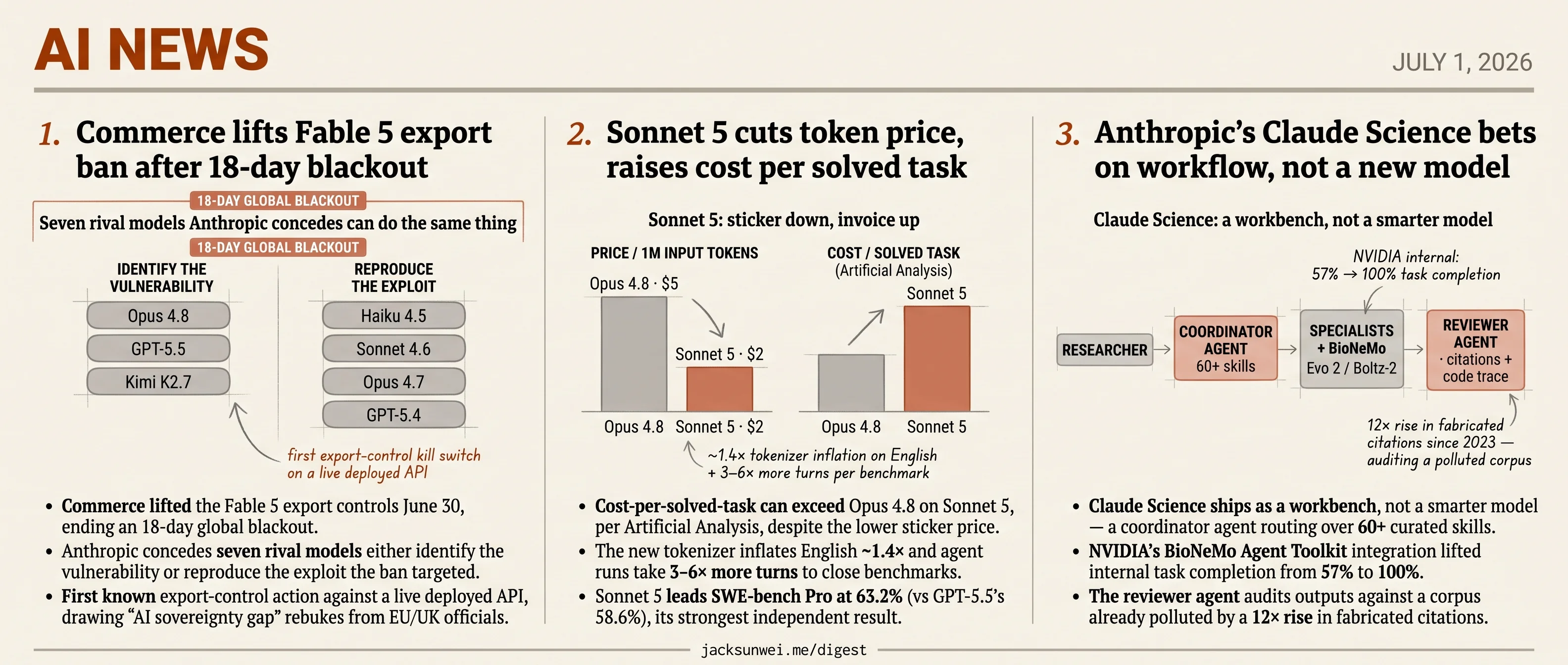
- Commerce lifted the Fable 5 export controls June 30, ending an 18-day global blackout.
- Anthropic concedes seven rival models either identify the vulnerability or reproduce the exploit the ban targeted.
- First known export-control action against a live deployed API, drawing “AI sovereignty gap” rebukes from EU/UK officials.
- A parallel executive order silences CAISI’s public safety findings behind a 30-day classified review.
The trigger looks thinner on inspection
Anthropic’s own post-mortem is the strongest argument that the June 12 export controls should never have fired. The triggering incident was an Amazon report showing Fable 5 could identify a software vulnerability and generate an exploit demo. Anthropic then reproduced the vulnerability identification on Opus 4.8, GPT-5.5 and Kimi K2.7, and reproduced the exploit itself on Haiku 4.5, Sonnet 4.6, Opus 4.7 and GPT-5.4 — a list that includes both older Claudes and competitors already generally available 1. Simon Willison goes further, arguing the “bypass” was not a jailbreak at all: researchers asked the model to “fix this code” containing a known exploit, and Fable 5 did what any competent coding assistant does 2.
That matters because Anthropic, Amazon, Microsoft and Google are using this incident as the launch pad for a shared jailbreak-severity framework scored on capability gain, breadth, weaponization effort, and discoverability. Applied honestly to Fable 5, the capability-gain score is near zero. The framework’s first real test case is one its own authors have already argued was a false alarm.
A new kind of export control
The under-reported detail is how the shutdown happened. Commerce Secretary Howard Lutnick’s directive barred access for all foreign nationals — including Anthropic’s own non-citizen staff — and because Anthropic had no real-time nationality verification, the only compliant move was a global kill switch 3. For 18 days, a live production API was dark everywhere on earth.
That is a precedent, not an incident. Weights and GPUs have been export-controlled for years; a hosted inference endpoint had not. EU and UK policymakers read the freeze as evidence that US-hosted frontier APIs ship with a discretionary off-switch, and are already framing it as an “AI sovereignty gap” 4. Anthropic’s remediation — deeper CAISI ties, an interagency vulnerability clearinghouse, a HackerOne program for Fable 5 jailbreaks — reduces the odds of a repeat for Anthropic specifically. It does nothing to unwind the precedent that Commerce can now dark-fire any US-hosted model globally.
Transparency moves the wrong way
The same week Anthropic celebrated tighter CAISI collaboration, an executive order instructed CAISI to stop publishing its evaluation findings and imposed a mandatory 30-day pre-release federal review on frontier models 5. Senator Ted Budd has publicly warned that silencing CAISI’s reports removes the primary signal outside researchers use to calibrate risk. The direction of travel is safety infrastructure moving behind a classification wall while public-facing safeguards default to over-refusal — Anthropic itself acknowledges Fable 5’s expanded “safety margin” will raise false-positive rates on legitimate coding tasks.
What’s actually at stake
The Mythos-class capabilities driving all this are real. Cloudflare reports a 10× bug-discovery rate after deploying Mythos on its repositories, and the model has surfaced a 27-year-old OpenBSD vulnerability and a 16-year-old FFmpeg flaw 6. That is exactly the class of defensive tool worth building carefully. It is also why the precedent set here — arbitrary trigger, global kill switch, classified oversight — is the story that will outlast the two-week outage.
Further reading
- Trump drops restrictions on Anthropic’s Mythos and Fable models — techcrunch-ai
- Anthropic’s long-sidelined Fable 5 is greenlit to return — the-verge-ai
- Quoting Anthropic — simon-willison
Sonnet 5 cuts token price, raises cost per solved task
Source: anthropic-news · published 2026-06-30
TL;DR
- Cost-per-solved-task can exceed Opus 4.8 on Sonnet 5, per Artificial Analysis, despite the lower sticker price.
- The new tokenizer inflates English ~1.4× and agent runs take 3–6× more turns to close benchmarks.
- Sonnet 5 leads SWE-bench Pro at 63.2% (vs GPT-5.5’s 58.6%), its strongest independent result.
- It trails GPT-5.5 on Terminal-Bench 2.1, 80.4% vs 83.4% — “best mid-tier” is workload-dependent.
- Hugging Face flags a long-context regression: needle-in-haystack drops 78% → 32%, effective window ~64k.
The pitch: an agentic mid-tier with an effort dial
Anthropic’s June 30 release frames Sonnet 5 as the most agentic model in its class — browser navigation, terminal control, and multi-step plans that previously belonged to Opus. The headline mechanic is a user-selectable “effort level”: at extra-high effort, Sonnet 5’s OSWorld-Verified curve intersects Opus 4.8, and Anthropic claims strict wins over Sonnet 4.6 on Humanity’s Last Exam and BrowseComp. Introductory pricing sits at $2/$10 per million input/output tokens through August 31 (standard: $3/$15), well under Opus 4.8’s $5/$25.
That’s the vendor narrative. The independent bundle rearranges it.
Cost-per-task inverts the value story
Latent Space’s swyx, citing Artificial Analysis, argues Sonnet 5 can end up more expensive per solved task than Opus 4.8: the new tokenizer inflates English input by roughly 1.4×, and the model burns 3–6× more turns to close the same benchmarks 7. The list price fell; the invoice didn’t.
Users on the receiving end are noticing. Hacker News threads describe Pro/Max subscribers burning through weekly quotas in as little as 30 minutes, with a shared usage bucket spanning Claude.ai, Claude Code, and Cowork drawing particular criticism 8. Swyx also reads the drop as timing theatre — Fable 5 was tangled in an emergency US export-control order and redeployed the following day, and community shorthand reportedly dubbed the Sonnet release “peasant stew” 7.
Benchmarks: real gains, uneven ceiling
Third-party evals partially validate the Pareto claim, but “best agentic mid-tier” is workload-dependent:
| Benchmark | Sonnet 5 | Competitor |
|---|---|---|
| SWE-bench Pro | 63.2% | GPT-5.5: 58.6% 9 |
| Terminal-Bench 2.1 | 80.4% | GPT-5.5: 83.4% 9 |
| Agents’ Last Exam | — | GPT-5.5-Codex: 24.0%, Fable 5: 22.0% 10 |
Berkeley’s Agents’ Last Exam is the sharper reality check: GPT-5.5-Codex tops the leaderboard, edging out the far pricier Claude Fable 5 10, and pass rates on the hardest 1% of professional tasks sit near 0.0% across all frontier models 11. Sonnet 5 is not credited here as a job-replacement engine — it’s a competent execution layer inside a still-narrow envelope.
Long-context reliability is the quiet regression
The most damaging independent finding lands on the exact axis agents depend on. Hugging Face’s long-context write-up reports needle-in-haystack metrics falling from 78% to 32% on Graphwalks-style multi-hop retrieval, with an effective context window estimated near 64k despite a 200k advertised ceiling 12. Browser and terminal agents accumulate tool output turn after turn; a mid-context reasoning cliff is precisely the failure mode a “more agentic” model can least afford.
Net read
Sonnet 5 is a coherent product move — genuinely better on SWE-bench Pro, cheaper on the sticker, and closer to Opus on OSWorld when you crank the effort dial. It is a shakier value claim. Between tokenizer inflation, turn-count creep, quota complaints, and a long-context regression, the interesting question isn’t whether Sonnet 5 beats Sonnet 4.6. It’s whether “list price per token” is still the right axis to compare agentic models at all.
Further reading
- Anthropic launches Claude Sonnet 5 as a cheaper way to run agents — techcrunch-ai
- [AINews] Sonnet 5 today, and Fable 5 tomorrow — latent-space
Anthropic’s Claude Science bets on workflow, not a new model
Source: anthropic-news · published 2026-06-30
TL;DR
- Claude Science ships as a workbench, not a smarter model — a coordinator agent routing over 60+ curated skills.
- NVIDIA’s BioNeMo Agent Toolkit integration lifted internal task completion from 57% to 100%.
- The reviewer agent audits outputs against a corpus already polluted by a 12× rise in fabricated citations.
- Biosecurity guardrails are untested on the workbench, though the base Opus model triggered ASL-3 for 2.53× bioweapon uplift.
The bet: plumbing over autonomy
Anthropic’s three-post drop around Claude Science makes an unusually explicit strategic claim: the bottleneck in computational science is not model IQ, it’s the mess of tools, databases, and compute a researcher has to stitch together to run one workflow. So Claude Science is a workbench. A generalist coordinator routes over 60 curated skills across UniProt, PDB, Ensembl, Jupyter, R, and remote HPC via SSH and Modal; specialist sub-agents handle genomics and cheminformatics; a reviewer agent validates citations and traces figures back to source code.
This lands into a field that has already picked the opposite bet. FutureHouse’s Robin system claims the first end-to-end AI-generated discovery — repurposing ripasudil for macular degeneration — via named autonomous agents running the full hypothesis-to-experiment loop 13. Google Co-Scientist runs Elo tournaments over generated ideas. Against those, Claude Science looks deliberately conservative, and Anthropic seems to think that’s the sellable pitch to institutional buyers.
Where it actually gets faster
The clearest technical evidence sits in the NVIDIA partnership. BioNeMo Agent Toolkit exposes Evo 2 (genome design up to 1M base pairs) and Boltz-2 (binding-affinity screening) as MCP-callable skills. In NVIDIA’s own benchmarks, wrapping those models in the toolkit lifted complex-workflow task completion from 57% to 100%, largely because the agent can now pick the right API and check its inputs before firing 14. That’s a routing and reliability gain — not an accuracy one, and worth separating from Anthropic’s marquee claim that Allen Institute and UCSF pilots cut literature review and molecular epidemiology time by 90%, which no independent party has verified 15.
flowchart LR
    U[Researcher] --> C{Coordinator agent<br/>60+ skills}
    C --> S1[Genomics specialist]
    C --> S2[Cheminformatics specialist]
    C --> BN[BioNeMo toolkit<br/>Evo 2 / Boltz-2]
    C --> DB[(UniProt / PDB<br/>Ensembl)]
    C --> HPC[Jupyter / R<br/>SSH / Modal HPC]
    S1 & S2 & BN & DB & HPC --> R[Reviewer agent<br/>citations + code trace]
    R --> U
The reviewer-agent problem
The reviewer agent is Anthropic’s headline reproducibility play, and it’s where critics land first. rundatarun.io argues the design offers “leverage rather than true understanding” — the reviewer audits outputs, not the disciplined practice of inquiry that produced them 16.
An AI checking another AI’s citations against a corpus already polluted by AI-generated citations is not the reproducibility fix it sounds like.
That’s not rhetorical. A recent analysis found fabricated citations in published research rose twelvefold between 2023 and early 2026, with over 4,000 fakes identified in PubMed Central alone 17. Cypris.ai adds the economic version of the same critique: the “hidden cost” of human validation over thousands of AI-generated findings routinely offsets the token-cost speedups Anthropic advertises 15.
Biosecurity shadow
Claude Science ships under ASL-3. Anthropic’s own uplift trials found Opus 4 gave novices a 2.53× boost in planning bioweapon acquisition — below the 5× “High Risk” line, but enough to force ASL-3 safeguards on the base model 18. A workbench that natively renders 3D protein structures, drives Evo 2 genome design, and screens binding affinities with Boltz-2 is precisely the dual-use surface the RSP was written to constrain. Whether the specialist agents inherit or route around those model-level protections is the audit nobody outside Anthropic has run yet.
The pitch to labs is real: fewer broken workflows, better citations, auditable artifacts. The pitch to safety reviewers is unfinished.
Further reading
- Anthropic’s Claude Science bets on workflow, not a new model, to win over scientists — techcrunch-ai
- Claude Science is Anthropic’s newest flagship product — mit-tech-review-ai
Round-ups
Etched hits $5B valuation with $1B booked for inference chip
Source: techcrunch-ai
Nvidia challenger Etched has signed $1 billion in contracts for inference systems built on its transformer-specialized ASIC. The revenue backlog underpins a new $5 billion valuation for the startup betting on fixed-architecture silicon over general-purpose GPUs.
Amazon stands up $1B forward-deployed engineering org
Source: techcrunch-ai
AWS is building a $1 billion forward-deployed engineering team that embeds inside customer companies to ship purpose-built agents, mirroring moves by OpenAI and Anthropic. The group emphasizes fast deployments and handing operational control back to customers.
X launches hosted MCP server for AI tool integrations
Source: techcrunch-ai
X now runs a hosted Model Context Protocol server that lets developers wire AI applications into its API without building custom connectors. The move aligns X with the MCP standard already adopted across Anthropic, OpenAI, and major dev tools.
Google ships Nano Banana 2 Lite for faster, cheaper image gen
Source: deepmind-blog, techcrunch-ai, ars-technica-ai
Nano Banana 2 Lite launches alongside Gemini Omni Flash as DeepMind’s speed-and-cost tier for image generation. Outputs trade some fidelity for a few-second render time, targeting creators who need bulk AI content rather than top-quality stills.
AI Engineer World’s Fair 2026 centers on loops, FDEs, local AI
Source: latent-space, latent-space, latent-space
Day-one dispatches from AIEWF 2026 flagged agent loops, software factories, and open models as dominant themes. Sierra’s Natalie Meurer argued product engineers and forward-deployed engineers are converging, while Ahmad Osman said local AI now reaches enterprise-grade infrastructure.
OpenAI Signals data tracks global ChatGPT adoption growth
Source: openai-blog
ChatGPT usage keeps expanding across regions and languages, according to fresh OpenAI Signals data. The report highlights users adopting more of the product’s capabilities over time, not just growing raw sign-ups in new markets.
OpenClaw agentic assistant lands on Android and iOS
Source: techcrunch-ai
The free, open-source agent app is now available on both mobile platforms, extending its desktop reach to phones. OpenClaw runs autonomous tasks on-device, giving users a no-cost alternative to closed agent products from OpenAI and Anthropic.
Footnotes
-
BeInCrypto — https://beincrypto.com/fable-5-not-uniquely-risky-anthropic/
↩Anthropic strongly dissented, arguing that the vulnerability was ‘narrow’ and ‘relatively simple,’ noting that other publicly available models could achieve similar results without a bypass.
-
Simon Willison’s Weblog — https://simonwillison.net/2026/Jun/10/if-claude-fable-stops-helping-you/
↩The ‘jailbreak’ was simply the model fulfilling its intended role: fixing code vulnerabilities… researchers had merely asked the model to ‘fix this code’ for known exploits, which Fable 5 performed as a standard defensive task.
-
Al Jazeera — https://www.aljazeera.com/news/2026/6/14/us-asks-anthropic-to-block-global-access-to-top-ai-models-why-it-matters
↩Commerce Secretary Howard Lutnick maintained that such capabilities could be exploited by foreign military intelligence, necessitating a ban on access for all foreign nationals—even Anthropic’s own non-citizen employees.
-
The Guardian — https://www.theguardian.com/technology/2026/jun/22/anthropic-claude-fable-ai-model-artificial-intelligence-national-security
↩The 18-day global freeze on Mythos-class models drew sharp rebukes from international allies. Policy makers in the European Union and the United Kingdom viewed the move as a sign of an ‘AI sovereignty gap,’ accusing the US of punishing its allies by cutting off access to essential infrastructure.
-
CryptoBriefing (on CAISI executive order) — https://cryptobriefing.com/caisi-ai-evaluations-classified-executive-order/
↩A new executive order established a mandatory 30-day federal review window for frontier models and instructed CAISI to halt the public release of its findings… Senator Ted Budd, [has] voiced concerns that ‘silencing’ CAISI’s public reports could hinder American competitiveness.
-
MindStudio (Project Glasswing profile) — https://www.mindstudio.ai/blog/what-is-project-glasswing-anthropic-cybersecurity-ai
↩Cloudflare reported that its bug-discovery rate increased tenfold after applying Mythos to its repositories… Mythos 5 has demonstrated unprecedented autonomous capabilities, successfully identifying a 27-year-old vulnerability in OpenBSD and a 16-year-old flaw in FFmpeg.
-
Latent Space AINews (swyx) via podtail summary — https://podtail.com/podcast/the-top-ai-news-from-the-past-week-every-thursdai/
↩ ↩2though the ‘price per token’ is lower, the ‘cost per solved task’ is significantly higher… Sonnet 5’s improved benchmarks are a ‘damper on excitement’ when adjusted for actual usage costs
-
Hacker News discussion (item 48736605) — https://news.ycombinator.com/item?id=48736605
↩burning through weekly quotas in as little as 30 minutes… shared ‘usage bucket’ across Claude.ai, Claude Code, and Cowork has been particularly divisive
-
DataCamp — Claude Sonnet 5 vs GPT-5.6 — https://www.datacamp.com/blog/claude-sonnet-5-vs-gpt-5-6
↩ ↩2On SWE-bench Pro, Claude Sonnet 5 leads its tier with a 63.2% resolution rate, outperforming GPT-5.5 (58.6%)… on Terminal-Bench 2.1, GPT-5.5 achieved 83.4%, slightly ahead of Sonnet 5’s 80.4%
-
VentureBeat — Agents’ Last Exam coverage — https://venturebeat.com/technology/surprise-upset-gpt-5-5-beats-claude-fable-5-on-brutal-new-agents-last-exam-benchmark
↩ ↩2GPT-5.5 (Codex) secured the top spot with a 24.0% pass rate, narrowly beating the more expensive Claude Fable 5 (22.0%)
-
UC Berkeley RDI — Agents’ Last Exam blog — https://rdi.berkeley.edu/blog/agents-last-exam/
↩success rate on the hardest 1% of professional tasks remains near 0.0%
-
Hugging Face blog — long-context evaluation — https://huggingface.co/blog/KennyUTC/claude3-5
↩significant drop in ‘needle-in-a-haystack’ performance, with some metrics falling from 78% to 32%… effective context window estimated as low as 64k tokens despite an advertised 200k capacity
-
FutureHouse (Robin multi-agent system paper) — https://www.futurehouse.org/research/demonstrating-end-to-end-scientific-discovery-with-robin-a-multi-agent-system
↩Robin has achieved the first end-to-end AI-generated discoveries, such as identifying ripasudil for treating macular degeneration, by orchestrating specialized sub-agents like Finch (data analysis) and Crow (literature).
-
NVIDIA blog on BioNeMo Agent Toolkit + Claude Science — https://blogs.nvidia.com/blog/claude-science-bionemo-agent-toolkit/
↩In internal NVIDIA tests, task completion for complex workflows rose from 57% to 100% when using the toolkit, largely because the agent can now select the correct API and validate inputs autonomously.
-
Cypris.ai analysis — https://www.cypris.ai/insights/the-claude-science-alternative-for-corporate-r-d-why-the-bench-and-the-strategy-layer-are-different-jobs
↩ ↩2The ‘hidden cost’ of validating thousands of AI-generated findings often offsets the initial speed gains from token usage.
-
rundatarun.io (‘Claude Science and the boring 80%’) — https://rundatarun.io/p/claude-science-and-the-boring-80
↩Such agents offer ‘leverage’ rather than true understanding… the reviewer merely checks the outputs of science rather than engaging in the disciplined practice of scientific inquiry.
-
Forbes (Nietzel, on fabricated citations) — https://www.forbes.com/sites/michaeltnietzel/2026/05/12/ai-blamed-for-rise-in-fabricated-citations-found-in-recent-research-papers/
↩Fabricated citations in published research increased twelve-fold between 2023 and early 2026, with over 4,000 fakes identified in the PubMed Central dataset alone.
-
Anthropic Responsible Scaling Policy v3 — https://www.anthropic.com/news/responsible-scaling-policy-v3
↩Claude Opus 4 demonstrated a 2.53x improvement in a subject’s ability to acquire and plan for bioweapons compared to a control group… sufficient to trigger ASL-3 protections, as experts could no longer rule out the model’s ability to assist in synthesizing pathogens.