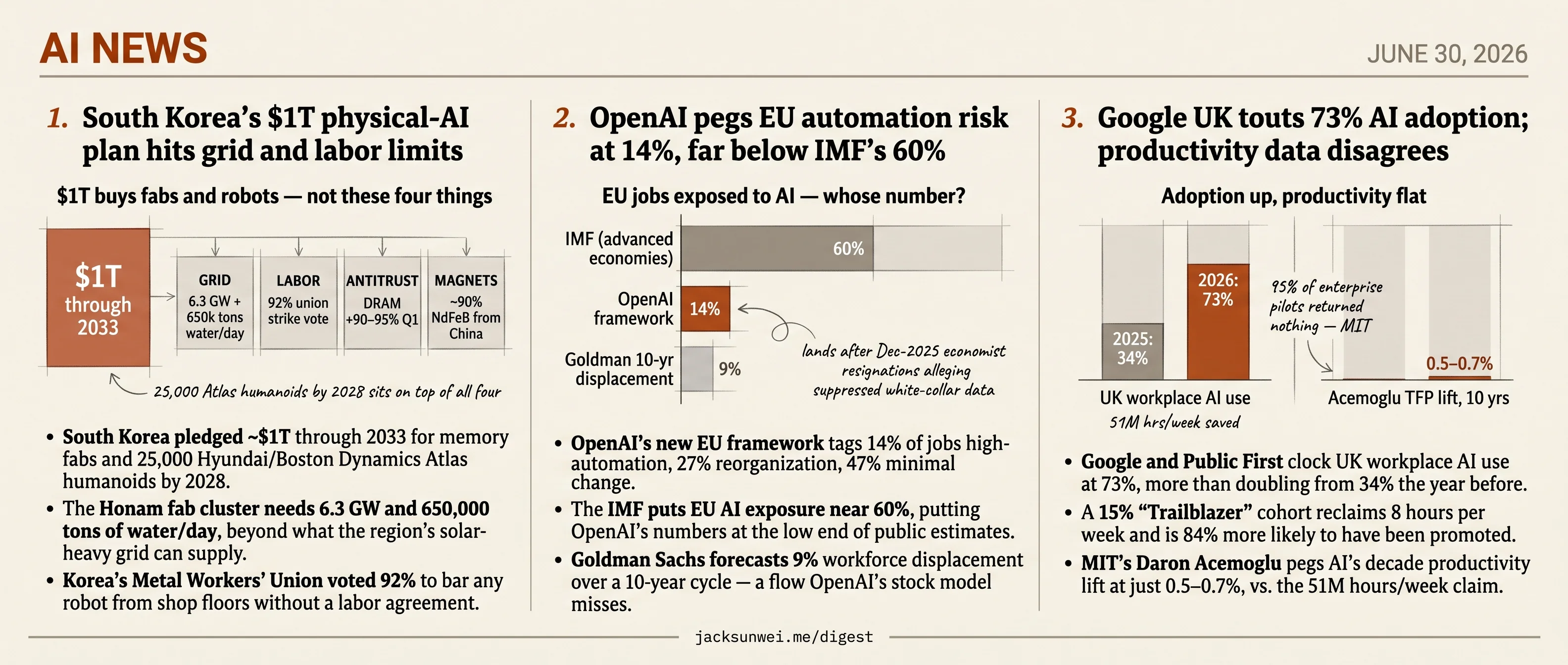
Korea, OpenAI, and Google UK each pitch AI numbers undercut by their own data
Korea's $1T fab plan, OpenAI's EU framework, and Google UK's adoption survey each meet tougher data on labor, grids, and productivity.
Korea, OpenAI, and Google UK each pitch AI numbers undercut by their own data
TL;DR
- South Korea commits ~$1T through 2033 for fabs and 25,000 Atlas humanoids by 2028.
- Korea’s Honam cluster needs 6.3 GW plus 650,000 tons of water daily, beyond the local grid.
- OpenAI’s EU framework tags 14% of jobs high-automation versus the IMF’s 60% exposure estimate.
- MIT’s Acemoglu pegs AI’s decade productivity lift at 0.5–0.7%, far below Google UK’s 51M-hours-a-week claim.
- Anthropic halves Claude pricing for California state agencies as federal ties cool.
Today’s AI-news leads all arrive as rollout pitches with a headline number attached — and each one gets checked against a different reality. South Korea unveils a ~$1T physical-AI program built around memory fabs and 25,000 Hyundai-Boston Dynamics humanoids, but the flagship Honam cluster needs 6.3 GW and 650,000 tons of water a day that the regional grid can’t deliver, and the Metal Workers’ Union has voted 92% to bar any robot without a labor agreement. OpenAI releases an EU automation framework pegging high-risk jobs at 14% — well below the IMF’s 60% exposure read — months after its own economists resigned alleging suppression of worse displacement data. Google UK touts 73% workplace AI adoption and a 51M-hours-per-week productivity claim that MIT’s Daron Acemoglu sizes at 0.5–0.7% over a decade.
Around the features, the round-ups sketch the same split: Anthropic deepens state-level government ties with a 50% California discount, Revelio finds heavy AI adopters actually grew headcount 10.2%, and LMArena turns evaluation traffic into a $100M run rate.
South Korea’s $1T physical-AI plan hits grid and labor limits
Source: ars-technica-ai · published 2026-06-29
TL;DR
- South Korea pledged ~$1T through 2033 for memory fabs and 25,000 Hyundai/Boston Dynamics Atlas humanoids by 2028.
- The Honam fab cluster needs 6.3 GW and 650,000 tons of water/day, beyond what the region’s solar-heavy grid can supply.
- Korea’s Metal Workers’ Union voted 92% to bar any robot from shop floors without a labor agreement.
- ~90% of humanoid-actuator NdFeB magnets come from China, deepening Korea’s rare-earth dependence as Atlas scales.
The headline number
Seoul’s two-track pledge — over $550B from Samsung, SK Hynix, Hyundai and peers, on top of state capital, totalling roughly $1T through 2033 — is being marketed as the move that pulls “physical AI” leadership away from the US and China. Memory fabs feed the data centers; Atlas humanoids and a 260,000-GPU Nvidia allocation (50k each to Samsung, SK and Hyundai, 60k to Naver, 50k to a national center) close the loop from HBM to robot 1. On paper it’s the most concretely-funded national AI-industrial strategy announced anywhere this cycle.
In practice, four frictions are already visible — and the announcement glossed all of them.
Power, water, and a political siting decision
The new southwestern Honam cluster alone is projected to draw 6.3 gigawatts and 650,000 tons of water per day. Korea JoongAng Daily reports that the region currently leans heavily on solar, “which cannot provide the 24/7 stable baseload power required for precision memory chip fabrication” 2. Analysts have framed Honam’s selection as an electoral favor from the Lee Jae-myung administration rather than a supply-chain optimization. Grid build-out for the existing Yongin cluster is already behind schedule, which puts the 2027–2033 fab milestones underpinning the trillion-dollar pitch into question before the first shovel hits Honam.
Labor declares ‘total war’ on the robot leg
The physical-AI half rests on Hyundai deploying 25,000 Atlas units by 2028. The Korean Metal Workers’ Union voted 92% on June 24 to authorize a general strike, declaring “total war” on unauthorized automation and stipulating that “not a single robot” reaches the shop floor without a labor-management agreement 3. This is the first frontal collision between chaebol automation plans and Korea’s organized labor, and it lands before deployment, not after.
Unit economics tighten the screw: a single enterprise Atlas costs $140k–$200k today, with Hyundai’s $20k target unlocking only past 150,000 cumulative units 4. The 25,000-unit 2028 number sits well short of that curve.
The shortage they’re being paid to solve
The “RAMageddon” framing rationalizing the memory spend is itself contested. A California class action filed in June 2026 accuses Samsung, SK Hynix and Micron of coordinating DRAM capacity cuts under cover of the HBM pivot, inflating Q1 prices 90–95% 5. The same firms now receiving state capital may be partly engineering the shortage the subsidies are meant to relieve.
The rare-earth chokepoint
Tech in Asia documents the supply-chain trap underneath the humanoids: roughly 88–90% of the NdFeB permanent magnets driving Atlas-class actuators are imported from China, and Korea’s localization rate for core robot components sits near 40% 6. Scaling Korean humanoid production scales Korean dependence on Chinese rare earths — the opposite of the decoupling story the announcement implies.
The $1T headline buys fabs and robots. It does not buy gigawatts, union consent, antitrust cover, or magnets.
Whether Seoul closes those four gaps over the next 24 months will determine if “physical AI leader by 2028” is a roadmap or a slogan.
Further reading
- South Korean tech giants commit over $550B to ease ‘RAMageddon’ — techcrunch-ai
OpenAI pegs EU automation risk at 14%, far below IMF’s 60%
Source: openai-blog · published 2026-06-29
TL;DR
- OpenAI’s new EU framework tags 14% of jobs high-automation, 27% reorganization, 47% minimal change.
- The IMF puts EU AI exposure near 60%, putting OpenAI’s numbers at the low end of public estimates.
- Goldman Sachs forecasts 9% workforce displacement over a 10-year cycle — a flow OpenAI’s stock model misses.
- Report lands after OpenAI economists resigned in late 2025, alleging suppression of worse white-collar displacement data.
A lowball number aimed at Brussels
OpenAI’s AI Jobs Transition Framework for the EU maps ESCO occupation codes against near-term model capabilities and concludes that only 14% of EU employment sits in the “higher automation potential” bucket, with another 27% facing “reorganization” and a comfortable 47% seeing “less immediate change.” Growth-oriented roles account for 12%, concentrated in Luxembourg, Sweden, and the Netherlands; Germany, Greece, and Italy carry the heavier automation load.
Read in isolation, it’s a tidy planning document. Read against the rest of the literature, it’s the floor of a very wide range. The IMF’s standing estimate is that “roughly 60% of jobs in advanced economies — including much of the EU — are exposed to AI” 7. Goldman Sachs’ June 2026 “AI Job Apocalypse” report projects “9% of the workforce could be displaced over a 10-year cycle” in the US 8 — a flow that OpenAI’s stock-based archetype model isn’t designed to surface. The 14% figure is best understood as a near-term technical-feasibility estimate filtered through European regulatory friction, not a forecast of net employment loss.
The credibility shadow
The framework arrives months after a public rupture inside OpenAI’s economics team. Tom Cunningham and at least one colleague resigned in late 2025, alleging the unit had been redirected from objective research into “a ‘de facto advocacy arm’ or ‘propaganda’ wing for the corporation” 9. Subsequent reporting cited whistleblower accounts that researchers were “specifically discouraged from publishing data showing ‘catastrophic’ potential for job losses,” with internal models reportedly showing entry-level white-collar displacement “outpacing job creation at a rate far higher than OpenAI’s public messaging suggested” 10.
That context matters for how policymakers should weight the Brussels-facing optimism here. The numbers in the report may be defensible on their own methodological terms, but they are also the corporate position of a company with active lobbying interests around the AI Act.
What the archetypes smooth over
The four-bucket frame organizes risk by country, not by worker. ILO data published in March 2026 found that “roughly 29% of jobs in female-dominated occupations are exposed to significant AI disruption, compared to only 16% in male-dominated fields” 11 — a gender gradient that disappears inside national averages. Bruegel has flagged similar concentration among younger and highly educated workers. Critics of the “reorganization” label, the report’s largest bucket at 27%, argue it euphemizes work intensification and algorithmic management already underway on shop floors and in call centers.
The geopolitical subtext
OpenAI’s chief economist Chatterji rolled the report out at a POLITICO Europe event where, by the coverage’s own account, Europe “felt increasingly ‘left in the cold’ due to new US trade restrictions… that limit access to cutting-edge models like GPT-5.6 to ‘trusted partners’ primarily within the US” 12. The “tailored national readiness plans” pitch — leverage your vocational data, your licensing systems, your vacancy statistics — arrives as OpenAI simultaneously signs the GPAI Code of Practice and lobbies against fragmented member-state rules.
Treat the framework as a useful ESCO-grounded mapping exercise. Don’t treat the 14% as the ceiling.
Google UK touts 73% AI adoption; productivity data disagrees
Source: google-ai-blog · published 2026-06-30
TL;DR
- Google and Public First clock UK workplace AI use at 73%, more than doubling from 34% the year before.
- A 15% “Trailblazer” cohort reclaims 8 hours per week and is 84% more likely to have been promoted.
- MIT’s Daron Acemoglu pegs AI’s decade productivity lift at just 0.5–0.7%, vs. the 51M hours/week claim.
- Labour and sovereignty critics call the 10M-worker training pledge a wedge for US hyperscaler dependency, not civic investment.
The adoption snapshot
Google UK’s new report with Public First lands a striking headline: workplace AI use jumped from 34% in 2025 to 73% in 2026, with a 15% elite of “AI Trailblazers” capturing most of the professional upside. Trailblazers reclaim a full working day each week, are 88% more likely to get a positive performance review, and 55% more likely to have secured a pay rise. Nationally, Google estimates AI is saving British workers 51 million hours per week — a figure the report likens to the entire NHS workforce’s output.
The behavioural diagnosis is the more interesting part. Mastery, the report argues, isn’t about coding: it’s about iterating, treating the model as a collaborator rather than a search box, and being given organisational permission to prompt. Only 37% of users have ever asked an AI to refine its own prompt; only a third have ever received written guidance from their employer.
Where the numbers stop adding up
The Trailblazer correlation isn’t fabricated — Forbes reports independently that 15.3% of AI-using workers (and 26% of Gen Z) attribute a recent promotion at least partly to AI-assisted output 13. But corroborating the correlation leaves the causal story wide open. The “ambitious worker who was already on the promotion track” reading fits the data equally well, and Google’s framing doesn’t engage with it.
The macro picture is harder to square. MIT’s Daron Acemoglu estimates only ~4.6% of workplace tasks are profitably automatable today, and that generative AI will lift total factor productivity by 0.5–0.7% over a decade 14. Goldman Sachs’ Jim Covello has been blunter: roughly $1 trillion of infrastructure spend is chasing a technology still “too expensive and unreliable” for high-value problems, and “the business case for AI remains unproven” 15. MIT’s State of AI in Business 2025 found 95% of corporate AI pilots delivered no measurable financial return 16.
| Source | Claim |
|---|---|
| Public First / Google [primary] | 51M hours/week saved; Trailblazers 84% more likely promoted |
| Acemoglu (MIT) 14 | +0.5–0.7% TFP over ten years |
| Covello (Goldman) 15 | $1T infra spend, business case unproven |
| MIT State of AI 16 | 95% of enterprise pilots return nothing |
Individual time savings of this magnitude should, eventually, show up in aggregate output. They aren’t.
Who captures the 8 hours?
Even granting the report’s numbers at face value, there’s a distributional question Google sidesteps. The Guardian, covering an IPPR report endorsed by the TUC, warns that without statutory consultation rights the UK “risks a repeat of the early Industrial Revolution, where technological gains were captured entirely by capital while wages stagnated for decades” 17. The reclaimed working day is an asset; the report is silent on who owns it.
The 10-million-worker training partnership with the UK government has drawn sharper pushback. Computer Weekly calls it a “betrayal of UK workers and our digital sovereignty,” arguing that free training functions as a customer-acquisition channel for US hyperscalers into British public services 18.
Treat the Public First numbers as a credible adoption snapshot. Treat the productivity narrative wrapped around them as the contested claim it is.
Round-ups
Anthropic cuts Claude price 50% for California government
Source: techcrunch-ai
Gov. Gavin Newsom struck a deal giving California state agencies access to Claude at half price, deepening Anthropic’s ties to Sacramento even as its relationship with the federal government sours.
Heavy AI adopters grew headcount 10.2%, entry-level jobs up 12%
Source: techcrunch-ai
A new Revelio Labs and Ramp report complicates the AI-kills-junior-jobs narrative: companies classified as high-intensity AI adopters expanded total headcount by 10.2%, with entry-level roles at those firms growing even faster at 12%.
LMArena hits $100M run rate nine months after going commercial
Source: techcrunch-ai
Arena, the crowd-sourced AI leaderboard widely cited by model labs, has reached a $100M business just nine months after launching paid services last September — turning its evaluation traffic into a commercial moat.
OpenAI teases a physical Codex shortcut device for July 15
Source: the-verge-ai
A square button-covered gadget tied to OpenAI’s Codex coding assistant debuts July 15, per a video posted to X. It is separate from the consumer AI hardware OpenAI is building with Jony Ive.
Cursor ships mobile app for steering coding agents remotely
Source: techcrunch-ai
The new Cursor mobile app lets developers monitor and direct background coding agents away from their desk, extending the IDE’s agent oversight to phones as autonomous coding work increasingly runs unattended.
Wix-owned Base44 rolls out in-house model to escape frontier dependence
Source: techcrunch-ai
Vibe coding platform Base44 is shipping its own AI model, aiming to eventually beat frontier providers it currently relies on. The move reflects a broader push by AI app startups to build defensibility through proprietary models.
Import AI 463 covers self-improving robots and a 10k Chinese GPU cluster
Source: import-ai
Jack Clark’s latest issue surveys research on robots that improve themselves, details a 10,000-GPU cluster stood up in China, and closes with an elegiac essay framing the present as an interregnum between human and machine eras.
Footnotes
-
AJU Press — https://m.ajupress.com/amp/20260604183070907
↩Nvidia [committed] to supply 260,000 high-end AI accelerators… 50,000 chips are reserved for the National AI Computing Center… and the remainder is split among private giants, with 50,000 each for Samsung, SK, and Hyundai, and 60,000 for Naver Cloud.
-
Korea JoongAng Daily — https://www.koreajoongangdaily.com/business/with-500b-set-to-flood-into-chip-hub-samsung-and-sk-hynix-face-water-and-talent-shortage/12748377
↩The new southwestern ‘Honam’ cluster alone is projected to require 6.3 gigawatts of power and 650,000 tons of water daily… the Honam region currently relies heavily on volatile renewable energy sources like solar, which cannot provide the 24/7 stable baseload power required for precision memory chip fabrication.
-
Futurism — https://futurism.com/robots-and-machines/korean-workers-strike-robots-replace
↩The Korean Metal Workers’ Union… authorized a general strike on June 24, 2026, with a 92% approval rate… declaring ‘total war’ on unauthorized automation, stipulating that ‘not a single robot’ will be permitted on the shop floor without a formal labor-management agreement.
-
The Korean Car Blog — https://thekoreancarblog.com/hyundai-vs-tesla-hyundai-motor-group-targets-150000-atlas-humanoids-by-2029/
↩A single enterprise-grade Atlas unit is estimated to cost between $140,000 and $200,000… Hyundai’s long-term goal is to drive the unit cost down to approximately $20,000 once production passes the 150,000-unit threshold.
-
Startup Fortune (on RAMageddon) — https://startupfortune.com/ramageddon-is-real-and-ai-data-centers-are-crowding-out-everyone-else-in-the-memory-market/
↩A class-action lawsuit filed in California in June 2026 accuses the ‘Big Three’—Samsung, SK Hynix, and Micron—of coordinating capacity cuts for traditional DRAM under the guise of an AI transition to artificially inflate prices.
-
Tech in Asia — https://www.techinasia.com/news/south-koreas-robotics-industry-faces-supply-chain-risk
↩South Korea currently imports nearly 90% of these [NdFeB] magnets from China… its localization rate for core components remains stuck at approximately 40%.
-
Dig.Watch — IMF/EU exposure analysis — https://dig.watch/updates/ai-to-reshape-eu-jobs
↩roughly 60% of jobs in advanced economies — including much of the EU — are exposed to AI
-
PYMNTS on Goldman Sachs ‘AI Job Apocalypse’ report — https://www.pymnts.com/economy/2026/goldman-sachs-says-ai-will-eliminate-15-million-us-jobs/
↩9% of the workforce could be displaced over a 10-year cycle
-
The Nov Tech (reporting on OpenAI economist resignations) — https://www.thenovtech.com/p/openais-economists-just-resigned
↩the economic research team was being diverted from objective analysis to serve as a ‘de facto advocacy arm’ or ‘propaganda’ wing for the corporation
-
eWeek — OpenAI researcher departure coverage — https://www.eweek.com/news/openai-researcher-leaves-december-2025/
↩researchers were specifically discouraged from publishing data showing ‘catastrophic’ potential for job losses… displacement of entry-level white-collar roles was outpacing job creation at a rate far higher than OpenAI’s public messaging suggested
-
ILO — gender exposure data, March 2026 — https://www.ilo.org/resource/news/new-ilo-data-confirm-women-face-higher-workplace-risks-generative-ai-men
↩roughly 29% of jobs in female-dominated occupations are exposed to significant AI disruption, compared to only 16% in male-dominated fields
-
Crypto Briefing — Chatterji at POLITICO Europe event — https://cryptobriefing.com/openai-chief-economist-eu-ai-strategies/
↩Europe felt increasingly ‘left in the cold’ due to new US trade restrictions… that limit access to cutting-edge models like GPT-5.6 to ‘trusted partners’ primarily within the US
-
Forbes — Colleen Batchelder — https://www.forbes.com/sites/colleenbatchelder/2026/06/15/gen-z-workers-are-getting-promoted-using-ai—heres-how-you-can-do-the-same/
↩approximately 15.3% of AI-using workers—and over 26% of Gen Z employees—received promotions attributed at least partially to AI-assisted output
-
MIT Sloan — Daron Acemoglu — https://mitsloan.mit.edu/ideas-made-to-matter/how-artificial-intelligence-impacts-us-labor-market
↩ ↩2only about 4.6% of workplace tasks are truly ripe for profitable automation… AI will increase total factor productivity by a mere 0.5% to 0.7% over a ten-year period
-
Crypto Briefing — Goldman Sachs’ Jim Covello — https://cryptobriefing.com/goldman-sachs-covello-warns-ai-investments/
↩ ↩2the industry is projected to spend roughly $1 trillion on infrastructure, yet the technology remains too expensive and unreliable to solve high-value, complex problems… the business case for AI remains unproven
-
MIT ‘State of AI in Business 2025’ report — https://mlq.ai/media/quarterly_decks/v0.1_State_of_AI_in_Business_2025_Report.pdf
↩ ↩295% of corporate AI pilots fail to deliver measurable financial returns
-
The Guardian / IPPR (TUC-backed) — https://www.theguardian.com/technology/2026/may/29/give-staff-more-say-over-ai-to-ensure-they-share-benefits-uk-thinktank-urges
↩Give staff more say over AI to ensure they share benefits… without legal guardrails, the UK risks a repeat of the early Industrial Revolution, where technological gains were captured entirely by capital while wages stagnated
-
Computer Weekly opinion (Foxglove-aligned critique) — https://www.computerweekly.com/opinion/The-UK-governments-AI-skills-programme-betrays-UK-workers-and-our-digital-sovereignty
↩The UK government’s AI skills programme betrays UK workers and our digital sovereignty