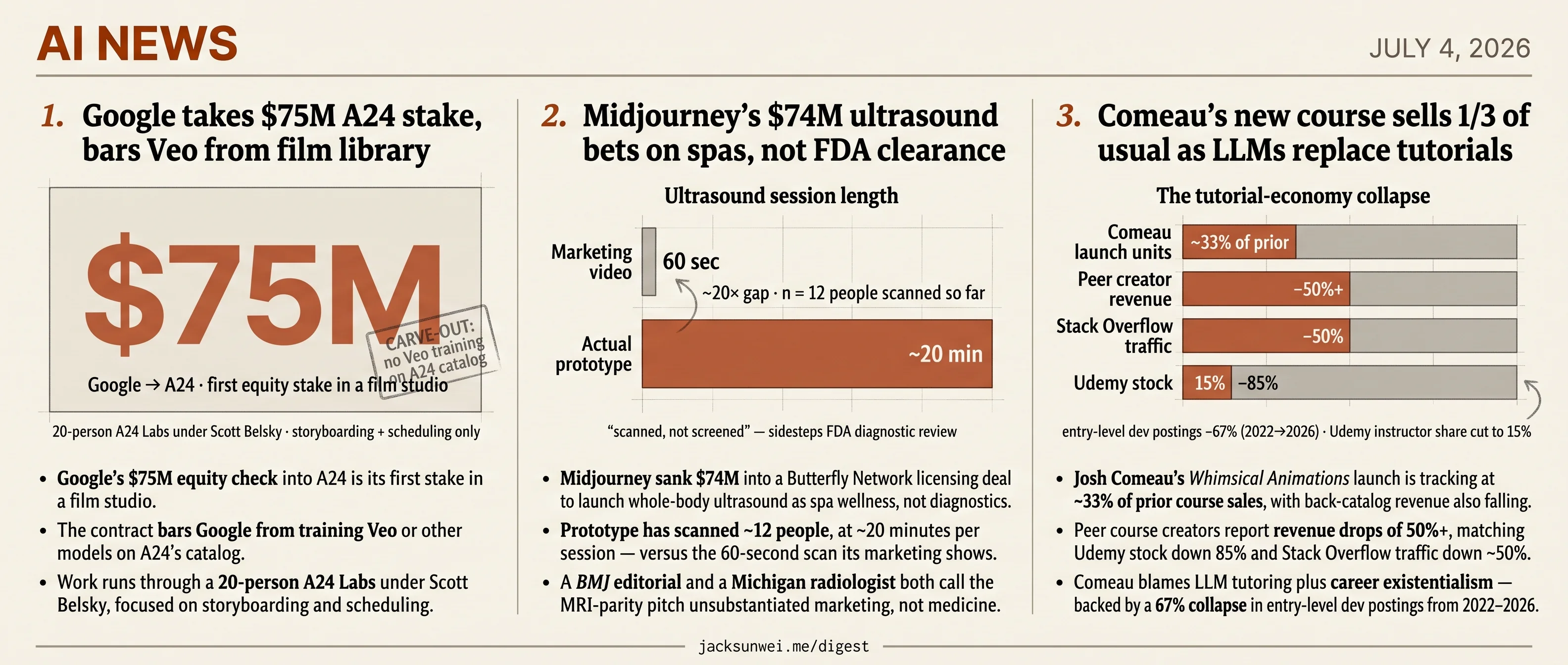
A24 bars Veo training, Midjourney sidesteps FDA, Comeau loses sales to LLMs
Three AI commercial moves each concede ground to a non-AI constraint: training rights, medical regulation, and LLM-driven substitution.
A24 bars Veo training, Midjourney sidesteps FDA, Comeau loses sales to LLMs
TL;DR
- Google takes a $75M stake in A24 with a contract barring Veo training on the studio’s catalog.
- Midjourney commits $74M to whole-body ultrasound branded as spa wellness, ducking FDA diagnostic review.
- Josh Comeau’s new course launch is tracking at 33% of prior sales as LLM tutoring displaces dev tutorials.
- Peer course creators log 50%+ revenue drops alongside a 67% collapse in entry-level dev postings since 2022.
Today’s three AI-news leads all involve real money — $75M into A24, $74M into a Butterfly Network license, a marquee course launch — and each deal is reshaped by a limit money can’t buy past. Google’s equity check into A24 comes with a written promise not to train Veo on the catalog. Midjourney’s ultrasound bet is engineered around FDA diagnostic rules by branding scans as wellness, not medicine. And Josh Comeau’s Whimsical Animations launch is tracking at a third of prior sales because the audience is asking Claude instead of buying the course.
The through-line isn’t AI’s advance; it’s what AI has to concede at the edges. IP rights in Hollywood, regulatory scope in medicine, and customer substitution in software education are each dictating the shape of the deal. The frontier labs aren’t setting the terms — the counterparties are.
Google takes $75M A24 stake, bars Veo from film library
Source: deepmind-blog · published 2026-07-03
TL;DR
- Google’s $75M equity check into A24 is its first stake in a film studio.
- The contract bars Google from training Veo or other models on A24’s catalog.
- Work runs through a 20-person A24 Labs under Scott Belsky, focused on storyboarding and scheduling.
- A24 director Kane Parsons calls generative AI “cultural and economic rot” — dissent from inside the roster.
The deal DeepMind’s blog didn’t spell out
The DeepMind announcement reads like a values statement: “filmmaker-forward,” “shared curiosity,” Gemini 3.5 and Gemini Omni in service of the artist’s vision. The interesting details are the ones it leaves out. TheWrap pegs the transaction at $75M for a non-exclusive research partnership — Google’s first equity position in a film studio — and confirms the contract explicitly forbids Google from training Veo or any other model on A24’s film library 1. The work is being run out of a 20-person A24 Labs group led by former Adobe chief product officer Scott Belsky, who is steering the roadmap toward pre-production utilities (storyboarding, scheduling) rather than the consumer-facing generative video tools that have defined the category so far 1.
That structure is a deliberate contrast to the Lionsgate–Runway deal, which centered on training a bespoke model on Lionsgate’s 20,000-title catalog and reportedly hit “early snags” because the library was too small to matter 2. A24 gets the credibility of a DeepMind partnership without handing over the IP.
The dissent is coming from inside the house
The louder problem for A24 is that some of its marquee directors are already on record against the underlying technology. Kane Parsons, the 21-year-old director of A24’s Backrooms, called generative AI “a symptom of a broader cultural and economic rot” and said he would make the tech “disappear forever” if he could 3. The Heretic team has taken to stamping “No Generative AI” credits on their films. The Art Directors Guild Local 800 has separately attacked AI storyboarding as a betrayal of collaborative cinema and as parasitic on uncompensated copyrighted training data — a critique that lands directly on the storyboard generator A24 Labs is building 4.
A24’s public defense is pragmatic. Spokesperson Sophia Shin: the studio would “rather have a seat at the table than on the sidelines,” and the point of the deal is to “dictate what tools get built for artists” rather than have them imposed by Silicon Valley 5. The training-data carveout gives that pitch some teeth.
Why Google is writing this check
$75M is a rounding error against Alphabet’s projected $175–185B in 2026 capex, and PitchBook explicitly frames it as a “modest check” landing in a market where AI content-creation VC funding jumped 50% year-over-year 6. The stake is priced at the same ~$3.5B valuation Thrive Capital set in 2024 6. The strategic read is that Google is buying cultural capital — credibility with elite filmmakers and a live testbed for Veo — not a controlling position or an IP grab 16.
The open question isn’t the contract. It’s whether A24’s auteur brand can absorb the association without hemorrhaging the filmmakers who made it worth buying into.
Midjourney’s $74M ultrasound bets on spas, not FDA clearance
Source: the-verge-ai · published 2026-07-03
TL;DR
- Midjourney sank $74M into a Butterfly Network licensing deal to launch whole-body ultrasound as spa wellness, not diagnostics.
- Prototype has scanned ~12 people, at ~20 minutes per session — versus the 60-second scan its marketing shows.
- A BMJ editorial and a Michigan radiologist both call the MRI-parity pitch unsubstantiated marketing, not medicine.
- “Scanned, not screened” branding sidesteps FDA diagnostic review while generating incidental findings patients cannot act on.
Marketing is running well ahead of evidence
Midjourney’s new 20-minute behind-the-scenes tour of its dunk-tank ultrasound scanner is, like the launch video before it, cinema. What it isn’t is data: no phantom studies, no head-to-head against MRI, no peer review. A BMJ editorial by neuroradiologist Gennaro D’Anna singles out exactly this pattern, warning that “potentially transformative medical tools are introduced via cinematic AI-generated marketing videos rather than through strict scientific validation” 7. Business Insider got University of Michigan radiologist Matthew Davenport on the record calling the MRI-parity pitch “wildly unsubstantiated” 8. The Verge’s skepticism is, if anything, mild next to the medical trade press.
The prototype numbers make the gap concrete. A first-principles teardown on the SWIMED Substack pegs the Gen 1 device at roughly 12 people scanned so far, with sessions taking about 20 minutes — not the 60 seconds the marketing implies. Closing that ~20× gap depends on unproven full-waveform inversion reconstruction working at production scale 9.
The physics ceiling nobody disputes
Even sympathetic readers hit a wall the roadmap can’t engineer around. Scott Alexander’s write-up on Astral Codex Ten notes that ultrasound simply cannot penetrate bone or air, which means “whole-body” excludes the brain, the lungs, and much of the bowel — “exactly where you’d most want a screening tool” 10. This isn’t a Midjourney-specific critique; it’s a modality limit. Any pitch that a spa ultrasound rivals MRI has to explain why the organs MRI is most valuable for are the ones ultrasound structurally cannot see.
The spa isn’t a soft launch — it’s the regulatory strategy
The framing everyone keeps missing: this isn’t a cautious wellness rollout ahead of a “real” clinical product. Radiology Business reports that the $74M Butterfly Network licensing deal is underwriting a screening business deliberately positioned as body-composition wellness 11. Wellfounded Health’s clinical read is blunter — the “scanned, not screened” label lets Midjourney skip FDA diagnostic clearance entirely, while generating thousands of incidental findings that patients have no clinical pathway to resolve 12. The liability for every ambiguous nodule gets punted to the customer and whichever downstream physician they panic-call.
That’s the actual story the behind-the-scenes video obscures. A generative-image startup with no clinical trial infrastructure is entering medical imaging by defining its product out of the regulated category. Whether the scanner works is almost secondary to whether “wellness” holds as a legal shield once the incidentalomas start piling up — and whether spa customers understand that the pretty grayscale image they’re paying for is not, by design, a diagnosis.
Comeau’s new course sells 1/3 of usual as LLMs replace tutorials
Source: simon-willison · published 2026-07-03
TL;DR
- Josh Comeau’s Whimsical Animations launch is tracking at ~33% of prior course sales, with back-catalog revenue also falling.
- Peer course creators report revenue drops of 50%+, matching Udemy stock down 85% and Stack Overflow traffic down ~50%.
- Comeau blames LLM tutoring plus career existentialism — backed by a 67% collapse in entry-level dev postings from 2022–2026.
- Udemy cut instructor revenue share to 15% in January 2026, squeezing independent creators from the platform side too.
The numbers hold up across the ecosystem
Comeau’s post — a Bluesky thread Simon Willison quoted in full — reports that his third course is on pace to sell roughly one-third the units of a typical launch, and that back-catalog sales are down significantly. He says peer conversations put the industry-wide hit at 50%+ revenue declines.
That’s not a solo data point. Salma Alam-Naylor’s contemporaneous “Goodbye, forever, probably” post frames the same collapse from the DevRel side, calling AI overviews “a war on the web that fragments communities and discourages developers from gathering in shared spaces to teach and learn” 13. A Stackademic essay adds harder figures: Udemy laid off ~10% of staff with its stock down 85%, and Stack Overflow traffic is down ~50% since the LLM surge 14. The 50% number Comeau heard from peers shows up independently at both the marketplace and Q&A tiers.
Career existentialism has a hiring chart behind it
Comeau’s first driver — students refusing to invest in a career they think is dying — isn’t vibes. Nucamp’s aggregate data shows entry-level developer postings down ~67% between 2022 and 2026, with actual junior hires down 73% 15. Stanford’s 2026 AI Index reports U.S. undergraduate CS enrollment fell 11% year-over-year while AI-focused graduate programs grew 17% 16. Learners aren’t leaving tech — they’re re-routing away from the general web-dev audience Comeau’s catalog serves.
The second mechanism the post skips
Comeau attributes the decline entirely to demand-side AI substitution, but platform economics are a parallel force. EzyCourse reports Udemy cut instructor revenue share to 15% for marketplace sales in January 2026 as it pivoted to Udemy Business subscriptions 17. Independent creators are compressed from both sides: LLM tutoring erodes willingness to pay, and marketplace margin cuts shrink what remains. Any “AI killed my course” narrative that ignores the platform squeeze is incomplete.
The perception gap that actually kills willingness-to-pay
There’s a wrinkle in the “LLMs are better teachers” thesis. Comeau’s own recent benchmark of Gemini Pro 3 on a semantic-layout problem was, per one recap, “a trainwreck” — the model repeatedly proposed display: contents, introducing accessibility regressions 18. If frontier models still fail the exact interaction and animation problems Whimsical Animations teaches, the substitution isn’t real on the merits. Buyers believe the LLM suffices, and that belief is enough to kill the sale.
LLMs slurp up all of our work and regurgitate it, without consent or compensation.
That reframes the crisis. It isn’t “AI became a better teacher than Comeau” — it’s “AI became a good-enough-looking teacher, trained on Comeau, and that perception collapsed his market.” The open question is whether hard-to-fake craft (animation, accessibility, taste) is more defensible than syntax tutorials, or whether the willingness-to-pay floor drops out at every tier simultaneously. Current evidence points to the latter.
Round-ups
Anthropic launches Claude Science workbench for drug research
Source: the-verge-ai
Claude Science pulls fragmented scientific tools and datasets into a single environment for researchers, generating figures and visuals alongside analysis. Unveiled at Anthropic’s ‘AI for Science’ briefing, the workbench signals the coding-tools leader’s push into drug development as its next commercial frontier.
MIT Tech Review maps AI’s move into industrial operations
Source: mit-tech-review-ai, mit-tech-review-ai
A two-part package examines how AI is becoming a core operating layer in heavy industry, from wind-turbine control to process-management frameworks like Lean Six Sigma and BPM. The focus: infrastructure-heavy sectors where safety and continuity matter more than chatbots.
Chrome and Safari challengers multiply as browser wars reignite
Source: techcrunch-ai
TechCrunch’s 2026 roundup surveys the alternative browsers gaining ground on Chrome and Safari, with the battleground shifting away from default search toward AI features and agentic browsing. The piece frames the resurgent competition as a fight for the next interface layer.
Fable returns as Anthropic ships a new Claude Sonnet
Source: bens-bites
Ben’s Bites flags the revival of Fable alongside a fresh Claude Sonnet release from Anthropic. Details are thin in the dispatch, but the pairing lands on the same day, giving builders both a returning creative tool and an updated mid-tier model to test.
TechCrunch’s AI glossary decodes hallucinations, agents and slang
Source: techcrunch-ai
The evergreen reference defines the terms flooding AI coverage in 2026, from hallucinations to agentic workflows, aimed at readers trying to keep pace with jargon. It’s positioned as a single-stop guide covering both technical vocabulary and industry slang.
Latent Space logs back-to-back quiet days in AI news
Source: latent-space, latent-space
Two consecutive AINews issues shipped with the same verdict: nothing shipped worth breaking down. The second edition hints at ‘a quiet day before the storm,’ suggesting the newsletter expects bigger releases imminently after the mid-week lull.
Footnotes
-
TheWrap — deal terms and Belsky/A24 Labs — https://www.thewrap.com/industry-news/tech/google-a24-investment-ai-research/
↩ ↩2 ↩3The $75M non-exclusive research deal — Google’s first equity stake in a film studio — explicitly bars Google from training its models (including Veo) on A24’s film library, and is run through a 20-person A24 Labs unit led by former Adobe CPO Scott Belsky.
-
Ngram — Hollywood AI deal comparison — https://www.ngram.com/blog/google-a24-lionsgate-runway-hollywood-ai-video
↩Unlike the Lionsgate–Runway deal, which trains a bespoke model on Lionsgate’s 20,000-title catalog (and reportedly hit ‘early snags’ because the library was too small), the A24 deal is structured around embedded researchers and workflow tools rather than IP training rights.
-
The Cool Down — on Kane Parsons — https://www.thecooldown.com/green-tech/a24-google-ai-deal-backrooms-director/
↩Kane Parsons, the 21-year-old director of A24’s Backrooms, called generative AI ‘a symptom of a broader cultural and economic rot’ and said he would make the technology ‘disappear forever’ if he could.
-
Soap Central — Art Directors Guild Local 800 — https://www.soapcentral.com/entertainment/news-the-art-directors-guild-criticizes-martin-scorsese-turning-back-human-artists-amid-ai-endorsement
↩ADG Local 800 accused filmmakers embracing AI storyboard tools of ‘turning their backs’ on collaborators and of relying on models ‘built by ingesting large swaths of copyrighted work’ without consent — a stance that directly implicates the A24/DeepMind storyboard generator.
-
LiveMint — A24 spokesperson Sophia Shin — https://www.livemint.com/news/us-news/a24-defends-ai-partnership-with-google-deepmind-wed-rather-have-a-seat-at-the-table-than-on-the-sidelines-11782504996618.html
↩A24 defended the deal saying it would ‘rather have a seat at the table than on the sidelines,’ arguing the partnership lets the studio ‘dictate what tools get built for artists’ rather than have them imposed by Silicon Valley.
-
PitchBook — market context — https://pitchbook.com/news/articles/googles-75m-stake-in-a24-follows-a-50-funding-increase-in-ai-content-creation-startups
↩ ↩2 ↩3Google’s $75M stake in A24 lands amid a 50% year-over-year jump in VC funding for AI content-creation startups, and sits at the same ~$3.5B valuation set by Thrive Capital’s 2024 round — a ‘modest check’ against Alphabet’s $175–185B 2026 capex.
-
The BMJ editorial (Gennaro D’Anna) — https://www.bmj.com/content/393/bmj-2026-100053
↩It is increasingly concerning when potentially transformative medical tools are introduced via cinematic AI-generated marketing videos rather than through strict scientific validation.
-
Business Insider (Matthew Davenport, Univ. of Michigan radiologist) — https://www.businessinsider.com/midjourney-medical-scanner-health-care-spa-2026-6
↩Claims that the scanner is ‘as powerful as MRI’ are wildly unsubstantiated.
-
SWIMED Substack (first-principles teardown) — https://swimed.substack.com/p/the-midjourney-scanner-a-first-principles
↩The Gen 1 prototype currently requires ~20 minutes and has scanned only about 12 people; bridging to the marketed 60-second scan depends on unproven improvements in signal processing and full-waveform inversion reconstruction.
-
Astral Codex Ten (Scott Alexander) — https://www.astralcodexten.com/p/preliminary-thoughts-on-the-midjourney
↩Ultrasound cannot see through bone or air, so ‘whole-body’ is a stretch — you’re missing the brain, lungs, and much of the bowel, which are exactly where you’d most want a screening tool.
-
Radiology Business — https://radiologybusiness.com/topics/healthcare-management/healthcare-economics/ai-lab-midjourney-investing-over-74m-launch-whole-body-ultrasound-screening-business
↩Midjourney is investing over $74M via a licensing deal with Butterfly Network to launch a whole-body ultrasound screening business, initially positioned as body-composition wellness rather than diagnostics.
-
Wellfounded Health analysis — https://wellfounded.health/insights/scanned-not-screened-what-the-midjourney-medical-scanner-actually-means-for-your-health
↩By branding the device as ‘scanned, not screened’ wellness, Midjourney sidesteps FDA diagnostic clearance while generating thousands of incidental findings that patients have no clinical pathway to act on.
-
Salma Alam-Naylor — ‘Goodbye, forever, probably’ — https://whitep4nth3r.com/blog/goodbye-forever-probably/
↩AI is killing developer education… AI overviews are a war on the web that fragments communities and discourages developers from gathering in shared spaces to teach and learn.
-
Stackademic — ‘I’m done: Why AI killed the coding tutorial’ — https://jp.sulat.com/im-done-why-ai-killed-the-coding-tutorial-1cc756b66764
↩Udemy reportedly laid off 10% of its staff as its stock dropped 85%, while Stack Overflow traffic has plunged 50% since the AI surge began.
-
Nucamp — ‘The Junior Developer Hiring Crisis in 2026’ — https://www.nucamp.co/blog/the-junior-developer-hiring-crisis-in-2026-how-to-get-your-first-full-stack-job
↩Entry-level developer postings plummeted by approximately 67% between 2022 and 2026… actual hiring into these positions has dropped by 73% in the same period.
-
Stanford HAI — 2026 AI Index (Education chapter) — https://hai.stanford.edu/ai-index/2026-ai-index-report/education
↩Traditional four-year computer science enrollment at U.S. universities fell by 11% between 2024 and 2025, while AI-related graduate programs saw a 17% increase.
-
EzyCourse — ‘Why Udemy Creators Are Frustrated’ — https://ezycourse.com/blog/why-udemy-creators-are-frustrated
↩Individual instructors saw their revenue share for marketplace sales drop to just 15% in January 2026, making the platform less sustainable for specialized content creators.
-
Medium (coders.stop) — ‘6 Moments When AI Coding Tools Made Things Catastrophically Worse’ — https://medium.com/@coders.stop/6-moments-in-2025-2026-when-ai-coding-tools-made-things-catastrophically-worse-0d4315a1fd37
↩Comeau himself conducted a benchmark experiment using Gemini Pro 3… The result was described as a ‘trainwreck,’ as the AI repeatedly suggested incorrect CSS like
display: contents, which introduced accessibility issues.