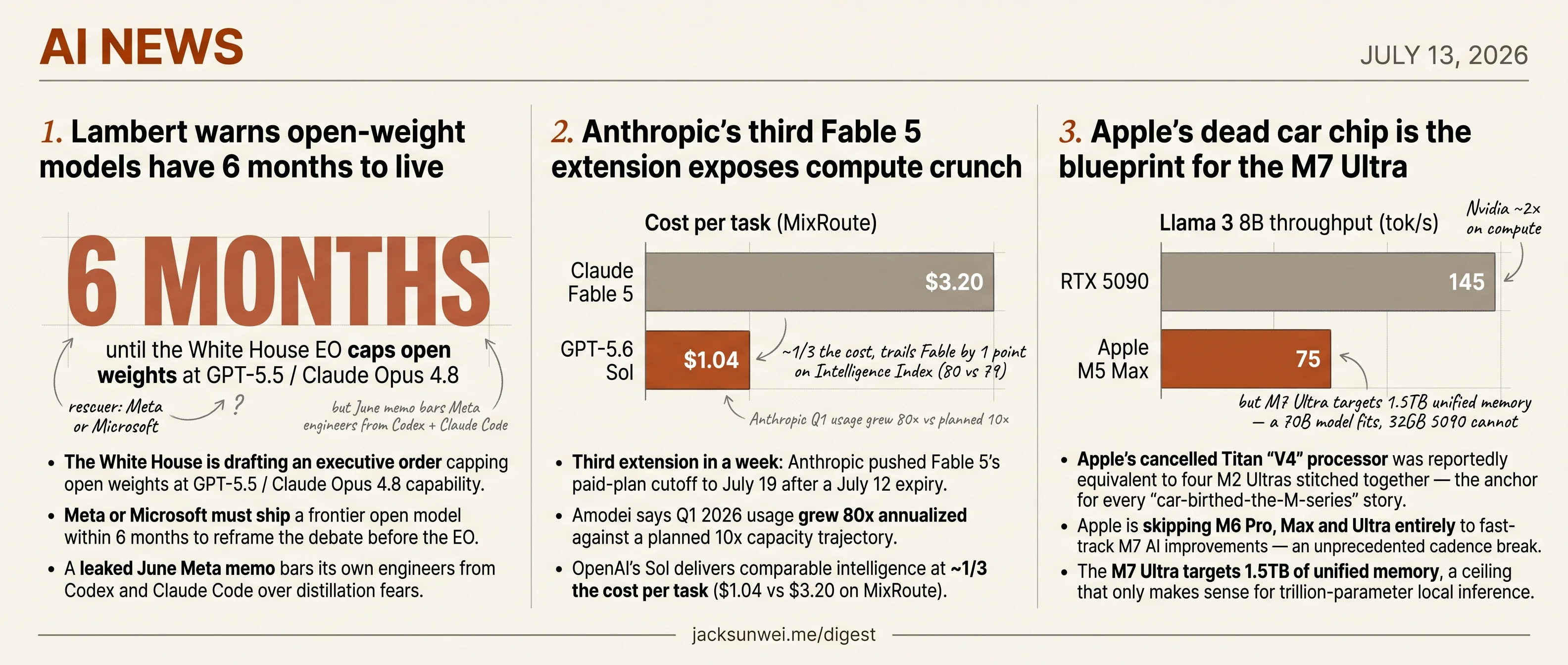
White House caps open weights, Anthropic rations Fable 5, Apple readies M7 Ultra
A leaked White House cap on open weights, an Anthropic compute crunch, and Apple's local-inference chip pivot define today's AI news.
White House caps open weights, Anthropic rations Fable 5, Apple readies M7 Ultra
TL;DR
- White House drafts an executive order capping open weights at GPT-5.5 / Claude Opus 4.8 capability.
- Anthropic extends Fable 5’s paid-plan cutoff a third time as usage hits 80× annualized growth.
- Apple’s M7 Ultra targets 1.5TB unified memory, positioning for trillion-parameter local inference.
- Meta’s leaked memo bars its own engineers from Codex and Claude Code over distillation fears.
- Community backlash targets both data-center buildouts and Meta’s celebrity-marketed smart glasses.
Today’s AI-news lands on three different ceilings. A leaked White House draft would cap open-weight releases at current frontier capability, giving Meta or Microsoft about six months to ship something at GPT-5.5 class before the door closes. Anthropic keeps sliding Fable 5’s paid-plan cutoff week by week because usage grew 80× annualized against a 10× capacity plan — and Sol now delivers similar intelligence at a third the cost, so the rationing looks less like triage and more like enterprise triage. Apple, meanwhile, is skipping the entire M6 Pro/Max/Ultra tier to fast-track an M7 Ultra aimed at 1.5TB of unified memory — a spec only trillion-parameter local inference explains.
The round-ups echo the ceiling motif from the ground up: community organizing against data-center buildouts is hardening into a durable policy fight, and Lorde used a Meta-sponsored festival stage to call smart glasses “not sexy.” The pushback is no longer online-only.
Lambert warns open-weight models have 6 months to live
Source: interconnects · published 2026-07-12
TL;DR
- The White House is drafting an executive order capping open weights at GPT-5.5 / Claude Opus 4.8 capability.
- Meta or Microsoft must ship a frontier open model within 6 months to reframe the debate before the EO.
- A leaked June Meta memo bars its own engineers from Codex and Claude Code over distillation fears.
- Hugging Face’s Delangue rejects the frontier-benchmark framing, calling open weights the “engine” to closed APIs’ “car.”
The executive order is not hypothetical
Nathan Lambert’s headline number — six months — is pegged to a specific artifact. Independent reporting confirms a White House EO is actively being drafted around a capability threshold tied to GPT-5.5 and Claude Opus 4.8, described in the readout as “a concrete threshold, not a vibe” 1. That matters because it forecloses the usual escape hatch of vague “frontier” language: any open-weight release that clears the bar triggers review, regardless of who ships it.
The regulatory context around the EO is already ugly. The EFF has called the administration’s recent ad hoc export controls — the ones that briefly forced Anthropic to suspend its Mythos and Fable models — “retaliatory,” warning they’ll push developers offshore rather than improve safety 2. Yann LeCun, now at AMI Labs, escalated further, calling the same bans an attempt to “ban the printing press” and warning of a “digital dictatorship” of West Coast labs 3. Lambert’s alarm is not a lone voice; it’s the moderate reading.
The prescription has a Meta-sized hole
Lambert’s fix rests on a US lab — realistically Meta or Microsoft — shipping a genuinely frontier open model fast enough to make the EO politically awkward. The problem: Meta’s own recent behavior runs directly against that story.
A June 2026 leak showed Meta restricting its own engineers from using OpenAI’s Codex and Anthropic’s Claude Code, on grounds that rival outputs could “contaminate” its training data and create IP liability 4. The anti-distillation logic Lambert identifies as the pretext for regulation is being practiced internally by the company he’s asking to save open source. A Meta that treats other labs’ tokens as radioactive is not a Meta gearing up to hand the world a GPT-5.5-class checkpoint.
The open camp doesn’t agree on what’s under threat
Clement Delangue rejects Lambert’s framing at its root. His analogy — open weights are the engine, closed APIs are the car — reframes the question away from leaderboard parity and toward ecosystem diffusion, arguing open source is “vital to avoid concentration of power” 5. In that view, chasing the frontier is the wrong fight; the value is in the long tail of fine-tuned, deployed, auditable models below the threshold the EO would ever touch.
That’s a real strategic split. Lambert says the frontier is the only place the fight matters because that’s where policy is being written. Delangue says fighting on the frontier is playing on the closed labs’ turf.
The security wedge nobody wants to talk about
The strongest empirical hook for the restriction camp is a Booz Allen finding that some Chinese open-weight coding models produced 130% more security flaws when prompted with U.S. government-affiliated personas 6. Whether the methodology survives scrutiny is beside the political point — this is the artifact the EO’s drafters will cite in the fact sheet. Lambert’s essay doesn’t engage with it, and any serious counter-argument to the EO will have to.
The six-month clock is real. The rescuer isn’t lined up, the open camp isn’t aligned on what it’s rescuing, and the hawks have their Exhibit A ready.
Anthropic’s third Fable 5 extension exposes compute crunch
Source: simon-willison · published 2026-07-12
TL;DR
- Third extension in a week: Anthropic pushed Fable 5’s paid-plan cutoff to July 19 after a July 12 expiry.
- Amodei says Q1 2026 usage grew 80x annualized against a planned 10x capacity trajectory.
- OpenAI’s Sol delivers comparable intelligence at ~1/3 the cost per task ($1.04 vs $3.20 on MixRoute).
- ~85% of Anthropic revenue is enterprise, so rationing quietly protects whale accounts at Max subscribers’ expense.
Access whiplash is now the product
Simon Willison flagged the July 12 date-bump as another incremental Anthropic retreat, but it’s actually the third short-notice reprieve in a single week — following expirations on July 7 and July 12 7. BleepingComputer’s term for the developer mood is “access whiplash”: teams can’t budget compute for a multi-week refactor when Anthropic will only commit to a Wednesday 7. Willison’s proposed fix — just make Fable permanent on paid plans — is the obvious move, and Anthropic’s continued silence on a roadmap is louder than the extensions themselves.
Why they can’t say yes
The compute picture explains the stalling. Dario Amodei disclosed that Q1 2026 usage grew 80x annualized against a planned 10x, and even the $1.25B/month Colossus 1 lease with SpaceX hasn’t closed the gap — API uptime fell to 98.95% during the crunch 8. Independent forecasters argue the bottleneck is physical power delivery rather than GPUs, which means the transition from “included” to “credits only” realistically takes months, not the week-long windows Anthropic keeps rolling forward 8.
Ramp’s enterprise spend data adds the strategic layer. Anthropic now leads OpenAI in business AI spend share at 34.4% vs 32.3%, with roughly 85% of Anthropic revenue coming from enterprise contracts 9. The rationing isn’t arbitrary — it’s deliberately protecting the accounts that pay the bills, at the direct expense of the $200/month Max subscribers Willison represents. UsageBox’s community numbers make the pain concrete: Fable counts as 2x Opus 4.8 against subscription quota, and a single complex refactoring session can burn 15–23% of a 5-hour window in under ten minutes, pushing some Max users back down to the $20 Pro tier 10.
OpenAI’s “winning” is real but noisy
Willison’s read that OpenAI is winning users on uncertainty alone is partially right, and the head-to-head math is uncomfortable for Anthropic:
| Metric (MixRoute) | GPT-5.6 Sol (Max Reasoning) | Claude Fable 5 |
|---|---|---|
| Coding Agent Index | 80 | 79 |
| Cost per task | $1.04 | $3.20 |
Sol trails Fable by a single point on the overall Intelligence Index but delivers comparable intelligence at roughly one-third the cost per task 11. Thibault Sottiaux’s confident tweet — 5-hour caps removed, efficiency landing, 6M active users — deserves scrutiny, though. The Decoder reports OpenAI admitted the ChatGPT Work rollout “didn’t get everything quite right,” and some Pro users say Sol actually consumed more quota than GPT-5.5 despite Altman’s claimed 54% efficiency gain 12. The cap removal is a reactive UX concession, not a flex of surplus capacity.
What’s actually at stake
Anthropic is running the playbook of a company that knows its best model is under-provisioned and its most vocal customers aren’t the ones it most needs to keep. Weekly extensions buy time to figure out whether Sol’s price-performance forces a real repricing of Fable access, or whether enterprise stickiness absorbs the individual churn. Willison’s frustration is the leading indicator; the Ramp share number is the lagging one to watch.
Apple’s dead car chip is the blueprint for the M7 Ultra
Source: the-verge-ai · published 2026-07-12
TL;DR
- Apple’s cancelled Titan “V4” processor was reportedly equivalent to four M2 Ultras stitched together — the anchor for every “car-birthed-the-M-series” story.
- Apple is skipping M6 Pro, Max and Ultra entirely to fast-track M7 AI improvements — an unprecedented cadence break.
- The M7 Ultra targets 1.5TB of unified memory, a ceiling that only makes sense for trillion-parameter local inference.
- Independent benchmarks puncture the triumphalism: an RTX 5090 still doubles an M5 Max on Llama 3 8B throughput.
The hardware claim, and where it comes from
The Verge’s retrospective, sourced to Mark Gurman, rests on one specific number that has been circulating since March 2024: the Titan “V4” processor Apple designed for its self-driving platform was roughly equivalent to four M2 Ultra chips fused together, and was nearly tape-out ready when the program was killed 13. That implies north of 500 billion transistors on a single package — a wild spec for an automotive part, and the anchor claim for every downstream “the car built the M-series” narrative. No independent teardown has verified it. It remains a leak, not a measurement.
The roadmap disruption is the real evidence
The tangible legacy isn’t the dead silicon — it’s what Apple is now shipping to absorb the team that built it. Gurman reports Apple is skipping the M6 Pro, Max and Ultra variants entirely to fast-track M7 improvements aimed squarely at AI workloads 14. That’s a cadence break without precedent in the Apple Silicon era. The M7 Ultra is being spec’d for up to 1.5TB of unified memory 15, a capacity ceiling Apple hasn’t touched since the 2019 Intel Mac Pro and one that makes no sense for Final Cut — it only pencils out if the target workload is running frontier-scale models locally.
In parallel, Ming-Chi Kuo says Apple’s Broadcom-partnered “Baltra” server ASIC enters mass production in H2 2026, feeding dedicated AI data centers that come online in 2027 16. Cadence break, memory ceiling, custom server silicon: those three moves are the Titan-to-AI pivot the Verge only sketches.
Where the “powerful AI chip” framing wobbles
The benchmark picture is less flattering than the headline. On small-model throughput, an RTX 5090 clocks ~145 tok/s on Llama 3 8B versus ~75 tok/s on an M5 Max — Nvidia roughly doubles Apple, and holds an order-of-magnitude lead on prefill 17. Apple’s edge is capacity: a 512GB Mac Studio will natively load a 70B model at ~18 tok/s that a 32GB RTX 5090 simply cannot fit. That’s a real win for local-inference hobbyists, but it’s a memory-ceiling story, not a compute-superiority story. “Powerful AI performer” is workload-dependent.
The strategic story being papered over
The sharper pushback is historical. One critique calls the car-as-AI-foundation narrative a “ghost story used to mask a decade of indecision,” pointing at the oscillation between an EV and a steering-wheel-less Level 5 pod as evidence of a fundamental strategic void 18. Titan burned roughly $10B, shed ~600 employees, and surrendered its California DMV permits before anyone reframed the salvage as an AI dividend. Patents and reassigned engineers are real assets. They are also convenient retcon material.
Net
The M7 roadmap break 1415 and the Baltra server program 16 are genuinely newsworthy — Apple is reorganizing its silicon around inference in a way it never did around GPUs. The “powerful AI chip” framing that ties it back to a dead car processor is the softer half of the story: half vindication, half narrative laundering.
Round-ups
Local backlash against AI data center buildout gains steam
Source: the-verge-ai
Community opposition to AI data centers is organizing as the buildout strains local power grids and water supplies. The Verge’s Stepback column traces years of groundwork before the AI boom, framing the fights ahead as a defining policy battle for the infrastructure era.
Lorde slams AI smart glasses onstage at Meta-sponsored festival
Source: the-verge-ai
Lorde used her set at Madrid’s Real Cool Festival to call AI glasses “not sexy,” an apparent jab at sponsor Ray-Ban and its Meta collaboration. The moment lands as Meta leans on celebrity and fashion tie-ins to normalize face-worn cameras.
Footnotes
-
AI Weekly summary of Lambert essay — https://aiweekly.co/alerts/nathan-lambert-gives-open-weight-models-6-months-to-live
↩current White House discussions suggest an executive order is being drafted… likely targeting models that reach the intelligence level of frontier systems such as GPT 5.5 or Claude Opus 4.8 — ‘a concrete threshold, not a vibe’
-
EFF — ‘AI Regulation Should Be Rational, Not Retaliatory’ — https://www.eff.org/deeplinks/2026/06/ai-regulation-should-be-rational-not-retaliatory
↩criticizing the administration’s recent use of ad hoc export controls against frontier labs like Anthropic as ‘retaliatory’… could undermine U.S. leadership by encouraging developers to move offshore
-
TechCentral — LeCun on Fable/Mythos bans — https://www.techcentral.ie/lecun-blasts-fable-and-mythos-bans/
↩LeCun likened the move to an attempt to ban the printing press… the real danger lies in a ‘digital dictatorship’ where a few West Coast companies control the world’s AI infrastructure
-
TipRanks — leaked Meta memo, June 2026 — https://www.tipranks.com/news/meta-shuts-engineers-out-of-claude-code-and-codex-over-distillation-fears
↩Meta restricted its own engineers from using tools like OpenAI’s Codex and Anthropic’s Claude Code… feared that outputs from these rival systems could contaminate Meta’s training data
-
Turing Post interview with Clement Delangue (Hugging Face) — https://www.turingpost.com/p/clem-delangue-hugging-face-ai-builders
↩comparing open-weight models to closed APIs is like comparing an engine to a car; while the API provides a finished product, the open ‘engine’ is what allows the broader ecosystem to innovate… open source is ‘vital to avoid concentration of power’
-
Help Net Security — Booz Allen report on Chinese coding models — https://www.helpnetsecurity.com/2026/06/09/chinese-ai-coding-models-security/
↩some Chinese models produced code with 130% more security flaws when prompted with U.S. government-affiliated personas
-
BleepingComputer — https://www.bleepingcomputer.com/news/artificial-intelligence/claude-fable-5-stays-free-for-paid-users-until-july-19-as-anthropic-buys-more-time/
↩ ↩2Anthropic’s July 13 extension is the third short-notice reprieve in a week, following prior expirations on July 7 and July 12, creating what developers on HN are calling ‘access whiplash’ with no long-term Fable roadmap.
-
EnterpriseDNA — Amodei on the 80x capacity crunch — https://enterprisedna.co/resources/news/anthropic-fable-5-subscription-return-july-12-2026/
↩ ↩2Amodei disclosed Q1 2026 usage grew ‘80-fold’ annualized vs a planned 10x, and independent forecasters argue the physical power/GPU bottleneck means credit-only-to-included transition takes months, not the week-long windows Anthropic keeps extending.
-
MindStudio / Ramp enterprise spend data — https://www.mindstudio.ai/blog/anthropic-vs-openai-business-adoption-2026-ramp-data-2
↩Anthropic now captures ~34.4% of business AI spending vs OpenAI’s 32.3%, and ~85% of Anthropic revenue is enterprise — suggesting the Fable rationing strategy is deliberately protecting whale accounts at the expense of individual Max subscribers.
-
UsageBox community analysis — https://usagebox.com/articles/claude-fable-5-usage-limits-subscription-burn-2026
↩Fable usage counts as double the cost of Opus 4.8 against subscription quota; Max-plan users report a single complex refactoring session consuming 15–23% of a 5-hour window in under ten minutes, prompting some to downgrade back to the $20 Pro plan.
-
MixRoute head-to-head benchmark analysis — https://mixroute.ai/blog/gpt-5-6-sol-vs-claude-fable-5/
↩Sol (Max Reasoning) leads the Coding Agent Index at 80 points while trailing Fable 5 by one point on overall Intelligence Index — but delivers comparable intelligence at roughly one-third the cost per task ($1.04 vs $3.20).
-
The Decoder — OpenAI ChatGPT Work rollout — https://the-decoder.com/openai-admits-it-didnt-get-everything-quite-right-with-chatgpt-work-launch-and-scrambles-to-fix-ux-and-costs/
↩Sottiaux admitted the initial rollout ‘didn’t get everything quite right’; the 5-hour cap removal follows user complaints that windows were exhausted in a few Sol tasks, and some Pro users report Sol actually consumed more quota than 5.5 despite Altman’s 54%-efficiency claim.
-
9to5Mac (March 2024) — https://9to5mac.com/2024/03/11/apple-car-chip-four-m2-ultra/
↩The custom chip Apple developed for its self-driving car project was reportedly equivalent in power to four M2 Ultra chips combined — a design that was nearly complete when the project was cancelled.
-
Gizchina on Gurman roadmap — https://www.gizchina.com/apple/apple-is-rebuilding-its-chip-roadmap-around-ai-m6-this-year-m7-next-m8-and-so-on
↩ ↩2Apple is rebuilding its chip roadmap around AI — M6 this year, M7 next, M8 and so on — with the company reportedly skipping the M6 Pro, Max and Ultra variants to fast-track M7 AI improvements.
-
VideoCardz — https://videocardz.com/newz/apple-m7-ultra-reportedly-designed-to-support-1-5tb-of-unified-memory
↩ ↩2The M7 Ultra is reportedly designed to support up to 1.5TB of unified memory, a ceiling not seen in Apple hardware since the 2019 Intel Mac Pro.
-
AndroidHeadlines / Kuo — https://www.androidheadlines.com/2026/01/apple-ai-server-chips-baltra-mass-production-2026-kuo.html
↩ ↩2Apple’s custom ‘Baltra’ AI server chip, co-developed with Broadcom, is scheduled for mass production in the second half of 2026, with dedicated AI data centers expected to begin full-scale operations in 2027.
-
PromptQuorum benchmark writeup — https://www.promptquorum.com/power-local-llm/apple-mlx-vs-nvidia-cuda-local-llm-2026
↩An RTX 5090 achieves ~145 tok/s on Llama 3 8B versus ~75 tok/s on the M5 Max, but the 32GB VRAM ceiling means it cannot natively load a 70B model that a 512GB Mac Studio handles at ~18 tok/s.
-
Carterverse (Medium) critique — https://carterverse.medium.com/the-apple-car-didnt-die-it-learned-italian-95903752cce5
↩The ‘car-became-AI-foundation’ narrative is a ghost story used to mask a decade of indecision; shifting goals between an EV and a steering-wheel-less Level 5 pod demonstrate a fundamental lack of vision.