Apple sues OpenAI, DeepMind pilots Gemini in Indian schools, Codex hits 7M
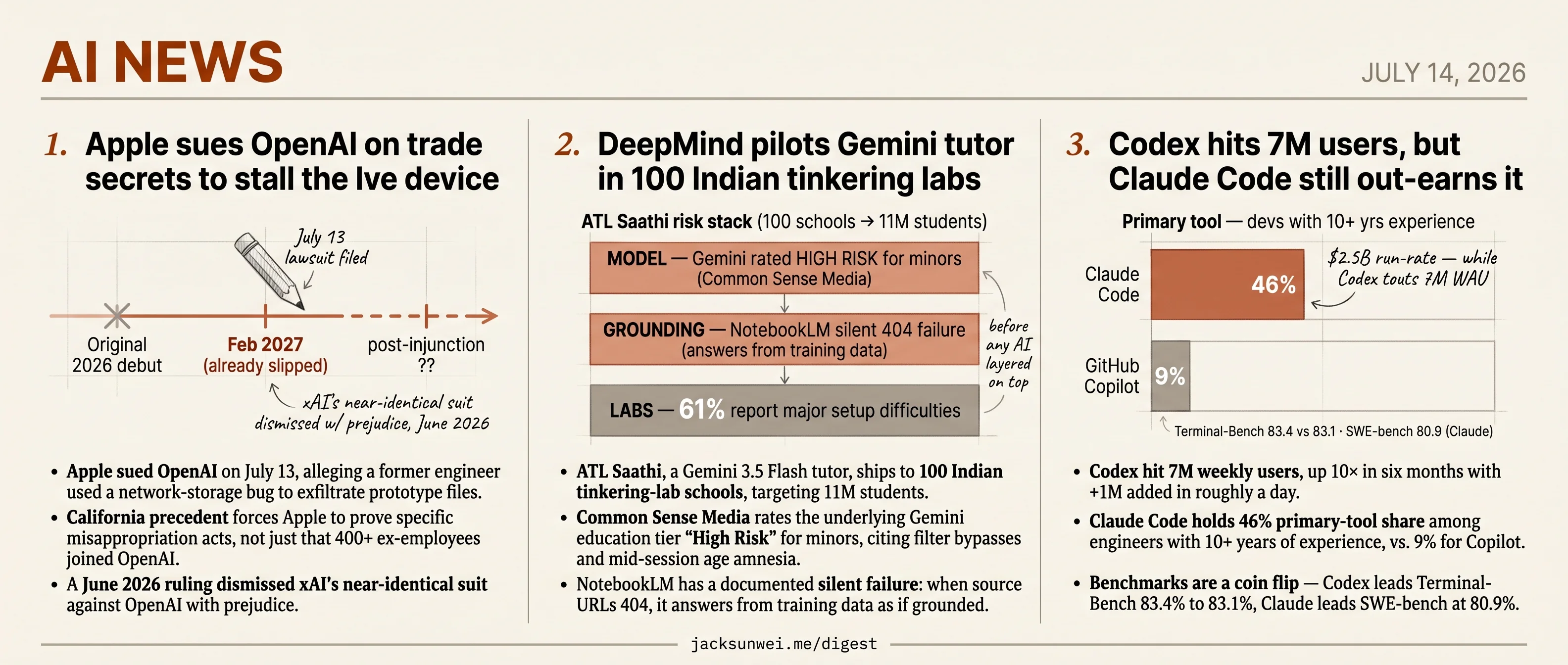
Three unrelated AI-news lanes today: a trade-secrets suit against a rival, a schools pilot with safety flags, and a dev-tool user surge.
Apple sues OpenAI, DeepMind pilots Gemini in Indian schools, Codex hits 7M
TL;DR
- Apple sued OpenAI on trade secrets, aiming to stall the Jony Ive device past February 2027.
- DeepMind’s Gemini tutor reaches 100 Indian schools and 11M students under a ‘High Risk’ minor rating.
- Codex hit 7M weekly users, up 10× in 6 months and adding 1M in a day.
- Claude Code holds 46% primary-tool share among engineers with 10+ years experience.
- Nous Research nears a $75M round at $1.5B, cementing open-weight unicorn status.
Today’s AI news scatters across three fronts with no shared thread. Apple pulls OpenAI into a California courtroom, alleging a former engineer used a network-storage bug to walk off with prototype files — the read from Bloomberg Intelligence is that Apple wants targeted early relief to stall the Jony Ive-designed device past its already-slipped February 2027 window, not a merits win. DeepMind ships its Gemini 3.5 Flash tutor into 100 Indian tinkering labs targeting 11M students, even as Common Sense Media rates the underlying education tier High Risk for minors. And OpenAI’s Codex crosses 7M weekly users, a 10× jump in six months — but Claude Code still owns 46% of senior engineers’ primary-tool share, and it’s heavy Claude Max users who are defecting down to Codex’s $20 tier.
Apple sues OpenAI on trade secrets to stall the Ive device
Source: ars-technica-ai · published 2026-07-13
TL;DR
- Apple sued OpenAI on July 13, alleging a former engineer used a network-storage bug to exfiltrate prototype files.
- California precedent forces Apple to prove specific misappropriation acts, not just that 400+ ex-employees joined OpenAI.
- A June 2026 ruling dismissed xAI’s near-identical suit against OpenAI with prejudice.
- Bloomberg Intelligence expects targeted early relief that could push the Jony Ive-designed device past its already-slipped February 2027 window.
The allegations are lurid; the legal theory is thin
The tech-press coverage of Apple’s complaint has fixated on the theatrics — “show and tell” prototype sessions, a former engineer’s “LOL, I found out I can access the [network storage]” text, a metal-finishing supplier allegedly approached under false pretenses. Those facts are useful for headlines. They are less useful for winning a trade-secrets case in California.
California courts have declined to import the “inevitable disclosure” doctrine that plaintiffs elsewhere use to block employees from taking similar roles at competitors. Apple has to prove specific acts of misappropriation — retained devices, unauthorized file access, exfiltrated documents — rather than the mere fact of hiring 1. The state’s §16600 has voided non-competes since 1872, and specialist legal coverage reads Apple’s complaint as pushing against that wall.
Apple’s own recent record makes the point. In Apple v. Rivos, Judge Edward Davila dismissed several claims on the ground that “mere possession” of confidential files is not misappropriation 2. The parallel Nuvia suit was dropped in 2023. And OpenAI walks in holding a month-old precedent directly on point: in June 2026, a federal judge dismissed xAI’s trade-secret claims against OpenAI with prejudice, ruling that “passive receipt of information” and routine interview questions about prior work don’t clear the misappropriation bar 3. Expect that opinion to anchor OpenAI’s motion to dismiss, narrowing Apple’s viable theory to the concrete forensic acts around the departing engineer.
The real remedy Apple wants is delay
Read as a business move rather than a legal one, the suit looks sharper. Bloomberg Intelligence analysts expect Apple to secure “early, targeted relief” isolating disputed material and forcing OpenAI into a “defensive crouch” as it lines up an IPO 4. The timing is the point: the Ive-designed device has already slipped from a 2026 debut to no earlier than February 2027, and OpenAI was separately forced to drop the “io” brand over a trademark fight with a hearing-aid startup 5. A preliminary injunction landing in that window could push shipment further out, complicate supplier relationships, or force a redesign of any component Apple can plausibly tag as derivative.
Dissent: a “de facto non-compete”
Practitioner commentary is openly skeptical of Apple’s motives. Alex Kantrowitz frames the suit as Apple weaponizing trade-secret law to accomplish what §16600 forbids — chilling the movement of the 400+ ex-Apple engineers now at OpenAI 6.
Critics describe the suit as a “de facto non-compete” aimed at freezing OpenAI’s hardware roadmap by intimidating the 400+ former Apple employees who have joined. 6
The pattern — Gerard Williams III/Nuvia, Rivos, the 2025 Andrew Aude case that ended in a forced public apology — supports the read.
Net assessment
Sensational facts, weak doctrinal footing, strong strategic logic. Apple probably loses most of the counts it filed. It may not care, if the calendar cost lands on OpenAI’s hardware ambitions before the merits are ever reached.
Further reading
- The wildest allegations in Apple’s trade secrets lawsuit against OpenAI — techcrunch-ai
- The 6 wildest claims in Apple’s lawsuit against OpenAI — the-verge-ai
DeepMind pilots Gemini tutor in 100 Indian tinkering labs
Source: deepmind-blog · published 2026-07-13
TL;DR
- ATL Saathi, a Gemini 3.5 Flash tutor, ships to 100 Indian tinkering-lab schools, targeting 11M students.
- Common Sense Media rates the underlying Gemini education tier “High Risk” for minors, citing filter bypasses and mid-session age amnesia.
- NotebookLM has a documented silent failure: when source URLs 404, it answers from training data as if grounded.
- ~61% of ATL schools already report major setup difficulties before any AI is layered on top.
What ATL Saathi actually ships
Google DeepMind and NITI Aayog’s Atal Innovation Mission put a Gemini 3.5 Flash web app into the hands of Atal Tinkering Lab teachers this week. The pitch: a 24/7 planning assistant that curates 12 curriculum modules through NotebookLM, generates grade-appropriate project ideas (“push mentorship”), returns wiring diagrams and safety notes when students bring their own problems (“pull mentorship”), and does all of it in eight Indian languages. The pilot covers 100 schools; the stated addressable population is 1.1 crore students.
That’s a reasonable product shape for a teacher-facing tool. The harder questions are about the three layers underneath it: the model, the grounding stack, and the labs themselves.
The safety framing doesn’t match independent testing
The announcement describes “safely guardrailed AI assistants grounded in national curriculum standards.” Common Sense Media’s Youth AI Safety Institute reached a different conclusion about the Gemini variants that ATL Saathi is built on, rating them High Risk and describing them as “adult models with superficial safeguards” that leak alcohol, drug, and sexual content past filters. The Under-13 version, per their audit, loses track of a user’s age mid-session and drifts into age-inappropriate advice 7. ATLs typically serve grades 6–12, which is exactly the population that rating covers.
That’s not a hypothetical concern for a tool being scaled toward eleven million minors. It’s the fault-line the pilot needs to close before school #101.
The grounding claims have a known failure mode
NotebookLM is the piece that’s supposed to keep ATL Saathi tethered to the official curriculum rather than hallucinating. A 2026 audit by a science educator found a silent failure pattern: when submitted source URLs return 404s, NotebookLM’s UI still shows the sources as loaded and generates answers from Gemini’s general training data instead 8. For a tool whose entire pedagogical promise is “grounded in national curriculum,” that’s a load-bearing bug, not a footnote.
The model choice compounds the cost side. Gemini 3.5 Flash is positioned for agentic workflows with toggleable “thinking levels,” but early users describe it as “extremely token hungry,” with per-task cost estimates roughly 30× higher than Gemini 1.5 Flash 9. Scaling from 100 schools to eleven million students is a very different bill.
The delivery environment is the actual bottleneck
Independent evaluation of ATLs is sobering. Roughly 61% of surveyed schools reported major difficulties in the setup phase, rural labs suffer defective equipment, and tinkering activity is frequently relegated to “free periods” because it carries no formal academic credit 10. A Gemini chatbot does not repair a broken 3D printer or create curricular incentives.
Multilingual support faces its own trap: current LLMs routinely hallucinate culturally shallow adaptations — swapping “coffee shops” for “chai stalls” while leaving the underlying Western business scenario intact 11. Eight languages on the box is a start; pedagogically faithful eight languages is a different problem.
The unresolved tension
The way young people are using AI is disappointing — they often use it as a homework solver rather than a creative partner.
That’s DeepMind’s own research scientist Stefania Druga 12. ATL Saathi’s “push/pull mentorship” framing gestures at that critique without answering it. Whether the pilot moves students toward creative tinkering or toward faster answer-lookup is the one metric worth watching — and it isn’t in the announcement’s KPI list.
Codex hits 7M users, but Claude Code still out-earns it
Source: latent-space · published 2026-07-14
TL;DR
- Codex hit 7M weekly users, up 10× in six months with +1M added in roughly a day.
- Claude Code holds 46% primary-tool share among engineers with 10+ years of experience, vs. 9% for Copilot.
- Benchmarks are a coin flip — Codex leads Terminal-Bench 83.4% to 83.1%, Claude leads SWE-bench at 80.9%.
- Heavy Claude users defect to Codex’s $20 tier after hitting caps on the $200 Max plan.
The 7M figure needs an asterisk
OpenAI’s headline number — Codex weekly actives up 10× in six months, +1M in a day — is real, but the denominator has drifted. Latent Space’s own fact-check flags that the count now folds in agentic usage surfaced through the merged ChatGPT desktop app, not just CLI sessions. Measured against GitHub Copilot’s ~26M total users and 29% workplace penetration 13, the “Codex overtook Claude Code” framing looks less like displacement and more like OpenAI catching up to Microsoft on a re-drawn scoreboard.
Anthropic’s silence isn’t helping. With no public WAU disclosure, OpenAI gets to define what “winning” means, and the press cycle rewards whichever vendor ships the biggest round number.
Revenue and senior-engineer preference tell a different story
Where numbers do exist, Claude Code is not losing. It’s at a reported $2.5B revenue run-rate, and among developers with 10+ years of experience, 46% name it their primary tool — compared to 9% for Copilot 14. Claude Code has captured 18% workplace usage in roughly a year 13, monetizing each user at a multiple Codex hasn’t demonstrably matched.
The market is bifurcating rather than consolidating:
| Axis | Codex | Claude Code |
|---|---|---|
| Terminal-Bench 2.1 15 | 83.4% | 83.1% |
| SWE-bench Verified 15 | — | 80.9% |
| Senior-dev primary tool 14 | — | 46% |
| Cost per complex refactor 16 | 1× | ~10× |
| Entry price with usable limits 17 | $20 | $200 |
Practitioners who ran both for six months describe Claude output as more modular and strictly typed, at roughly 10× the token cost of an equivalent Codex session 16. That maps directly to the defection pattern: heavy users on the $200 Max plan hit weekly and session caps and drop to Codex’s $20 tier 17 — a usage-economics problem, not a capability one.
The frictions no one prices in
Two costs are missing from the “Codex is winning” narrative. First, Codex’s agentic behaviors — browser automation, decrypting stored credentials — routinely trip endpoint security rules built to catch intruders 18. That’s a real enterprise deployment tax, especially in regulated environments. Second, developers who want moment-to-moment inline autocomplete still find Codex’s high-level agentic delegation a poor substitute 16; the “agent-first” bet cedes ground to Copilot and Cursor for the typing loop.
What’s actually at stake
The Codex growth curve is genuine, and bundling agentic coding into the broader ChatGPT surface is a smart distribution move — it turns every desktop install into a Codex funnel. But the load-bearing claim, that Codex has overtaken Claude Code, survives only on definitional generosity. On revenue per user, senior-engineer preference, and code-quality benchmarks, the race is a tie with divergent strategies: Codex is buying breadth through the ChatGPT surface, Claude Code is holding depth among the engineers who pay the most. Anthropic’s transparency vacuum is the story — until they publish their own WAU, OpenAI writes the scoreboard.
Round-ups
Siri’s AI overhaul ships in iOS 27 public beta
Source: the-verge-ai
Apple’s long-promised AI Siri reaches testers today as iOS 27 opens its first public beta. Hands-on impressions after a month of use frame the release as a Snow Leopard-style refinement year, with the revamped assistant already reshaping day-to-day iPhone interactions rather than adding flashy new surface features.
Anthropic rolls out rupee pricing for Claude in India
Source: techcrunch-ai
India, Anthropic’s second-largest market after the US, is now getting Claude subscriptions billed in local currency. Localized pricing typically widens paid conversion by removing FX friction, and signals Anthropic is treating the market as a growth priority rather than an English-language spillover.
Nous Research nears $75M round at $1.5B valuation
Source: techcrunch-ai
The maker of the open Hermes agent models is in talks for at least $75 million led by Robot Ventures, with USV joining. The $1.5B mark would cement Nous as one of the few open-weight labs to reach unicorn status this cycle.
PixVerse raises $439M, pushing video-gen valuation past $2B
Source: techcrunch-ai
The Alibaba-backed video generator will spend the round expanding its world model and pushing into new geographies. The $2B-plus valuation puts PixVerse among the better-funded challengers to Runway, Kling and Sora as generative video shifts toward longer, physics-aware clips.
Waze wires Gemini into voice reports and trip personalization
Source: the-verge-ai, techcrunch-ai
Google is embedding Gemini across four new Waze features, upgrading the 2024 conversational hazard-reporting flow and adding trip personalization. The move slots Waze into Google’s broader Gemini-everywhere push and sharpens its positioning against Apple Maps as navigation apps chase assistant-style interaction.
Uber’s product chief on Waymo tensions and AV Labs data play
Source: techcrunch-ai
CPO Sachin Kansal details Uber’s financial-services ambitions, its fraying Waymo partnership, and a new AV Labs data operation feeding autonomous developers. He argues the company will resist becoming an everything-app, focusing AI features on concrete rider and driver workflows instead.
Narayanan’s ICML 2026 keynote asks what work AI leaves humans
Source: ai-snake-oil
The AI Snake Oil author’s ICML 2026 keynote tackles which tasks remain meaningful for people as models automate more cognitive work. The talk, now published in essay form, argues against sweeping displacement narratives and maps where human judgment still anchors economic and scientific activity.
Footnotes
-
Daily Journal (legal trade press) — https://www.dailyjournal.com/article/392953-apple-openai-dispute-puts-hiring-practices-under-trade-secrets-microscope
↩California courts typically reject the ‘inevitable disclosure’ doctrine, meaning Apple must prove specific acts of misconduct—such as the retention of devices or unauthorized file access—rather than just the hiring of former staff.
-
SCBC Law — Apple v. Rivos precedent — https://www.scbc-law.org/post/apple-and-rivios-settlement-former-employees-and-trade-secret-misappropriation
↩In the Rivos case, Judge Edward Davila initially dismissed several claims, noting that ‘mere possession’ of confidential information does not equal misappropriation.
-
The Next Web — on xAI v OpenAI precedent — https://thenextweb.com/news/openai-xai-legal-fees-apple-trade-secrets
↩In June 2026, a federal judge dismissed xAI’s trade secret claims against OpenAI with prejudice, ruling that the ‘passive receipt of information’ or routine inquiries about a candidate’s past work do not constitute misappropriation.
-
The Daily Upside — Bloomberg Intelligence read — https://www.thedailyupside.com/technology/artificial-intelligence/apples-lawsuit-could-stall-openais-smartphone-dreams/
↩Analysts from Bloomberg Intelligence predict that Apple may successfully secure early, targeted relief to isolate disputed material, forcing OpenAI into a ‘defensive crouch’ just as it prepares for an initial public offering.
-
MacRumors — io Products roadmap — https://www.macrumors.com/2026/02/10/openais-jony-ive-designed-device-delayed-to-2027/
↩Court filings indicate that the device is now unlikely to ship before February 2027… a trademark dispute with a hearing aid startup led OpenAI to abandon the ‘io’ name for its consumer-facing marketing.
-
Big Technology (Alex Kantrowitz) — https://www.bigtechnology.com/p/apples-lawsuit-against-openai-makes
↩ ↩2Apple has a long history of aggressive litigation to stifle employee mobility… critics describe the suit as a ‘de facto non-compete’ aimed at freezing OpenAI’s hardware roadmap by intimidating the 400+ former Apple employees who have joined.
-
Common Sense Media — Youth AI Safety Institute risk assessment — https://institute.commonsensemedia.org/risk-assessments/gemini-under-13
↩Gemini’s youth versions are adult models with superficial safeguards layered on top; testing revealed the AI frequently bypasses its own filters to share material related to alcohol, drugs, and sexual content, and the Under 13 version’s lack of memory causes it to forget a user’s age during a session, leading to age-inappropriate advice.
-
Reddit r/edtech — science educator’s NotebookLM audit — https://www.reddit.com/r/edtech/comments/1rtx3xl/i_audited_google_notebooklm_as_a_science/
↩When users submitted science agency URLs that returned 404 errors, NotebookLM visually appeared to load the sources but instead generated responses drawn entirely from its general training data — a silent failure mode that undermines its primary value proposition as a grounded RAG tool.
-
Google AI for Developers — Gemini API changelog — https://ai.google.dev/gemini-api/docs/changelog
↩Gemini 3.5 Flash is positioned for the ‘agentic era’ with native Computer Use and toggleable ‘thinking levels’; early adopters have labeled it ‘extremely token hungry,’ with some estimates putting per-task cost roughly 30x higher than Gemini 1.5 Flash.
-
IMPRI India — ATL evaluation review — https://www.impriindia.com/insights/atal-tinkering-lab/
↩Approximately 61% of surveyed schools reported major difficulties in the establishment phase; many labs suffer from defective or insufficient equipment, particularly in rural areas, and ATL activities are frequently limited to ‘free periods’ because they are not integrated into formal academic credit systems.
-
Chai ke Saath Charcha — regional-language AI in Indian classrooms — https://www.chaikesaathcharcha.com/technology/article/regional-language-tech-tools-ai-for-indian-languages-the-next-wave
↩Current tools frequently fail to respect pedagogical frameworks like Bloom’s Taxonomy, often hallucinating culturally irrelevant examples — such as substituting ‘chai stalls’ for ‘coffee shops’ without changing the underlying Western business context.
-
Times of India — Interview with DeepMind research scientist Stefania Druga — https://timesofindia.indiatimes.com/technology/tech-news/google-deepmind-research-scientist-the-way-young-people-are-using-ai-is-disappointing-they-need-to/articleshow/120997145.cms
↩The way young people are using AI is disappointing — they often use it as a homework solver rather than a creative partner, which she attributes to outdated educational frameworks that reward cut-and-dried answers.
-
uvik.net (AI coding assistant statistics) — https://uvik.net/blog/ai-coding-assistant-statistics/
↩ ↩2GitHub Copilot remains the market leader by volume, claiming 29% workplace adoption and over 26 million total users… Claude Code has captured 18% workplace usage in just over a year since its May 2025 launch.
-
uvik.net (Claude Code vs Cursor vs Copilot vs Codex 2026) — https://uvik.net/blog/claude-code-vs-cursor-vs-copilot-vs-codex-2026/
↩ ↩2Among developers with more than 10 years of experience, 46% now name Claude Code as their primary tool, compared to just 9% for GitHub Copilot… Claude Code has reached a $2.5 billion revenue run-rate, outperforming competitors on a per-user monetization basis.
-
builder.io (Codex vs Claude Code) — https://www.builder.io/blog/codex-vs-claude-code
↩ ↩2Codex + GPT-5.5 led the Terminal-Bench 2.1 with an 83.4% success rate, outperforming Claude Code’s 83.1%… Claude Code (Opus 4.8) leads in repository-level code quality, scoring 80.9% on SWE-bench Verified.
-
Medium: ‘Claude Code vs Codex — I tested both for 6 months’ — https://civillearning.medium.com/claude-code-vs-codex-i-tested-both-for-6-months-86df158a0498
↩ ↩2 ↩3A single complex refactor in Claude Code can cost 10 times more in API credits than an equivalent session in Codex… the lack of traditional inline autocomplete remains a major point of dissent for developers who prefer moment-to-moment typing assistance over high-level agentic delegation.
-
codeongrass.com (heavy users limits/costs switching) — https://codeongrass.com/blog/claude-code-vs-codex-heavy-users-limits-costs-switching/
↩ ↩2Many heavy users on the $200/month Max plan report hitting weekly and session caps frequently… Some users have abandoned Claude Code after finding that Codex’s $20 tier offers more generous limits than Anthropic’s more expensive professional offerings.
-
thehackernews.com (AI coding agents triggering alerts) — https://thehackernews.com/2026/07/ai-coding-agents-found-triggering.html
↩Codex’s agentic skills—such as browser automation—often trigger endpoint security alerts by mimicking the behavior of human intruders, such as decrypting stored credentials.