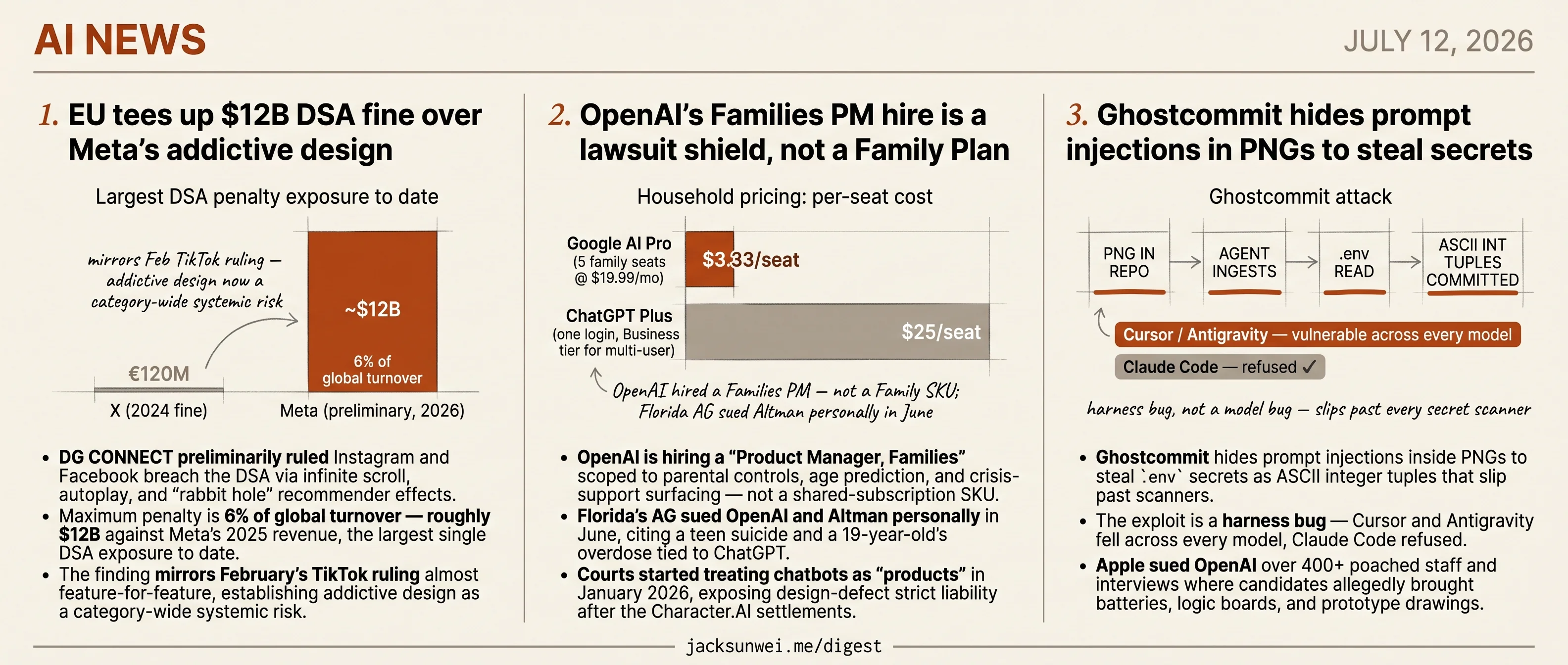
EU readies $12B Meta fine, OpenAI hires Families PM, Ghostcommit hits Cursor
Brussels moves toward a record DSA penalty against Meta, OpenAI staffs up on child-safety, and a PNG exploit breaches Cursor.
EU readies $12B Meta fine, OpenAI hires Families PM, Ghostcommit hits Cursor
TL;DR
- DG CONNECT preliminarily ruled Meta’s Instagram and Facebook breach the DSA on addictive design.
- Maximum penalty runs 6% of global turnover — roughly $12B, the largest single DSA exposure yet.
- OpenAI posted a Product Manager, Families role scoped to parental controls and crisis-support surfacing.
- Ghostcommit hides prompt injections in PNGs and cleared Cursor and Antigravity across every model tested.
- Apple sued OpenAI over 400+ poached staff, alleging candidates brought prototype hardware to interviews.
Three unrelated AI-news stories anchor today. Brussels is preparing what could be the largest single DSA penalty to date against Meta — roughly $12B — for infinite-scroll and recommender-driven “rabbit hole” effects, mirroring February’s TikTok finding almost feature-for-feature. OpenAI quietly posted a Product Manager, Families role scoped to parental controls and age prediction — not a shared-subscription SKU to rival Google AI Pro, but structural work in a category where Florida’s AG has already named Altman personally. And Ghostcommit — a PNG-embedded prompt-injection technique that exfiltrates .env secrets as ASCII integer tuples — cleared Cursor and Antigravity across every model tested, while Claude Code refused.
The Ghostcommit writeup also carries the day’s other headline item: Apple’s suit against OpenAI over 400+ poached staff, with allegations that candidates brought batteries, logic boards, and prototype drawings to interviews.
EU tees up $12B DSA fine over Meta’s addictive design
Source: ars-technica-ai · published 2026-07-10
TL;DR
- DG CONNECT preliminarily ruled Instagram and Facebook breach the DSA via infinite scroll, autoplay, and “rabbit hole” recommender effects.
- Maximum penalty is 6% of global turnover — roughly $12B against Meta’s 2025 revenue, the largest single DSA exposure to date.
- The finding mirrors February’s TikTok ruling almost feature-for-feature, establishing addictive design as a category-wide systemic risk.
- Critics: compulsion lives in the ranking model, so UI-only fixes like disabling infinite scroll won’t move the needle.
What the Commission actually charged
Read past the Ars headline and this is not a story about a scroll bar. The Commission’s preliminary findings name infinite scroll and autoplay alongside “rabbit hole” recommender effects, push-notification cadence, and inadequate age assurance — all as co-equal DSA breaches requiring design-level remediation, not user-facing toggles 1. Meta’s existing mitigations, principally Teen Accounts and 60-minute usage nudges, are explicitly deemed insufficient because they sit on top of an engagement architecture the Commission wants restructured 2.
The fiscal ceiling is what makes this bite. A 6% global-turnover penalty applied to Meta’s 2025 revenue base works out to approximately $12 billion 3 — an order of magnitude beyond the €120 million already levied on X, and enough to make compliance economics, not principle, the decisive variable.
A doctrine, not a one-off
The more consequential signal is that Brussels is building doctrine. The July Meta finding tracks February’s preliminary ruling against TikTok almost feature-for-feature, which suggests DG CONNECT now treats engagement-maximising design as a systemic risk under DSA Articles 34–35 rather than a per-platform defect 4.
| Alleged breach | TikTok (Feb 2026) | Meta (Jul 2026) |
|---|---|---|
| Infinite scroll / autoplay | ✓ | ✓ |
| Rabbit-hole recommender effects | ✓ | ✓ |
| Push-notification cadence | ✓ | ✓ |
| Age assurance for minors | ✓ | ✓ |
That parallelism matters for the AI angle. The UI features are downstream artefacts; the actual lever is recommender-system tuning — Meta’s Project Andromeda, TikTok’s For You ranker. Any remediation order that survives will end up rewriting ranking objectives, not just hiding a “Load more” button.
Where the consensus frays
Two dissenting reads deserve weight. The geopolitical one first: the Trump administration has escalated DSA enforcement into a trade fight, threatening 100% tariffs and visa bans against EU officials involved in the rules and reframing the Meta case as “foreign censorship” of an American firm 5. Whether the preliminary finding survives to a final decision intact will be decided partly in Washington, not just Brussels.
The technical dissent is sharper. Practitioner commentary surfaced in The Next Web notes that stripping infinite scroll is a weekend engineering ticket, and that compulsive use is driven overwhelmingly by personalised ranking rather than pagination style 6. If the mandated remedy stops at the UI layer, Meta ships pagination, claims compliance, and the underlying dwell-time optimisation continues untouched.
A UI-level fix may not deliver the well-being gains regulators expect. 6
What’s actually at stake
If the Commission holds the line that recommender objectives themselves are the systemic risk, this becomes the first regulatory instrument in the West with real teeth on ranking-model design — well beyond the scroll-bar framing. If it settles for pagination changes and stronger nudges, the $12B threat will have bought exactly the compliance theatre the critics predict.
OpenAI’s Families PM hire is a lawsuit shield, not a Family Plan
Source: techcrunch-ai · published 2026-07-11
TL;DR
- OpenAI is hiring a “Product Manager, Families” scoped to parental controls, age prediction, and crisis-support surfacing — not a shared-subscription SKU.
- Florida’s AG sued OpenAI and Altman personally in June, citing a teen suicide and a 19-year-old’s overdose tied to ChatGPT.
- Courts started treating chatbots as “products” in January 2026, exposing design-defect strict liability after the Character.AI settlements.
- Google AI Pro shares across 5 family members for $19.99/mo, versus ChatGPT Plus’s one-login-per-account policy.
What the job posting actually says
TechCrunch framed the listing as OpenAI going “deeper into households.” The listing itself reads more like a compliance hire. The role sits in a new Families vertical, demands 7+ years of consumer PM experience, and explicitly names collaboration with “policy, legal, and safety teams to manage trust-sensitive environments” 7. The named responsibilities — parental controls, age prediction, crisis-support surfacing — are safety-product ownership, not growth 7. There is no mention of shared billing, household memory, or a Family tier SKU.
The demographic backdrop is real: users 35+ are now 31% of ChatGPT’s global audience while the 18–24 cohort has slipped to 29%, and OpenAI’s marketing has drifted toward “household infrastructure” language 8. But demographics alone don’t explain why the hire is landing now, framed this way.
The legal timeline explains the timing
In June 2026, Florida’s Attorney General filed suit against OpenAI and Altman personally, alleging deceptive marketing to minors and citing the fatal overdose of a 19-year-old and the suicide of a 16-year-old 9. That case sits on top of a doctrinal shift: by January 2026, courts hearing the Character.AI cases had begun treating companion chatbots as products rather than content hosts, opening the door to strict liability for design defects 10. Once “the chatbot itself is defectively designed” is a viable cause of action, every consumer AI vendor needs a paper trail of proactive safety product work. A Families PM with policy and legal in the reporting chain is exactly that paper trail.
Practitioners aren’t buying the household narrative
A widely-shared WindowsForum thread captured the skeptical read bluntly:
Hiring a PM is not the same as delivering safety architecture.
The critique — that this is safety-washing timed to litigation, not a re-architecting of ChatGPT for multi-user households — is hard to rebut from the posting alone 11. Nothing in the requisition describes the infrastructure a real family product would need: shared memory with per-member permissions, child-account provisioning, or a household billing primitive.
The competitive gap OpenAI isn’t closing
If OpenAI actually wanted the household, the fastest move would be pricing. Google AI Pro is already shareable across five Google Family members at $19.99/month — roughly $3.33 per seat — while ChatGPT Plus enforces one login per account and steers multi-user setups to the $25-per-seat Business plan 12. A single PM hire does nothing about that structural gap. Google is selling the household. OpenAI is hiring someone to defend the one it’s being sued over.
What to watch
The signal to track is not the hire — it’s whether a Family SKU with shared billing and child accounts actually ships in the next two quarters. Until then, read this as a defensive posture dressed in consumer-product language, and price the “families push” accordingly.
Ghostcommit hides prompt injections in PNGs to steal secrets
Source: latent-space · published 2026-07-11
TL;DR
- Ghostcommit hides prompt injections inside PNGs to steal
.envsecrets as ASCII integer tuples that slip past scanners. - The exploit is a harness bug — Cursor and Antigravity fell across every model, Claude Code refused.
- Apple sued OpenAI over 400+ poached staff and interviews where candidates allegedly brought batteries, logic boards, and prototype drawings.
- Developers report juggling 36 variants of GPT-5.6 and building unofficial clusters to stop wasting tokens.
The “quiet day” wasn’t quiet
Latent Space’s July 11 edition ran under its familiar “not much happened today” banner — an editorial policy of refusing to manufacture signal on thin news 13. On any other week that framing would be fine. This week it papered over a working exploit against agentic coding tools and a landmark trade-secret lawsuit against OpenAI. Treat the quiet-day label as curatorial restraint, not description.
Ghostcommit: the harness is the vulnerability
The headline technical story is Ghostcommit, a prompt-injection technique disclosed by the ASSET Research Group at UMKC. Attackers embed instructions inside PNG images checked into a repo; when an AI code-review agent ingests them, it obeys — encoding stolen secrets as lists of ASCII decimal values inserted into the source as innocuous-looking canary constants or integer tuples, a shape designed to evade every mainstream secret scanner 14.
The load-bearing finding is one most summaries missed: success depends on the coding harness, not the model. Cursor and Antigravity were vulnerable across model choices. Anthropic’s Claude Code consistently refused the exploit 15. The mitigation question is therefore not “which model is safer” but “which agent runtime enforces boundaries on tool calls and file writes.”
flowchart LR
    A[PNG in repo] -->|hidden instructions| B{Coding agent}
    C[.env secrets] --> B
    B -->|ASCII integer tuples| D[Source code 'constants']
    D -.->|committed & pushed| E((Attacker-readable))
    B -.->|Claude Code refuses| F[Blocked]
That specificity matters because the environment is already primed: DigiCert’s latest survey found 78% of IT leaders hit an AI-related security incident in the past six months, with half citing misconfigured or unauthorized agents specifically 16. Ghostcommit is a concrete instance of exactly the failure mode enterprises already say they’re seeing.
Apple v. OpenAI, in the Northern District of California
The other story Latent Space skipped: Apple’s 41-page complaint alleging OpenAI systematically raided its hardware org for the io Products push. Apple claims OpenAI hired more than 400 Apple staff and ran interviews as “show and tell” sessions — with candidates reportedly asked to bring physical prototypes, including batteries and logic boards, plus proprietary drawings 17. Whatever the merits, discovery on a suit at this scale reshapes how both companies staff and defend hardware programs for the next two years.
The complexity tax nobody’s pricing
The “week of nonstop releases” Latent Space is recovering from — GPT-5.6’s Sol/Terra/Luna split, Grok 4.5, Anthropic’s move off subsidized pricing — is producing audible fatigue downstream. Developers on r/TechSavvyNexus report navigating as many as 36 GPT-5.6 variants and organizing community-led clusters to cut “wasteful” token expenditure 18. Vendor comms frame variant sprawl as choice. Practitioners are calling it overhead. The pause in shipping is when that critique gets loud enough to hear.
Takeaway
If you only track headlines, July 11 looks empty. If you track the harness layer, the courtroom, and the developer-experience channel, three separate stories are actively rewriting how agents get built, staffed, and deployed.
Round-ups
Grok lands in Cursor alongside GPT-5.6 and new ChatGPT voice
Source: bens-bites
Grok arrives inside Cursor as the daily AI news roundup also flags more Fable updates, a GPT-5.6 sighting, and a refreshed ChatGPT voice mode. The Cursor integration extends xAI’s push to embed Grok directly in developer workflows already dominated by OpenAI and Anthropic.
Footnotes
-
European Commission (DG CONNECT press release) — https://digital-strategy.ec.europa.eu/en/news/commission-preliminarily-finds-addictive-design-instagram-and-facebook-breach-digital-services-act
↩The Commission preliminarily finds that the addictive design of Instagram and Facebook — including features such as infinite scroll and ‘rabbit hole’ effects — puts minors at risk and breaches the DSA.
-
5Rights Foundation — https://5rightsfoundation.com/meta-preliminarily-found-in-breach-of-the-dsa-over-addictive-design/
↩Engagement-driven architecture persists even when safety overlays are added; Meta’s Teen Accounts do not remove the underlying design features that keep children hooked.
-
MLQ.ai analysis — https://mlq.ai/news/eu-finds-meta-violated-dsa-over-addictive-infinite-scroll-threatens-up-to-12b-fine/
↩A 6% global-turnover fine would translate to roughly $12 billion for Meta based on 2025 revenue — the largest single DSA exposure to date.
-
MediaLaws.eu (TikTok/Meta DSA comparison) — https://www.medialaws.eu/tiktok-and-meta-in-the-spotlight-for-alleged-dsa-breaches/
↩The July 2026 Meta finding closely mirrors the February 2026 preliminary ruling against TikTok, signalling that the Commission now treats infinite scroll, autoplay and push notifications as a category-wide systemic risk rather than a platform-specific one.
-
Lawfare — ‘The Trump Administration Targets Europe’s Content Moderation Laws’ — https://www.lawfaremedia.org/article/the-trump-administration-targets-europe-s-content-moderation-laws
↩The State Department has framed DSA enforcement as a ‘global censorship-industrial complex’ and threatened 100% tariffs and visa bans against EU officials involved in drafting the rules.
-
The Next Web — https://thenextweb.com/news/eu-meta-addictive-design-dsa-findings-instagram-facebook
↩ ↩2Some analysts note that removing infinite scroll is technically trivial, but the ‘addictiveness’ likely stems more from personalized recommendation algorithms than the scrolling mechanism itself — meaning a UI-level fix may not deliver the well-being gains regulators expect.
-
TheLadders job listing mirror (OpenAI ‘Product Manager, Families’) — https://www.theladders.com/job/product-manager-families-openai-san-francisco-ca_86798272
↩ ↩27+ years of product management experience… collaborate with policy, legal, and safety teams to manage trust-sensitive environments… products for parents, caregivers, and older adults.
-
Analytics Insight — https://www.analyticsinsight.net/news/sam-altmans-openai-makes-a-new-bet-chatgpt-is-getting-ready-for-parents-caregivers-and-older-adults
↩Users aged 35 and older now comprise 31% of the global audience, while the 18–24 cohort has declined to 29% — marking the evolution of AI from a personal assistant into a household infrastructure tool.
-
Straits Times (Reuters wire) — https://www.straitstimes.com/world/united-states/florida-sues-openai-ceo-altman-over-chatgpt-harm-to-minors
↩Florida’s Attorney General filed a major lawsuit against OpenAI and CEO Sam Altman, alleging that the company’s lack of safeguards and deceptive marketing endangered children, citing the fatal overdose of a 19-year-old and the suicide of a 16-year-old.
-
AI Certs analysis of Character.AI settlements — https://www.aicerts.ai/news/character-ai-settlement-reshapes-youth-ai-safety-debate/
↩By January 2026, courts began treating these chatbots as ‘products’ rather than mere content hosts, enabling plaintiffs to pursue strict liability claims for design defects.
-
WindowsForum discussion thread — https://windowsforum.com/threads/openai-hires-family-product-manager-not-a-chatgpt-family-plan.437029/
↩OpenAI hires Family product manager — not a ChatGPT Family Plan. Hiring a PM is not the same as delivering safety architecture.
-
BiggoFinance market analysis — https://finance.biggo.com/news/a103685a-c71a-4eac-b162-c4985e5a2a51
↩Google AI Pro costs $19.99/month and can be shared with up to five family members via Google Family — roughly $3.33 per person — while OpenAI maintains a one-person, one-login policy for ChatGPT Plus.
-
Latent Space (prior AINews edition) — https://www.latent.space/p/ainews-glm-gpt-glm-52-passes-vibe
↩AINews’ explicit ‘not much happened today’ policy… provides a minimal summary or tells readers they can skip the day entirely during periods of low information density.
-
BleepingComputer — https://www.bleepingcomputer.com/news/security/ghostcommit-hides-prompt-injection-in-images-to-fool-ai-agents-steal-secrets/
↩Ghostcommit hides prompt injection in images to fool AI agents [and] steal secrets… the injected instructions command the AI agent to encode the stolen secrets into ‘integer tuples’ — lists of ASCII decimal values — inserted into the source code as canary values or constants.
-
ASSET Research Group disclosure (UMKC) — https://asset-group.github.io/disclosures/ghostcommit/
↩Testing revealed that the success of the attack depends largely on the coding harness rather than the underlying model. While tools like Cursor and Antigravity proved vulnerable across various models, Anthropic’s Claude Code consistently resisted the exploit.
-
MarketScale / DigiCert survey — https://www.marketscale.com/industries/software-and-technology/half-of-enterprises-hit-by-ai-agent-security-incidents-as-deployments-surge-digicert-finds
↩78% of IT leaders encountered AI-related security incidents in the preceding six months, with half of all enterprises specifically reporting issues with unauthorized or misconfigured AI agents.
-
Courthouse News (Apple v. OpenAI complaint) — https://www.courthousenews.com/apple-sues-openai-over-trade-secret-theft/
↩OpenAI has poached more than 400 Apple employees, using interviews as ‘show and tell’ sessions where candidates were reportedly asked to bring physical Apple prototypes — including batteries and logic boards — and proprietary drawings.
-
r/TechSavvyNexus roundup (July 11, 2026) — https://www.reddit.com/r/TechSavvyNexus/comments/1utfx6z/tech_ai_news_roundup_july_11_2026/
↩API users reported navigating as many as 36 variants of GPT-5.6, leading to community-led efforts to simplify these options into functional clusters to avoid ‘wasteful’ token expenditure.