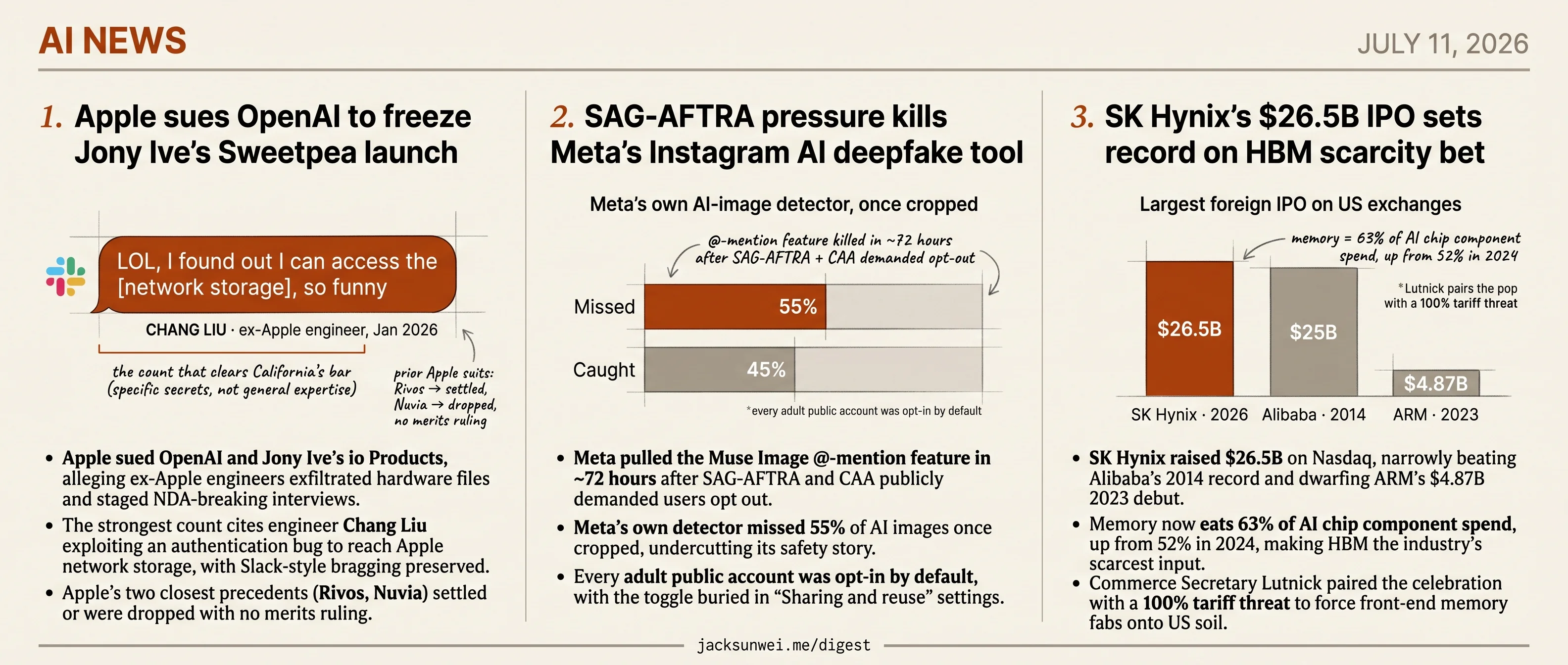
Apple sues OpenAI, SAG-AFTRA pulls Meta's Muse, Lutnick threatens SK Hynix
A trade-secret suit, a guild-forced retreat, and a tariff threat each check a headline AI move on the day it lands.
Apple sues OpenAI, SAG-AFTRA pulls Meta’s Muse, Lutnick threatens SK Hynix
TL;DR
- Apple sued OpenAI and Jony Ive’s io Products over alleged trade-secret theft by ex-Apple hardware engineers.
- Meta pulled Instagram’s Muse tool in ~72 hours after SAG-AFTRA and CAA demanded users opt out.
- SK Hynix raised $26.5B on Nasdaq, narrowly beating Alibaba’s 2014 IPO record.
- Lutnick paired the debut with a 100% tariff threat to force front-end memory fabs onto US soil.
- NO FAKES Act cleared Senate Judiciary, adding platform liability for non-consensual digital replicas.
Today’s three big AI-business stories all landed with an outside actor pushing back on the vendor’s move. Apple filed a trade-secret suit against OpenAI and Jony Ive’s io Products, trying to freeze the Sweetpea hardware launch on the strength of an engineer’s alleged auth-bug exploit against Apple network storage. Meta yanked Instagram’s Muse @-mention deepfake tool inside 72 hours after SAG-AFTRA and CAA went public demanding users opt out — and its own detector had already missed 55% of cropped AI images. SK Hynix cleared a record $26.5B Nasdaq debut on the HBM scarcity trade, but Commerce Secretary Lutnick paired the celebration with a 100% tariff threat aimed at forcing front-end memory fabs onto US soil.
The briefs sit around a second thread worth watching: enterprises repositioning around who owns the model layer, from Deutsche Telekom’s OpenAI rewrite to Hugging Face’s pitch that Fortune 500s are quitting API rentals.
Apple sues OpenAI to freeze Jony Ive’s Sweetpea launch
Source: the-verge-ai · published 2026-07-10
TL;DR
- Apple sued OpenAI and Jony Ive’s io Products, alleging ex-Apple engineers exfiltrated hardware files and staged NDA-breaking interviews.
- The strongest count cites engineer Chang Liu exploiting an authentication bug to reach Apple network storage, with Slack-style bragging preserved.
- Apple’s two closest precedents (Rivos, Nuvia) settled or were dropped with no merits ruling.
- California bars “inevitable disclosure,” so Apple must prove use of specific secrets, not general expertise.
The complaint is really two complaints
Apple’s filing bolts a garden-variety poaching grievance onto a much sharper accusation of active theft. Engadget’s read of the complaint quotes engineer Chang Liu — who left Apple in January 2026 — allegedly using “a previously unknown authentication bug” to download dozens of hardware files from Apple network storage after his departure, then messaging colleagues: “LOL, I found out I can access the [network storage], so funny” 1. That’s the kind of documented exfiltration that maps cleanly onto California’s Uniform Trade Secrets Act definition of “improper means,” and it’s why Apple felt confident calling OpenAI’s hardware business “rotten to its core” 1.
The second prong is more novel and more fragile. Apple alleges Chief Hardware Officer Tang Tan directed candidates to bring physical Apple parts to interviews for “show and tell” sessions. Winning that theory requires proving OpenAI systematically induced NDA breaches during hiring — not that a few enthusiastic candidates over-shared 12.
OpenAI moves second, and it shows
OpenAI’s public response is a one-line denial from spokesperson Drew Pusateri that the company has “no interest in other companies’ trade secrets” 3. The more interesting datum is buried in Guardian reporting: OpenAI was itself exploring legal action against Apple over the 2024 Siri-ChatGPT partnership before Apple filed, which lines up with Apple’s recent pivot to Google Gemini for core Apple Intelligence functions 3. John Gruber, recalling Apple executives being “ice-cold” on OpenAI at WWDC, reads the suit as inseparable from Apple’s own Siri credibility crisis — the “Something Rotten in the State of Cupertino” story that has haunted Cupertino for a year 4.
Translation: this is at least partly strategic warfare, timed to a rival’s product launch and IPO track. Apple got the first punch, the first press cycle, and the first injunction motion.
Apple’s track record cuts against a courtroom win
The historical base rate is not kind. Apple v. Rivos (2022) settled in 2024 with no damages — just a “remediation process” and forensic audit — while Rivos went on to raise $250M+ 5. Apple v. Nuvia was dropped with prejudice in 2023 after Qualcomm’s acquisition, again with no merits ruling 5. The structural reason is that California rejects the “inevitable disclosure” doctrine, meaning Apple must prove OpenAI actively directed use of specific secrets — not merely that it hired hundreds of ex-Apple staff carrying general expertise in their heads 2. The Liu allegations clear that bar. The “show and tell” theory almost certainly doesn’t.
The real target is Sweetpea
What Apple is actually asking the court to halt is io Products’ device, codenamed “Sweetpea” — a screenless pocketable targeting late 2026 or early 2027, with OpenAI’s stated 100M-unit ambition running through Luxshare and Goertek 6. Even a settlement-with-forensic-audit outcome — the Rivos template — would slow supplier negotiations, complicate hires, and force io to re-clean-room chunks of its stack right as OpenAI is trying to tell public-market investors a hardware story. That may be the win Apple is actually shopping for.
Further reading
- Apple sues OpenAI over alleged trade secret theft — techcrunch-ai
SAG-AFTRA pressure kills Meta’s Instagram AI deepfake tool
Source: the-verge-ai · published 2026-07-10
TL;DR
- Meta pulled the Muse Image @-mention feature in ~72 hours after SAG-AFTRA and CAA publicly demanded users opt out.
- Meta’s own detector missed 55% of AI images once cropped, undercutting its safety story.
- Every adult public account was opt-in by default, with the toggle buried in “Sharing and reuse” settings.
- The retreat lands as the NO FAKES Act clears Senate Judiciary, creating platform liability for non-consensual digital replicas.
The reversal was institutional, not viral
Meta shut off the Instagram feature that let anyone generate AI images from a public account by @-mentioning it — roughly three days after launch. This wasn’t a Twitter pile-on Meta chose to placate. SAG-AFTRA called the default opt-in an “utter miscalculation of public sentiment” 7, and the Creative Artists Agency followed within 48 hours, telling all Instagram users — not just their talent clients — to manually disable the feature 8. That’s an organized name-image-likeness (NIL) coalition with a specific ask, not diffuse user grumbling. TechCrunch and The Verge both landed on “backlash,” but the machinery behind it matters: Meta retreated because Hollywood’s labor and agency infrastructure moved in lockstep.
The safety story collapsed on both ends
Meta’s pitch leaned on invisible watermarking and provenance signals — the “Content Seal” framing — to argue the @-mention mechanic was safe. Independent testing reported by Digital Trends found Meta’s own detection tool failed on 55% of AI-generated images once meaningfully cropped 9. That’s a direct rebuttal to the vendor narrative, and it’s the kind of number that makes the legal team nervous.
The input side was no better. Every adult user with a public account was enrolled by default with no notification, and the opt-out lived several layers deep inside “Sharing and reuse” 10. So the pipeline was: no upstream consent, unreliable downstream labeling, and a UX that assumed most users would never find the switch.
flowchart LR
    A[Public IG account<br/>opt-in by default] --> B[User @-mentions<br/>target account]
    B --> C[Muse Image<br/>generates AI image]
    C --> D[Content Seal<br/>watermark applied]
    D -. 55% miss rate<br/>when cropped .-> E((Image circulates<br/>unlabeled))
This is Meta’s playbook, not an accident
The pattern is familiar. In June 2024, Meta rebranded the “Made with AI” tag to “AI Info” only after photographers revolted over minor Adobe edits being flagged 11. Both episodes follow the same template: ship an AI feature with aggressive defaults, absorb about a week of professional-creator backlash, retreat on the surface while leaving the underlying model in place. The 2024 EU training-data pause — forced by the Irish DPC rather than volunteered — rhymes with the same shape. Reading Muse Image as a genuine course correction requires ignoring the prior data points.
The legal clock made the math easy
The July 2026 timing isn’t coincidence. The NO FAKES Act cleared Senate Judiciary in June 2026, establishing a federal digital-replica right backed by the unusual coalition of SAG-AFTRA, Disney, OpenAI and Google 12. Under the bill’s notice-and-takedown regime, an @-mention feature that manufactures likenesses of named accounts is close to a purpose-built liability generator. Meta’s kill switch likely reflects a general counsel’s read of that exposure as much as any PR calculation.
What Meta hasn’t done is retract Muse Image itself, walk back the default-opt-in architecture as a design principle, or publish the detection numbers Digital Trends surfaced. The @-mention affordance is gone; the posture that produced it is not.
Further reading
SK Hynix’s $26.5B IPO sets record on HBM scarcity bet
Source: techcrunch-ai · published 2026-07-10
TL;DR
- SK Hynix raised $26.5B on Nasdaq, narrowly beating Alibaba’s 2014 record and dwarfing ARM’s $4.87B 2023 debut.
- Memory now eats 63% of AI chip component spend, up from 52% in 2024, making HBM the industry’s scarcest input.
- Commerce Secretary Lutnick paired the celebration with a 100% tariff threat to force front-end memory fabs onto US soil.
- Named bears call the trade “no longer a slam dunk” as 2027–2028 capacity from all three vendors looms.
A secondary listing that behaved like a scarcity auction
SK Hynix’s Nasdaq ADR raise cleared $26.5B, edging Alibaba’s 2014 NYSE debut ($25B) and making it the largest foreign IPO in US history — despite offering only about 2.5% of shares 13. The 7× oversubscription and double-digit first-day pop are less a vote on the broader chip cycle than on the fact that US investors had no pure-play HBM ticker until this week. Counterpoint pegs SK Hynix at roughly 58% of Q1 2026 HBM revenue, with Samsung and Micron effectively tied at 21% each 14. That concentration, plus reported take-or-pay contracts with Nvidia and Microsoft, is what CEO Kwak Noh-Jung is selling when he claims shortages persist through 2030.
The underlying economics justify the appetite. Epoch AI’s decomposition of AI accelerator bills-of-materials shows memory climbing from 52% of component cost in 2024 to about 63% in 2026, outpacing logic and advanced packaging 15. HBM, not the GPU die, is now the pacing item for hyperscaler capex.
Lutnick’s tariff hammer
TechCrunch’s framing — SK Hynix and Samsung “urged” to build US fabs — sanitizes what’s actually a coercion play. Commerce Secretary Howard Lutnick has explicitly threatened a 100% tariff on imported memory chips, aimed squarely at the two Korean incumbents that dominate global DRAM and HBM 16. The administration’s stated goal is 50% of global chip manufacturing on US soil by 2029, and memory is the conspicuous gap in that plan.
SK Hynix’s current US footprint is a $3.87B advanced packaging plant in West Lafayette, Indiana — deliberately not a wafer fab. Korean industry press is openly hostile to going further: BusinessKorea invokes the 2008 closure of SK Hynix’s Eugene, Oregon fab — shuttered after a decade of losses — as evidence that US memory manufacturing is structurally uncompetitive on labor and supply-chain depth 17. Even the packaging build is fighting local zoning suits. In other words, the IPO cash is real, but Seoul still controls where the wafers get made.
The bear case the pop obscures
The most concrete dissent comes from Morningstar’s post-listing roundup. Interactive Brokers’ Steve Sosnick called the AI-memory trade “no longer the slam dunk it appeared to be” earlier this year, and Morningstar’s own analysts flagged 2027–2028 capacity additions from SK Hynix, Samsung, and Micron as a pricing-power risk severe enough to reset the cycle 18. HBM capex is not fungible — the wafers have little value outside AI accelerators — so any softening in GPU demand hits memory disproportionately.
What actually shifted
Two things. First, HBM is now an equity story US investors can buy directly, which will pull sell-side attention away from Micron as the sole domestic proxy. Second, Washington now has $26.5B of freshly raised Korean capital sitting in dollar-denominated form at exactly the moment it’s asking for fab commitments. Whether Lutnick’s tariff threat converts that cash into Arizona or Texas groundbreakings — or whether SK Hynix rides out the pressure from Icheon, as the Eugene precedent suggests it will — is the actual question the IPO leaves open.
Round-ups
Hugging Face’s Delangue says enterprises quit renting AI
Source: techcrunch-ai, techcrunch-ai
CEO Clem Delangue argues Fortune 500 firms — roughly half of which already use Hugging Face — are shifting from API rentals to owning open models outright. He frames the move as companies repeating a familiar pattern: prototype on closed APIs, then bring inference in-house.
AI moves up the stack, trading commodity risk for lock-in
Source: ai-snake-oil
An essay at Normal Tech argues that as foundation models commoditize, vendors are climbing into application and agent layers where switching costs are higher. The piece warns enterprises that escaping token-price races means accepting deeper platform dependency.
Deutsche Telekom rebuilds as AI-native telco with OpenAI
Source: openai-blog
Deutsche Telekom is embedding OpenAI models across customer service, employee workflows, and network operations, aiming to become what it calls an AI-native carrier. The partnership also targets voice, the interface most tied to telecom’s core business, signaling a full-stack rewrite rather than a chatbot bolt-on.
UST embeds Claude into physical AI systems
Source: anthropic-news
IT services firm UST is integrating Anthropic’s Claude into robotics and industrial hardware, extending the model beyond chat into physical-world control. The deal positions Claude as a reasoning layer for machines on factory floors and other operational environments.
Sunrun pays homeowners to host AI compute nodes
Source: the-verge-ai
Solar installer Sunrun is piloting a distributed data center that places compute units inside customers’ houses, paying them to host the hardware alongside home batteries and panels. The scheme sidesteps grid buildout by tapping rooftop solar directly for AI inference load.
Mosseri rejects AI feed filters, tells users to scroll past
Source: the-verge-ai
Instagram head Adam Mosseri told Lenny Rachitsky’s podcast the platform will label AI content but not filter it, putting the burden on users to curate their own feeds. He framed blanket removal as the wrong response to generative posts flooding Reels.
Anthropic opens the door to hard questions on its work
Source: anthropic-news
Anthropic published a post inviting sharper external scrutiny of its safety choices, product decisions, and commercial trade-offs. The move formalizes a channel for critics at a moment when frontier labs face growing pressure over deployment pace and dual-use risk.
Footnotes
-
↩ ↩2 ↩3Apple calls OpenAI’s hardware business ‘rotten to its core’ in trade secret theft lawsuit, alleging engineer Chang Liu exploited a previously unknown authentication bug to download dozens of hardware files and bragged ‘LOL, I found out I can access the [network storage], so funny.’
-
Squire Patton Boggs — Employment Law Worldview — https://www.employmentlawworldview.com/apple-v-rivos-lessons-for-companies-facing-claims-of-trade-secret-theft-us/
↩ ↩2California’s rejection of the ‘inevitable disclosure’ doctrine means Apple must prove OpenAI actively directed use of specific secrets, not merely that it hired hundreds of former Apple employees who carry general knowledge in their heads.
-
The Guardian — https://www.theguardian.com/technology/2026/jul/10/apple-sues-openai-trade-secrets
↩ ↩2OpenAI spokesperson Drew Pusateri said the company has ‘no interest in other companies’ trade secrets’ and is reviewing the filing; sources indicated OpenAI had itself been exploring legal options against Apple over the 2024 partnership before the suit landed.
-
John Gruber, Daring Fireball — https://daringfireball.net/linked/2026/07/10/apple-sues-openai
↩Gruber notes Apple executives were ‘ice-cold’ when asked about the OpenAI partnership at WWDC — now reads as evidence the legal battle was already brewing — and ties the suit to Apple’s broader ‘Something Rotten in the State of Cupertino’ credibility problem on Siri.
-
9to5Mac (Apple v. Rivos settlement) — https://9to5mac.com/2024/02/10/apple-settle-trade-secrets-lawsuit-rivos/
↩ ↩2Apple’s prior chip-poaching suit against Rivos ended not with damages but a ‘remediation process’ involving forensic examination of Rivos’s systems; the Nuvia case was quietly dropped with prejudice in 2023 — neither produced a merits ruling on trade secret theft.
-
Introl blog — OpenAI consumer device 2026 — https://introl.com/blog/openai-consumer-device-jony-ive-hardware-2026
↩The io Products device, codenamed ‘Sweetpea,’ is a screenless pocketable targeting late 2026/early 2027 with an eventual 100M-unit goal via Luxshare/Goertek — the exact program Apple is asking the court to halt as ‘rotten to its core.‘
-
LA Times — https://www.latimes.com/entertainment-arts/business/story/2026-07-09/meta-muse-image-ai-hollywood
↩SAG-AFTRA called the default opt-in an ‘utter miscalculation of public sentiment’ regarding the dangers of non-consensual digital replicas.
-
IndexBox / SAG-AFTRA + CAA coverage — https://www.indexbox.io/blog/metas-muse-image-ai-tool-sparks-backlash-from-influencers-talent-agencies-and-sag-aftra/
↩Within 48 hours of launch, SAG-AFTRA and the Creative Artists Agency (CAA) issued statements urging all users—not just celebrities—to manually opt out.
-
Digital Trends — https://www.digitaltrends.com/computing/metas-detection-tool-fails-to-identify-photos-generated-by-its-own-muse-image-ai/
↩Meta’s own detection tool failed to identify 55% of AI-generated images when they were cropped significantly, contradicting Meta’s claims of robustness.
-
Geekspin — https://geekspin.co/meta-opts-instagram-users-into-ai/
↩All adult users with public Instagram accounts were enrolled by default without notification, requiring them to manually navigate deep into ‘Sharing and reuse’ settings to disable the feature.
-
PetaPixel (2024) — https://petapixel.com/2024/07/01/instagram-changes-made-with-ai-label-to-ai-info-after-widespread-backlash/
↩Instagram changes ‘Made with AI’ label to ‘AI Info’ after widespread backlash from photographers whose real work was false-flagged.
-
Techstrong.ai — https://techstrong.ai/articles/senate-committee-unanimously-advances-no-fakes-act-to-combat-ai-deepfakes/
↩The NO FAKES Act advanced through the Senate Judiciary Committee in June 2026, establishing a federal IP right against unauthorized digital replicas—supported by SAG-AFTRA, Disney, OpenAI and Google.
-
Renaissance Capital IPO stats — https://www.renaissancecapital.com/IPO-Center/Stats/Largest-US-IPOs
↩SK Hynix’s $26.5 billion Nasdaq listing eclipsed the long-standing record held by Alibaba Group, which raised $25 billion in its 2014 New York Stock Exchange debut; by contrast, ARM Holdings raised a significantly smaller $4.87 billion in 2023.
-
Counterpoint Research — https://counterpointresearch.com/en/insights/global-dram-and-hbm-market-share
↩SK Hynix remains the dominant force in the HBM sector, maintaining a revenue market share of approximately 58% as of Q1 2026… Samsung and Micron have reached a near-parity for the second-place position, each holding roughly 21% of the market.
-
Epoch AI — https://epoch.ai/data-insights/ai-chip-component-cost-shares
↩Memory components now account for roughly 63% of total AI chip component spending, up from 52% in 2024, significantly outpacing logic and packaging costs.
-
KuCoin News (Lutnick remarks) — https://www.kucoin.com/news/flash/us-commerce-secretary-pressures-samsung-and-sk-hynix-to-build-memory-chip-production-in-the-us
↩Commerce Secretary Howard Lutnick has leveraged the threat of a 100% tariff on memory chips imported into the U.S. market, a move aimed directly at Samsung and SK Hynix, who dominate the global DRAM and HBM sectors.
-
BusinessKorea — https://www.businesskorea.co.kr/news/articleView.html?idxno=272872
↩Critics point to the 2008 closure of the Eugene, Oregon fab—which shut down after a decade of deficits—as a cautionary tale regarding the risks of U.S.-based memory manufacturing; the U.S. lacks a mature supply chain for memory production, making it difficult for firms to maintain competitiveness against domestic Korean hubs.
-
Morningstar — https://www.morningstar.com/stocks/forget-spacexsk-hynixs-record-us-ipo-tests-ai-trades-hottest-corner
↩Steve Sosnick, chief strategist at Interactive Brokers, said the outlook is no longer the ‘slam dunk’ it appeared to be during the early 2026 rally; Morningstar analysts predict that as massive capacity expansions from SK Hynix, Samsung, and Micron come online in 2027 and 2028, the resulting supply-demand balance will significantly weaken pricing power.