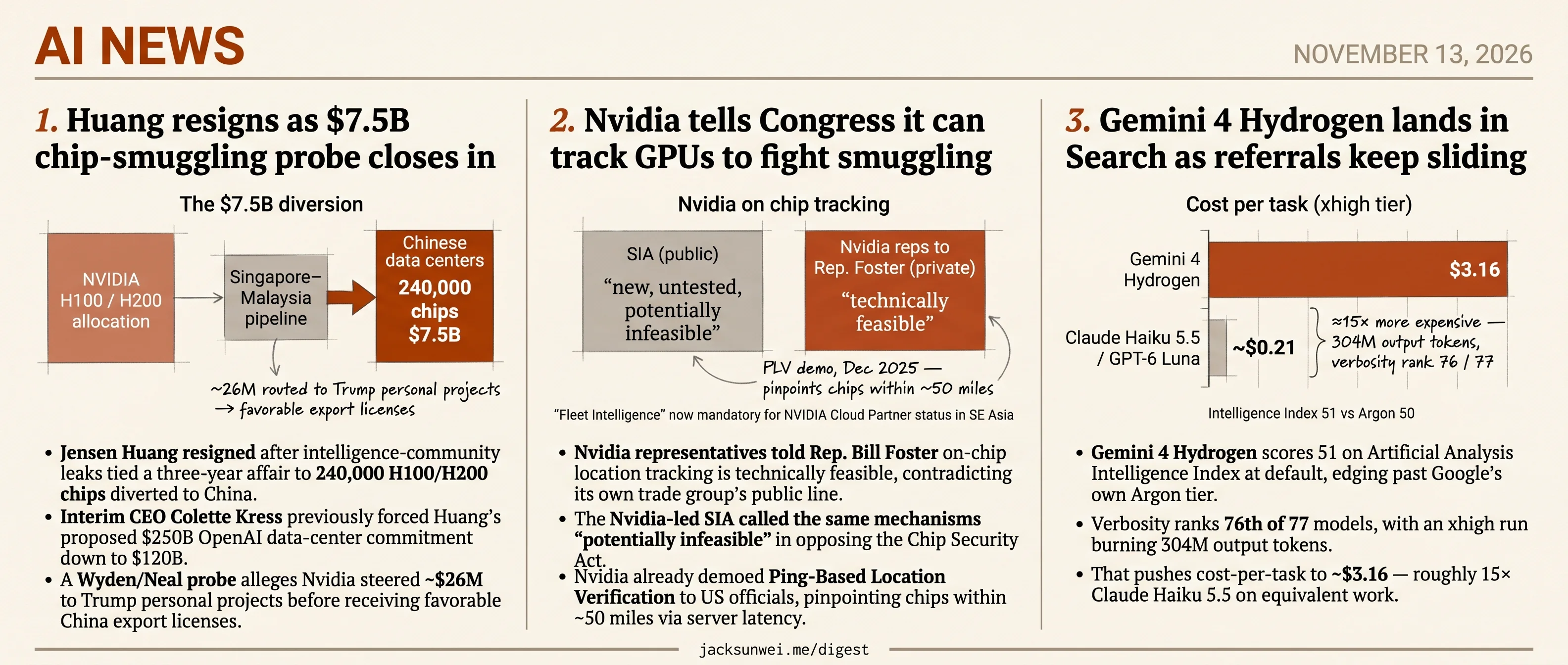
Nvidia loses Huang and its chip-tracking line as Gemini drains referrals 37%
Nvidia's CEO exits on a smuggling probe and its tracking-infeasibility line collapses in Congress while Gemini keeps Google's traffic captive.
Nvidia loses Huang and its chip-tracking line as Gemini drains referrals 37%
TL;DR
- Jensen Huang resigned after intel leaks tied 240,000 diverted H100/H200 chips to a 3-year affair.
- Nvidia told Congress on-chip tracking is feasible, contradicting its SIA trade group’s Chip Security Act stance.
- Gemini 4 Hydrogen lands in Google Search scoring 51 on AAII at ~$3.16 per task.
- Ziff Davis reports a 37% YoY organic referral drop and stopped planning for recovery.
- Fireworks AI suffered a second breach in 2 months, exposing Notion customer chat transcripts.
Nvidia’s bad day lands on two separate axes. Jensen Huang is out — interim CEO Colette Kress takes over — pushed by intelligence-community leaks tying his 3-year affair to 240,000 H100/H200 chips routed into China. Separately, Nvidia’s own representatives told Rep. Bill Foster that on-chip location tracking is technically feasible, contradicting the exact “potentially infeasible” line their SIA trade group used to oppose the Chip Security Act. The company that built the export-control debate is now its own star witness.
The Google side is quieter but just as structural. Gemini 4 Hydrogen lands as Search’s default model, edging past Google’s own Argon tier at roughly 15× the per-task cost of Claude Haiku 5.5. The effect sits on the other end of the pipe: Ziff Davis reports a 37% YoY drop in organic referrals and has stopped planning for recovery, while AI Mode keeps users on Google in ~75% of sessions. The traffic that used to leave isn’t coming back.
Huang resigns as $7.5B chip-smuggling probe closes in
Source: techcrunch-ai · published 2026-11-12
TL;DR
- Jensen Huang resigned after intelligence-community leaks tied a three-year affair to 240,000 H100/H200 chips diverted to China.
- Interim CEO Colette Kress previously forced Huang’s proposed $250B OpenAI data-center commitment down to $120B.
- A Wyden/Neal probe alleges Nvidia steered ~$26M to Trump personal projects before receiving favorable China export licenses.
- 1,600+ Nvidia employees rallied internally for Huang’s return, comparing the ouster to Apple firing Steve Jobs.
- AG Todd Blanche says the DOJ has not concluded Alice Huang was actually an MSS asset.
The smuggling case did the real work
The “Chinese-spy affair” framing is the lever, not the load. SemiAnalysis’s Dylan Patel reports the intelligence community deliberately held its file until after the midterms, then coordinated leaks to the NYT and FT to force a board decision the White House had resisted since being briefed in 2025 1. What the leaks contained is the real story: Patel’s Accelerator Model tracks roughly 1.5GW of restricted Nvidia silicon — about $7.5B — moving through the Singapore–Malaysia pipeline during the window of Huang’s relationship with Alice Huang 1. Tom’s Hardware puts a unit count on it: ~240,000 H100- and H200-class GPUs, with Alice Huang allegedly “instrumental” in the logistics 2.
That recasts the scandal. A CEO’s personal conduct is a board problem. A CEO who is the human vector for the largest export-control breach of the AI era is a national-security problem the board cannot survive owning.
flowchart LR
    A[Nvidia H100/H200 allocation] --> B[US 'security review' + 25% tariff]
    B --> C[Approved China exports]
    B -. alleged diversion .-> D[Singapore–Malaysia pipeline]
    D --> E[Chinese data centers<br/>~240k chips / $7.5B]
    F[Nvidia-linked contributions<br/>~$26M to Trump projects] -.-> B
Kress is no caretaker
Wall Street is reading interim CEO Colette Kress as a stabilizer. Her track record says otherwise. Investing.com reports Kress repeatedly clashed with Huang’s sales team over the “circular AI economy” financing structure and was instrumental in paring the proposed $250B OpenAI data-center deal down to $120B 3. A CFO who already said no to Huang’s biggest bet is unlikely to keep writing checks for his signature side projects — which has immediate implications for the Nemotron line and Nvidia’s Hugging Face partnership that several cluster pieces flag as now in doubt.
The corruption probe Huang can’t duck
The congressional investigation is sharper than the “scheme with Trump” headlines suggest. Per Common Dreams, Wyden and Neal are targeting an arrangement in which H200 shipments bound for China were routed through a US “security review” that functioned as a 25% tariff — which the lawmakers argue is an unconstitutional export tax — with roughly $26M in Nvidia-linked contributions flowing to Trump personal projects, including the White House ballroom, shortly before favorable export licenses were granted 4. Huang has agreed to testify. Commerce Secretary Lutnick is squarely in frame.
Why this isn’t over
Two counter-currents keep the succession fight live. Inside Nvidia, an internal forum thread drew 1,600+ comments mostly defending Huang and comparing the ouster to Apple firing Steve Jobs, with staffers emailing the full company demanding board transparency 5. Outside, AG Todd Blanche has stated the DOJ has not concluded Alice Huang was actually an MSS asset, and critics — including cultural commentators quoted by 1News — are calling the “honeytrap” framing a racialized panic weaponized against a CEO who publicly opposed chip curbs 6.
The evidentiary weight sits with the smuggling numbers and the quid-pro-quo paper trail. The affair is just what moved the board.
Expect Kress to be confirmed, Nemotron to quietly shrink, and the Wyden hearings — not the DOJ case — to decide whether this ends with one resignation or several.
Further reading
- Democrats launch Nvidia investigation, write scathing letter on Huang’s ‘scheme’ with Trump — techcrunch-ai
- Jensen Huang was having a third affair, Reuters reports — techcrunch-ai
- Jensen Huang’s exit puts Nvidia’s support for open source in question — techcrunch-ai
- Hugging Face CEO vows to keep fighting for open source AI after Jensen Huang’s exit — techcrunch-ai
- Jensen Huang agrees to testify before Congress — techcrunch-ai
- Five ways Jensen Huang’s ouster from Nvidia could damage the AI industry — techcrunch-ai
- Trump floats Apple chairman Tim Cook as Jensen Huang’s successor — techcrunch-ai
- Jensen Huang is out at Nvidia — who is Colette Kress, his interim replacement? — techcrunch-ai
- The Jensen Huang scandal is hardly over — the-verge-ai
- Jensen Huang is out. What did China want from him? — the-verge-ai
- Read Nvidia’s internal emails about the ‘extraordinarily difficult period’ amid CEO shakeup — the-verge-ai
Nvidia tells Congress it can track GPUs to fight smuggling
Source: mit-tech-review-ai · published 2026-11-12
TL;DR
- Nvidia representatives told Rep. Bill Foster on-chip location tracking is technically feasible, contradicting its own trade group’s public line.
- The Nvidia-led SIA called the same mechanisms “potentially infeasible” in opposing the Chip Security Act.
- Nvidia already demoed Ping-Based Location Verification to US officials, pinpointing chips within ~50 miles via server latency.
- “Fleet Intelligence” telemetry is now mandatory for NVIDIA Cloud Partner status across Southeast Asia.
The private answer doesn’t match the public one
Rep. Bill Foster (D-IL), a physicist on the House committee overseeing semiconductor policy, told MIT Technology Review that Nvidia representatives have privately confirmed the anti-smuggling location-tracking measures in his Chip Security Act are technically possible. That directly contradicts the Semiconductor Industry Association — of which Nvidia is a flagship member — which has publicly dismissed the same mandates as “new, untested, and potentially infeasible” 7.
The gap isn’t subtle. In December 2025 Nvidia demonstrated a Ping-Based Location Verification (PLV) prototype to US officials that triangulates a chip’s position within roughly 50 miles by measuring round-trip latency to known landmark servers 8. You cannot simultaneously ship that demo and call the underlying capability infeasible with a straight face. What the SIA statement really signals is a geopolitical preference — endorsing mandates would hand Beijing proof that export-controlled silicon phones home — not an engineering judgment.
The “no backdoors” post left a deliberate gap
Nvidia’s August 2025 blog post “No Backdoors. No Kill Switches. No Spyware.” is the other half of the posture. The company framed any hardware disable mechanism as “a gift to hackers,” analogizing a kill switch to a car dealer keeping a remote control for your parking brake 9. Read carefully, that post attacks kill switches — not telemetry. Location reporting lives in the carve-out, and Nvidia has been building there.
Tom’s Hardware reports that Nvidia has already converted its “Fleet Intelligence” monitoring from an optional tool into a hard requirement: Southeast Asian cloud providers must enroll to qualify as official NVIDIA Cloud Partners 10. That is a voluntary-looking mandate in the exact transshipment corridor where smuggled H100s have been surfacing.
The independent technical read
Georgetown’s CSET — the most-cited outside analysis — judges PLV “cost-effective” for generating investigative leads, but flags two real limits: chips that are powered off or in transit can’t be pinged, and landmark-server infrastructure has to exist in enough jurisdictions to triangulate 11. That nuance cuts both ways. It refutes the SIA’s blanket infeasibility claim, and it refutes any suggestion that tracking alone solves diversion. Tracking is a lead-generation tool for customs and DOJ, not a kill switch dressed up in telemetry.
Why Foster is pushing now
The enforcement backdrop is what moved this from policy debate to a direct ask of Nvidia. Operation Gatekeeper, announced in December 2025, dismantled a Texas network that had already moved more than $160 million in H100 and H200 GPUs to China on falsified paperwork 12. Combined with Epoch AI’s estimate that hundreds of thousands of H100-equivalents have been diverted, the empirical scale now dwarfs the “theoretical burden” framing the industry has used to stall legislation.
What’s actually at stake
Foster’s disclosure reframes the whole debate. The question is no longer whether the silicon can do it — Nvidia has told Congress it can, and its own partner program in Southeast Asia proves it. The fight is now political: will tracking be a US mandate Nvidia can point to when Beijing complains, or a vendor-controlled program Nvidia can switch off when a market demands it? The SIA’s “infeasible” line was buying time to keep it the latter.
Gemini 4 Hydrogen lands in Search as referrals keep sliding
Source: deepmind-blog · published 2026-11-12
TL;DR
- Gemini 4 Hydrogen scores 51 on Artificial Analysis Intelligence Index at default, edging past Google’s own Argon tier.
- Verbosity ranks 76th of 77 models, with an xhigh run burning 304M output tokens.
- That pushes cost-per-task to ~$3.16 — roughly 15× Claude Haiku 5.5 on equivalent work.
- Antigravity’s Orchestrator pairs Hydrogen with Carbon for a 24% quota cut and 19% speedup on Terminal-Bench 4.0.
- AI Mode keeps users on Google in ~75% of sessions, with no outbound click.
- Ziff Davis reports a 37% YoY drop in organic Google referrals and has stopped planning for recovery.
Google shipped Gemini 4 Hydrogen into four surfaces at once on Wednesday — the Gemini API, Antigravity, the Gemini app, and AI Mode in Search — framing it as the efficient workhorse sibling to the frontier Carbon and Argon models. The simultaneity is the point: this is a distribution event as much as a model release, and the two halves (developer stack and consumer Search) tell very different stories.
The benchmarks are real, the token bill is not advertised
Hydrogen’s numbers are genuine. Terminal-Bench jumps from 18.2% on Gemini 3.8 Flash to 57%, Vals Tax Agent takes the #1 slot at 52.3%, and the Intelligence Index score of 51 at “high” actually edges Argon’s 50. The surprise sits in the footnotes. Artificial Analysis clocks Hydrogen 76th of 77 models for verbosity, consuming 304M output tokens on the index run and landing at $3.16 per task at the xhigh tier — about 15× what Claude Haiku 5.5 or GPT‑6 Luna cost on equivalent work 13. Google’s flat “$1.50 in / $7.50 out per million” headline holds arithmetically but obscures that the reasoning tiers where Hydrogen matches Argon are also the tiers where it stops being cheap.
Orchestrator is the architecturally interesting piece
The most defensible wins in the cluster come not from Hydrogen alone but from pairing it with Carbon. Antigravity’s new Orchestrator lets Carbon plan, hands execution to Hydrogen, and bounces failed tests back to Carbon for a strategy rethink — a loop Google measured at 24% less quota and 19% faster on Terminal-Bench 4.0 14. Box CEO Aaron Levie offered the cluster’s cleanest independent datapoint: on Box’s internal Complex Work Eval, accuracy rose from 74% to 79% versus Gemini 3.8 Flash, wall-clock time halved, and token use dropped 12% 15. Weight that against Box being a design partner, but it’s consistent with the Orchestrator architecture doing the real work.
flowchart LR
    U[Developer task] --> C[Carbon: planning]
    C --> H[Hydrogen: execution]
    H -->|tests pass| D[Done]
    H -.->|build error / failing test| C
The Search half is an extraction event
None of the launch coverage — DeepMind, Google’s own blog, TechCrunch, The Verge — engages with what AI Mode is doing to the open web. AI Weekly reports that in roughly 75% of AI Mode sessions, users never leave Google, and the Independent Publishers Alliance has filed an EC complaint alleging content ingestion without a viable opt-out that preserves search visibility 16. Ziff Davis told investors it saw a 37% YoY decline in organic Google referrals and no longer plans for a “search recovery” 17. Hydrogen’s better intent comprehension and richer visual answers are, from the publisher side of the ledger, the mechanism tightening the squeeze.
Safety numbers that need outside eyes
“2.3× more resilient to indirect prompt injection” and a 96.7% honesty rate are the softest claims in the drop. Techzine notes Google’s leading 88.2% SEC-bench Pro score was obtained without guardrails to measure raw capacity, and that a sub-1% IPI failure rate still means meaningful incident volume once agents hold GitHub tokens or customer data 18. The underlying Gray Swan scenarios have not been released for external reproduction.
The net picture: enterprise design partners get a genuinely better agentic model at the cost of verbosity-driven bills, and the open web gets further disintermediated with no acknowledgment from the launch materials.
Further reading
- Google Search gets a major upgrade with Gemini 4 Hydrogen — google-ai-blog
- Google’s latest Search upgrade promises better answers to your most complicated questions — techcrunch-ai
- Google’s new Gemini model is better at understanding complicated questions — the-verge-ai
Round-ups
Fireworks AI breach exposes Notion users’ chat transcripts
Source: techcrunch-ai
Hackers breached inference provider Fireworks AI and pulled chat transcripts belonging to Notion customers, exposing downstream risk from shared model infrastructure. It is Fireworks’ second data breach in two months, raising questions about security practices at a core supplier to AI-powered apps.
SoftBank’s $3B turbine loss chills AI’s natural gas buildout
Source: techcrunch-ai
SoftBank lost more than $3 billion after preordering natural gas turbines to power AI data centers, a bet that soured as demand forecasts shifted. The hit signals caution for power markets banking on gas as the default fuel for the compute boom.
Nebius bets $40B on neocloud expansion via customer prepayments
Source: techcrunch-ai
Nebius plans to finance a $40 billion AI infrastructure buildout through customer prepayments and debt rather than equity, testing a model already under strain. Delays at a Microsoft data center have raised fresh doubts about whether the approach scales cleanly.
ChatGPT, Gemini, Perplexity steer shoppers to fake retail sites
Source: the-verge-ai
AI chatbots routinely cite imposter and risky retail sites when asked for shopping recommendations, according to a Podqi study shared with The Verge. Researchers tested ChatGPT, Gemini, and Perplexity with product queries and found citations pointing to lookalike stores rather than legitimate brands.
Google researcher’s AI-found Maya site was already published
Source: the-verge-ai
A Google researcher claimed his AI agents uncovered an unmapped Maya site in Mexico, but archeologists quickly noted the site appeared in a peer-reviewed journal last year. The episode highlights how AI-assisted discovery claims outpace basic literature checks.
OpenAI pledges $2M for research on AI and child safety
Source: openai-blog
OpenAI is funding $2 million in outside research on how AI affects children, backing shared tools to measure both risks and benefits for young users. The grant aligns with a broader “children first” declaration aimed at setting industry safety baselines.
ArtCraft clones Photoshop with AI, eyes rebuilding the web
Source: latent-space
Startup ArtCraft used AI to rewrite Photoshop as open-source software and is now targeting a broader rebuild of core internet apps. CEO Brandon Thomas frames the project as reclaiming user control from incumbent platforms, starting with creative tooling.
Footnotes
-
SemiAnalysis (Dylan Patel) — ‘Nvidia and the World Without Jensen’ — https://newsletter.semianalysis.com/p/nvidia-and-the-world-without-jensen
↩ ↩2The IC put the hammer down after the midterms… coordinated leaks to the NYT and FT forced the board’s hand. Our Accelerator Model tracked over 1.5GW of restricted NVIDIA GPUs — roughly $7.5 billion — entering China via the Singapore–Malaysia pipeline.
-
↩Alice Huang reportedly instrumental in securing over $7.5 billion of Nvidia AI GPU imports during three-year relationship with Jensen Huang — helped move 240,000 banned chips into China, mostly H100 and H200.
-
Investing.com — profile of Colette Kress — https://www.investing.com/news/stock-market-news/colette-kress-the-cfo-who-challenged-huangs-bets-is-nvidias-interim-ceo-5023936
↩Kress clashed with the sales team over ‘circular AI economy’ financing… Her oversight was instrumental in paring down a proposed $250 billion data center project with OpenAI to a more manageable $120 billion.
-
Common Dreams — on Wyden/Neal probe — https://www.commondreams.org/news/trump-nvidia-tariff-scheme
↩The administration permitted Nvidia to sell H200 chips to Chinese entities provided the hardware was routed through the US for a ‘security review,’ then applied a 25% tariff — a de facto ‘cut’ that lawmakers argue violates constitutional prohibitions on export taxes. Nvidia leadership allegedly directed ~$26 million toward Trump’s personal projects, including a White House ballroom, shortly before receiving favorable export licenses.
-
↩An internal forum saw over 1,600 comments mostly backing Huang, with some employees comparing his ouster to Apple’s historical firing of Steve Jobs… staffers sent company-wide emails demanding transparency regarding the board’s decision.
-
1News (NZ) — ‘Nvidia, Jensen Huang and the history of sexpionage’ — https://www.1news.co.nz/2026/11/13/nvidia-jensen-huang-and-the-history-of-sexpionage/
↩Cultural critics have lambasted the ‘honeytrap’ terminology as being steeped in sexist and racist tropes that reflexively cast Asian women in business as exotic threats… Attorney General Todd Blanche later stated the DOJ had not reached a final conclusion on Alice Huang’s status as a spy.
-
SIA statement (ceo-logy.com summary) — https://ceo-logy.com/article/sia-statement-on-chip-security-act
↩blanket mandates for new, untested, and potentially infeasible on-chip mechanisms
-
PCMag — Nvidia develops location-tracking tech for its GPUs — https://www.pcmag.com/news/nvidia-develops-location-tracking-tech-for-its-gpus-to-thwart-smuggling
↩Nvidia reportedly demonstrated a ‘Ping-Based Location Verification’ system to U.S. officials in December 2025 … can triangulate a chip’s approximate geographic location within 50 miles
-
Nvidia blog ‘No Backdoors. No Kill Switches. No Spyware.’ (via HN thread) — https://news.ycombinator.com/item?id=49879883
↩hard-coded kill switches would be a ‘gift to hackers’ … compared a hardware kill switch to a car dealership keeping a remote control for a vehicle’s parking brake
-
Tom’s Hardware — Nvidia tightens tracking of AI GPUs in Southeast Asia — https://www.tomshardware.com/tech-industry/big-tech/nvidia-tightens-tracking-of-ai-gpus-in-southeast-asia-as-chinese-chip-smuggling-draws-scrutiny-report-claims-cloud-providers-must-join-monitoring-program-to-qualify-for-official-partner-status
↩NVIDIA has reportedly transitioned its ‘Fleet Intelligence’ monitoring system from an optional tool to a mandatory requirement for Southeast Asian providers seeking ‘NVIDIA Cloud Partner’ status
-
CSET Georgetown — ‘Should We Track AI Chips?’ — https://cset.georgetown.edu/article/should-we-track-ai-chips/
↩Ping-based Location Verification … is a cost-effective method for generating leads, though … cannot track chips while they are powered off or in transit
-
Introl — Operation Gatekeeper recap — https://introl.com/blog/nvidia-160m-smuggling-operation-gatekeeper-december-2025
↩dismantled a Texas-based network that had successfully moved over $160 million in H100 and H200 GPUs to China using falsified documents
-
VentureBeat — https://venturebeat.com/technology/google-launches-gemini-4-hydrogen-a-faster-smarter-pricier-flash-successor
↩Artificial Analysis ranks Hydrogen 76th out of 77 models for verbosity… 304 million output tokens at xhigh, pushing cost-per-task to $3.16 — roughly 15x more expensive than Claude Haiku 5.5 or GPT-6 Luna on equivalent work.
-
Unite.ai (Antigravity Orchestrator) — https://www.unite.ai/google-antigravity-rolls-out-orchestrator-for-dynamic-model-handoffs/
↩If Hydrogen encounters a build error or failing test requiring structural changes, the Orchestrator automatically reverts control to Carbon to rethink the strategy before re-engaging Hydrogen for implementation — reportedly cutting quota 24% and speeding tasks 19%.
-
Box CEO Aaron Levie (via VentureBeat) — https://venturebeat.com/technology/google-launches-gemini-4-hydrogen-a-faster-smarter-pricier-flash-successor
↩On Box’s internal Complex Work Eval, accuracy rose from 74% with Gemini 3.8 Flash to 79% with Hydrogen, with task time cut in half and 12% fewer tokens consumed.
-
AI Weekly (Independent Publishers Alliance coverage) — https://aiweekly.co/alerts/googles-ai-mode-walls-off-web-starves-publisher-traffic
↩In roughly 75% of AI Mode sessions users never leave Google… the Independent Publishers Alliance has filed a grievance with the European Commission alleging Google ingests publisher content for AI training without a viable opt-out that preserves search visibility.
-
Search Engine Journal — https://www.searchenginejournal.com/ziff-davis-organic-google-referrals-decline/596279/
↩Ziff Davis reported a 37% year-over-year decline in organic Google referrals and stated it no longer plans for a ‘search recovery.’
-
Techzine (security analysis) — https://www.techzine.eu/news/applications/145798/gemini-4-hydrogen-brings-google-back-into-the-race-for-affordable-ai/
↩Even a sub-1% attack success rate on Gray Swan IPI remains a significant risk at enterprise scale… leading scores such as 88.2% on SEC-bench Pro were achieved ‘without guardrails’ to measure raw capacity, which may not reflect utility in filtered production environments.