Nvidia weighs Huang ouster, Gemini lands third, AlphaGenome misses 70%
Nvidia's board weighs ousting Huang, Gemini Decisions arrives third and overpriced, and AlphaGenome 2 still misses 70% of causal variants.
Nvidia weighs Huang ouster, Gemini lands third, AlphaGenome misses 70%
TL;DR
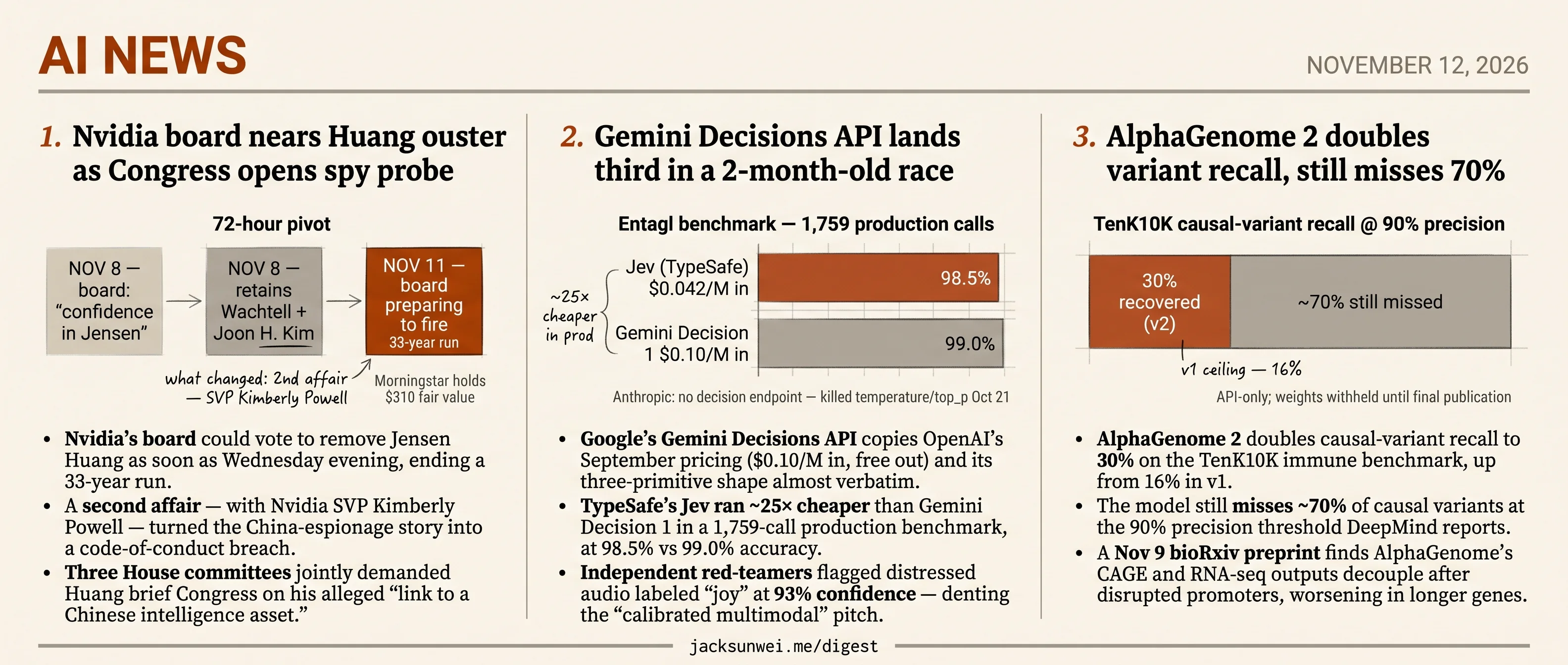
- Nvidia’s board may vote Wednesday to remove Jensen Huang after China-espionage probe and second affair surface.
- Google’s Gemini Decisions API lands 25× pricier than TypeSafe’s Jev in a 1,759-call production benchmark.
- AlphaGenome 2 recalls just 30% of causal variants, missing 70% at DeepMind’s own precision threshold.
- TSMC invested $1B across Anthropic and OpenAI, deepening chipmaker-lab circular financing.
- OpenAI quarterly revenue topped $10B for the first time, up 50% from Q2’s $6.7B.
Three frontier names take a hit today, each from a different direction. Nvidia’s board is reportedly closing in on a Wednesday vote to remove Jensen Huang — the China-espionage story, already serious, picked up a code-of-conduct angle after a second affair with an SVP surfaced, and three House committees want him in front of Congress. Google’s long-awaited Gemini Decisions API finally shipped, two months behind OpenAI’s September launch and roughly 25× more expensive than TypeSafe’s Jev in a production benchmark. And DeepMind’s AlphaGenome 2 doubled its recall on the TenK10K immune panel — to 30%, which is to say it still misses seven causal variants in ten at the precision bar DeepMind itself reports.
Underneath those, the money keeps circulating: TSMC put $1B into Anthropic and OpenAI, OpenAI’s quarterly revenue crossed $10B for the first time, and British inference-chip challenger Fractile raised $720M. The capital-formation story hasn’t paused. Today’s launches just each arrived short of the claim on the box.
Nvidia board nears Huang ouster as Congress opens spy probe
Source: techcrunch-ai · published 2026-11-11
TL;DR
- Nvidia’s board could vote to remove Jensen Huang as soon as Wednesday evening, ending a 33-year run.
- A second affair — with Nvidia SVP Kimberly Powell — turned the China-espionage story into a code-of-conduct breach.
- Three House committees jointly demanded Huang brief Congress on his alleged “link to a Chinese intelligence asset.”
- Morningstar held its $310 fair value, a notable counterweight to sell-side cuts pricing in a leadership vacuum.
The 72-hour pivot
On Nov 8, Nvidia’s board said it had “confidence in Jensen and his leadership team” and no reason to believe national security or trade secrets had been compromised. In the same breath it retained Wachtell Lipton and former acting U.S. Attorney Joon H. Kim to run an independent probe 1. Three days later, the WSJ was reporting the board is preparing to fire him.
What changed in between wasn’t the China allegation — that had been public for weeks. It was the second affair. The Alice Huang/Megaspeed story was a national-security problem the board could ring-fence with outside counsel. An intra-company relationship with SVP Kimberly Powell is a governance problem the board cannot delegate, because the code of conduct is the board’s own document.
The scandal didn’t start in November
The TechCrunch cluster treats this as a sudden blow-up. It isn’t. Short-seller Culper Research flagged the Huang–Megaspeed relationship as “uncomfortably close” back in May 2026, documenting Megaspeed’s balance sheet ballooning from $33M in late 2023 to roughly $3B a year later, with $2.9B in “refundable deposits” from undisclosed sources 2. The forensic skeleton the NYT and WSJ later dressed up with the espionage angle was sitting in a short report everyone ignored for six months.
That matters because the “key-man risk” the market is now pricing landed on a customer base that had already begun diversifying. Futuriom’s numbers show custom ASIC shipments projected to grow ~45% this year against 16% for merchant GPUs, with Microsoft’s Maia 300 and Meta’s MTIA v2 now positioned as primary inference systems rather than experiments 3. An ouster accelerates that trend; it does not start it.
Washington is now a parallel track
Even if the board keeps Huang, he does not get the story back. Chairmen Mast, Moolenaar and Crawford have jointly demanded a closed-door briefing on Huang’s alleged intelligence-asset link 4, and Senators Warren and Banks are already using the scandal to push the AI Overwatch Act. Beijing has pre-positioned its own framing — a “politically motivated witch hunt” aimed at the Trump administration’s AI agenda 5 — which guarantees this becomes a U.S.–China diplomatic artifact regardless of what Nvidia’s directors decide this week.
What’s actually uncertain
The consensus around “Huang is gone” is shakier than the cluster implies. Morningstar’s $310 fair-value hold is the tell: a mainstream sell-side analyst is explicitly saying the CEO-level deception has not reached the forecast, and demand for Blackwell is unchanged 6. The board has three bad options — fire the founder of 33 years, keep him and inherit a congressional subpoena cycle, or install a co-CEO structure that satisfies neither constituency.
The question worth watching isn’t whether Huang survives the week. It’s whether the hyperscalers’ quiet silicon exit ramps 3 get a lot less quiet by Q1 — and whether an AI buildout this concentrated can tolerate even the perception that its central CEO is a counterintelligence liability.
Further reading
- Who could replace Jensen Huang? A highly unscientific list of possible successors — techcrunch-ai
- The unfolding Jensen Huang scandal: a timeline — techcrunch-ai
- Jensen Huang accused of having another affair — with an Nvidia exec — techcrunch-ai
- Congress to call Jensen Huang in to answer for alleged Chinese spy affair — techcrunch-ai
- Is Jensen Huang’s bad behavior more commonplace than it seems? — techcrunch-ai
- Nvidia is reportedly preparing to fire Jensen Huang — the-verge-ai
Gemini Decisions API lands third in a 2-month-old race
Source: google-ai-blog · published 2026-11-11
TL;DR
- Google’s Gemini Decisions API copies OpenAI’s September pricing ($0.10/M in, free out) and its three-primitive shape almost verbatim.
- TypeSafe’s Jev ran ~25× cheaper than Gemini Decision 1 in a 1,759-call production benchmark, at 98.5% vs 99.0% accuracy.
- Independent red-teamers flagged distressed audio labeled “joy” at 93% confidence — denting the “calibrated multimodal” pitch.
- Anthropic is the holdout, killing temperature/top_p entirely in its Oct 21 API and pushing an “Advisor Tool” pattern instead.
Google didn’t invent this category
The Gemini Decisions API, announced November 11, is being pitched as a new product category: a non-generative endpoint that returns calibrated probabilities over closed sets instead of decoded tokens. It is not new. TypeSafe AI’s Jev opened the category earlier this year, and OpenAI’s Decisions API has been in public beta since September — same $0.10/M input price, same free output tokens, same three primitives that Google is now rebranding as noul, choice, and score 7. Latent Space’s “D-Day” framing is pointed: this is the moment decision models become table stakes, not the moment they were invented, and Google reportedly beat Anthropic to the punch only because Anthropic chose not to compete 89.
The investor subtext is why the drop lands harder than the technology warrants. Jev reportedly hit ~13% of paid team traffic on major API gateways within weeks of launch, and the window for an independent “System One” layer of the stack is closing as hyperscalers absorb it 810.
The benchmark fight cuts both ways
Google leads with a calibration-error story — Gemini Decision 1 posts the lowest ECE across reasoning, ranking, and agent-routing suites, and the API sustains 150–250ms latency across up to 100 questions per pass. Independent numbers complicate the pitch.
| Model | Input $/M tok | Output | Entagl accuracy | Notable gap |
|---|---|---|---|---|
| Jev (TypeSafe) | $0.042 | free | 98.5% | ~25× cheaper in prod 11 |
| OpenAI Decisions (GPT-6 Luna) | $0.10 | free | — | ~10× faster than Responses 7 |
| Gemini Decision 1 | $0.10 | free | 99.0% | lowest ECE on reasoning 11 |
| Anthropic | — | — | — | no decision endpoint 9 |
The “5× cheaper than Flash-Lite” headline collapses once the comparison moves off Google’s own baseline. And Hokai’s independent red-team found calibration claims that look great on text benchmarks don’t carry over to sensory modalities: distressed audio classified as “joy” at 93% confidence, and only 21% confidence detecting AI-generated video 12. Low ECE on ranking tasks is not the same as low ECE on the “natively multimodal” use cases Google leads the announcement with.
Anthropic’s bet against the category
Anthropic’s absence is itself a product position. The 2026-10-21 API version removed temperature, top_p, and top_k outright — the endpoints now return 400 errors — and nudges developers toward the “Advisor Tool” pattern, where a cheap executor consults a smarter advisor mid-generation 9. Two coherent bets on the same problem: Google and OpenAI believe decisions are a separable product with their own pricing surface; Anthropic believes they’re a prompting pattern on top of reasoning models, and that a dedicated typed endpoint mostly launders miscalibration into confident-sounding output.
What’s actually at stake
Ron Schmelzer’s critique names the real risk: well-formed, strongly-typed decisions are harder to audit than conversational outputs — an incorrect choice with a 0.94 probability doesn’t look like a hallucination the way a wrong paragraph does 10. The interesting question isn’t whether Google’s calibration numbers hold up (Hokai suggests they don’t, modality-dependent) but whether the industry will decide in twelve months that “decision models” were a real stack layer or a brief pricing arbitrage that reasoning models re-absorbed.
Further reading
- [AINews] D-Day (Decision Models Day) — latent-space
AlphaGenome 2 doubles variant recall, still misses 70%
Source: the-verge-ai · published 2026-11-11
TL;DR
- AlphaGenome 2 doubles causal-variant recall to 30% on the TenK10K immune benchmark, up from 16% in v1.
- The model still misses ~70% of causal variants at the 90% precision threshold DeepMind reports.
- A Nov 9 bioRxiv preprint finds AlphaGenome’s CAGE and RNA-seq outputs decouple after disrupted promoters, worsening in longer genes.
- DeepMind ships API-only access with weights withheld until final publication, forcing users to upload single-cell RNA-seq data to Google.
The benchmark jump is real — and narrower than the launch suggests
DeepMind’s headline figure is a near-doubling on the TenK10K immune-cell benchmark: AlphaGenome 2 recovers 30% of putatively causal expression-linked variants, up from 16% in v1, with directional (sign-of-effect) accuracy climbing to 43% from 23% 13. Peter Donnelly, whose firm Genomics plc is a launch partner, calls it a “step change” and is wiring the model into its Mystra agentic platform for drug-target work with Novo Nordisk, BridgeBio, and Relation Therapeutics 14.
The number worth lingering on is the one DeepMind leads with less: at 90% precision, the model still misses roughly 70% of causal variants. Independent reviewers note that for personal gene-expression prediction on individual-level data, boring supervised baselines like Elastic Net can still edge it out. A separate TU Munich group fine-tuned the AlphaGenome backbone into “Scooby-2” and hit Pearson r=0.56 on cell-type-specific expression differences, consistently beating the older Borzoi model 15 — strong evidence the architecture is a good substrate, but also evidence that specialist downstream models are still doing the real lifting.
A mechanism red flag from bioRxiv
The most substantive critique arrived two days before the launch coverage. A Nov 9 bioRxiv study systematically perturbed 2,111 promoters in silico and found AlphaGenome’s CAGE track crashing as a transcriptionally coherent model should — while its RNA-seq predictions for downstream exons stayed largely unchanged:
discordance was particularly severe in longer genes and became apparent from the second exon onward 16
That’s not a precision complaint; it’s a consistency complaint. The model’s own output tracks don’t agree on what a disrupted promoter should do to the resulting transcript. For splicing variants, distal truncations, and long genes (DMD famously exceeds AlphaGenome’s 1 Mb context window), that undercuts the “regulatory grammar” framing the Verge piece leans on. It doesn’t invalidate the TenK10K numbers, but it suggests the model is pattern-matching cleanly on some tracks and doing something less mechanistic on others.
API-only, pharma-first
Unlike AlphaGenome 1, v2 ships as a hosted API with weights withheld “until final publication” 17. Running it requires uploading single-cell RNA-seq data to Google — which independent analysts flag as a GDPR “special category” problem for European academic users, and a reproducibility problem for everyone 17. The commercial channel, meanwhile, is already live through Genomics plc’s partners 14. The gap between “non-commercial API for academics” and “private preview for named pharmas” is a distribution choice, not a technical one, and it’s the part of the story the launch coverage mostly skips.
What’s actually at stake
The flagship case study — computationally recovering a causal variant in the ETS2 inflammatory pathway that took wet-lab teams years to pin down, with a MEK-inhibitor therapeutic hypothesis already queued 18 — is a legitimate proof point. But treating AlphaGenome 2 as a solved regulatory-genomics oracle misreads the evidence. Recall ceilings are modest, a credible mechanism critique is in the literature before the model is even published, and the deployment posture favors partners over the academic community that validated v1. All three will shape how fast the ETS2-style wins actually generalize.
Round-ups
TSMC puts $1B into Anthropic and OpenAI as AI financing loops tighten
Source: ars-technica-ai
TSMC, the Taiwanese foundry that fabricates most advanced AI accelerators, is backing its two largest model-maker customers with a combined $1B investment. The move deepens the circular financing pattern tying chipmakers to labs, landing as broader AI-trade sentiment wobbles.
OpenAI quarterly revenue tops $10B for the first time
Source: techcrunch-ai
OpenAI’s sales crossed $10B in a single quarter, up roughly 50% from the $6.7B booked in Q2. The jump signals ChatGPT and API demand still compounding quarter-over-quarter, giving the company fresh cover for its massive compute and training commitments.
Mercor raises $750M Series D at $20B valuation on $3B run rate
Source: latent-space
Mercor closed a $750M Series D valuing the AI talent-and-data marketplace at $20B, against a $3B annualized revenue run rate. The round lands the same week Google pushed Gemini 4 Carbon to general availability, underscoring how fast labeling-adjacent infrastructure is scaling with frontier training.
UK’s Fractile raises $720M to challenge Nvidia on inference chips
Source: techcrunch-ai
Fractile pulled in $720M to build purpose-built AI inference silicon, vaulting the British startup into the top tier of funded chip challengers. The round reflects investor appetite for Nvidia alternatives as inference workloads, not training, increasingly dominate datacenter spending.
United bars personal AI agents from booking its flights
Source: the-verge-ai
United will block personal AI assistants from purchasing tickets, citing privacy and regulatory risk. The airline says agent-driven bookings remain rare so far, echoing DoorDash’s experience, but it wants a policy in place before consumer agents like ChatGPT’s and Perplexity’s scale up.
Engineers show early Jev System One builds at AI Engineer Code Summit
Source: latent-space
Jev, the new System One model class, drew real production demos from Glean and others at the AI Engineer Code Summit. Lead creator Diogo Almeida urged developers to automate everything, framing Jev as the substrate for a new wave of agentic engineering workflows.
Google Labs debuts Tabletop, an agentic space for group planning
Source: google-ai-blog, the-verge-ai
Tabletop is a new Google Labs experiment that lets groups vibecode custom collaboration apps — itineraries, polls, brackets — by describing them in natural language. The interface resembles Asana or Monday, but swaps rigid templates for AI-generated interactive tools. A waitlist is open now.
Footnotes
-
NVIDIA Investor Relations — Board statement (Nov 8) — https://investor.nvidia.com/news/press-release-details/2026/Statement-from-NVIDIA-Board-of-Directors/default.aspx
↩The Board expressed ‘confidence in Jensen and his leadership team’ and said it had no reason to believe national security or trade secrets had been compromised, even as it retained Wachtell, Lipton and former acting U.S. Attorney Joon H. Kim to lead an independent probe.
-
CBS News — on Culper Research short report — https://www.cbsnews.com/news/nvidia-short-seller-culper-jensen-huang/
↩Culper Research warned in May 2026 of an ‘uncomfortably close’ relationship between Jensen Huang and Alice Huang, flagging Megaspeed’s balance sheet ballooning from $33 million in late 2023 to roughly $3 billion by end of 2024.
-
Futuriom — ‘How the Hyperscalers Are Moving Beyond Nvidia’ — https://www.futuriom.com/articles/news/how-the-hyperscalers-are-moving-beyond-nvidia/2025/09
↩ ↩2Custom ASIC shipments are projected to grow nearly 45% this year versus 16% for merchant GPUs; Microsoft’s Maia 300 and Meta’s MTIA v2 are now positioned as ‘primary inference systems,’ decoupling core profitability from Nvidia’s ecosystem.
-
U.S. House Foreign Affairs Committee press release — https://foreignaffairs.house.gov/news/press-releases/chairmen-mast-moolenaar-and-crawford-request-jensen-huang-brief-congress-on-link-to-chinese-intelligence-asset
↩Chairmen Mast, Moolenaar and Crawford jointly demanded Huang appear for a closed-door briefing on his ‘link to a Chinese intelligence asset,’ escalating the matter from a corporate scandal to a formal national-security inquiry.
-
Newsweek — China response — https://www.newsweek.com/china-suggests-jensen-huang-probe-politically-motivated-12693278
↩Chinese state media dismissed the investigation as a ‘politically motivated witch hunt’ aimed at undermining the Trump administration’s AI agenda and further blockading Chinese technological progress.
-
Morningstar equity research note — https://www.morningstar.com/stocks/nvidia-watching-potential-succession-plan-any-signs-customer-impact
↩Morningstar maintained its $310 fair value estimate, noting that while ‘deception may have occurred at the CEO level,’ it had not yet crept into the company’s underlying financial forecasts or the high demand for its hardware.
-
OpenAI community post — Decisions API public beta — https://community.openai.com/t/decisions-api-is-now-available-in-public-beta/1403877
↩ ↩2OpenAI launched the Decisions API in September 2026 powered by GPT-6 Luna at $0.10 per million input tokens with free output tokens, roughly 10x faster than the Responses API.
-
Latent Space — AINews ‘D-Day’ — https://latent.space/p/ainews-d-day-decision-models-day/
↩ ↩2Google’s move validates the sector’s maturity, signaling to investors that the window for independent ownership of this ‘layer’ of the AI stack is rapidly closing… Gemini Decision 1 reportedly beat Anthropic to market.
-
Medium / automation.labs — Claude API 2026-10-21 analysis — https://medium.com/@automation.labs/claude-api-2026-10-21-9-breaking-changes-ranked-by-blast-radius-1a1d033209a8
↩ ↩2 ↩3Anthropic has not released a standalone Decision Classifier API; instead the 2026-10-21 version removes temperature, top_p and top_k entirely, returning 400 errors, and pushes developers toward the ‘Advisor Tool’ architecture.
-
Forbes — Ron Schmelzer on decision models category — https://www.forbes.com/sites/ronschmelzer/2026/10/12/decisions-decisions-a-guide-to-the-new-wave-of-ai-decision-models-besides-jev/
↩ ↩2Decision models like Jev accounted for nearly 13% of paid team traffic on major API gateways within weeks of launch… critics note that well-formed but incorrect ‘typed’ decisions could be harder to audit than conversational outputs.
-
36Kr — Jev vs Gemini Decision 1 benchmark writeup — https://eu.36kr.com/en/p/4066443558491008
↩ ↩2Jev is priced at $0.042 per million input tokens versus Gemini Decision 1’s $0.10… In an Entagl benchmark of 1,759 decisions Jev was approximately 25 times cheaper, with 98.5% accuracy vs 99.0% for a frontier Gemini model.
-
hokai.io — independent red-team of Gemini Decision 1 — https://hokai.io/hub/models/gemini-decision-1
↩The model misidentified a distressed voice as ‘joy’ with 93% confidence and showed only 21% confidence in detecting AI-generated video footage, suggesting calibration metrics don’t translate to all modalities.
-
DeepMind blog — https://deepmind.google/blog/alphagenome-2-deciphering-how-cells-read-dna-to-better-understand-disease/
↩AlphaGenome 2 recovered 30% of putatively causal expression-linked variants on the TenK10K immune cell benchmark, nearly doubling the 16% achieved by AlphaGenome 1; directional accuracy improved to 43%, up from 23%
-
Genomics plc / Peter Donnelly — https://www.genomics.com/newsroom/alphagenome-2-a-step-change-in-predicting-what-dna-does-and-what-it-might-add-to-drug-discovery---by-professor-sir-peter-donnelly-ceo-genomics
↩ ↩2Genomics plc plans to incorporate AlphaGenome 2 into its Mystra agentic platform to help bridge the gap between simple genetic associations and actionable drug targets
-
cellcog.ai technical review — https://cellcog.ai/blog/alphagenome-2/
↩Independent researchers from the Technical University of Munich evaluated AlphaGenome-based architectures; their Scooby-2 model achieved a Pearson correlation of 0.56 in predicting cell-type-specific gene expression differences, with fine-tuned AlphaGenome backbones consistently outperforming Borzoi
-
bioRxiv preprint (Nov 9, 2026) — https://www.biorxiv.org/content/10.64898/2026.11.06.764851v1
↩while the model correctly predicted a massive drop in CAGE signals upon promoter disruption, the predicted RNA-sequencing signals remained largely unaffected for downstream exons… discordance was particularly severe in longer genes and became apparent from the second exon onward
-
i-scoop.eu analysis — https://www.i-scoop.eu/alphagenome-2/
↩ ↩2AlphaGenome 2 is not fully open-source… weights will only be released upon final publication; access is via a hosted API, raising supplier risk and data-privacy concerns since users must upload single-cell RNA-seq data
-
Spondylitis Association on ETS2 pathway — https://spondylitis.org/research-new/study-highlights-ets2s-role-in-driving-inflammatory-conditions-offers-hope-for-new-therapies/
↩MEK inhibitors can suppress the ETS2 pathway in macrophages, but currently cause severe systemic side effects; future work must focus on modifying these molecules to target macrophages specifically