Anthropic files $1.4T IPO, Gemini undercuts Claude, OpenAI opens ChatGPT ads
Anthropic opens a $1.4T IPO roadshow, Google undercuts Claude on price, and OpenAI turns ChatGPT into an ad platform.
Anthropic files $1.4T IPO, Gemini undercuts Claude, OpenAI opens ChatGPT ads
TL;DR
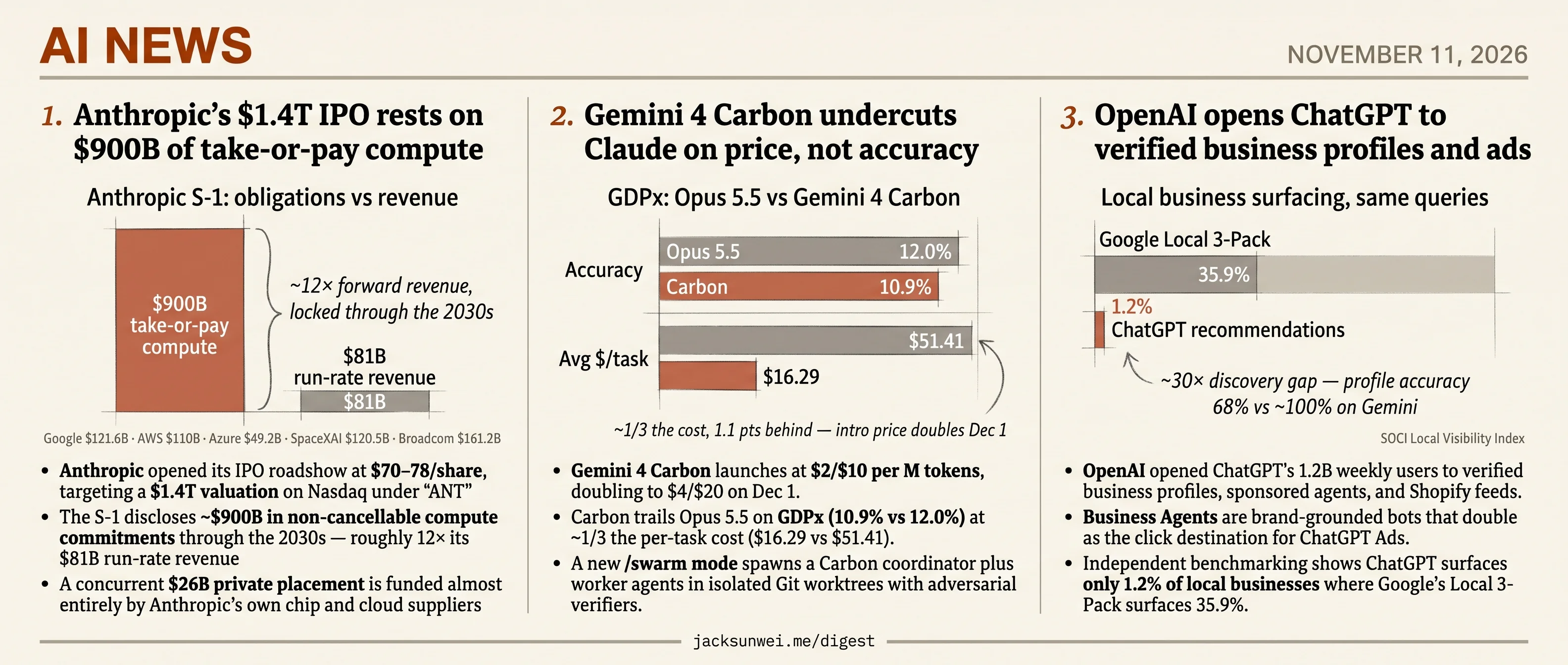
- Anthropic opens IPO roadshow at $70–78/share, targeting a $1.4T valuation under ticker ANT.
- Gemini 4 Carbon launches at $2/$10 per M tokens, trailing Opus 5.5 10.9% vs 12.0% on GDPx.
- OpenAI opens ChatGPT to verified business profiles, sponsored agents, and Shopify feeds.
- New York’s RAISE Act takes effect, binding OpenAI and Anthropic to state-level safety disclosure.
- Nvidia faces governance crisis over alleged Huang–Chinese intelligence affair.
Today is a business-model day for the frontier labs. Anthropic opened its IPO roadshow at a $1.4T valuation, with an S-1 that discloses roughly $900B in non-cancellable compute commitments and a $26B private placement funded almost entirely by its own suppliers. Google shipped Gemini 4 Carbon at a third of Opus 5.5’s per-task cost — a direct price war with the company going public tomorrow. OpenAI turned ChatGPT into an ad platform, with verified business profiles, sponsored agents, and Shopify feeds now reaching 1.2B weekly users.
Three labs, three answers to the same compute bill: raise the capital, cut the price, sell the attention. The round-ups track the regulatory and governance side — New York’s RAISE Act takes effect today binding OpenAI and Anthropic, Nvidia’s board is navigating the Huang scandal, and Anthropic’s Claude Meetings launch extends the enterprise push the IPO is pricing.
Anthropic’s $1.4T IPO rests on $900B of take-or-pay compute
Source: anthropic-news · published 2026-11-10
TL;DR
- Anthropic opened its IPO roadshow at $70–78/share, targeting a $1.4T valuation on Nasdaq under “ANT”
- The S-1 discloses ~$900B in non-cancellable compute commitments through the 2030s — roughly 12× its $81B run-rate revenue
- A concurrent $26B private placement is funded almost entirely by Anthropic’s own chip and cloud suppliers
- Class F founders keep 50.1% voting power post-IPO, making Anthropic a “controlled company” exempt from Nasdaq independence rules
The headline number isn’t $1.4T
Anthropic is selling 825M shares into a book that reportedly cleared within hours. The more load-bearing figure in the S-1 is buried deeper: roughly $895–$901B in take-or-pay compute contracts stretching into the 2030s, split across Google Cloud ($121.6B), AWS ($110B), Azure ($49.2B), SpaceXAI ($120.5B) and Broadcom ($161.2B) 1. Measured against an $81B revenue run-rate, that is ~12× forward revenue in locked obligations before a dollar of salaries, inference costs, or safety research. Q3 2026 revenue growth has reportedly decelerated from triple digits to 45–47%, and the company swung back to a $567M operating loss after a brief Q2 adjusted-profit blip.
Michael Burry, newly short the sector, called the structure “catastrophically vulnerable” and suggested a crash preventing these IPOs would be “for the benefit of humanity” 2. That is a trader’s line, but the arithmetic is independent of the trader.
Circular money, concentrated demand
The $26B private placement running alongside the IPO is being funded by Nvidia, AMD, Broadcom, Micron, TSMC, Google and Microsoft — the same firms Anthropic pays for chips and compute, and whose marketplaces resell Claude 3. Roughly 20% of H1 2026 revenue came from just two unnamed clients 3. Defenders call this efficient demand aggregation; Ed Zitron and B. Riley analysts call it hyperscalers feeding themselves money. The S-1 does not make it easy to disentangle organic demand from capital that has made a round trip through a supplier’s balance sheet.
flowchart LR
    S[Nvidia / AMD / Broadcom<br/>Google / Microsoft / TSMC] -->|$26B placement| A[Anthropic]
    A -->|$900B take-or-pay| C[Cloud + chip suppliers]
    A -->|Claude API| M[AWS / GCP marketplaces]
    M -->|revenue share| A
    C -.->|same entities.| S
Governance public investors can’t touch
Class A buyers get economics and almost no control. Class F founders hold 50.1% of the vote, and a single Class T share held by the Long-Term Benefit Trust elects a board majority — enough to make Anthropic a “controlled company” exempt from Nasdaq independent-committee rules. Jay Ritter notes the $250M-per-founder cashout is unremarkable by current standards, around 1.5% of each stake, leaving roughly $18B retained apiece 4. The question is whether PBC-plus-LTBT governance survives contact with quarterly earnings. Encode AI’s Nathan Calvin has catalogued a pattern of Responsible Scaling Policy weakenings and industry-favorable lobbying; Dario Amodei’s 2,000-word reply conceded “messaging errors” but defended the race-to-the-top doctrine 5. Jacob Coxon resigned pre-IPO, forfeiting equity.
The risk Anthropic flagged itself
Tucked inside a 94-page risk section, Anthropic warns its own models could pose “catastrophic or existential risks to humanity” and “take harmful actions independently.” Tech Policy Press argues that language, combined with national-security and emergency authorities, gives the U.S. government a plausible path to seize the company at a steep discount to the IPO price 6. It is an edge-case scenario, but it is in the prospectus because Anthropic’s lawyers put it there.
The book may be covered. The three questions underneath it — serviceability of $900B in obligations, how much demand is really circular, and whether mission governance holds past the first bad quarter — are not.
Further reading
- All 7 Anthropic founders will each cash out about $250M in IPO — techcrunch-ai
- Anthropic sets IPO price range of $70 to $78 per share to reach an implied valuation of $1.404 trillion — techcrunch-ai
- Anthropic targets $1.4 trillion IPO — the-verge-ai
Gemini 4 Carbon undercuts Claude on price, not accuracy
Source: deepmind-blog · published 2026-11-10
TL;DR
- Gemini 4 Carbon launches at $2/$10 per M tokens, doubling to $4/$20 on Dec 1.
- Carbon trails Opus 5.5 on GDPx (10.9% vs 12.0%) at ~1/3 the per-task cost ($16.29 vs $51.41).
- A new /swarm mode spawns a Carbon coordinator plus worker agents in isolated Git worktrees with adversarial verifiers.
- Google’s Signal Lean proof excludes side-channel attacks on a Google-built libsignal variant.
The pricing counter-punch
Carbon shipped roughly 24 hours after Anthropic’s Claude Fable 5.2, and the clearest read on the launch is economic, not scientific. The Decoder called it “yesterday’s news in the fastest model cycle yet,” noting Google has pivoted from intelligence gains to aggressive pricing 7. Artificial Analysis still places Fable ahead on raw intelligence; Carbon’s wedge is a $2/$10 introductory rate that doubles on Dec 1. DeepMind’s “2× lower cost per task than the next best external model” line is less a capability claim than a land-grab with a built-in expiration date.
The independent numbers back that framing. On GDPx, a cross-industry agentic benchmark, Carbon trails Claude Opus 5.5 on accuracy but demolishes it on cost 8:
| Model | GDPx accuracy | Avg $/task |
|---|---|---|
| Claude Opus 5.5 | 12.0% | $51.41 |
| Gemini 4 Carbon | 10.9% | $16.29 |
| GPT-6 Astra | — | $53.99 |
Google’s leaderboard sweep — CursorBench 4.0, Perplexity’s WANDR (owned by the same party reporting the result), Zapier’s AutomationBench — is best read as cost-adjusted wins, not frontier dominance.
/swarm is the actual product
The more interesting shipped artifact is /swarm in the new Antigravity platform. Independent reporting fills in what the DeepMind post glosses: a Carbon “coordinator” spins specialized workers into isolated Git worktrees, with adversarial verifier agents challenging their changes over a shared append-only message board 9.
flowchart LR
    U[User prompt] --> C{Carbon coordinator}
    C --> W1[Worker: worktree 1]
    C --> W2[Worker: worktree 2]
    C --> W3[Worker: worktree 3]
    W1 --> V[Adversarial verifier]
    W2 --> V
    W3 --> V
    V --> M[(Append-only message board)]
    M --> C
That architecture explains the headline demos — 94% resolution on 16 HubX bugs with zero regressions, a 906k-triangle Three.js reconstruction built across ten overnight loops — and also the cost tail. Parallel agents “deplete quotas much faster than standard API calls” 9, and the Hacker News thread on Antigravity is openly hostile: users cite retroactive quota cuts, forced migration off the Gemini CLI, and account suspensions when routing to third-party models 10. Broadcom’s “13-Hour Collapse” note cuts the other way too — swarm-speed vulnerability discovery (Wiz’s two-hour zero-days) only helps attackers against anyone still on periodic patching 11.
Safety claims with asterisks
SecurityWeek is the sharpest corrective on the safety sheet. The AlphaProof Code / Signal verification — pitched as proving a protocol in weeks that normally takes years — covers a Google-built variant of libsignal, excludes side-channel attacks, and Google itself concedes prompt-injection resistance “remains an area for continued improvement” 12. That directly undercuts the “first model at 0.0% on Gray Swan IPI” line in the release.
Resistance to prompt injection “remains an area for continued improvement.” — Google, per SecurityWeek 12
A benchmark shutout doesn’t neutralize the lethal-trifecta pattern — private data plus untrusted content plus exfiltration channels — at the system level, and /swarm’s connector-heavy worker fleet is exactly where that pattern lives.
What to watch
Carbon is a credible, incremental release whose real news is pricing and the /swarm orchestration primitive. The Dec 1 price reset is the forcing function: if Antigravity’s quota and reliability complaints aren’t fixed by then, Google will have traded a two-week discount window for a durable developer-trust problem.
Further reading
- Google releases Gemini 4 Carbon with agent ‘swarm’ feature — the-verge-ai
OpenAI opens ChatGPT to verified business profiles and ads
Source: openai-blog · published 2026-11-10
TL;DR
- OpenAI opened ChatGPT’s 1.2B weekly users to verified business profiles, sponsored agents, and Shopify product feeds.
- Business Agents are brand-grounded bots that double as the click destination for ChatGPT Ads.
- Independent benchmarking shows ChatGPT surfaces only 1.2% of local businesses where Google’s Local 3-Pack surfaces 35.9%.
- One small advertiser’s postmortem: $500 burned in an hour, 13% click fidelity, zero verified leads.
The commerce stack ChatGPT is quietly assembling
With “Businesses in ChatGPT,” OpenAI is no longer pretending its assistant is just an assistant. The November 10 launch bundles three pieces into a single commerce layer: a Business Hub where merchants claim and verify a profile, Shopify-synced product feeds with live pricing and inventory, and Business Agents — brand-specific bots that explain products, make recommendations, and serve as the click destination for ChatGPT Ads. Analytics (mentions, clicks, discovery topics) close the loop. The shape is unmistakable: this is Google Business Profile plus AdWords plus Merchant Center, collapsed into one conversational surface.
flowchart LR
    S[Shopify catalog<br/>product feed] --> H[Business Hub<br/>verified profile]
    H --> A[Business Agent]
    AD[ChatGPT Ads<br/>sponsorship] --> A
    U[ChatGPT user<br/>1.2B weekly] --> A
    A --> W[Merchant website<br/>click-out]
    A --> M[Aggregated analytics:<br/>mentions, clicks, topics]
Digiday reads the free-agent/paid-placement split as a classic two-tier funnel 13. The strategic context reinforces it: the same week, OpenAI acquired travel-agent startup Odessia (~$60M annualized GMV), and Expedia and Booking Holdings fell 2–4% on the news 14. OpenAI wants both the horizontal discovery layer and the vertical transaction stacks underneath it.
Verification is the first broken link
Every downstream feature — publishing a profile, deploying an agent, pulling analytics — is gated on identity verification through Persona. Merchants in OpenAI’s own community forum describe that pipeline as “broken”: high failure rates, expired sessions with no manual escalation, and GDPR concerns about mandatory biometric and ID capture 15. Any adoption number OpenAI cites in the coming quarters should be read against this bottleneck. The blue check is cheap to promise and expensive to actually issue.
”Verified” is an identity claim, not a safety guarantee
Zenity Labs recently disclosed AgentForger, a CSRF flaw that let attackers silently provision agents inside a victim organization’s workspace — invisible, persistent, and acting with the org’s identity 16. OpenAI patched it, but the class of attack is exactly what a verified-agent marketplace multiplies. Enterprise buyers should treat Business Agents as privileged service accounts with external reach, not chatbots. The checkmark says “this brand is who they claim to be.” It does not say “this agent won’t be hijacked into exfiltrating your workspace data.”
The discovery and ROI gap
OpenAI’s pitch leans on “high-intent” users and a 1.2B weekly audience. The independent numbers are less flattering. SOCi’s Local Visibility Index found ChatGPT recommends roughly 1.2% of local businesses for queries where Google’s Local 3-Pack surfaces 35.9%, with profile accuracy at 68% versus near-100% for Gemini 17. That’s the actual baseline the Business Hub is trying to close — a credibility gap, not a competitive pincer.
On the paid side, one small-business advertiser documented burning a $500 ChatGPT Ads budget in under an hour, with only 13% of reported clicks actually landing on their site and zero verified leads attributed 18.
“$500 budget vanished in an hour with zero verified leads.” 18
Two features ship well: the Shopify integration, and the UI separation between agent conversations and ChatGPT’s own answers. The two weakest links — verification UX and agent security — are the ones the launch post glosses over, and they’re where the flywheel will stall first.
Further reading
- OpenAI rolls out new business profiles, making ChatGPT just a little bit more like Google — techcrunch-ai
- ChatGPT is getting verified AI ‘Business Agents’ — the-verge-ai
Round-ups
New York’s AI safety law kicks in, binding OpenAI and Anthropic
Source: techcrunch-ai
New York’s RAISE Act takes effect, forcing frontier labs to register with the state, disclose safety practices, and report critical incidents or pay fines. OpenAI, Anthropic, and other major developers now face the first US state-level oversight regime with real enforcement teeth.
Jensen Huang’s alleged Chinese spy affair triggers Nvidia governance crisis
Source: techcrunch-ai, techcrunch-ai, the-verge-ai
The scandal around Nvidia’s CEO and an alleged Chinese intelligence asset is spiraling into a boardroom and national-security story, with governance experts saying they’ve never seen anything like it. The timing lands as Washington and Beijing race to lock down AI infrastructure supply chains.
Anthropic launches Claude Meetings and an AI office suite
Source: techcrunch-ai, the-verge-ai
Claude Meetings listens as colleagues talk, drafting plans, mapping timelines on a whiteboard, and pulling figures from connected work apps in real time. The launch anchors Anthropic’s broader push into an office suite aimed squarely at enterprise customers already using Claude Code.
PSI uses unreleased Anthropic model to crack 20-year quantum question
Source: techcrunch-ai
Startup PSI is pitching AI-driven scientific discovery as a business, and points to a proof point: an unreleased Anthropic model helped resolve a fundamental quantum computing problem that had stumped researchers for close to two decades.
Adobe MAX goes all-in on agentic AI across Photoshop, Premiere, and Firefly
Source: the-verge-ai, google-ai-blog, techcrunch-ai, the-verge-ai
Adobe is wiring AI agents into Creative Cloud via a new MCP server that lets third-party models drive Photoshop, Premiere, and Firefly. A Firefly prototype builder takes aim at Figma, and a Google partnership brings Adobe editing into Drive and Gemini.
Google Cloud debuts Gemini for healthcare to unify clinical data
Source: google-ai-blog
Gemini for Healthcare targets hospital IT by stitching together fragmented clinical records and automating paperwork-heavy workflows. Google Cloud is pitching the suite as a fix for administrative burnout, letting clinicians query patient data in natural language instead of hopping between electronic health record systems.
Gemini Intelligence rolls out November features to more Android devices
Source: google-ai-blog
Google is expanding its Gemini Intelligence layer across Android phones, the Gemini app, and Notebook, bundling a new batch of November features. The push widens on-device access beyond Pixel-first launches, bringing assistant and note-taking tools to a broader set of hardware.
Footnotes
-
MLQ.ai analysis of S-1 compute obligations — https://mlq.ai/news/anthropics-compute-bill-901-billion-of-cloud-chip-and-data-center-commitments-against-an-81-billion-run-rate/
↩Anthropic has committed to staggering ‘take-or-pay’ contracts totaling over $900 billion through the 2030s — $121.6B Google Cloud, $110B AWS, $49.2B Azure, $120.5B SpaceXAI, $161.2B Broadcom — against an $81B run rate.
-
Business Insider / Michael Burry — https://www.businessinsider.com/michael-burry-warns-against-openai-anthropic-going-public-2026-9
↩Burry characterized the industry as ‘catastrophically vulnerable,’ noting Anthropic’s future commitments are 12x its current annual run-rate revenue, and suggested a market crash preventing these IPOs would be ‘for the benefit of humanity.’
-
Business Insider on circular private placement — https://www.businessinsider.com/anthropic-ipo-big-tech-ai-private-placement-money-loop-explained-2026-11
↩ ↩2The concurrent $26B private placement is funded by Nvidia, AMD, Broadcom, Micron, TSMC, Google and Microsoft — the same firms Anthropic pays for chips and compute — while ~20% of H1 2026 revenue came from just two unnamed clients.
-
WealthManagement.com (Jay Ritter quoted) — https://www.wealthmanagement.com/high-net-worth/anthropic-founders-to-cash-out-1-75b-in-blockbuster-ipo
↩Jay Ritter noted the market has grown increasingly comfortable with founders ‘taking money off the table’ — the $250M per founder represents roughly 1.5% of each stake, leaving each with ~$18B in retained shares and 50.1% combined Class F voting power.
-
Dealroom — Amodei response to Nathan Calvin — https://dealroom.co/news/164701-anthropic-s-dario-amodei-answers-a-safety-critic-point-by-point-concedin/
↩Encode AI’s Nathan Calvin argued Anthropic’s ‘mistakes’ — weakening the Responsible Scaling Policy, lobbying for industry-favorable bills — consistently favor commercial interests; Amodei conceded messaging errors in a 2,000-word reply but defended the ‘race to the top’ doctrine.
-
Tech Policy Press — ‘Could the Government Seize Anthropic at a Discount?’ — https://www.techpolicy.press/could-the-government-seize-anthropic-at-a-discount/
↩The U.S. government could potentially seize control of the company at a steep discount to its IPO price under national security or emergency powers — a risk Anthropic itself flags in a 94-page risk section warning its models could pose ‘catastrophic or existential risks to humanity.’
-
The Decoder — https://the-decoder.com/gemini-4-carbon-arrives-just-in-time-to-feel-like-yesterdays-news-in-the-fastest-model-cycle-yet/
↩Gemini 4 Carbon arrives just in time to feel like yesterday’s news in the fastest model cycle yet
-
AF.net realtime benchmarks — https://af.net/realtime/gemini-4-carbon-hits-10-9-in-gdpx-benchmark-at-16-29-per-task/
↩Gemini 4 Carbon completes complex agentic tasks at an average cost of $16.29 per task, compared to $51.41 for Claude Opus 5.5 and $53.99 for GPT-6 Astra; Opus still holds the top GDPx accuracy at 12.0% vs Carbon’s 10.9%
-
The New Stack — https://thenewstack.io/gemini-4-carbon-swarm/
↩ ↩2/swarm utilizes a coordinator to spin up specialized parallel workers in isolated Git worktrees and adversarial verifiers to challenge code changes… developers have cautioned that parallel agent execution can deplete quotas much faster than standard API calls
-
Hacker News discussion — https://news.ycombinator.com/item?id=45967906
↩stereotypical big corp misstep regarding pricing, particularly retroactive changes to usage limits that left subscribers unable to use the tool for days… a ‘bait and switch’ that traded a lightweight tool for a heavier, less reliable suite
-
VMware Tanzu (Broadcom) — https://blogs.vmware.com/tanzu/broadcoms-investment-in-spring-to-combat-ai-fueled-security-challenges-in-the-enterprise/
↩the ‘13-Hour Collapse’ — AI-assisted agents can now identify, weaponize, and deploy exploits within hours of a code disclosure, rendering periodic patching cycles obsolete
-
SecurityWeek — https://www.securityweek.com/google-widens-gemini-4-carbon-access-after-ai-agents-verify-signal-code/
↩ ↩2the Lean verification work on Signal currently excludes side-channel attacks and was tested on a Google-specific build rather than Signal’s own production applications; resistance to prompt injection ‘remains an area for continued improvement’
-
↩OpenAI’s new business agents give brands a free way into the conversation — it’s also selling as an ad
-
↩Shares of Expedia and Booking Holdings fell between 2% and 4% after OpenAI acquired travel-agent startup Odessia, which had already processed an annualized $60 million in travel volume
-
OpenAI Developer Community (forum thread) — https://community.openai.com/t/the-broken-openai-persona-identity-verification-what-it-is-and-why-its-problematic/1354535
↩The broken OpenAI Persona identity verification — what it is and why it’s problematic
-
SecurityWeek — https://www.securityweek.com/openai-fixes-chatgpt-agent-flaw-that-could-let-attackers-forge-an-ai-insider/
↩OpenAI fixes ChatGPT agent flaw that could let attackers forge an AI insider — a CSRF attack (“AgentForger”) that allowed unauthorized users to create invisible, remotely controlled agents within an organization’s workspace
-
GrowthBoss (SOCi Local Visibility Index summary) — https://growthboss.co/blog/local-business-ai-visibility-gap
↩35.9% of local businesses appear in Google’s Local 3-Pack, but only 1.2% are recommended by ChatGPT for the same queries; profile accuracy on ChatGPT was roughly 68% vs nearly 100% for Google Gemini
-
Out of the Box Advisors (practitioner review) — https://www.outoftheboxadvisors.com/post/we-spent-real-money-on-chatgpt-ads-for-small-business-here-s-the-honest-truth
↩ ↩2$500 budget vanished in an hour with zero verified leads and only 13% of reported clicks actually reaching the website