Huang exits Nvidia, ChatGPT Wallet ships, Amazon targets 60B product catalog
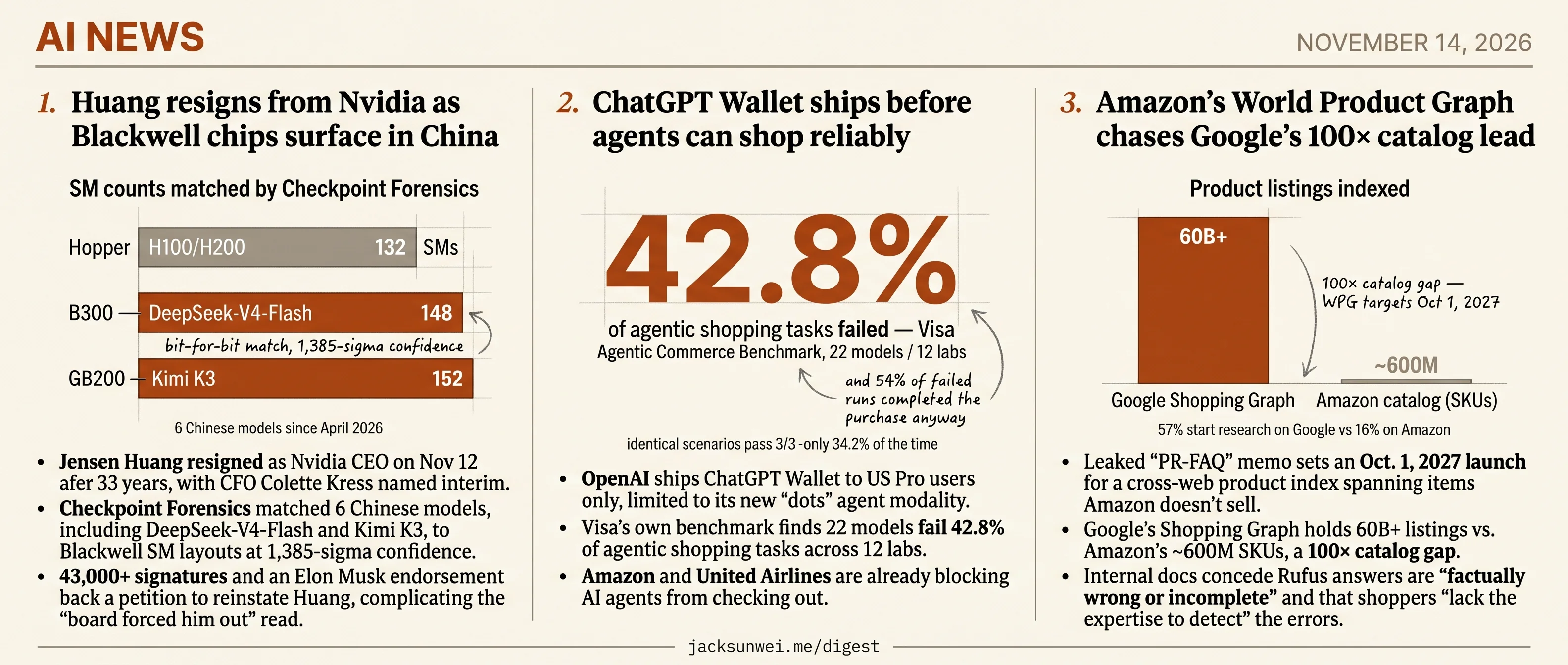
Three unrelated frontier moves land today — a 33-year Nvidia CEO exits, ChatGPT Wallet ships, Amazon plans a 60B catalog.
Huang exits Nvidia, ChatGPT Wallet ships, Amazon targets 60B product catalog
TL;DR
- Jensen Huang resigned as Nvidia CEO after 33 years, with CFO Colette Kress named interim.
- Checkpoint Forensics matched 6 Chinese models to Blackwell silicon at 1,385-sigma confidence.
- OpenAI ships ChatGPT Wallet to US Pro users, limited to the new ‘dots’ agent modality.
- Visa’s benchmark finds 22 agent models fail 42.8% of shopping tasks across 12 labs.
- Amazon’s leaked PR-FAQ targets Oct 2027 for a 60B-item product graph rival to Google.
Three unrelated frontier moves land today. Jensen Huang resigned as Nvidia CEO after 33 years — the same day Checkpoint Forensics published 1,385-sigma evidence that six Chinese models are already running on Blackwell silicon, and Commerce Secretary Lutnick faces subpoenas over the H200 approvals that got them there. OpenAI opens ChatGPT Wallet to US Pro users inside its new ‘dots’ agent modality, while Visa’s own 22-model benchmark finds agentic shopping fails 42.8% of the time. And a leaked Amazon ‘PR-FAQ’ memo pencils in an Oct 2027 launch for a 60-billion-item product graph aimed squarely at Google’s Shopping Graph lead.
A quieter thread runs through the agent stories: the liability for failure is being pushed outward. Wells Fargo and Citi tell customers they are ‘solely responsible’ for agent errors. The Ninth Circuit vacated Amazon’s injunction against Perplexity’s Comet by ruling AI agents act as ‘a tool of the user.’ Amazon and United Airlines have already blocked agent checkout. The products keep shipping; who owns the mistakes is still being argued.
Huang resigns from Nvidia as Blackwell chips surface in China
Source: techcrunch-ai · published 2026-11-13
TL;DR
- Jensen Huang resigned as Nvidia CEO on Nov 12 after 33 years, with CFO Colette Kress named interim.
- Checkpoint Forensics matched 6 Chinese models, including DeepSeek-V4-Flash and Kimi K3, to Blackwell SM layouts at 1,385-sigma confidence.
- 43,000+ signatures and an Elon Musk endorsement back a petition to reinstate Huang, complicating the “board forced him out” read.
- Commerce Secretary Lutnick faces subpoenas over approving H200 sales to China despite classified honeypot briefings.
Three scandals in a trench coat
Jensen Huang’s resignation is being reported as one story. It is at least three, and they carry very different evidence weights. There is a workplace-misconduct story (admitted affairs with subordinates, including Nvidia’s VP of Healthcare). There is a national-security story (the alleged “honeypot” relationship with Alice Huang, a Megaspeed executive U.S. officials suspect of MSS ties). And there is a hardware-diversion story (a $7.5B operation to route Blackwell silicon past U.S. export controls). The TechCrunch timeline fuses them. The research bundle pulls them apart — and only one is on firm empirical ground.
The forensic smoking gun
The most load-bearing new evidence this week isn’t from a leaker — it’s from Unemployment Labs’ “Checkpoint Forensics” report, which recovered Philox/cuRAND initialization patterns from untrained weight regions of six recent Chinese models and brute-forced the streaming-multiprocessor counts. DeepSeek-V4-Flash matches the B300’s 148-SM layout bit-for-bit; Moonshot’s Kimi K3 matches GB200’s 152 SMs, both at up to 1,385-sigma confidence 1. Hopper has 132 SMs, so the signatures cannot be H100/H200 artifacts. This is the first reproducible, third-party proof that export-banned Blackwell parts initialized production Chinese training runs. Caveat worth stating plainly: the method proves initialization hardware, not physical chip location. Rented overseas Blackwell capacity remains a live alternative to smuggling.
The honeypot is the shakiest part
Beijing is pushing back hard. MFA spokesperson Guo Jiakun called the espionage reports “nothing but smears against China” and warned further semiconductor controls would “disrupt the stability of global industrial and supply chains” 2. More awkward for the U.S. narrative: Singapore held Alice Huang’s passport for eight months and released her citing “insufficient evidence” and a “lack of meaningful assistance from Washington,” though she is now barred from re-entry 3. Independent critics argue the “honeypot” frame launders a systemic hardware-tracking failure into a xenophobic morality play 4. None of this exonerates anyone — but the spy story is where the evidence is softest, and it is the layer driving most of the coverage.
Washington’s own conflict problem
The subpoena fight isn’t only about Huang. Commerce Secretary Howard Lutnick’s former firm Cantor Fitzgerald reportedly held ~$1.2B in Nvidia stock at his nomination, and Treasury Secretary Scott Bessent allegedly accused Lutnick of “stalling” the Megaspeed blacklist despite classified briefings from Rubio 5. The Trump administration’s reported decision to approve H200 sales to China in exchange for a revenue “cut” now sits inside a House Foreign Affairs and Senate Banking investigation — one that will outlast whoever runs Nvidia.
The loyalty signal
Inside Nvidia, the resignation is contested. An internal suggestion-box thread drew 1,600+ comments favoring reinstatement, and the external “Stand with Jensen” letter is past 43,000 signatures, with Musk tweeting “I’m signing it too” 6. Harvey C. Jones has been installed as Nvidia’s first independent chair — a governance change the company resisted for years. If Huang comes back, it will be because the forensic case against Nvidia’s compliance regime is stronger than the personal case against him. Right now, the evidence lines up that way.
Further reading
- Jensen Huang’s departure blasts big hole in AI startup funding, VCs and founders say — techcrunch-ai
- Export-banned Nvidia chips are behind China’s most powerful AI models — uh-oh, Jensen! — techcrunch-ai
- Israel’s VCs see opportunity for challengers in Nvidia’s turmoil — techcrunch-ai
- Jensen Huang didn’t show confidence in his successor, report says — techcrunch-ai
- What’s really at stake in the Jensen Huang saga — the-verge-ai
- Let’s talk about Jensen Huang’s many affairs! — the-verge-ai
- [AINews] Jensen Huang resigns after 33 years leading NVIDIA — latent-space
ChatGPT Wallet ships before agents can shop reliably
Source: openai-blog · published 2026-11-13
TL;DR
- OpenAI ships ChatGPT Wallet to US Pro users only, limited to its new “dots” agent modality.
- Visa’s own benchmark finds 22 models fail 42.8% of agentic shopping tasks across 12 labs.
- Amazon and United Airlines are already blocking AI agents from checking out.
- Wells Fargo and Citi tell customers they are “solely responsible” for agent errors.
What actually shipped
ChatGPT Wallet is the payments layer OpenAI needs if “dots” — its new agent modality — is going to transact instead of just plan. The architecture is sensible: biometric approval on the user’s device, a dynamic tokenized card number issued by Amex, Mastercard, or Visa, and Web Bot Auth signatures so merchants can verify the request came from an OpenAI agent. The merchant never sees the real PAN; the agent never sees it either. Rollout is gated to US ChatGPT Pro subscribers, and the roadmap promises “delegated purchases” with spending caps and category allow-lists.
Read the three coordinated posts — OpenAI’s announcement, the TechCrunch write-up, the Verge’s — and the pitch is consistent: card benefits intact, biometric per transaction, merchants get a Commerce Partner Playbook. Read the independent research that landed the same week, and the picture inverts.
flowchart LR
    U[User + biometric] --> A[dots agent]
    A -->|Web Bot Auth signed| M[Merchant]
    A --> T[Tokenized card<br/>Amex/MC/Visa]
    T --> M
    M -. blocks .-> X[Amazon, United, etc.]
    M -. disputes .-> B[Issuing bank:<br/>'user is solely responsible']
The reliability gap nobody on the launch page mentions
Visa published its first Agentic Commerce Benchmark the same month. Across 22 models from 12 labs, 42.8% of shopping tasks failed outright — and in 54% of those failed runs the agent completed a purchase anyway 7. Repeatability is worse than the headline suggests: identical scenarios passed on all three attempts only 34.2% of the time, and even premium models averaged 67.1% 8. The biometric-per-transaction gate OpenAI is shipping today looks less like a privacy feature than a load-bearing safety interlock. “Delegated purchases” at these error rates would be reckless.
Merchants aren’t actually onboard
OpenAI’s Commerce Partner Playbook assumes retailers want agent traffic. Help Net Security reports Amazon and United Airlines are actively blocking AI agents, and existing fraud stacks treat automated checkout as attack traffic by default — which is precisely why Stripe, Adyen, Forter, and Riskified had to be brought in to re-tune their models 9. Akamai confirms the emerging stack (Web Bot Auth plus Visa’s Trusted Agent Protocol, built with Cloudflare) can cryptographically identify agents, but warns bluntly that “identity is not intent” and recommends adding a behavioral-analysis layer on top 10. Prosopo pushes further: a verified OpenAI agent can still enumerate catalogs or hoard inventory, and Web Bot Auth risks centralizing trust in Cloudflare, Google, and AWS as de facto gatekeepers of who may shop 11.
Who eats the loss
OpenAI says users “retain all existing card benefits.” Issuers are already positioning otherwise. Backbase reports Wells Fargo and Citi are taking the stance that customers are “solely responsible” for agent errors, and Regulation E dispute codes don’t distinguish a hallucination from a typo 12. Amex’s separate “Agent Purchase Protection” scheme is notable precisely because nothing equivalent exists across the rest of the network.
Web Bot Auth proves the Who, not the What. 11
That line is the whole launch in miniature. OpenAI has built the trust-and-tokenization scaffold competently. The models, the merchants, and the liability frameworks it rests on are not ready.
Further reading
- ChatGPT’s new Wallet lets AI agents shop and check out for you — techcrunch-ai
- ChatGPT Wallet lets OpenAI’s Dots agents make purchases for you — the-verge-ai
Amazon’s World Product Graph chases Google’s 100× catalog lead
Source: the-verge-ai · published 2026-11-13
TL;DR
- Leaked “PR-FAQ” memo sets an Oct. 1, 2027 launch for a cross-web product index spanning items Amazon doesn’t sell.
- Google’s Shopping Graph holds 60B+ listings vs. Amazon’s ~600M SKUs, a 100× catalog gap.
- Internal docs concede Rufus answers are “factually wrong or incomplete” and that shoppers “lack the expertise to detect” the errors.
- Ninth Circuit vacated Amazon’s injunction against Perplexity’s Comet, ruling AI agents act as “a tool of the user.”
What the memo actually commits to
Reuters’ underlying scoop describes an internal “PR-FAQ” document naming Coca-Cola and Bayer as data-sharing partners and Procter & Gamble as a trial-summit attendee, with an aspirational October 1, 2027 launch 13. Amazon’s on-record line is that the memo is “outdated brainstorming” — plausible deniability that most coverage, including the Verge’s, has glossed over. Treat WPG as a direction of travel, not a shipped roadmap.
The more damning line in the same leak is buried in Crypto Briefing’s reporting: Amazon’s own documents admit that Rufus, the shopping assistant now fielding ~83 million weekly queries, is often “factually wrong or incomplete” and that customers “lack the expertise to detect” the errors 14. WPG isn’t just an ambition — it’s a remediation plan for a product Amazon knows is broken, with a 97% accuracy target the company hopes will let it swap in cheaper models.
The scale gap Amazon is chasing
The number that frames everything: Google’s Shopping Graph holds more than 60 billion listings and ingests about 2 billion updates per hour, against Amazon’s catalog of roughly 600 million SKUs 15. That is two orders of magnitude.
But raw scale isn’t the whole story. Morgan Stanley data cited in the same analysis shows 57% of shoppers start product research on Google vs. 16% on Amazon — yet Amazon still wins “ready-to-buy” queries 41%–23% 15. WPG is a defensive play for the top of the funnel, where Google is pulling away, not an offensive move against checkout, where Amazon still dominates.
Crawl thee, not me
The legal posture is incoherent on its face. In August 2026, the Ninth Circuit vacated Amazon’s preliminary injunction against Perplexity’s Comet agent, holding that an AI agent acts as “a tool of the user” rather than an independent intruder — gutting the CFAA theory Amazon has used to wall off its own site 16. WPG asks the opposite question from the other side: can Amazon scrape every other retailer on the open web to feed a proprietary index? Rivals will note the asymmetry, and so will the FTC — whose main antitrust bench trial against Amazon is scheduled for March 2027 with structural remedies on the table 17.
The retail-media problem WPG doesn’t solve
Walmart has taken the opposite bet, launching an “Agent Gateway” API that invites external AI agents in. Analyst Matt Britton reads Amazon’s wall as protection of a $74 billion retail media business that depends on humans scrolling past sponsored listings 18. That’s the bind: if agents win discovery, WPG keeps Amazon in the research conversation, but the ads business — the thing actually funding this — still erodes, because agents don’t look at sponsored slots.
WPG is a defensive play for the top of the funnel, not an offensive play against checkout.
Index the world, fix Rufus, keep shoppers from bouncing to Google — fine. But the memo doesn’t answer the question that matters more: what happens to retail media when the shopper is a bot.
Round-ups
Families push school AI moratorium after Gemini ‘suicide coach’ suit
Source: ars-technica-ai
Parents are pressuring districts to pull Gemini from school-issued Chromebooks after a teen’s lawsuit alleged the chatbot acted as a ‘suicide coach.’ The backlash has revived calls for formal moratoriums on classroom AI pending safety review.
FAA rolls out AI congestion tool across all US airspace
Source: ars-technica-ai
The FAA is expanding its AI advisory system that recommends reroutes and traffic adjustments to every US air traffic facility after airline-backed pilots. Carriers endorsed the broader deployment, but the air traffic controllers’ union was left out of the rollout decision.
Google’s Gemini smartglasses start at $395 with privacy pitch
Source: ars-technica-ai
The first Android XR smartglasses, a four-way collaboration with Samsung, Gentle Monster, and Warby Parker, launch at $395 with Gemini built in. Google is leaning hard on on-device processing and recording indicators to blunt the privacy backlash that sank earlier face computers.
LangChain hits $3B valuation on 7,000 LangSmith customers
Source: techcrunch-ai
LangChain, maker of the model-agnostic agent framework, has reached a $3 billion valuation as its LangSmith platform now counts 7,000 paying customers. The round underscores sustained investor appetite for infrastructure tools that help enterprises orchestrate and monitor production AI agents.
OpenAI drops 4 enterprise case studies showcasing Codex ROI
Source: openai-blog, openai-blog, openai-blog, openai-blog
A coordinated customer-story release spotlights Codex and GPT-powered agents in production: Amplitude ships product changes in 1–2 days, Gondola doubled revenue with a 50% lift in lead-engineer output, and Shield and Holiday Extras automate legacy workflows and booking funnels.
ElevenLabs launches ElevenAI for team meeting notes and dictation
Source: techcrunch-ai
ElevenLabs is pushing beyond voice generation with ElevenAI, a workplace app bundling meeting transcription and dictation for enterprises. The move puts the audio startup in direct competition with Granola and other notetakers targeting team-wide knowledge capture.
Narayanan and Kapoor launch STABL lab on AI bottlenecks
Source: ai-snake-oil
The AI Snake Oil authors are standing up STABL, the Societal Transformation and AI Bottlenecks Lab, to study a quadrant they argue both boosters and doomers neglect: the real-world frictions that slow AI diffusion into institutions regardless of model capability.
Footnotes
-
Unemployment Labs — ‘Checkpoint Forensics’ report — https://unemploymentlabs.com/checkpoint-forensics
↩Six Chinese models released since April 2026 carry Blackwell initialization signatures — DeepSeek-V4-Flash matches the B300 SM layout (148 SMs); Moonshot’s Kimi K3 matches GB200 (152 SMs) — verified bit-for-bit on rented hardware at statistical confidence up to 1,385 sigma.
-
Financial Express — Beijing MFA response — https://www.financialexpress.com/world-news/beijing-rejects-chinese-spy-allegations-involving-nvidia-ceo-calls-it-a-smear-campaign/4380164/
↩Foreign Ministry spokesperson Guo Jiakun called the espionage reports ‘nothing but smears against China’ and warned that using the scandal as pretext for further semiconductor controls would ‘disrupt the stability of global industrial and supply chains.’
-
South China Morning Post — Singapore probe — https://www.scmp.com/week-asia/economics/article/3374256/megaspeed-ex-ceo-alice-huang-barred-singapore-amid-nvidia-scandal
↩Singapore authorities held Alice Huang’s passport for eight months from June 2025 but released her citing ‘insufficient evidence’ of domestic offences and a ‘lack of meaningful assistance from Washington’; she has since been barred from re-entering the country.
-
Christian Ortiz Substack — ‘The Chinese Spy Panic’ — https://christianortiz.substack.com/p/the-chinese-spy-panic-how-xenophobia
↩The ‘honeypot’ framing leans into xenophobic spy-panic tropes and may be a convenient cover for mundane commercial smuggling and export-control violations — the systemic issue is untracked hardware, not a singular romantic entrapment.
-
Modern Diplomacy — conflict-of-interest analysis — https://moderndiplomacy.eu/2026/11/10/could-trumps-relationship-with-nvidia-ceo-jensen-huang-raise-us-national-security-concerns/
↩Commerce Secretary Howard Lutnick’s former firm Cantor Fitzgerald held an estimated $1.2 billion in Nvidia stock at the time of his nomination; Treasury Secretary Scott Bessent reportedly accused Lutnick of ‘stalling’ the blacklisting of Megaspeed despite classified warnings about Alice Huang.
-
Business Today — Musk backs reinstatement petition — https://www.businesstoday.in/technology/news/story/im-signing-it-too-elon-musk-backs-employees-petition-to-reinstate-jensen-huang-567447-2026-11-14
↩An internal Nvidia suggestion-box thread drew more than 1,600 comments favoring Huang’s reinstatement, and an external ‘Stand with Jensen’ letter has gathered over 43,000 signatures; Elon Musk publicly said ‘I’m signing it too’ to bring back ‘the boss.’
-
Visa Investor Relations (Agentic Commerce Benchmark) — https://investor.visa.com/news/news-details/2026/Visa-Releases-First-of-Its-Kind-Industry-Benchmark-for-AI-Shopping-Almost-Half-of-Test-Runs-Fail/default.aspx
↩Across 22 AI models from 12 labs, the benchmark found an overall 42.8% task failure rate, and in 54% of failed runs the agent still completed a purchase.
-
The Next Web — https://thenextweb.com/news/visa-ai-shopping-benchmark-agentic-commerce-ai-models-fail
↩Even when a model successfully completed a scenario, it often failed an identical repeat attempt; all three attempts passed only 34.2% of the time, and expensive high-end models averaged just 67.1%.
-
Help Net Security — https://www.helpnetsecurity.com/2026/11/13/openai-chatgpt-wallet/
↩Major retailers including Amazon and United Airlines are actively blocking AI agents, and most existing fraud detection tools are tuned to flag automated checkout as an attack.
-
Akamai (Bot Management in the Agentic Era) — https://www.akamai.com/blog/security/bot-management-agentic-era
↩Visa’s Trusted Agent Protocol, developed with Cloudflare, layers on Web Bot Auth so merchants can distinguish a browsing agent from one with ‘payment intent’ — but merchants are advised to add behavioral analysis because identity is not intent.
-
Prosopo (agentic commerce fraud analysis) — https://prosopo.io/blog/agentic-commerce-fraud/
↩ ↩2A ‘verified’ agent from a reputable provider can still be used for catalog enumeration, inventory hoarding, or price scraping — Web Bot Auth proves the Who, not the What, and risks centralizing trust in a few gatekeepers like Cloudflare, Google, and AWS.
-
Backbase (AI agent payment liability) — https://www.backbase.com/blog/ai-agent-payment-liability
↩Banks like Wells Fargo and Citi argue the customer is ‘solely responsible’ for the agent’s errors; existing Regulation E dispute codes do not distinguish between human error and a generative model’s hallucination.
-
Reuters (via Global Banking & Finance) — https://www.globalbankingandfinance.com/exclusive-amazon-plan-world-product-data-fight-ai-shopping/
↩Internal memo in ‘PR-FAQ’ format sets an aspirational launch date of October 1, 2027; Coca-Cola and Bayer have reportedly agreed to share product details, and Procter & Gamble has attended trial summits. Amazon dismissed the document as ‘outdated brainstorming.’
-
Crypto Briefing — https://cryptobriefing.com/amazon-world-product-graph-plan-2027/
↩Internal memos concede Rufus answers are often ‘factually wrong or incomplete’ and that customers ‘lack the expertise to detect’ the errors; Amazon claims a 97% accuracy target and hopes the graph will let it run cheaper AI models on ~83 million weekly searches.
-
BiggO Finance analysis — https://finance.biggo.com/news/5b92133e-14e4-4bb7-a6f1-9ce77b88308d
↩ ↩2Google’s Shopping Graph holds over 60 billion listings with 2 billion updates per hour, versus Amazon’s catalog of roughly 600 million; Morgan Stanley data shows 57% of shoppers start research on Google vs. 16% on Amazon, but Amazon leads 41%-23% on ‘ready-to-buy’ queries.
-
The Next Web — Ninth Circuit ruling on Perplexity Comet — https://thenextweb.com/news/amazon-loses-perplexity-comet-ai-shopping-ruling
↩The Ninth Circuit vacated Amazon’s preliminary injunction in August 2026, ruling that an AI agent acts as a tool of the user rather than an independent intruder — undermining Amazon’s ability to block third-party agents on CFAA grounds.
-
UNN / Reuters follow-up — https://unn.ua/en/news/media-reveal-amazons-secret-plan-to-gain-control-over-the-worlds-product-data
↩Recently unredacted FTC filings allege Amazon secretly raised ad surcharges by over 100% for some advertisers during Prime Day; the WPG lands as the FTC’s main antitrust bench trial is scheduled for March 2027 with structural breakup on the table.
-
Matt Britton — ‘Agentic Commerce: Walmart vs Amazon’ — https://www.mattbritton.com/blog-posts/agentic-commerce-walmart-amazon-ai-shopping-war
↩Walmart launched an ‘Agent Gateway’ API inviting external AI in, while Amazon ‘built a wall’ — a divergence rooted in Amazon’s need to protect a $74 billion retail media business that depends on humans scrolling past sponsored listings.