MTurk closes signups, IXL bans Alpha School, Gemini kept off Declaration text
Amazon retires MTurk signups, IXL cuts off an AI-only school, and Google keeps Gemini away from the Declaration's prose.
MTurk closes signups, IXL bans Alpha School, Gemini kept off Declaration text
TL;DR
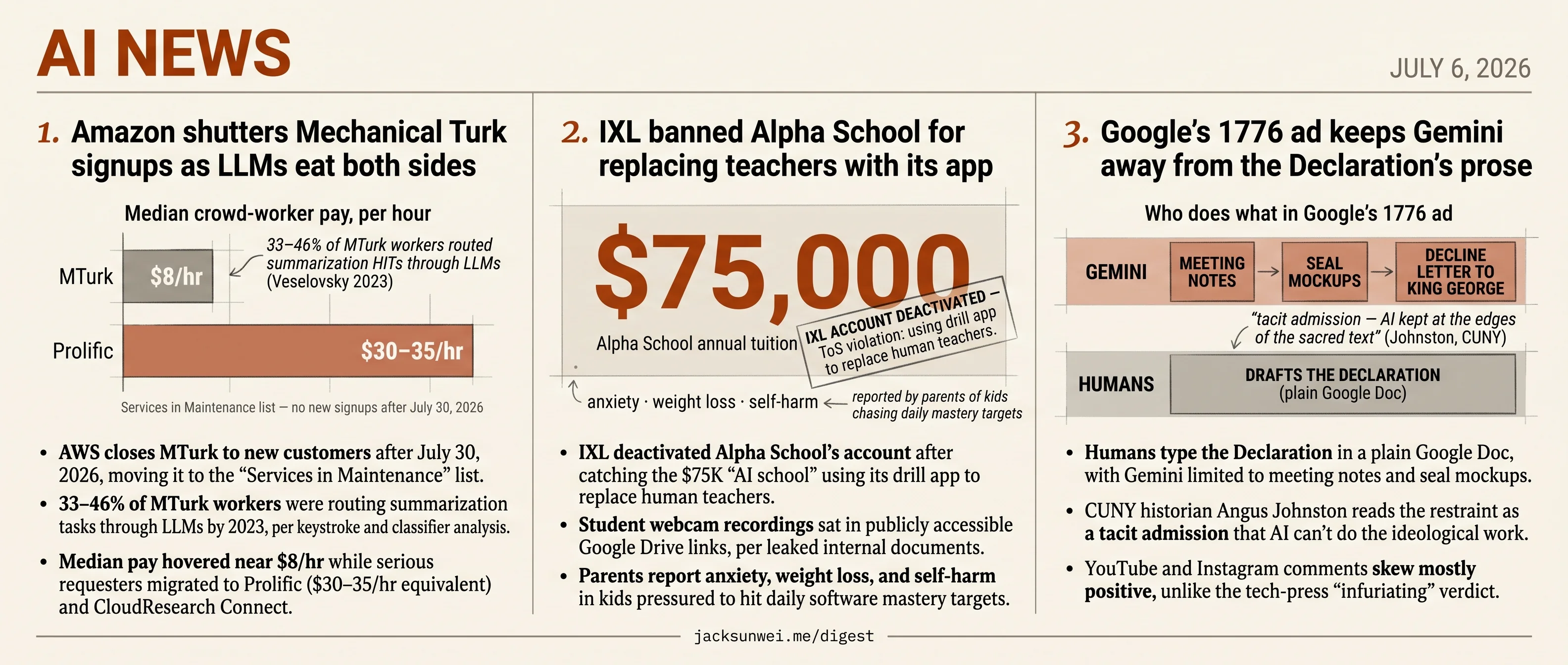
- Amazon closes MTurk to new customers after July 30, moving it to maintenance status.
- IXL deactivated Alpha School for using its drill app to replace human teachers.
- Google’s 1776 ad has humans type the Declaration, with Gemini limited to notes and mockups.
- 33-46% of MTurk workers were routing summarization tasks through LLMs by 2023.
- Alpha School left student webcam recordings in publicly accessible Google Drive links.
Today’s three AI-news stories land in different domains — a labor platform, an ed-tech vendor, a holiday ad — but each one marks the same boundary. Amazon is retiring signups on Mechanical Turk, the human-labeling substrate its own models depend on, after researchers caught a third of workers already routing tasks through LLMs. IXL deactivated Alpha School’s account when the $75K/year ‘AI school’ used its drill app to replace teachers, with leaked documents showing student webcam recordings in open Drive folders and reports of self-harm. And Google’s own July 4 spot keeps Gemini away from the Declaration’s prose entirely — humans type the text; the assistant gets meeting notes and seal mockups.
The pattern isn’t a coordinated backlash. It’s three separate parties — a platform owner, a vendor, an ad team inside a frontier lab — drawing the same line in three different places, around the human-authored substrate the technology keeps trying, and failing, to fully replace.
Amazon shutters Mechanical Turk signups as LLMs eat both sides
Source: techcrunch-ai · published 2026-07-05
TL;DR
- AWS closes MTurk to new customers after July 30, 2026, moving it to the “Services in Maintenance” list.
- 33–46% of MTurk workers were routing summarization tasks through LLMs by 2023, per keystroke and classifier analysis.
- Median pay hovered near $8/hr while serious requesters migrated to Prolific ($30–35/hr equivalent) and CloudResearch Connect.
- Model-collapse researchers warn synthetic pipelines still need a human ground-truth anchor — exactly the substrate now disappearing.
A slow fade, not a shutdown
Amazon didn’t kill Mechanical Turk on July 5. It admitted the platform was already dead. AWS quietly moved MTurk to its “Services in Maintenance” list — no new features, no new customer signups after July 30, 2026, though existing requesters and workers keep access 1. That’s the shape of a zombie service being unplugged, not a product decision.
The practical death happened years ago. Median pay stagnated around $8/hr as bots and fraud eroded quality, and any requester who cared about data integrity had already migrated to Prolific or CloudResearch Connect — platforms that enforce pay floors and ship bot-screening tools (CloudResearch’s “Sentry”) that MTurk never built 2.
The load-bearing history
MTurk’s importance to modern ML isn’t nostalgia — it’s causal. Fei-Fei Li’s team estimated that labeling ImageNet with undergrads at $10/hr would have taken about 19 years. MTurk compressed it to 2.5, mobilizing roughly 49,000 workers across 167 countries to label 14 million images into 21,000 categories 3. That dataset seeded AlexNet and every deep-learning system that followed. The same substrate later underwrote the first wave of RLHF preference labeling, before frontier labs graduated to managed vendors like Scale and Surge for expert annotators.
The AI-eating-AI failure mode
The proximate cause of MTurk’s irrelevance is the market flipping on itself. Veselovsky et al.’s 2023 “GPTurk” study used keystroke dynamics and a fine-tuned synthetic-text classifier to estimate that 33–46% of MTurk workers were using LLMs to complete text summarization HITs 4. That figure is task-specific — subjective or perceptual work probably fares better — but it broke the platform’s one non-negotiable value proposition: buying verifiably human labels.
flowchart LR
    A[Requesters wanting human labels] -->|GPT is cheaper| B[SageMaker Ground Truth / vendors]
    A -.->|shrinking demand| M[MTurk]
    W[Workers] -->|route HITs through ChatGPT| M
    M -.->|median $8/hr, no bot screening| P[Prolific / CloudResearch]
    W -->|follow the pay floor| P
Once you can’t trust the “human” label, and the model you were trying to train can do the labeling itself for a fraction of the cost, the middle collapses.
What the vendor narrative elides
Turkopticon organizer Krystal Kauffman frames the wind-down as the end of an unaccountable system, not a graceful retirement — mass rejections that let requesters keep data without paying, opaque suspensions, no portable reputation across platforms 5. Amazon’s messaging includes no transition plan for two decades of accrued worker reputation histories, the one asset workers actually own on the platform.
The dissent worth carrying
There’s a counterintuitive coda. Researchers studying model collapse argue that training on synthetic outputs alone causes degenerative drift; the only stable strategy is accumulate — synthetic data supplementing a core of human ground truth 6. MTurk’s substrate of cheap, at-scale human labeling is disappearing precisely when the alignment and post-training stack arguably needs it most. The replacement isn’t Prolific at 4× the price. It’s a smaller pool of expert annotators at managed vendors — and a growing bet that models can bootstrap themselves without the anchor that built them.
IXL banned Alpha School for replacing teachers with its app
Source: the-verge-ai · published 2026-07-05
TL;DR
- IXL deactivated Alpha School’s account after catching the $75K “AI school” using its drill app to replace human teachers.
- Student webcam recordings sat in publicly accessible Google Drive links, per leaked internal documents.
- Parents report anxiety, weight loss, and self-harm in kids pressured to hit daily software mastery targets.
- Rich kids get AI-augmented human teachers, while public schools face AI pitched as the teacher substitute.
The Verge’s roundup of AI-native private schools — Alpha, Forge Prep, and a growing microschool tier — treats the trend as a curiosity of the rich. The independent reporting around Alpha in particular tells a much harder story: the flagship’s marketing claims are contested by its own vendors, its ex-staff, and the parents of its students.
The numbers Alpha is selling, and the ToS violation underneath
Alpha’s public pitch rests on eye-popping metrics: average students in the 99th percentile on NWEA MAP, math growth exceeding 200% of projections, and only “2 Hour Learning” per day. The school’s principal went so far as to feed the raw dataset into Gemini and Claude to benchmark Alpha against Phillips Exeter and Dalton 7.
The problem is what’s actually running under the hood. IXL — an off-the-shelf K-12 practice platform — deactivated Alpha’s account after discovering the school was using it to replace teachers, a direct violation of IXL’s terms of service. IXL’s leadership stated the software is meant to supplement, not replace, “trained, caring teachers” 8. That single fact undercuts the “AI-native school” branding: much of what parents are paying $75,000 for appears to be third-party edtech rewrapped as proprietary AI.
A 404 Media investigation, built on leaked internal documents and former employees, goes further — describing AI-generated lesson plans that hand back incorrect answers, keystroke and webcam monitoring software that follows students home, and sensitive student video sitting in publicly accessible Google Drive links 9.
The harm the trend piece skipped
The Verge frames AI schools as a lifestyle choice. Downstream reporting surfaces harm the original piece doesn’t mention. Parents interviewed after Wired’s coverage describe children with anxiety, weight loss, and self-harm tied to the pressure of hitting daily software mastery targets. Internal Slack messages have Alpha staff themselves describing the gamified metric-chasing regime in blunt terms:
“educational malpractice” 10
Combine that with the surveillance findings 9, and the picture stops looking like personalized tutoring. It looks like piecework monitored by bossware, aimed at 8-year-olds.
The second digital divide
Alpha isn’t alone in the segment. Sora Schools serves ~573 students at $17,900 tuition on $31M in funding; Astra Nova, the online successor to SpaceX’s Ad Astra, enrolls 315 students from 45 countries with “conundrum-based” admissions 11. This is a segmented microschool market, not a single runaway winner.
The interesting policy question isn’t whether Alpha parents are getting $75K of value. It’s what happens next. Critics quoted in The Decoder warn of an emerging “second digital divide”: wealthy children get high-touch human instruction augmented by AI, while under-resourced public schools get AI as a cost-cutting substitute for teachers 12. The template being piloted in Austin’s mansions is the one districts under budget pressure will be sold in three years.
The Verge is directionally right that rich families are buying this. The story it didn’t tell is that the product may not work, may be harming kids, and is a dry run for something much bigger.
Google’s 1776 ad keeps Gemini away from the Declaration’s prose
Source: the-verge-ai · published 2026-07-05
TL;DR
- Humans type the Declaration in a plain Google Doc, with Gemini limited to meeting notes and seal mockups.
- CUNY historian Angus Johnston reads the restraint as a tacit admission that AI can’t do the ideological work.
- YouTube and Instagram comments skew mostly positive, unlike the tech-press “infuriating” verdict.
- 2024’s pulled “Dear Sydney” Olympics ad was the same failure mode: Gemini adjacent to something the audience codes as sacred.
The tell: Gemini gets the chores, humans get the quill
The Verge’s “infuriating” read is fair as vibes criticism but misses the more damning detail hiding in the spot itself. Independent recaps note that Gemini never actually drafts the Declaration. It summarizes a meeting, brainstorms national-seal concepts via a “help me visualize” tool, and helps politely decline King George’s document-access request — but the prose of the document stays in human hands, typed into a Google Doc 13.
That is not an accident of storyboarding. Google’s marketing org made a deliberate choice about where the AI could plausibly add value in a founding-document fantasy, and the answer was: at the edges. Angus Johnston, a CUNY history professor, calls this the real story:
Critics argue this ‘handwaving’ of the document’s prose is a quiet admission by Google that AI is ill-suited for the complex human judgment required for founding documents. 14
An ad built to sell Workspace as an AI-first collaboration suite concedes, in its own staging, that the actual creative act is the part you don’t hand to the model. That is a sharper critique than “cringe.”
The reception is more split than tech Twitter suggests
The outrage cycle around the spot is real, but it is narrower than it looks from inside the professional-commentator bubble. Coverage of platform reactions describes YouTube and Instagram comments as “mostly positive,” with general audiences engaging with the tongue-in-cheek humor — Samuel Adams wanting to “settle this over beers” is landing as intended. Bluesky and technical forums are where the reception turns overwhelmingly critical 15.
Whether that split vindicates Google’s media buyers or indicts mainstream taste depends on your priors. But it’s worth naming: the cringe verdict is a class of viewer’s verdict, not the aggregate one.
Second strike, same wire
The more useful frame is pattern recognition. In 2024, Google pulled “Dear Sydney” from Olympics coverage after critics called it “disturbing” and “anti-human” for depicting a father using Gemini to ghostwrite his daughter’s fan letter to Sydney McLaughlin-Levrone 16. The 1776 spot rhymes almost too neatly: both put Gemini adjacent to something the audience codes as sacred — a child’s sincerity in one case, a founding document in the other — and both trip the same trip-wire. Two years, two identical failure modes, one marketing org that keeps re-testing whether the culture has moved.
It hasn’t, quite. And the ad is landing in a busier field than Google seems to have modeled. A federally-backed “Freedom Trucks” tour is currently running AI monologues from a synthetic George Washington that scholars say misrepresent his rhetoric 17, and Truthout has documented taxpayer-funded Semiquincentennial campaigns using AI to render the Founders as faultless heroes while omitting slavery and Indigenous displacement 18. Google’s spot reads as apolitical corporate whimsy, but it is participating in an aesthetic that historians are already organized against. That context is what turns a cringe ad into a story worth writing about.
Footnotes
-
SiliconAngle — https://siliconangle.com/2026/07/05/amazons-mechanical-turk-service-now-life-support-stops-accepting-new-users/
↩Amazon’s Mechanical Turk service is now on life support… moved to its ‘Services in Maintenance’ list, meaning no new features will be added and new customer sign-ups end July 30, 2026, while existing users retain access.
-
MLQ.ai analysis — https://mlq.ai/news/amazon-closes-mechanical-turk-to-new-customers-winding-down-pioneering-crowdsourcing-platform/
↩Median MTurk pay hovered around $8/hr while workers migrated to Prolific ($30–35/hr equivalent) and CloudResearch Connect, which enforce pay floors and bot-screening tools like Sentry that MTurk never adopted.
-
Quartz — ‘The data that changed the direction of AI research’ — https://qz.com/1034972/the-data-that-changed-the-direction-of-ai-research-and-possibly-the-world
↩Under the original plan of hiring undergrads at $10/hr, labeling ImageNet would have taken ~19 years; using Mechanical Turk, ~49,000 workers across 167 countries labeled 14M images across 21,000 categories over 2.5 years.
-
Veselovsky et al., ‘Artificial Artificial Artificial Intelligence’ (arXiv 2306.07899) — https://arxiv.org/abs/2306.07899
↩We estimate that 33-46% of crowd workers used LLMs when completing a text summarization task, based on a combination of keystroke detection and synthetic-text classification.
-
Turkopticon blog (Krystal Kauffman) — https://blog.turkopticon.net/?page_id=3369
↩Turkers built the foundations of modern AI models and deserve a seat at the table — the platform’s ‘black box’ management, mass rejections and sudden suspensions denied workers accountability long before this wind-down.
-
Level Up Coding — ‘Can AI models learn from synthetic data without collapsing?’ — https://levelup.gitconnected.com/can-ai-models-learn-from-synthetic-data-without-collapsing-d8ab1e83e962
↩Replacing human data with synthetic outputs leads to mathematical model collapse; only an ‘accumulate’ strategy — synthetic data supplementing a core of human ground truth — avoids degenerative drift.
-
Alpha School blog — ‘Mid-Year Report Card’ — https://alpha.school/blog/alphas-mid-year-report-card-is-in-heres-what-the-data-actually-says/
↩Alpha’s principal fed the school’s raw NWEA MAP dataset into Gemini and Claude to benchmark performance against Phillips Exeter and The Dalton School, reporting average students in the 99th percentile and math growth exceeding 200% of projections.
-
LetsDataScience — ‘Alpha School Generates Faulty AI Lesson Plans’ — https://letsdatascience.com/news/alpha-school-generates-faulty-ai-lesson-plans-7bce9d05
↩IXL deactivated Alpha’s account after discovering the school was using its platform to replace human teachers, a direct violation of IXL’s terms of service; IXL leadership stated the software is meant to supplement, not replace, ‘trained, caring teachers.’
-
404 Media — ‘Students Are Being Treated Like Guinea Pigs’ — https://www.404media.co/students-are-being-treated-like-guinea-pigs-inside-an-ai-powered-private-school/
↩ ↩2Leaked internal documents and former employees describe AI-generated lesson plans that produce incorrect answers, intensive productivity-monitoring software that follows students at home, and sensitive student data — including video recordings — stored in publicly accessible Google Drive links.
-
Terry U. Substack — ‘Five Stories Buried in Wired’s Bombshell’ — https://terryu.substack.com/p/five-stories-buried-in-wireds-bombshell
↩Parents reported children suffering from anxiety, weight loss and self-harm from pressure to hit software targets; leaked Slack messages show staff calling the gamified metric-chasing ‘educational malpractice.’
-
Wikipedia — Astra Nova School — https://en.wikipedia.org/wiki/Astra_Nova_School
↩Astra Nova, the online successor to SpaceX’s Ad Astra, enrolls only 315 students from 45 countries with ‘conundrum-based’ admissions; Sora Schools has raised $31M and serves ~573 students at $17,900 tuition — an order of magnitude cheaper than Alpha’s $75,000.
-
The Decoder — ‘AI Private Schools Sell Wealthy US Families on Personalized Learning’ — https://the-decoder.com/ai-private-schools-sell-wealthy-us-families-on-personalized-learning-over-traditional-education/
↩Critics warn of an emerging ‘underclass’ taught primarily through screens as a cost-saving measure, while affluent students receive high-touch human-led education supplemented by AI — a ‘second digital divide’ in the making.
-
hostdir.net analysis of the 1776 spot — https://hostdir.net/blog/google-ad-imagines-declaration-of-independence-drafted-with-ai-sparks-debate
↩Gemini is used for meeting notes and a ‘help me visualize’ tool explores ideas for the national seal, but the actual text of the Declaration is strictly drafted by the humans in a Google Doc.
-
AI Weekly recap citing historian Angus Johnston — https://aiweekly.co/alerts/googles-july-4-ad-puts-the-founders-inside-google-workspace
↩CUNY history professor Angus Johnston noted the irony of the ad’s ‘restraint’… critics argue this ‘handwaving’ of the document’s prose is a quiet admission by Google that AI is ill-suited for the complex human judgment required for founding documents.
-
NewsBytes coverage of platform reception — https://www.newsbytesapp.com/news/science/google-imagines-how-founding-fathers-would-draft-declaration-with-ai/story
↩Comments on YouTube and Instagram have been mostly positive, with audiences engaging with the ‘tongue-in-cheek’ humor… in contrast, response on Bluesky and technical forums has been overwhelmingly critical.
-
Forbes on the 2024 ‘Dear Sydney’ pull — https://www.forbes.com/sites/maryroeloffs/2024/08/02/google-pulls-controversial-dear-sydney-gemini-ai-ad-from-olympics-coverage-what-to-know/
↩Google pulled the ‘Dear Sydney’ Gemini ad from Olympics coverage after critics called it ‘disturbing’ and ‘anti-human’ for having a father use AI to ghostwrite a fan letter for his daughter.
-
Gizmodo on Trump-era AI Founding Fathers exhibit — https://gizmodo.com/trumps-new-history-exhibit-features-fake-quotes-from-ai-generated-founding-fathers-2000652792
↩An AI George Washington featured in the federally-backed ‘Freedom Trucks’ tour delivered monologues that lacked the first president’s characteristic focus on republican values, instead favoring modern religious rhetoric.
-
Truthout on Semiquincentennial ‘AI slop’ — https://truthout.org/articles/taxpayer-funded-250th-anniversary-group-pushes-ai-slop-to-whitewash-us-history/
↩Taxpayer-funded 250th anniversary group pushes AI slop to whitewash US history… campaigns use AI to depict the Founders as faultless heroes while omitting their role in slavery and the displacement of Indigenous peoples.