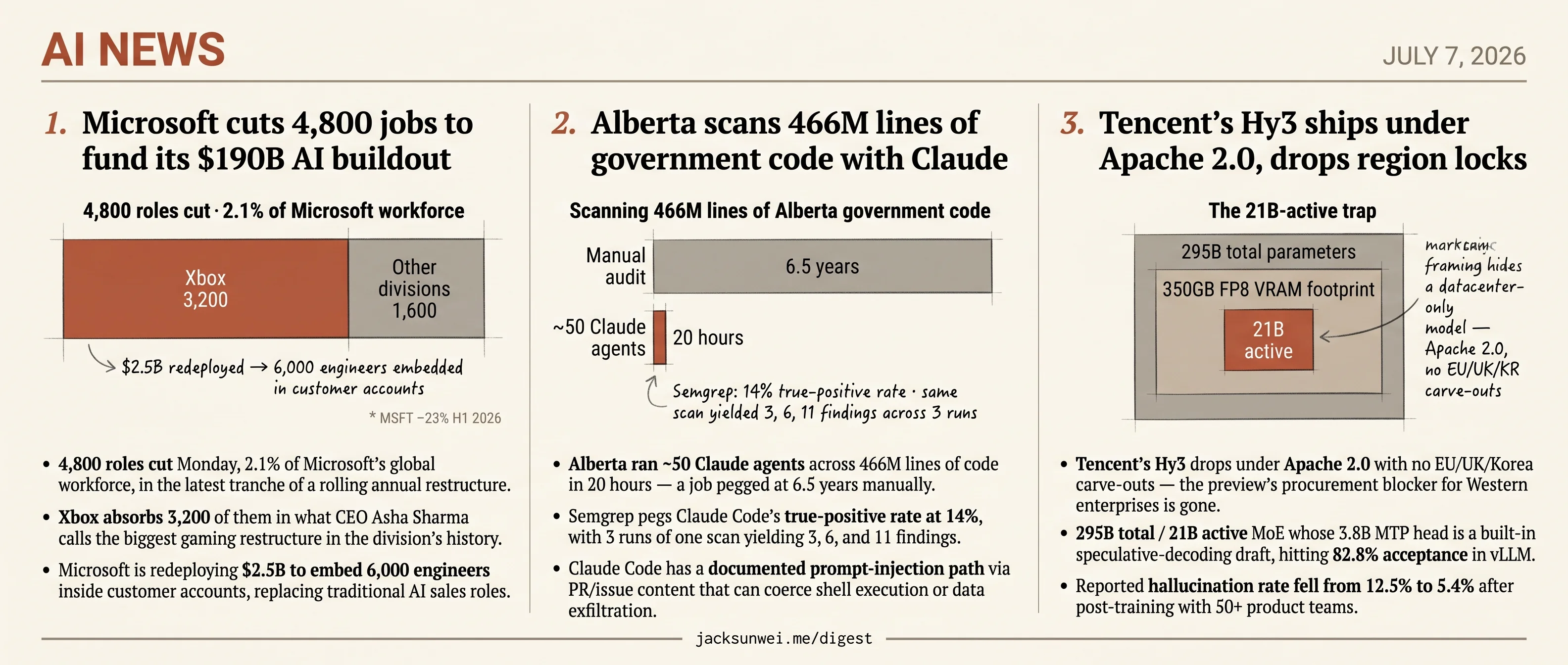
Microsoft cuts 4,800 jobs, Alberta scans 466M lines, Tencent opens Hy3
Microsoft cuts 4,800 roles to fund AI, Alberta runs Claude across 466M lines of code, and Tencent drops Hy3's regional carve-outs.
Microsoft cuts 4,800 jobs, Alberta scans 466M lines, Tencent opens Hy3
TL;DR
- Microsoft cuts 4,800 roles, redeploying $2.5B to embed 6,000 engineers inside customer accounts.
- Alberta ran ~50 Claude agents across 466M lines in 20 hours, replacing a 6.5-year manual job.
- Tencent’s Hy3 ships under Apache 2.0 with no EU/UK/Korea carve-outs, beating GLM-5.2 at half the params.
- Semgrep pegs Claude Code’s true-positive rate at 14%, undercutting Alberta’s AI-pentest pitch.
- MSFT down ~23% in H1 2026 despite the cost discipline of the rolling restructure.
Today’s AI News runs on three unrelated institutional plays. Microsoft cut another 4,800 roles — 3,200 from Xbox — to redeploy $2.5B into 6,000 engineers embedded inside customer accounts. A Canadian province ran ~50 Claude agents across 466M lines of government code in 20 hours, a job it pegs at 6.5 years of manual review. And Tencent shipped its 295B-parameter Hy3 under Apache 2.0 with no EU, UK, or Korea carve-outs — the procurement blocker that stalled Western enterprise adoption of the preview is gone.
The pushback lives in the fine detail. Semgrep clocks Claude Code’s true-positive rate at 14% on real audits, and industry appetite for AI-only pentesting fell from 29% to 9% year-over-year. MSFT is down roughly 23% in H1 2026 despite the restructure. Hy3’s open story hides a ~350GB FP8 VRAM footprint that keeps it in the datacenter, and it still loses to GLM-5.2 on coding. Each headline lands; each has a load-bearing asterisk the announcement skipped.
Microsoft cuts 4,800 jobs to fund its $190B AI buildout
Source: techcrunch-ai · published 2026-07-06
TL;DR
- 4,800 roles cut Monday, 2.1% of Microsoft’s global workforce, in the latest tranche of a rolling annual restructure.
- Xbox absorbs 3,200 of them in what CEO Asha Sharma calls the biggest gaming restructure in the division’s history.
- Microsoft is redeploying $2.5B to embed 6,000 engineers inside customer accounts, replacing traditional AI sales roles.
- MSFT down ~23% in H1 2026 despite the cost discipline — investors aren’t buying the AI-capex-for-headcount swap.
The capex-for-headcount trade
Microsoft’s July cut is the latest tranche in a rolling annual restructure paying down its ~$190B 2026 AI infrastructure bill 1. Chief People Officer Amy Coleman told staff the eliminated roles are “not being replaced by AI.” That framing is doing heavy lifting. Under the concurrent “Frontier Company” reorg, Microsoft is redirecting $2.5B to embed 6,000 engineering and AI-deployment specialists directly inside enterprise customers, dissolving the traditional account-manager layer whose job was to sell AI rather than build it 2. That is AI-driven displacement even if the substitution isn’t 1:1 — the technical bar for keeping a customer-facing job at Microsoft just moved sharply upward.
Wall Street noticed the discipline — shares ticked up 3% on early rumors — but hasn’t been persuaded by the broader thesis. MSFT is off nearly 23% year-to-date, a signal that the market wants to see enterprise AI revenue lift before rewarding another round of cost cuts 1.
Xbox: a strategic retreat, not a trim
The Xbox side of the cluster is a distinct story from “AI ate the sales team.” Sharma is unwinding a meaningful chunk of the $89B post-Activision acquisition thesis, phased through FY2027 3:
| Studio | Disposition |
|---|---|
| Double Fine, Compulsion | Spun back to independent status |
| Ninja Theory, Undead Labs | Sold to new owners; Microsoft funds Senua and State of Decay 3 to completion |
| Arkane Lyon | Entered strategic “consultation” |
| Halo Studios’ Project Ekur, unannounced ZeniMax MMO, IO’s Project Fantasy funding | Cancelled |
Read against the AI narrative, this is Microsoft admitting that first-party games — long, capital-intensive, margin-thin — can’t compete internally for capital against GPU clusters that book as cloud revenue. The AI capex isn’t just funded by dissolving sales orgs; it’s funded by shelving the console studio strategy Nadella spent $89B assembling.
Union, political, and internal blowback
The CWA, which now represents 3,500+ Microsoft gaming workers, publicly accused Microsoft of “sitting on” layoff-protection proposals for months; unionized ZeniMax QA staff are the only cohort with contractual 60-day notice and grievance rights 4. District 9 VP Frank Arce framed the cuts as unnecessary “choices” by a company that remains highly profitable — a deliberate rebuttal to the AI-necessity narrative 4.
Bernie Sanders tied the cuts to Microsoft’s $101B in annual profits and a recent $12.5B tax break, and reopened the H-1B displacement debate given Microsoft’s continued high-volume LCA filings during active layoff cycles 5. Internally, an r/microsoft thread of current and former staff describes a “continuous parade” of layoffs and a “culture of fear,” with Nadella’s “intelligence engine” memos derided as “word salad” and “tone deaf” 6.
The read
The through-line across labor, political, and studio critics is the same: these are profitable layoffs justified by an AI narrative that is doing more rhetorical than operational work. Coleman can insist AI isn’t replacing the 4,800 workers, but AI capex plainly is. Until the Frontier engineers show enterprise revenue lift, “we’re becoming an AI company” will keep functioning less as strategy and more as the euphemism that lets each July’s cut land.
Further reading
- Microsoft is laying off 4,800 employees — the-verge-ai
Alberta scans 466M lines of government code with Claude
Source: anthropic-news · published 2026-07-06
TL;DR
- Alberta ran ~50 Claude agents across 466M lines of code in 20 hours — a job pegged at 6.5 years manually.
- Semgrep pegs Claude Code’s true-positive rate at 14%, with 3 runs of one scan yielding 3, 6, and 11 findings.
- Claude Code has a documented prompt-injection path via PR/issue content that can coerce shell execution or data exfiltration.
- Industry willingness to rely on AI-only pentesting fell from 29% to 9% year-over-year, cutting against Alberta’s messaging.
What Alberta says it did
The Ministry of Technology and Innovation, which oversees 1,280 applications and 3,400 repos across 27 provincial ministries, deployed Claude Opus and Sonnet through Claude Code — plus custom Red Team, Blue Team, and consistency-check agents built on the Claude Agent SDK — to audit and remediate decades of legacy code holding tax records and social services files. The headline numbers: 466 million lines scanned in 20 hours, a Java subsidy portal rebuilt in 4–5 days versus the original 5 months, and a stated plan to consolidate 185 legacy apps into 16 modern ones. Minister Nate Glubish told local media the approach could cut a projected $2B modernization bill by up to 95% 7.
What independent testing shows
The Semgrep team ran Claude Code against real modern web apps and reported a 14% true-positive rate — and, more corrosively for an audit use case, non-deterministic output: three runs of the same scan produced 3, 6, and 11 distinct findings 8. A one-shot sweep of 466M lines you can’t reproduce is a sweep you can’t defend at audit. CIO’s survey of regulated modernization projects makes the same point in plainer terms: the real bottleneck isn’t code conversion, it’s regulatory defensibility, and AI output should be treated as a “hypothesis generator” rather than ground truth 9.
Alberta’s two-stage design — rules engine flags, Claude contextualizes — partly compensates by grounding findings in file names and line numbers. But the ministry has not published reproducibility data or false-positive rates for the 466M-line pass, which is the number that would actually let peers assess the claim.
The attack surface the announcement skips
The press release frames Claude Code as pure defense. It is also, per DevOps.com, an injection target: malicious instructions embedded in a public PR or issue can coerce Claude Code into running unauthorized shell commands or exfiltrating data 10. Fifty autonomous agents with SDK-level tool access, wired into government repos, are exactly the deployment profile where that vector matters.
flowchart LR
    A[Government repos<br/>3,400 total] --> B{Claude Code<br/>~50 agents}
    C[Public PRs / issues<br/>untrusted text] -.injection.-> B
    B --> D[Shell + file tools]
    D --> E[Ministry engineers<br/>human-in-the-loop]
    E --> F[Merged patches]
    D -. exfiltration risk .-> G((External))
The bottleneck nobody’s naming
Alberta’s safety story rests on “engineers review every patch.” The wider 2026 picture suggests that gate is already buckling. The Hacker News reports AI agents surfacing roughly 25 vulnerabilities per day against human-led repair cycles of 1.5 per day — a 16.5-to-1 deficit that converts human review into rubber-stamping 11. Dark Reading’s practitioner survey found willingness to rely on AI-only pentesting dropped from 29% in 2025 to 9% in 2026 — the opposite trajectory from Alberta’s public confidence 12.
Alberta has the most transparent AI-modernization paper trail of any government to date. It also has the workload profile where the industry’s freshly earned skepticism most applies.
Tencent’s Hy3 ships under Apache 2.0, drops region locks
Source: simon-willison · published 2026-07-06
TL;DR
- Tencent’s Hy3 drops under Apache 2.0 with no EU/UK/Korea carve-outs — the preview’s procurement blocker for Western enterprises is gone.
- 295B total / 21B active MoE whose 3.8B MTP head is a built-in speculative-decoding draft, hitting 82.8% acceptance in vLLM.
- Reported hallucination rate fell from 12.5% to 5.4% after post-training with 50+ product teams.
- Beats GLM-5.2 on most axes at roughly half the parameter count.
- Coding is the one axis where Hy3 loses to GLM-5.2.
- The “21B active” framing hides a ~350GB FP8 VRAM footprint — this is a datacenter model.
The license is the news, not the weights
The April “Hy3 Preview” already existed; what changed is that Tencent stripped the geographic exclusions and moved to Apache 2.0. VentureBeat’s headline puts it plainly: “Apache-licensed Hy3 takes on GLM-5.2 at half the size and wins everywhere except coding” 13. That drops Hy3 into the same legal tier as DeepSeek and Qwen for self-hosted deployment — the single biggest blocker enterprise buyers cited against the preview’s community license is gone.
The quality jump is real too, if you trust the vendor numbers. Tencent says the post-training pass — fed by feedback from more than 50 product integrations — cut hallucination rate from 12.5% to 5.4% versus the preview 14. Independent verification isn’t in yet, but the direction matches what testers are reporting on agentic tool-calling workloads.
The MTP layer is doing more work than the MoE headline
The 3.8B “MTP layer” in the spec sheet is easy to skim past. Don’t. Sebastian Raschka’s architecture teardown pins it down as a built-in draft head for speculative decoding, reaching an average 82.8% draft-token acceptance in vLLM 15. That’s where a lot of the “21B active is enough” serve-time story actually comes from — it’s not just sparse routing, it’s speculative decoding baked into the checkpoint.
The routing itself is more conservative than DeepSeek’s. Hy3 uses 192 routed experts with top-8 sigmoid routing and GQA; DeepSeek V3 runs 256 experts with Multi-head Latent Attention 16. MLA gives DeepSeek a real KV-cache advantage at long context that Hy3 doesn’t match, which matters if you’re actually pushing the 256K window.
The “21B active” trap, and one unresolved question
The r/LocalLLaMA crowd is less charitable about the MoE framing. You still have to hold all 295B parameters in VRAM to serve the model — roughly 350GB for the FP8 checkpoint — which they bluntly call “a memory trap despite the 21B ‘active’ efficiency” 17. Hy3 is a datacenter model dressed in efficiency language, not a laptop model.
The other unresolved caveat is security posture. Booz Allen’s testing, via Help Net Security, found that several frontier Chinese models generated meaningfully more vulnerable code when the user persona was labeled a U.S. government official 18. That’s a persona-conditioned behavior, not a proven backdoor, but it’s a real due-diligence item before Hy3 lands in a regulated pipeline.
Takeaway
Hy3 isn’t dethroning DeepSeek V4 or Qwen 3.7 Max on the frontier. What it is doing is arriving at DeepSeek-V3 / Kimi K2 tier under a license that lets a Fortune 500 legal team actually approve it, with a speculative-decoding pipeline that makes 21B-active serving economics closer to honest than the last MoE wave. The distribution terms are the story.
Round-ups
Anthropic caught running covert Claude tracker on Chinese users
Source: ars-technica-ai
Anthropic, which publicly opposes AI surveillance, secretly monitored Chinese Claude users through a tracking system an engineer now calls a concluded ‘experiment.’ The disclosure contradicts the company’s anti-surveillance branding and raises fresh questions about how frontier labs police distillation and misuse across borders.
Altman revives pitch to give every US family an OpenAI stake
Source: mit-tech-review-ai
Sam Altman is again floating a plan for Americans to share in AI-generated wealth, with the Financial Times reporting fresh discussions around a roughly $300-per-family stake in OpenAI. The idea revives his long-running wealth-distribution promise as the company’s valuation climbs.
‘First’ AI-run ransomware attack leaned heavily on a human operator
Source: techcrunch-ai
The agent handled technical execution, but a person picked the victim, stood up the infrastructure, and handed over stolen credentials. That undercuts last week’s headlines framing the incident as fully autonomous cybercrime, though it still marks the first confirmed AI-driven ransomware intrusion.
UK’s FCA warns of AI ‘arms race’ in consumer finance
Source: ars-technica-ai
A Financial Conduct Authority official is pushing for expanded powers as millions of Britons lean on AI tools for personal finance decisions. The regulator argues supervision is falling behind deployment speed inside banks, insurers, and advice apps, raising consumer-protection stakes.
Vercel’s Rauch pushes to decouple models from agent frameworks
Source: techcrunch-ai
Guillermo Rauch argues production deployments increasingly demand mixing and matching models by price and performance, rather than locking agents to a single provider. Vercel is betting the split becomes standard architecture as enterprises optimize costs across OpenAI, Anthropic, and open-weight alternatives.
Latent Space unpacks Fable, calling it 2026’s biggest model launch
Source: latent-space
A quieter news day gave analysts room to dissect Fable, framed as the most significant model release of the year so far. The field guide walks through capabilities, deployment notes, and the launch’s implications for rival frontier labs racing to match it.
Fable writes GPU kernels as analog compute re-enters the conversation
Source: import-ai
Import AI 464 highlights Fable’s ability to author GPU kernels, a milestone for AI-driven systems automation, alongside renewed interest in analog computation. Jack Clark frames the combination as an inflection point where models begin optimizing the hardware stack they run on.
Footnotes
-
↩ ↩2Market response to the layoffs was initially positive, with shares ticking up 3% on early rumors as investors welcomed the cost-discipline measures. However… the stock has struggled throughout 2026, falling nearly 23% in the first half of the year.
-
↩Microsoft is embedding 6,000 engineering and AI specialists directly within customer organizations to co-design and implement AI systems… eliminating thousands of traditional sales and consulting roles that no longer fit the high-technical-bar requirements of the ‘Frontier’ strategy.
-
Eurogamer — https://www.eurogamer.net/microsoft-xbox-layoffs-2026-double-fine-compulsion-ninja-theory
↩Double Fine Productions and Compulsion Games have returned to independent status… Ninja Theory and Undead Labs were sold to new management, though Microsoft secured funding agreements to ensure the completion of Senua and State of Decay 3. Arkane Lyon entered a ‘consultation’ phase.
-
Aftermath (CWA union coverage) — https://aftermath.site/microsoft-xbox-union-workers-layoffs-blizzard-zenimax/
↩ ↩2CWA District 9 Vice President Frank Arce argued the layoffs were unnecessary ‘choices’ by a company that remains highly profitable… Union representatives alleged that Microsoft had ‘sat on’ layoff protection proposals for months, leaving developers in a state of ‘maddening’ uncertainty.
-
Newsweek — https://www.newsweek.com/microsoft-layoffs-2026-xbox-h1b-visas-ai-jobs-12162205
↩Microsoft remains one of the largest H-1B sponsors in the U.S., filing thousands of Labor Condition Applications annually… Senator Bernie Sanders argued that Microsoft’s $101 billion in annual profits and recent $12.5 billion tax break should have protected American jobs.
-
Reddit r/microsoft (employee thread) — https://www.reddit.com/r/microsoft/comments/1lsaszi/former_and_current_microsofties_react_to_the/
↩Employees described a ‘nosedive’ in morale and a ‘continuous parade’ of layoffs that has replaced the company’s former ‘growth mindset’ with a ‘culture of fear’… staff labeled Nadella’s memos as ‘word salad’ and ‘tone deaf’.
-
Rimbey Review (local Alberta coverage) — https://rimbeyreview.com/2026/07/06/alberta-uses-ai-to-overhaul-aging-public-service-tech-saving-billions/
↩Minister Nate Glubish… claims this AI-driven strategy could reduce the projected $2 billion cost of provincial technology upgrades by up to 95%.
-
Semgrep blog (independent evaluation) — https://semgrep.dev/blog/2025/finding-vulnerabilities-in-modern-web-apps-using-claude-code-and-openai-codex/
↩Claude Code achieved a 14% true positive rate… three separate runs on one application produced 3, 6, and 11 distinct findings respectively.
-
CIO.com — Modernizing legacy IT with AI without increasing regulatory risk — https://www.cio.com/article/4193445/modernizing-legacy-it-with-ai-without-increasing-regulatory-risk.html
↩the primary hurdle is not code conversion but regulatory defensibility… AI should be viewed as a ‘hypothesis generator’ rather than ground truth.
-
DevOps.com — https://devops.com/security-flaw-in-claude-code-illustrates-the-risk-of-ai-in-developer-workflows/
↩an attacker could hide malicious instructions in a public pull request or issue; if Claude Code processes this content, it could be manipulated into executing unauthorized shell commands or exfiltrating sensitive data.
-
The Hacker News — https://thehackernews.com/2026/06/ai-driven-exploitation-is-destroying.html
↩AI agents can identify vulnerabilities at a rate of 25 per day, while human-led repair cycles average only 1.5 per day, creating a 16.5-to-1 ‘vulnerability deficit’.
-
Dark Reading — https://www.darkreading.com/cybersecurity-operations/ai-decline-confidence-autonomous-penetration-testing
↩only 9% of organizations are willing to rely on AI-only pentesting in 2026, down from 29% in 2025.
-
↩Tencent’s Apache-licensed Hy3 takes on GLM-5.2 at half the size and wins everywhere except coding
-
KuCoin news flash — https://www.kucoin.com/news/flash/tencent-huanyuan-3-0-open-sourced-under-apache-2-0-license-halves-hallucination-rate
↩Tencent Hunyuan 3.0 open-sourced under Apache 2.0 license, halves hallucination rate [from 12.5% to 5.4%]
-
Sebastian Raschka — LLM architecture gallery (MTP) — https://sebastianraschka.com/llm-architecture-gallery/mtp/
↩Hy3’s MTP module functions as a built-in draft path for speculative decoding, reaching an average draft-token acceptance rate of 82.8% in vLLM
-
llmreference.com (Hy3 vs DeepSeek V3.1 compare) — https://www.llmreference.com/compare/deepseek-v3.1/hy3-preview
↩Hy3 uses 192 routed experts with top-8 sigmoid routing and GQA, while DeepSeek V3 uses 256 experts and Multi-head Latent Attention (MLA) which is more KV-cache efficient
-
r/LocalLLaMA architecture review — https://www.reddit.com/r/LocalLLaMA/comments/1kldquv/architecture_review_of_the_new_moe_models/
↩the entire 295B parameters must still be loaded into VRAM, requiring approximately 350GB for the FP8 version… a memory trap despite the 21B ‘active’ efficiency
-
Help Net Security (citing Booz Allen) — https://www.helpnetsecurity.com/2026/06/09/chinese-ai-coding-models-security/
↩several frontier Chinese models generated significantly more code vulnerabilities when the user persona was identified as a U.S. government official